


Product Name: Vicenin III
Synonym name: Vicenin 3; 6-C-Glucosyl-8-C-xylosylapigenin; 6-beta-D-Glucopyranosyl-8-beta-D-xylopyranosylapigenin
Catalogue No.: BP1478
Cas No.: 59914-91-9
Formula: C26H28O14
Mol Weight: 564.496
Botanical Source: Vitex lucens and other plants
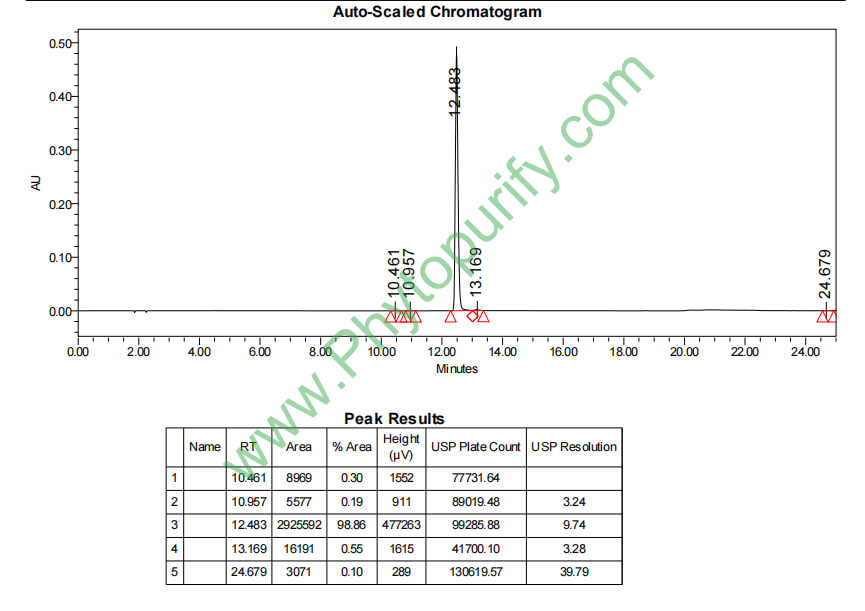
Purity: 95%~99%
Analysis Method: HPLC-DAD or/and HPLC-ELSD
Identification Method: Mass, NMR
Packing: Brown vial or HDPE plastic bottle
Can be supplied from milligrams to grams. Inquire for bulk scale.
For Reference Standard and R&D, Not for Human Use Directly.
HPLC of Vicenin III
Storage conditions:Short-term storage at 2~8℃, long-term storage at -20 ~ -80℃
250.9700
-.7329
-.8187
1.8667
.5365
.1989
Low
75.7862
4.7667
Yes
No
No
No
Yes
No
0.6
Yes
No
Yes
No
Flavonoids, as one of the most widely distributed plant secondary metabolites in nature, have long been an important source of drug development and functional food development due to their diverse chemical structures and extensive biological activities. Vicenin III, also known as apigenin 6-C - β - D-glucosyl-8-C - β - D-xyloside, is a unique dual C-glycosylated flavonoid. Compared with common O-glycosides, its sugar group is directly connected to the C-6 and C-8 positions of the apigenin nucleus through stable carbon carbon bonds. This structure endows it with higher chemical stability and metabolic resistance, making it less susceptible to gastrointestinal enzymes or acid hydrolysis, and thus may have better oral bioavailability and in vivo stability. Since its discovery, Weizening III has attracted much attention due to its anti-inflammatory, antioxidant, anti diabetes, neuroprotective, potential anti-tumor and other pharmacological activities in a variety of in vitro and in vivo models. This article aims to provide a systematic review of the chemical properties, plant sources, pharmacological activities, mechanisms of action, pharmacological evaluation, and clinical application potential of Vitamin III, in order to provide comprehensive scientific references for the in-depth research and development of this natural product.
The molecular formula of Weichenning III (CAS number: 59914-91-9) is C26H28O14, with a molecular weight of 564.4960. Its core structure is 5,7,4 '- trihydroxyflavone (apigenin), which is connected to a β - D-glucose group and a β - D-xylose group through C-glycosidic bonds at positions 6 and 8 of the A ring, respectively. This dual C-glycosylation pattern is its most prominent structural feature, making it a structural analogue of isovitexin (apigenin 8-C-glucoside), but with an additional xylose group substitution.
In terms of physical and chemical properties, Vincenib III exhibits typical polar molecular characteristics. Its calculated lipid water partition coefficient (LogP) is -0.7329, indicating strong hydrophilicity. The topologically polar surface area (TPSA) is as high as 250.9700 Å ², mainly attributed to the large number of hydroxyl groups and oxygen atoms on the sugar ring in the molecule, which are potential hydrogen bond donors and acceptors. The high TPSA and negative LogP values together explain its good water solubility (predicted value of approximately 1.8667 mg/mL). These properties suggest that its distribution in the body may be more inclined towards aqueous environments and less likely to penetrate the lipid bilayer. Preliminary pharmacological predictions indicate that its ability to cross the blood-brain barrier is low, which poses a challenge for the development of central nervous system drugs, but may also reduce potential neurological side effects. In addition, its hERG inhibition risk prediction is negative, and the Ames test prediction value is 0.6 (usually considered negative if<1.0), indicating a low potential mutagenic risk and a relatively good safety starting point in terms of cardiac toxicity and genetic toxicity.
Vitamin III is not widely present in all plants, but appears as a characteristic or secondary component in certain specific families and genera of plants. Its main plant sources include:
1. Leguminous plants Some leguminous plants are common sources of vitamin III.
2. Plants of the family Verbenaceae For example, the genus Wisteria(Phyla Spp.) and the genus Vitex(Vitex Some species of spp. have been reported to contain this ingredient.
3. Other sources It has also been sporadically detected in some Asteraceae, Lamiaceae, and fern plants.
The extraction of vitamin III from plant materials usually follows the general extraction process for flavonoids. The conventional methods include:
* Solvent extraction method The most commonly used method is to use methanol, ethanol, or their aqueous solutions (such as 70-80% ethanol) for hot reflux or cold soaking extraction. Due to the high polarity of Vitamin III, a higher proportion of aqueous alcohol solution usually results in better extraction efficiency.
* Ultrasound assisted extraction/Microwave assisted extraction These modern technologies utilize ultrasound or microwave energy to destroy plant cell walls, significantly reducing extraction time, lowering solvent consumption, and increasing yield.
* Purification and Separation After filtration and concentration, the crude extract needs to be further separated and purified to obtain high-purity Vicatin III. The commonly used techniques include:
* Liquid-liquid extraction Extract the target components in sections using different polar solvents such as petroleum ether and ethyl acetate, and preliminarily enrich them.
* column chromatography This is a crucial purification step, often using silica gel, polyamide, macroporous adsorption resin (such as AB-8, D101) or reverse phase silica gel (such as C18) as the stationary phase, and gradient elution with different ratios of chloroform methanol, methanol water and other systems.
* Preparation type high-performance liquid chromatography For obtaining high-purity monomer compounds, preparative HPLC (usually using a reverse phase C18 column with acetonitrile water or methanol water as the mobile phase) is the most effective and accurate method.
The optimization of extraction process requires comprehensive consideration of raw material characteristics, target product purity requirements, and cost-effectiveness.
A large number of studies have shown that Vitamin III has multiple biological activities, and its pharmacological spectrum mainly revolves around antioxidant and anti-inflammatory core, and extends to multiple disease-related fields.
antioxidant activity As a polyphenolic compound, the phenolic hydroxyl group of vitamin III is the structural basis for its ability to scavenge free radicals. Research has shown that it can effectively scavenge DPPH radicals, ABTS ⁺ radicals, superoxide anions, and hydroxyl radicals, and its activity is stronger than some simple flavonoid O-glycosides. In addition, it can enhance the endogenous antioxidant defense system of cells, such as upregulating the activities of superoxide dismutase (SOD), catalase (CAT), and glutathione peroxidase (GPx), and increasing the level of reduced glutathione (GSH), thereby reducing cellular damage caused by oxidative stress.
anti-inflammatory activity In various inflammatory models, such as the lipopolysaccharide induced macrophage RAW264.7 model, Vicatin III exhibits significant anti-inflammatory effects. It can dose dependently inhibit the production of nitric oxide (NO), prostaglandin E2 (PGE2), and key pro-inflammatory cytokines such as tumor necrosis factor - α (TNF - α), interleukin-6 (IL-6), and IL-1 β. This effect is the basis for its intervention in various inflammation related diseases.
Anti diabetes and its complications Research has shown that Vitamin III has alpha glucosidase inhibitory activity, which can delay the digestion and absorption of carbohydrates and help reduce postprandial blood sugar. In the animal model of diabetes induced by streptozotocin, it can improve the blood sugar level, dyslipidemia, and alleviate complications such as diabetes nephropathy and retinopathy. Its mechanism is related to antioxidant, anti-inflammatory and inhibition of the formation of advanced glycation end products.
Neuroprotective activity In cellular and animal models of neurodegenerative diseases such as Alzheimer's disease and Parkinson's disease, Vitinine III has shown protective effects. It can alleviate neuronal apoptosis induced by β - amyloid or 6-hydroxydopamine, and improve cognitive and motor function deficits. Its neuroprotective effect is closely related to inhibiting oxidative damage, reducing neuroinflammation, and regulating the expression of apoptosis related proteins.
Cardiovascular protective activity: Preliminary studies suggest that Weizening III may play a protective role in cardiovascular diseases such as atherosclerosis, myocardial ischemia/reperfusion injury through antioxidant, anti-inflammatory, inhibiting the abnormal proliferation of vascular smooth muscle cells and improving endothelial function.
Antitumor activity Although the research is still in the initial stage, it has been reported that Weizening III has growth inhibition and apoptosis promoting effects on some cancer cell lines (such as breast cancer, liver cancer, colon cancer cells), and its mechanism may involve cell cycle arrest, activation of mitochondrial apoptosis pathway, etc. However, its specificity and in vivo anti-tumor efficacy still need to be further explored.
Other activities There have also been studies reporting the potential antibacterial, antiviral (such as dengue virus), and hepatoprotective activities of Vicatin III.
The multiple pharmacological activities of Vitamin III stem from its regulation of multiple signaling pathways within cells. Its mechanism of action is complex and interrelated, with its strong antioxidant and anti-inflammatory abilities at its core.
Regulating oxidative stress-related pathways:
Inhibition of inflammatory signaling pathway:
Regulating cell apoptosis and autophagy pathways In neuroprotective and anti-tumor studies, it has been demonstrated that Vicatin III can regulate the Bcl-2/Bax ratio, inhibit caspase-3 activation, and thus suppress apoptosis. Meanwhile, it may also affect cellular autophagy levels by regulating pathways such as AMPK/mTOR.
Enzyme inhibition Direct inhibition of specific enzyme activity is also one of its mechanisms, such as inhibition of alpha glucosidase, acetylcholinesterase (AChE), and some inflammation related kinases.
Epigenetic regulation There are cutting-edge studies suggesting that flavonoids may exert their effects by affecting histone modifications or non coding RNA. It remains to be clarified whether Vicatin III has such effects.
The action of Vitamin III has the characteristics of multi-target and multi pathway, which is not only its advantage in treating complex multifactorial diseases, but also brings challenges to its mechanism research.
Despite the encouraging biological activity demonstrated by Vicerin III in vitro, its successful development as a drug is highly dependent on its drug like and pharmacokinetic (PK) behavior in vivo.
As a natural C-glycosylated flavonoid with multi-target activity, Vicatin III has broad prospects for clinical application and development, but also faces many challenges.
Potential application directions:
1. Adjuvant therapy for metabolic diseases Based on its anti diabetes, lipid regulating and anti obesity related inflammation activities, it is expected to develop natural drugs or functional food ingredients for the prevention or auxiliary treatment of type 2 diabetes and its complications (such as diabetes nephropathy).
2. Preventive agents for neurodegenerative diseases Although BBB penetration is a barrier, its powerful antioxidant and anti neuroinflammatory effects make it potential for early intervention, prevention, or delay of Alzheimer's disease and Parkinson's disease progression. It may be possible to improve its brain delivery efficiency through nanocarrier systems such as liposomes and polymer nanoparticles.
3. Management of chronic inflammatory diseases: It is suitable for long-term management of chronic low-grade inflammation related diseases such as arthritis, atherosclerosis, nonalcoholic fatty liver disease, etc.
4. Cosmetic additives Its potent antioxidant and anti-inflammatory properties can be used to develop anti-aging, anti photodamage, and soothing sensitive skincare products.
Challenges faced and future research directions:
1. In depth study on the mechanism of action It is necessary to use gene knockout/knock in technology, proteomics, metabolomics and other methods to more accurately elucidate its primary molecular targets and core pathways of action.
2. Preclinical development of the system Standardized pharmacological evaluation (validated in animal models closer to human diseases), toxicological studies (acute toxicity, chronic toxicity, reproductive toxicity, etc.), and comprehensive pharmacokinetic studies mentioned above must be completed.
3. Strategies for improving bioavailability Explore new drug delivery systems (such as self microemulsions, solid dispersions, phospholipid complexes) or make reasonable structural modifications to improve their oral absorption and target tissue distribution.
4. clinical research Ultimately, it is necessary to conduct Phase I-III clinical trials to verify its safety, efficacy, and optimal dosing regimen in humans.
5. Sustainable sources and synthesis Given its usually low content in plants, it is necessary to develop efficient plant cultivation, extraction and purification processes, or explore chemical synthesis and biosynthetic pathways (such as synthetic biology methods) to meet the needs of future large-scale applications.
As a structurally unique dual C-glycosylated flavonoid, Vicatin III has shown great potential in intervening in various diseases with oxidative stress and chronic inflammation as the common pathological basis, thanks to its excellent antioxidant and anti-inflammatory abilities. From chemical stability to a wide range of multi-target pharmacological activities, it has laid a solid foundation for its transition from a plant metabolite to a candidate drug or functional product. However, the road from laboratory research to clinical application is still long, and its relatively poor membrane permeability and unclear in vivo fate are currently the main bottlenecks. Future research should focus on in-depth analysis of its molecular action network and optimizing its drug properties through pharmaceutical and medicinal chemistry methods. With the continuous deepening of interdisciplinary research, Weichenning III is expected to realize its value in the fields of innovative natural product drugs and precision nutrition interventions, contributing a plant-based power to human health.
