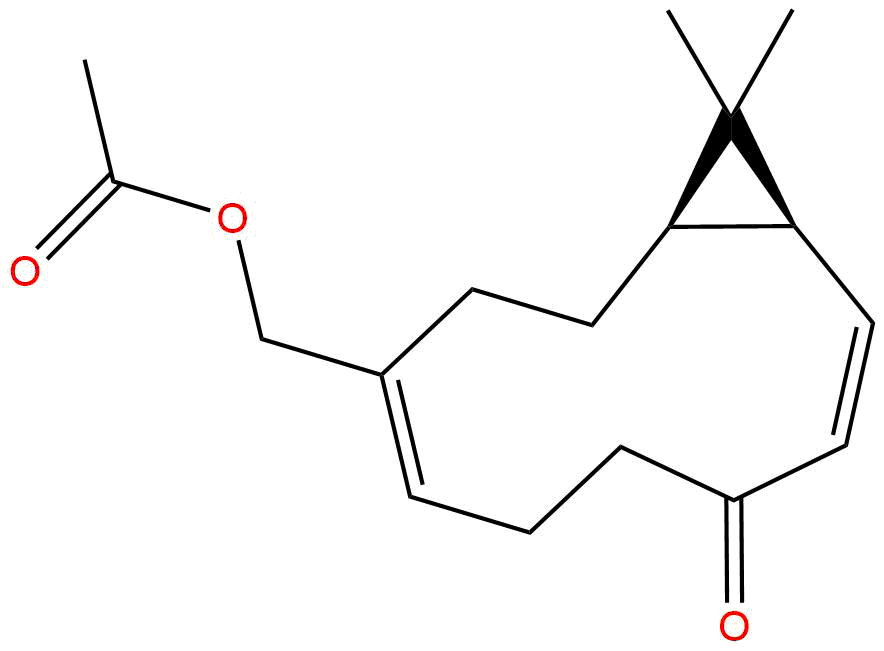


Product name: Kissoone C
Synonym name:
Catalogue No.: BP2200
Cas No.: 903559-03-5
Formula: C17H24O3
Mol Weight: 276.376
Botanical Source:
Type of Compound:
Purity: 95%~99%
Analysis Method: HPLC-DAD or/and HPLC-ELSD
Identification Method: Mass, NMR
Packing: Brown vial or HDPE plastic bottle
Storage: Store in a well closed container, protected from air and light. Put into refrigerate or freeze for long term storage.
Whenever possible, you should prepare and use solutions on the same day. However, if you need to make up stock solutions in advance, we recommend that you store the solution as aliquots in tightly sealed vials at -20℃. Generally, these will be useable for up to two weeks.
The product could be supplied from milligrams to grams
Inquire for bulk scale.
For Reference Standard and R&D, Not for Human Use Directly.
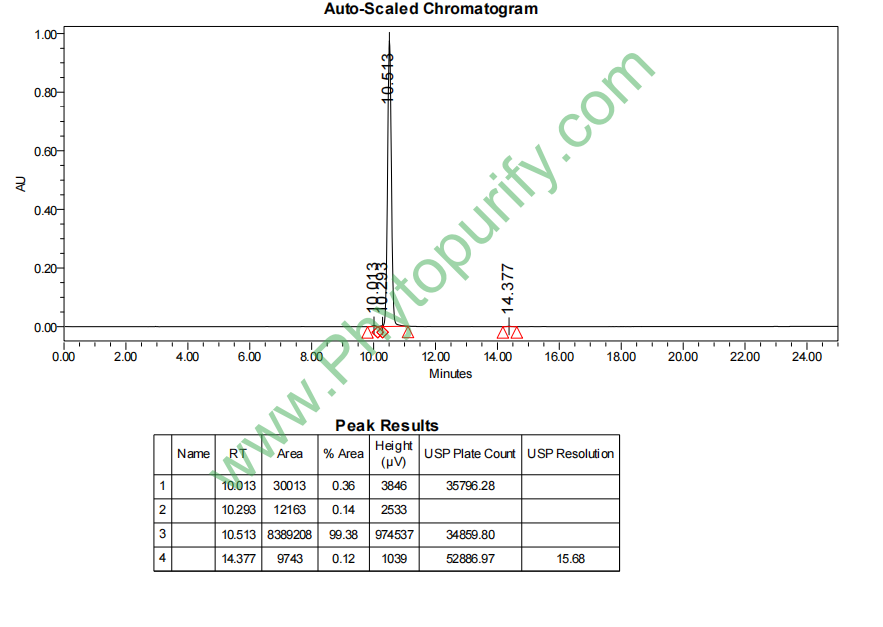
HPLC of Kissoone C
Storage conditions:Short-term storage at 2~8℃, long-term storage at -20 ~ -80℃
Natural products, as an important source of drug discovery, occupy an irreplaceable position in modern pharmacological research. Due to their structural diversity and wide range of biological activities, sesquiterpenes have become one of the hotspots in the development of natural medicines. Kissoone C, As a novel ternary sesquiterpene compound, it has been isolated and identified for the first time from the roots of Valeriana officinalis, demonstrating unique potential for neuroprotection and promoting nerve regeneration. In recent years, with the increasing incidence of neurodegenerative diseases and skin immune related diseases such as psoriasis, it is particularly important to explore the natural active ingredients with dual functions of neuroprotection and immune regulation. This article will provide a systematic review of the chemical structure, physicochemical properties, sources and extraction methods, pharmacological activity and mechanism of action, pharmacological evaluation and pharmacokinetic characteristics of Kissoon C, and explore its potential value and development prospects in clinical applications.
Kissoone C (CAS number: 903559-03-5) is a ternary sesquiterpene compound with the molecular formula of C15H24O4 and a molecular weight of 276.3760. Its structural feature is a typical tricyclic skeleton, containing multiple oxygen functional groups, endowing it with certain polarity and biological activity. The LogP value is 3.0444, indicating that it has moderate lipid solubility, which is conducive to cell membrane penetration and in vivo distribution. The topological polar surface area (TPSA) is 43.37 Å ², indicating that its molecular polarity is moderate and conducive to binding with biomolecules. Low water solubility (0.0489 mg/mL) suggests limited solubility in aqueous phase, which may affect oral bioavailability. The high blood-brain barrier permeability indicates that Kissoon C has the potential to enter the central nervous system. The hERG channel inhibition experiment showed a negative result, indicating a low risk of cardiac toxicity. The Ames mutagenicity test result is 0.0, indicating no genotoxicity risk and good safety.
Kissoon C is mainly extracted from the roots of Valerian, a plant traditionally used for treating neurological disorders and sleep disorders. Valerian root contains various sesquiterpenes and volatile oil components, and is an important source of natural pharmacological active substances. During the extraction process, ethanol or methanol is usually used as solvents for reflux extraction, followed by liquid-liquid distribution and column chromatography techniques for separation and purification. High performance liquid chromatography (HPLC) and gas chromatography-mass spectrometry (GC-MS) are widely used for component analysis and identification. In recent years, the application of supercritical CO2 extraction technology has improved extraction efficiency and purity, reduced residual organic solvents, and complied with the principles of green chemistry. The purified Kissoone C can be structurally confirmed by means of nuclear magnetic resonance (NMR), infrared spectroscopy (IR), and mass spectrometry (MS).
The pharmacological activity of Kissoon C is mainly reflected in neuroprotection and promotion of nerve regeneration. In vitro experiments have shown that Kissoon C can significantly enhance nerve growth factor (NGF) - mediated neurite outgrowth in PC12D cells, promote neuronal morphological differentiation and axonal extension. This mechanism of action may involve the activation of signal transduction pathways within neurons, promoting cytoskeleton reorganization and growth factor expression. In addition, preliminary studies suggest that it has a regulatory effect on inflammatory responses, especially in immune-mediated skin disease models such as psoriasis, showing the potential to inhibit the release of pro-inflammatory factors and regulate immune cell activity.
Psoriasis, as a chronic inflammatory skin disease, has a complex pathogenesis involving multiple signaling pathways and cytokines. Kissoone C may exert anti-inflammatory and immunomodulatory effects by regulating key targets such as RARA, RARG, STAT3, MAPK1, TNF, MAPK8, PIK3CA, EGFR, PTGS2, and NFKB1, and alleviate skin pathological changes. These targets play a central role in the pathological process of psoriasis, involving cell proliferation, differentiation, inflammation mediation, and immune response.
Kissoone C enhances NGF mediated neurite outgrowth, indicating that its mechanism of action is closely related to the neurotrophic factor signaling pathway. NGF activates downstream MAPK/ERK and PI3K/Akt signaling pathways through TrkA receptors, promoting neuronal survival and protrusion growth. Kissoon C may promote morphological differentiation and functional recovery of neurons by enhancing the activity of these signaling pathways.
In terms of molecular targets related to psoriasis, Kissoon C may exert its effects through multi-target synergistic regulation:
Kissoone C may exert therapeutic potential for psoriasis by inhibiting the excessive activation of these signaling pathways, reducing inflammatory responses and abnormal cell proliferation.
From the perspective of drug properties, Kissoon C exhibits good pharmacokinetic characteristics. Its molecular weight of 276.3760 conforms to Lipinski's rule, and a LogP value of 3.0444 suggests moderate lipid solubility, which is beneficial for oral absorption and cell membrane penetration. The TPSA is 43.37 Å ², and low polarity helps to penetrate the blood-brain barrier, making it suitable for the treatment of central nervous system diseases. Low water solubility may limit its oral bioavailability, but its solubility and stability can be improved through formulation optimization (such as nanocarriers, liposomes, etc.).
In terms of safety, Kissoone C showed negative results in hERG channel inhibition experiments, reducing the risk of cardiac toxicity. The Ames test result is 0, indicating no mutagenicity and high safety. Preliminary pharmacokinetic studies have shown that it is widely distributed in the body, especially at high concentrations in brain tissue, which meets its neuroprotective needs.
In the future, further research on in vivo pharmacokinetics is needed to clarify its absorption, distribution, metabolism, and excretion (ADME) characteristics, evaluate its half-life, bioavailability, and the activity and toxicity of potential metabolites. In addition, drug interactions and long-term toxicological assessments are also important steps in drug development.
Kissoon C, with its ability to promote neural burst growth, has demonstrated potential applications in neurodegenerative diseases, nerve injury repair, and cognitive impairment. Its high blood-brain barrier permeability makes it an ideal candidate molecule for the treatment of central nervous system diseases. Combined with its regulatory effect on psoriasis related targets, Kissoon C may be developed as a novel anti-inflammatory and immunomodulatory drug, expanding into the field of skin disease treatment.
Future research should focus on the following directions:
In summary, Kissoone C, as a natural sesquiterpene compound with multi-target effects, has good pharmacological properties and broad clinical application prospects, and is expected to become an important new drug candidate in the fields of neuroprotection and immune regulation.
Kissoone C, as a novel natural product of ternary sesquiterpenes, exhibits dual potential in promoting nerve growth and regulating immune inflammation due to its unique chemical structure and excellent biological activity. Its good pharmacokinetic parameters and safety evaluation have laid a solid foundation for subsequent drug development. In the future, through systematic pharmacological mechanism research, pharmacokinetic optimization, and preclinical validation, Kissoon C is expected to become a new natural drug for the treatment of neurodegenerative diseases and immune related diseases such as psoriasis. The continuous development of natural product pharmacology will provide more opportunities for the clinical translation of Kissoon C, promoting its application and innovation in modern medicine.
