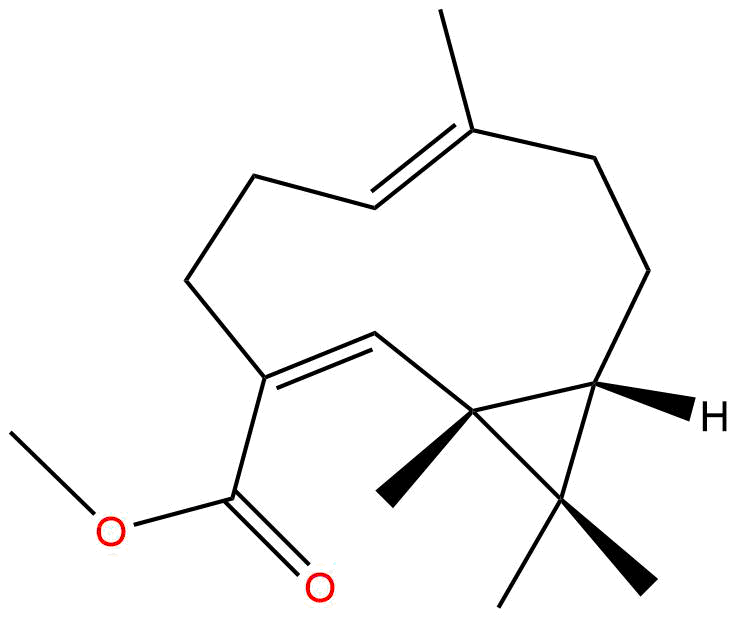


Product name: Volvalerenic acid A methyl ether
Synonym name:
Catalogue No.: BP2204
Cas No.:
Formula: C16H24O2
Mol Weight: 248.366
Botanical Source:
Type of Compound:
Purity: 95%~99%
Analysis Method: HPLC-DAD or/and HPLC-ELSD
Identification Method: Mass, NMR
Packing: Brown vial or HDPE plastic bottle
Storage: Store in a well closed container, protected from air and light. Put into refrigerate or freeze for long term storage.
Whenever possible, you should prepare and use solutions on the same day. However, if you need to make up stock solutions in advance, we recommend that you store the solution as aliquots in tightly sealed vials at -20℃. Generally, these will be useable for up to two weeks.
The product could be supplied from milligrams to grams
Inquire for bulk scale.
For Reference Standard and R&D, Not for Human Use Directly.
Storage conditions:Short-term storage at 2~8℃, long-term storage at -20 ~ -80℃
null
null
null
Volvalerenic acid A methyl ether is a traditional medicinal plant derived from the herb Valeriana officinalis(Valeriana officinalis)Natural organic compounds isolated and identified. As a member of the active ingredient family of Valerian, its chemical structure can be classified as sesquiterpenes or their derivatives, and it is one of the important chemical entities that may contribute to its biological activity in the volatile oils and extracts of Valerian. The Chinese name of this compound can be directly translated as "Valerian acid A methyl ether", and its English name "Volvalerenic acid A methyl ether" directly reflects its structural association with the known component "Volvalerenic acid A", which is the product of methylation modification of the latter.
Although its specific molecular formula, molecular weight, and CAS number are not yet complete in public databases, which are common in newly discovered or poorly studied natural products, its clear plant source - Valerian provides a solid background for its biological activity research. As a calming and calming herb with a history of over a thousand years of application, modern pharmacological research has revealed that its extract has various central nervous system related activities such as anti anxiety, sedative hypnotic, and antispasmodic effects. The discovery of Volvalerenic acid A methyl ether is the result of systematic plant isolation and identification by scientists to further analyze the "active substance basis" of Valeriana officinalis and search for more selective and effective lead compounds.
At present, there is relatively limited independent and in-depth pharmacological research data on this compound, and its clear molecular targets and related disease-related data have not been fully elucidated. This is not only a gap in current research, but also indicates the potential research value of this compound as a "new chemical entity" (NCE). A systematic evaluation of its chemical, pharmacological, and pharmacological properties is of great significance for understanding the modern scientific connotation of the traditional efficacy of Valerian and discovering new candidate molecules for the treatment of neurological and psychiatric disorders. This article aims to conduct a comprehensive scientific review and prospective analysis of Volvalerenic acid A methyl ether based on existing information and combined with the research paradigm of natural product pharmacy.
The chemical structure of Volvalenic acid A methyl ether is the material basis for all its biological activities. From its name, it can be inferred that it is a methyl ether derivative of "Volvalerenic acid A". Usually, the "Volvalerenic acid" series of compounds belong to the characteristic of valerian Sesquiterpenes This type of compound is composed of three isoprene units, with diverse skeleton types, often containing structural features such as carboxyl groups, double bonds, and ring systems.
In summary, Volvalerenic acid A methyl ether is a mid molecular weight sesquiterpene derivative with typical natural product characteristics, and its specific physicochemical properties can only be accurately calculated and measured after its structure is fully analyzed.
The only known plant source of Volvalenic acid A methyl ether is Valerian(Valeriana officinalis L.)It belongs to the Caprifoliaceae family. Valerian is a perennial herbaceous plant, and its dry roots and rhizomes are the medicinal parts.
Volvalerenic acid A methyl ether, as a sesquiterpene component identified in the volatile oil or polar extract of Valeriana officinalis, is a part of the complex "chemical fingerprint" of Valeriana officinalis. Its existence provides another potential candidate molecule for explaining the traditional efficacy of Valerian at the molecular level. Studying such specific components can help to delve deeper from the level of "crude extract" to the level of "clear monomer", thereby more accurately elucidating the mechanism of action and structure-activity relationship.
At present, there is a severe lack of independent and detailed pharmacological research reports on Volvalenic acid A methyl ether, and its direct molecular targets and clear mechanism of action have not yet been revealed. This is usually the norm in the early stages of natural product research. However, we can make reasonable scientific inferences and hypotheses from the known research on its "parent plant" Valerian and structurally similar active ingredients in Valerian.
(1) Inference based on the overall pharmacological effects of Valeriana officinalis
The most definite pharmacological effect of Valerian extract is Calming, anti anxiety, and sleep promoting Numerous preclinical studies (animal experiments) and some clinical studies support its role by regulating the excitability of the central nervous system (CNS). Therefore, Volvalerenic acid A methyl ether, as one of the components of Valerian, is primarily hypothesized to have an active field Neuropsychiatric system。
(2) Hypothesis based on the mechanism of action of similar compounds
The pharmacological mechanism of many sesquiterpene compounds in Valeriana officinalis, such as ferulic acid and acetoxyferulic acid, provides important clues for understanding the possible role of Volvalerenic acid A methyl ether. These mechanisms may include:
* Regulation of gamma aminobutyric acid (GABA) system This is the most widely studied hypothesis in the mechanism of action of valerian. GABA is the main inhibitory neurotransmitter in the central nervous system. Research has shown that some sesquiterpenes from Valerian can:
*As GABA_A receptor allosteric modulator Not directly binding to GABA recognition sites, but binding to benzodiazepine sites or other conformational sites, enhancing the binding affinity or channel opening frequency between GABA and receptors, thereby enhancing GABAergic neurotransmission and producing sedative and anti anxiety effects. This is similar to the site of action of benzodiazepines (such as diazepam), but the binding mode and effect may be different, which may explain their lower dependence and side effects.
*Affects the synthesis, release, or reuptake of GABA.
* Regulation of the 5-hydroxytryptamine (5-HT) system The 5-HT system is closely related to emotion and sleep regulation. There are studies suggesting that extracts of Valerian may exert anti anxiety effects by acting on 5-HT receptors (such as 5-HT1A receptors).
* Other neurotransmitter systems May have indirect regulatory effects on systems such as norepinephrine and dopamine.
(3) Potential pathways of action of Volvalerenic acid A methyl ether
As structurally similar sesquiterpenes, Volvalerenic acid A methyl ether highly likely Affect CNS through one or more of the above pathways. Specifically:
1. Target hypothesis It could be a potential GABA_A receptor allosteric modulator The lipophilic part of its molecular structure may allow it to cross the blood-brain barrier, while specific polar groups (such as carboxyl and ether bonds) may participate in specific interactions with receptor proteins. Radioligand binding experiments and electrophysiological patch clamp techniques are needed to verify whether it binds and how it regulates GABA_A receptor function.
2. Inference of association with diseases If its GABA regulatory activity is confirmed, then it is associated with a series of Diseases related to dysfunction of the GABAergic system Potential associations have been generated:
* anxiety disorder Generalized anxiety disorder, panic disorder, etc.
* sleep disorder Insomnia.
* epilepsy Some types of epileptic seizures are associated with insufficient GABAergic inhibition.
* Spasmodic diseases Excessive muscle tension.
3. Possible functional characteristics Natural product derived GABA_A receptor modulators often have higher receptor subtype selectivity or milder modes of action. Compared to synthetic drugs, if Volvalerenic acid A methyl ether can retain this characteristic, it may mean Lower sedative side effects, lower tolerance and dependency risks This is its potential advantage as a novel lead compound for anti anxiety/hypnosis.
(4) Research gaps and necessity
At present, all the above mechanisms are reasonable speculations based on background knowledge. To confirm the pharmacological activity of Volvalenic acid A methyl ether, systematic in vitro and in vivo experiments must be conducted:
* in vitro Conduct binding and functional experiments on cell lines expressing different subtypes of GABA_A receptors; Screen for other neurotransmitter receptors and ion channels.
* in vivo Evaluate its activity in classic behavioral models of mice or rats, such as elevated maze test for anxiety and pentobarbital induced sleep test for sedation and hypnosis.
Pharmacokinetic assessment aims to predict the likelihood of a compound developing into a successful drug, involving multiple properties such as absorption, distribution, metabolism, excretion, and toxicity (ADMET). Although the complete pharmacological parameters of Volvalerenic acid A methyl ether, such as TPSA, precise LogP, BBB penetration prediction, and in vitro toxicity data, are currently lacking, we can still conduct preliminary and qualitative evaluations based on its chemical structure type and known information, and apply well-known methods Lipinski's Five Rules Rule of Five (Ro5) serves as a preliminary tool for screening oral active drugs.
(1) Lipinski's Five Rules Compliance Analysis
This rule mainly applies to small molecule drugs administered orally:
1. Molecular weight (MW)<500 Da According to inference, its MW is approximately between 260-300 Da,fully comply with。
2. Lipid water partition coefficient (calculated LogP, cLogP)<5 Based on the sesquiterpene skeleton and oxygen-containing functional groups, it is speculated that its cLogP is in the range of 2-4,Very likely to meet。
3. Number of hydrogen bond donors (HBD, such as OH, NH) ≤ 5 If it is a hydroxymethylation product of Volvalerenic acid A and the carboxyl group may exist in the form of free acid or methyl ester, its HBD number may be only 1 (if it is a free acid) or 0 (if it is a methyl ester and there are no other hydroxyl groups) on the carboxyl group,Very likely to meet。
4. Number of hydrogen bond acceptors (HBA, such as N, O) ≤ 10 The molecule may contain 3-4 oxygen atoms (carboxyl, ether bonds, etc.), with a number much lower than 10,fully comply with。
Preliminary Conclusion:Volvalerenic acid A methyl ether Very likely to fully comply with Lipinski's five rules This indicates that it has good oral absorption potential.
(2) Prediction of other key pharmacological parameters
* Topological Polarity Surface Area (TPSA)TPSA is related to the membrane permeability and bioavailability of compounds. Usually, TPSA<140 Å ² is beneficial for cell infiltration, while<60 Å ² is beneficial for penetrating the blood-brain barrier (BBB). This molecule contains carboxyl groups (approximately 37 Å ²) and ether bonds (approximately 9 Å ²). If it is a free acid, the TPSA is approximately 46 Å ²; if it is a methyl ester, it is even lower.Predicting a smaller TPSA is beneficial for passive diffusion and potential BBB penetration This is crucial for its expected central nervous system function.
* Blood-brain barrier (BBB) penetrability Considering its small molecular weight, moderate LogP, and small TPSA, this compound Having the chemical structure foundation to penetrate BBB This is a necessary prerequisite for it to exert its sedative hypnotic and anti anxiety central effects.
* Metabolic stability Sesquiterpenes may undergo phase I metabolism (such as oxidation by cytochrome P450 enzymes) and phase II metabolism (such as glucuronic acid binding) in vivo. The methyl ether bond is relatively stable, but if there is a free carboxyl group, it is prone to glucuronic acid binding reaction (forming acyl glucuronide), which may accelerate its clearance. Liver microsomal metabolism experiments are needed to evaluate.
* Toxicity risk (early warning)There is currently no toxicity data available. Natural products are not necessarily non-toxic. Preliminary cytotoxicity testing (such as toxicity to liver cell line HepG2) and screening for common toxic targets of drugs (such as hERG channels, related to cardiac toxicity) are required. The overall safety of Valerian extract is good, but high doses may cause headaches, gastrointestinal discomfort, etc. The toxicity of individual components needs to be independently evaluated.
(3) Comprehensive potential assessment of traditional Chinese medicine
From a chemical structure perspective, Volvalenic acid A methyl ether exhibits Good drug like properties It meets the basic structural requirements of oral active compounds and has the potential to penetrate the blood-brain barrier and act on central targets. Its main Uncertainty and potential challenges lie in:
1. Pharmacological activity intensity and selectivity This is the core that determines its value. If the activity is weak, the medicinal value is low.
2. Metabolic rate If metabolism is too fast, it may lead to insufficient exposure and short half-life in the body, requiring structural optimization.
3. Feasibility of synthesis Extracting and separating a large amount from Valerian is uneconomical. If the activity is significant, it is necessary to develop a fully synthetic or semi synthetic route to achieve scalability and structural modification.
(1) Research Status
Volvalenic acid A methyl ether is currently under research in natural product chemistry Early detection and identification stage The existing information indicates that it has been isolated from Valeriana officinalis and preliminarily structurally identified (likely through spectroscopic methods), but its biological research is almost blank. In publicly available scientific literature databases such as PubMed and SciFinder, independent pharmacological research reports on its specific name are difficult to find. This usually means:
*It may have been isolated and reported as one of many known or new compounds during systematic plant research on Valeriana officinalis, but it has not yet become the focus of further pharmacological research.
*The relevant activity data may exist in reports studying the "total extract" or "specific fractions" of valerian, but their individual contributions are obscured by the synergistic effects of the mixture.
Therefore, current knowledge about this compound mainly focuses on its Plant origin and inferred chemical structure Up, its The biological function and potential for drug development are a "black box" that needs to be opened up。
(2) Application prospects and future directions
Although the research foundation is weak, it is precisely this unknown combination with the significant medicinal value of its source plants that endows Volvalerenic acid A methyl ether with unique research significance and application prospects.
The key steps for future research should include:
1. Confirm chemical structure Obtain complete spectral data and confirm it through synthesis if necessary.
2. System pharmacology screening The focus is on in vitro screening of nervous system targets such as GABAergic and 5-HTergic, and verifying their anti anxiety, sedative, and hypnotic activities in animal models.
3. Preliminary ADMET assessment Conduct basic permeability (such as Caco-2 cell model), metabolic stability, and in vitro toxicity tests.
4. Study on Structure Activity Relationship If the activity is established, synthesize a series of structurally similar compounds and explore their pharmacophores.
Conclusion
Volvalenic acid A methyl ether is a potential sesquiterpene natural product derived from the classic sedative herb Valerian, whose structure has not yet been fully disclosed. It conforms to most of the structural characteristics of excellent oral drugs, especially with the potential to penetrate the blood-brain barrier, making it naturally suitable for exploration in the treatment of central nervous system diseases. Although its specific biological activity and mechanism of action are still unknown, based on its profound medicinal background from plant sources and reasonable chemical structure inference, it deserves to be listed as Potential candidates for neuropsychiatric lead compounds Conducting systematic chemical and biological research on it not only helps to interpret the ancient herb of Valerian in modern scientific language, but also has the potential to discover new treatment options for increasingly common modern diseases such as anxiety and insomnia that originate naturally, have novel mechanisms of action, and are safer. This precisely reflects the core value of natural product pharmaceutical research: to seek the light of wisdom that inspires human health from the chemical diversity of nature.
Batch can search by a CAS number,one per line
