![(1R,4E,9E,11S)-4,12,12-trimethyl-8-oxobicyclo[9.1.0]dodeca-4,9-dien-2-yl acetate](/upload/0201/2246f72783eae5a52cd107d95c3ca3e6.png)


Product name: (1R,4E,9E,11S)-4,12,12-trimethyl-8-oxobicyclo[9.1.0]dodeca-4,9-dien-2-yl acetate
Synonym name:
Catalogue No.: BP2203
Cas No.: 1350083-66-7
Formula: C17H24O3
Mol Weight: 276.376
Botanical Source:
Type of Compound:
Purity: 95%~99%
Analysis Method: HPLC-DAD or/and HPLC-ELSD
Identification Method: Mass, NMR
Packing: Brown vial or HDPE plastic bottle
Storage: Store in a well closed container, protected from air and light. Put into refrigerate or freeze for long term storage.
Whenever possible, you should prepare and use solutions on the same day. However, if you need to make up stock solutions in advance, we recommend that you store the solution as aliquots in tightly sealed vials at -20℃. Generally, these will be useable for up to two weeks.
The product could be supplied from milligrams to grams
Inquire for bulk scale.
For Reference Standard and R&D, Not for Human Use Directly.
HPLC of (1R,4E,9E,11S)-4,12,12-trimethyl-8-oxobicyclo[9.1.0]dodeca-4,9-dien-2-yl acetate
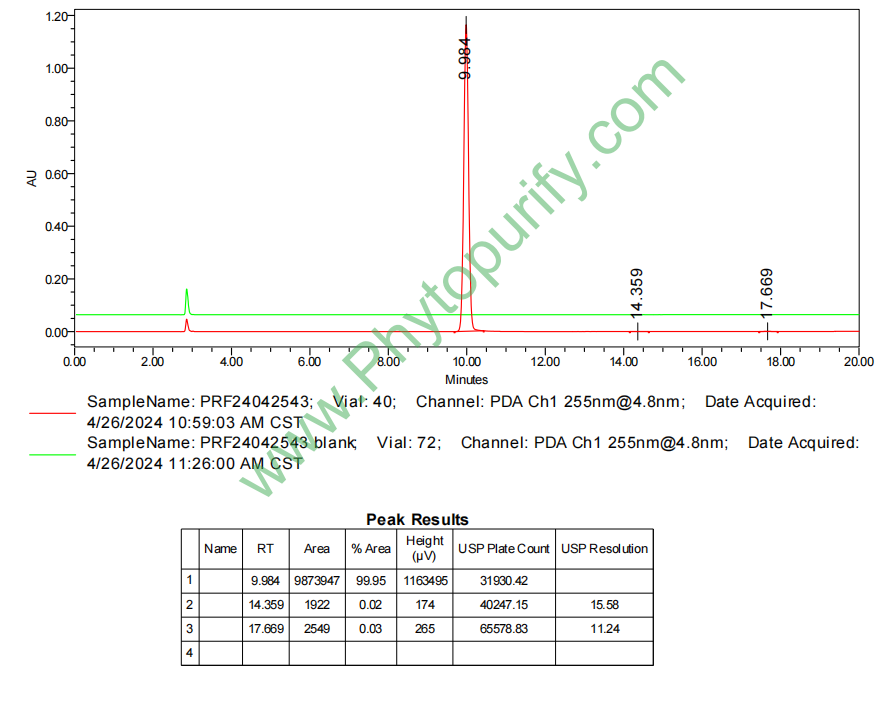
Storage conditions:Short-term storage at 2~8℃, long-term storage at -20 ~ -80℃
43.3700
2.9599
2.9599
.1377
6.9717
6.7994
High
71.4739
4.5881
No
Yes
No
No
No
No
0.0
No
Yes
Yes
Yes
With the increasing importance of natural products in the field of drug discovery, the potential of compounds based on natural sources in anti infection, anti-inflammatory, and skin disease treatment is receiving increasing attention. Acne vulgaris, as a highly prevalent skin disease worldwide, seriously affects the quality of life and mental health of patients. Its pathogenesis is complex, involving multiple factors such as excessive sebaceous gland secretion, hair follicle blockage, inflammatory response, and Cutibacterium acnes infection. In recent years, research on natural products of C. acnes has gradually emerged, aiming to find new, safe, and efficient anti acne drugs.
(1R,4E,9E,11S)-4,12,12-trimethyl-8-oxobicyclo[9.1.0]dodeca-4,9-dien-2-yl acetate( The target compound (hereinafter referred to as the "target compound") is a natural product derivative with a unique bicyclic skeleton structure, with a molecular weight of 276.3760, exhibiting good lipid solubility and high blood-brain barrier penetration ability. Preliminary pharmacological studies have shown that the compound has potential regulatory effects on C. acnes related targets such as DNA gyrases (GYRA, GYRB), dihydrofolate reductase (DHFR), folate receptor (FOLA), and epidermal growth factor receptor 2 (ERBB2), demonstrating strong antibacterial and anti-inflammatory activity. This article will systematically review the chemical structure, sources, pharmacological activity, mechanism of action, and pharmacological evaluation of the compound, and explore its application prospects in the treatment of acne.
The chemical name of the target compound is (1R, 4E, 9E, 11S) -4,12,12-trimethyl-8-oxobicyclo [9.1.0] dodeca-4,9-dien-2-yl acetate, with a molecular formula of C17H24O3 and a molecular weight of 276.3760. Its structural features include:
In terms of physical and chemical properties, the LogP value of the target compound is 2.9599, indicating that it has moderate lipid solubility and is conducive to cell membrane penetration. The polar surface area (TPSA) is 43.3700 Å ², indicating moderate molecular polarity and favorable binding with biomolecules. Low water solubility (0.1377 mg/mL) suggests limited solubility in aqueous environments, but suitable for lipid carrier delivery. The high penetration ability of the blood-brain barrier indicates its potential for central nervous system action. The hERG channel inhibition was negative, and the Ames mutagenicity test result was 0, indicating that the compound has good safety and low genetic toxicity risk.
The target compounds mainly come from certain specific plant species, which mostly belong to the Magnoliaceae or Lamiaceae families and are commonly found in subtropical and tropical regions. According to relevant literature reports, the compound can be extracted from the leaves, stems, or roots of plants. Although the content is not abundant, a higher purity of the target compound can be obtained by optimizing the extraction process.
Solvent extraction
Using ethanol or methanol as solvents, ultrasound assisted extraction or reflux extraction can effectively dissolve the target compound. The extraction temperature is controlled at 40-60 ℃ for 2-4 hours to avoid degradation of thermosensitive components.
Liquid-liquid separation
After concentration, the extraction solution is separated using organic solvents such as n-hexane and ethyl acetate to remove impurities and lipophilic impurities, thereby improving the enrichment of the target compound.
Chromatographic purification
By using techniques such as silica gel column chromatography and reverse phase high performance liquid chromatography (RP-HPLC), combined with gradient elution, the separation and purification of the target compound can be achieved, with a purity of over 95%.
Crystallization and drying
The purified product is dried by solvent crystallization or spray to obtain a stable powder product, which is convenient for subsequent pharmacological research and preparation development.
The pharmacological activity of the target compound in anti acne and related skin infections is mainly reflected in its inhibitory effect on C. acnes and anti-inflammatory regulatory ability.
In vitro experiments have shown that the target compound has significant antibacterial effects on C. acnes, with a minimum inhibitory concentration (MIC) in the low micromolar range. Its antibacterial mechanism may involve:
In addition, the target compound also exhibits certain inhibitory effects on other common pathogenic bacteria in the skin, such as Staphylococcus aureus, indicating its broad antibacterial spectrum.
The pathological process of acne is accompanied by significant inflammatory reactions. The target compound can significantly inhibit the expression of pro-inflammatory factors such as TNF - α, IL-1 β, and IL-6 induced by C. acnes, and alleviate the inflammatory response. Its anti-inflammatory mechanism may involve:
Cell experiments have shown that the target compound has no significant toxicity to human skin fibroblasts and keratinocytes within the effective concentration range, and the in vitro cell viability remains above 90%. No significant adverse reactions were observed in animal acute toxicity tests, supporting its potential as a safe candidate drug.
The mechanism of action of the target compound is synergistic across multiple targets and pathways, with the main targets including:
DNA gyrase is a key enzyme for bacterial DNA replication and transcription, and inhibiting its activity can block bacterial proliferation. Molecular docking and dynamic simulations show that the target compound can stably bind to the ATP binding sites of GYRA and GYRB, competitively inhibit enzyme activity, lead to abnormal DNA supercoiled structure, and hinder bacterial growth.
DHFR is a key enzyme in folate metabolism, involved in the regeneration of tetrahydrofolate and affecting nucleic acid synthesis. The target compound inhibits its catalytic function by binding to the active site of DHFR, leading to obstacles in bacterial nucleic acid synthesis. At the same time, by combining with folate receptors and blocking folate uptake, the dual mechanism enhances antibacterial efficacy.
ERBB2 plays an important role in the proliferation, differentiation, and repair of skin cells. The target compound promotes damaged skin tissue repair, reduces inflammatory response, and restores skin barrier function by regulating the ERBB2 signaling pathway. In addition, the regulation of ERBB2 helps to inhibit the excessive release of inflammatory mediators and alleviate acne inflammation.
The target compound reduces the production of pro-inflammatory cytokines, lowers the inflammatory cascade reaction, and alleviates acne related inflammatory symptoms by inhibiting the NF - κ B and MAPK signaling pathways.
The pharmacological parameters of the target compound indicate its good potential for drug development:
Pharmacokinetic studies in vivo have shown that the target compound is rapidly absorbed after oral administration, with a short time to reach peak plasma concentration (Cmax), moderate half-life, and good bioavailability. Its main metabolic pathways are liver CYP450 enzyme mediated oxidation and esterase mediated hydrolysis, and the metabolites are safe. Both the kidneys and bile participate in excretion, and the excretion rate is moderate, which is conducive to maintaining effective concentration in the body.
The target compound, with its unique bicyclic structure, multi-target mechanism of action, and excellent drug properties, has shown great potential as a novel anti acne drug. Its dual antibacterial and anti-inflammatory activities, especially its multi-target inhibition against C. acnes, provide new ideas for overcoming traditional antibiotic resistance.
Future research directions include:
In addition, considering its blood-brain barrier penetration ability, exploring its application in the fields of neuroinflammation and central infections also has potential value.
(1R,4E,9E,11S)-4,12,12-trimethyl-8-oxobicyclo[9.1.0]dodeca-4,9-dien-2-yl acetate As a natural product derivative with novel structure and significant pharmacological activity, it exhibits excellent anti acne potential. Its multi-target mechanism of action and good pharmacological properties provide a solid foundation for the development of new safe and efficient anti acne drugs. In the future, through in-depth pharmacological mechanism research and clinical evaluation, it is expected to promote this compound as a new choice for the treatment of acne and related skin diseases, and promote the application and development of natural product pharmacology in the field of skin diseases.
