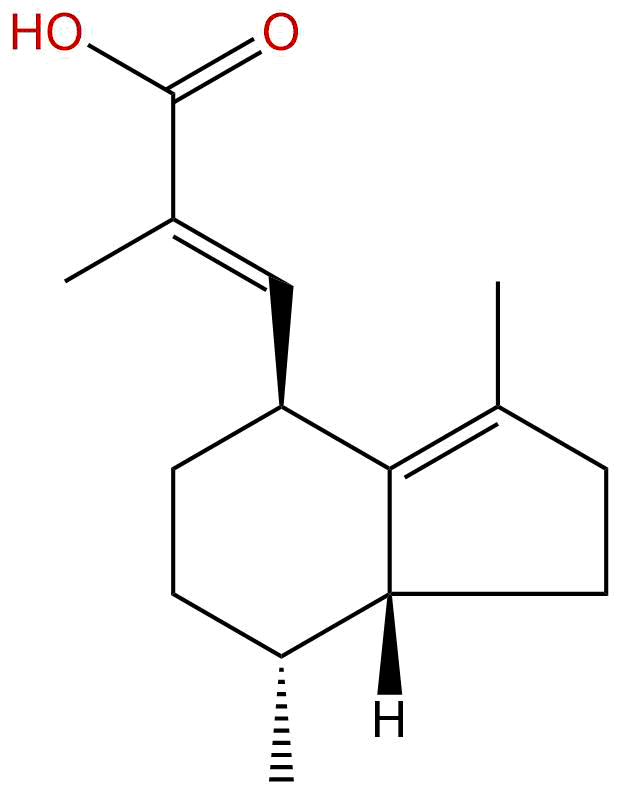


Product name: Valerenic acid
Synonym name: (-)-Valerenic acid;Nardin
Catalogue No.: BP4739
Cas No.: 3569-10-6
Formula: C15H22O2
Mol Weight: 234.339
Botanical Source:
Type of Compound:
Purity: 95%~99%
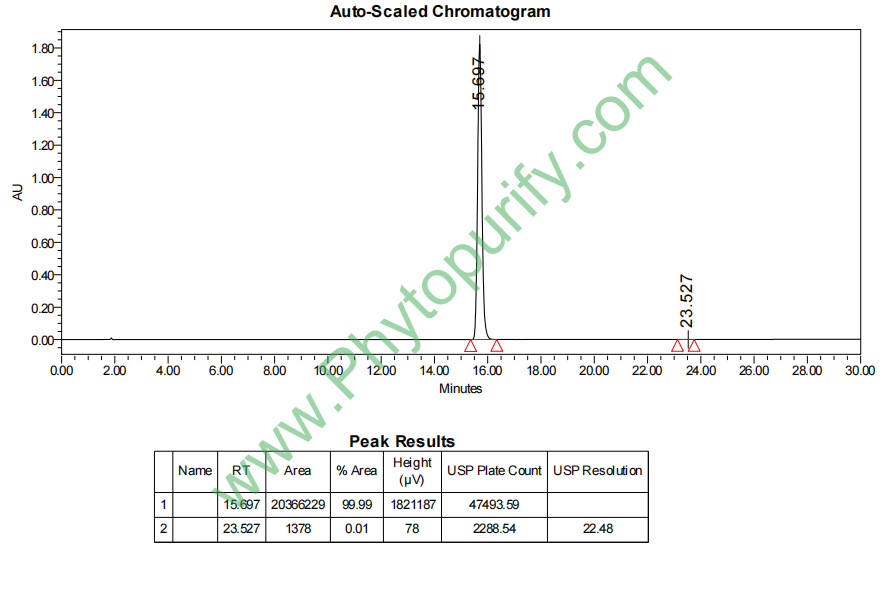
Analysis Method: HPLC-DAD or/and HPLC-ELSD
Identification Method: Mass, NMR
Packing: Brown vial or HDPE plastic bottle
Storage: Store in a well closed container, protected from air and light. Put into refrigerate or freeze for long term storage.
Whenever possible, you should prepare and use solutions on the same day. However, if you need to make up stock solutions in advance, we recommend that you store the solution as aliquots in tightly sealed vials at -20℃. Generally, these will be useable for up to two weeks.
The product could be supplied from milligrams to grams
Inquire for bulk scale.
For Reference Standard and R&D, Not for Human Use Directly.
HPLC of Valerenic acid
Storage conditions:Short-term storage at 2~8℃, long-term storage at -20 ~ -80℃
Valerionic acid (CAS number: 3569-10-6) is a natural sesquiterpene product isolated from the traditional herb Valeriana officinalis L. As one of the main active ingredients in Valerian, Valerian acid has attracted much attention due to its significant central nervous system regulatory effects. In recent years, with the in-depth study of pharmacology of natural products, Valerian acid has gradually been revealed as an orally active GABAA receptor allosteric modulator and 5-HT5a receptor partial agonist, with multiple biological activities such as anti anxiety, sedative, and antioxidant effects. This article provides a systematic review of the chemical structure and physicochemical properties, plant sources and extraction methods, pharmacological activity, mechanism of action, pharmacological evaluation, and clinical application prospects of valerolac acid, aiming to provide theoretical basis and research reference for its further drug development and clinical application.
Valerian acid is a sesquiterpene compound with a molecular formula of C15H22O2 and a molecular weight of 234.3390. Its structural features include a sesquiterpene skeleton containing a cyclopentene ring and a carboxylic acid functional group, belonging to the optical isomer of (-) - valeric acid. The LogP value of Valerian acid is 4.1047, indicating its strong lipid solubility, which is beneficial for penetrating lipid membranes, especially the blood-brain barrier (BBB). Its topological polar surface area (TPSA) is 37.3 Å ², further supporting its excellent membrane permeability. The low water solubility (0.1498 mg/mL) suggests limited solubility in the aqueous phase, but this is also consistent with the characteristics of most fat soluble natural products. In the in vitro safety evaluation, Valerian acid did not exhibit hERG channel inhibitory activity, and the Ames mutagenicity test result was negative, indicating that it has a good safety basis.
The chemical structural formula of valeric acid is as follows:
  O
  ||
C-C5环-倍半萜骨架
(Note: This is a structural schematic, please refer to relevant chemical databases for specific structures)
Valerian acid is mainly present in the roots and rhizomes of Valeriana officinalis L. Valerian is a perennial herbaceous plant widely distributed in Europe and North America, and has been extensively studied for its traditional sedative and anti anxiety uses. Valerian root contains various active ingredients, including volatile oils, valerolac acid and its derivatives, sesquiterpenes, flavonoids, and organic acids.
The extraction of valeric acid is usually carried out using solvent extraction combined with chromatographic separation technology. Common extraction solvents include ethanol, methanol, and ethyl acetate. The specific steps generally include:
In recent years, emerging technologies such as supercritical CO2 extraction and microwave-assisted extraction have also been applied to the extraction of valeric acid, significantly improving extraction efficiency and purity.
Valerian acid, as the main active ingredient of Valerian, exhibits various central nervous system pharmacological activities, mainly including anti anxiety, sedative, antidepressant, and antioxidant effects.
Numerous in vitro and in vivo studies have shown that valerolac acid has significant anti anxiety effects. Its anti anxiety effect is mainly achieved by regulating GABAA receptors. GABAA receptors are the main inhibitory neurotransmitter receptors in the central nervous system, regulating the balance of neural excitability. Valerian acid, as a positive allosteric regulator of GABAA receptors, can enhance GABA mediated neural inhibition and thus exert anti anxiety effects.
In addition, Valerian acid also acts on the 5-hydroxytryptamine (5-HT) receptor subtype 5-HT5a, acting as a partial agonist to regulate the neurotransmitter system and further promote anti anxiety activity.
Valerian acid can induce sedative and hypnotic effects by enhancing GABAA receptor function. Animal experiments have shown that valerolac acid can shorten sleep latency, prolong sleep time, and exhibit good sedative and hypnotic activity.
Some studies have also found that valerolac acid can regulate neurotransmitters and signaling pathways such as dopamine (DRD2), serotonin (HTR1A, HTR2A), and brain-derived neurotrophic factor (BDNF), demonstrating potential antidepressant effects.
Valerian acid has significant antioxidant properties, can scavenge free radicals, and alleviate oxidative stress damage. Its antioxidant mechanism may be related to the carboxylic acid groups and lipid solubility characteristics in its sesquiterpene structure, which can effectively protect nerve cells from oxidative damage and promote neuroprotection.
The pharmacological effects of Valerian acid are mainly achieved through multiple targets and pathways, involving neurotransmitter receptors, signal transduction molecules, and neurotrophic factors.
Valerian acid acts as a positive allosteric regulator of GABAA receptors, particularly mediating its anti anxiety activity through GABAA receptors containing the β 3 subunit. GABAA receptor is a ligand gated chloride ion channel, and upon binding with GABA, chloride ion influx occurs, leading to neural inhibition. Valerian acid enhances the inhibitory signaling of neurons by increasing the effect of GABA, thereby reducing anxiety and inducing sedation.
Valerian acid acts as a partial agonist of the 5-hydroxytryptamine 5-HT5a receptor, regulating the 5-HT nervous system. 5-HT5a receptors play an important role in regulating emotions, sleep, and cognitive function, and the excitatory effect of valerolac acid can help improve anxiety and emotional disorders.
Valerian acid also involves targets such as dopamine receptors (DRD2), serotonin receptors (HTR1A, HTR2A), and neurotransmitter transporter protein (SLC6A4), regulating neurotransmitter balance. In addition, Valerian acid can affect the activity of monoamine oxidase A (MAOA), regulate neurotransmitter metabolism, and thus exert anti anxiety and anti depression effects.
Valerian acid affects the expression of cAMP response element binding protein 1 (CREB1) and brain-derived neurotrophic factor (BDNF), promoting neuroplasticity and neuroprotection. The regulation of these signaling pathways helps improve neurological function and alleviate symptoms of anxiety and depression.
Valerian acid has good medicinal properties. Its molecular weight is 234.3390, in accordance with Lipinski's rule, with a LogP of 4.1, indicating moderate lipid solubility, which is beneficial for oral absorption and blood-brain barrier penetration. The TPSA is 37.3 Å ², and low polarity contributes to the infiltration of the central nervous system.
Low water solubility (0.1498 mg/mL) may limit its bioavailability, but it can be improved through formulation technology. Pharmacokinetic studies in vivo have shown that oral administration of valerolac acid can effectively enter brain tissue and exert central effects.
In terms of safety, Valerian acid did not show hERG channel inhibition, reducing the risk of cardiac toxicity; The Ames test is negative, indicating no mutagenicity and high safety.
However, further research is needed on the metabolic pathway of valerolac acid, and preliminary data suggests that it may be metabolized through the liver cytochrome P450 enzyme system, posing a potential risk of drug interactions.
Valerian acid, as the main active ingredient of Valerian, has broad clinical application prospects due to its significant anti anxiety, sedative, and antioxidant activities. Currently, Valerian extract has been widely used as a natural medicine for the adjuvant treatment of anxiety and sleep disorders, and the purification and monomer research of Valerian acid have laid the foundation for its standardized and regulated drug development.
In the future, Valerian acid can be used as a candidate compound for novel anti anxiety drugs, especially for patients with mild to moderate anxiety and those with poor tolerance to traditional drugs. Its multi-target mechanism of action provides the possibility of treating various neurological and psychiatric disorders.
In addition, the antioxidant and neuroprotective effects of valerolac acid suggest its potential application value in neurodegenerative diseases, cognitive disorders, and other fields.
However, the clinical application of valerolac acid still faces some challenges, including limited bioavailability due to low water solubility, unclear pharmacokinetic characteristics, and insufficient long-term safety evaluation. Future research should focus on:
Valerian acid, as a sesquiterpene natural product derived from the traditional herb Valerian, has become an important research object in the field of natural product pharmacology due to its unique chemical structure and multi-target pharmacological effects. It exerts significant anti anxiety, sedative, and antioxidant effects by regulating GABAA receptors and 5-HT5a receptors, demonstrating good drug efficacy and safety.
Although significant progress has been made in the research of valerolac acid, its pharmacokinetic properties, long-term safety, and clinical efficacy still need to be further explored. In the future, combining modern medicinal chemistry, pharmacology, and clinical research methods, valerolac acid is expected to develop into a safe and effective new central nervous system drug, providing new strategies and choices for the treatment of anxiety disorders and related neurological and psychiatric disorders.
