


Product name: Ziyuglycoside I
Synonym name: Kudinoside H; Gouguside 7
Catalogue No.: BP1467
Cas No.: 35286-58-9
Formula: C41H66O13
Mol Weight: 766.966
Botanical Source: Ilex cornuta and Ilex kudincha
Physical Description: White powder
Type of Compound: Triterpenoids
Purity: 95%~99%
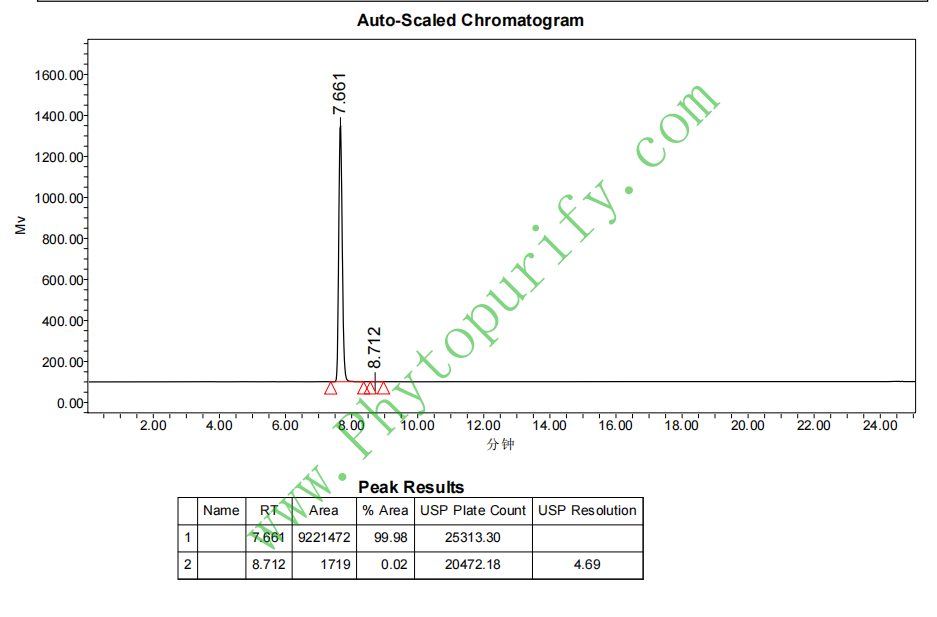
Analysis Method: HPLC-DAD or/and HPLC-ELSD
Identification Method: Mass, NMR
Packing: Brown vial or HDPE plastic bottle
Storage: Store in a well closed container, protected from air and light. Put into refrigerate or freeze for long term storage.
Whenever possible, you should prepare and use solutions on the same day. However, if you need to make up stock solutions in advance, we recommend that you store the solution as aliquots in tightly sealed vials at -20℃. Generally, these will be useable for up to two weeks.
The product could be supplied from milligrams to grams, up to kilograms
Inquire for bulk scale.
Descriptions:
Ziyuglycoside I, isolated from S. officinalis root extract, has anti-wrinkle activity, could be used as an active ingredient for cosmetics.[1]
References:
[1] Kim Y H, Chung C B, Kim J G, et al. Biosci Biotech Bioch, 2008, 72(2):303-11.
[2] Xie J B ,Bi Z M, Li P. Pharmaceutical Journal, 2003, 38(07):534-6.
HPLC of Ziyuglycoside I
Storage conditions:Short-term storage at 2~8℃, long-term storage at -20 ~ -80℃
215.8300
2.6332
2.6329
.0330
.6529
.7270
Low
74.8682
5.8603
No
No
No
No
No
No
0.0
Yes
No
No
Yes
Natural products have long been an important source of drug discovery and development, particularly in the fields of anti-tumor, anti-inflammatory, and skin health. Ziyuglycoside I (CAS number: 35286-58-9) is a traditional medicinal plant derived from the Chinese elm tree(Sanguisorba officinalis L. The triterpenoid saponins isolated from roots have attracted much attention in recent years due to their diverse biological activities. Early research revealed its potential application in the cosmetics field, mainly manifested in significant anti wrinkle activity and the ability to promote the expression of type I collagen. With the deepening of research, Sanguisorba officinalis saponin I has been found to show strong pharmacological effects in anti inflammation, inducing tumor cell apoptosis and other aspects, especially in the treatment of triple negative breast cancer (TNBC) and other refractory diseases. Its mechanism of action involves the regulation of the p53 signaling pathway and the regulation of multiple key inflammatory and tumor related targets, such as interleukin-6 (IL-6), signal transduction and transcription activator 3 (STAT3), and nuclear factor kappa B (NF - κ B). This article aims to provide a systematic review of the chemical properties, plant sources, pharmacological activities, molecular mechanisms of action, pharmacological evaluation, and clinical application prospects of Diyu saponin I, in order to provide comprehensive scientific references for the in-depth research and development of this compound.
The molecular formula of Diyu saponin I is C41H66O13, with a molecular weight of 766.9660 Da. Its chemical structure belongs to pentacyclic triterpenoid saponins, and its aglycone is an Oleanane type triterpenoid, with sugar chains connected at positions C-3 and C-28, respectively. Typical glycosylation compositions include glucose, arabinose, etc., and this specific glycosylation modification has a decisive impact on their biological activity and water solubility.
According to the analysis of the parameters related to drug properties, the lipid water partition coefficient (LogP) of Diyu saponin I is 2.6332, indicating that it has a certain degree of lipophilicity, but not high hydrophobicity. Its topological polar surface area (TPSA) is as high as 215.8300 Å ², mainly attributed to multiple hydroxyl groups and oxygen atoms on the sugar ring in the molecule, indicating strong molecular polarity. The water solubility value is 0.0330 mg/mL, belonging to the category of slight solubility, which is consistent with its saponin structural characteristics, that is, it has both hydrophilic (glycosyl) and lipophilic (triterpenoid glycoside) parts. These physical and chemical properties determine its absorption and distribution characteristics in living organisms. For example, higher TPSA and molecular weight may pose challenges to its oral bioavailability. In addition, the predicted data shows that its ability to cross the blood-brain barrier is low, which limits its direct effect on central nervous system diseases, but may also reduce the potential risk of neurotoxicity. In terms of preliminary safety prediction, Diyu saponin I did not show hERG potassium channel inhibitory activity (low risk of arrhythmia), and the Ames test predicted a value of 0.0, suggesting that it may not have direct genetic toxicity.
Diyu saponin I mainly comes from the plant Diyu in the Rosaceae family, genus Diyu(Sanguisorba officinalis L. Dry roots. As a traditional Chinese medicine, Eucommia ulmoides has the effects of cooling blood, stopping bleeding, detoxifying and healing sores. Its chemical composition is complex, and in addition to Eucommia ulmoides saponin I, it also contains various active ingredients such as Eucommia ulmoides saponin II, tannins, flavonoids, etc.
The extraction of saponins I from plant materials is usually carried out using solvent extraction combined with modern separation and purification techniques. The standard procedure is as follows:
1. Preprocessing and Extraction After drying and crushing the roots of Eucommia ulmoides, methanol, ethanol, or ethanol water mixed solvents are often used for reflux extraction or ultrasound assisted extraction. The alcohol extraction method can effectively dissolve saponin components.
2. Preliminary enrichment After the extraction solution is concentrated under reduced pressure, the obtained extract can be suspended in water and then extracted sequentially with organic solvents such as petroleum ether and ethyl acetate to remove fat soluble impurities and some moderately polar components. Diyu saponin I mainly exists in the subsequent n-butanol extraction site or water layer (enriched by macroporous adsorption resin treatment).
3. Separation and Purification: The parts enriched in saponins are further separated by column chromatography, and commonly used fillers include silica gel, reverse silica gel (such as ODS), dextran gel (Sephadex LH-20), etc. By gradient elution using chloroform methanol water or methanol water systems with different ratios, combined with thin-layer chromatography (TLC) or high-performance liquid chromatography (HPLC) monitoring, the monomer compounds are gradually separated.
4. appraisal The final purified Diyu saponin I needs to be structurally confirmed by spectroscopic techniques such as nuclear magnetic resonance (NMR, including 1H-NMR, 13C-NMR, 2D-NMR), mass spectrometry (MS), and infrared spectroscopy (IR). High performance liquid chromatography-mass spectrometry (HPLC-MS) is also commonly used for qualitative and quantitative analysis of this component during the extraction process.
Optimizing the extraction process (such as solvent ratio, temperature, time) and adopting new preparation techniques such as high-speed countercurrent chromatography can help improve the extraction efficiency and purity of Diyu saponin I.
The pharmacological activity research of Diyu saponin I has expanded from the initial field of skin care to multiple biomedical fields such as anti-tumor and anti-inflammatory, demonstrating multifaceted therapeutic potential.
Skin protection and anti wrinkle activity This is one of the earliest discovered activities of Diyu saponin I. Research has confirmed that saponins from Eucommia ulmoides can significantly promote the synthesis of type I collagen in human skin fibroblasts. Type I collagen is the main structural protein of the dermis layer of the skin, and its reduced content and structural damage are key factors in skin aging and wrinkle formation. Diyu saponin I enhances skin elasticity by upregulating collagen gene expression, thereby exerting anti wrinkle and anti-aging effects, making it a highly promising active ingredient in functional cosmetics.
Antitumor activity Sanguisorba officinalis saponin I can inhibit proliferation and induce apoptosis of many tumor cells, especially in the study of triple negative breast cancer (TNBC). TNBC lacks estrogen receptor, progesterone receptor, and HER2 expression, resulting in limited treatment options and poor prognosis. Experiments have shown that saponins I from Eucommia ulmoides can effectively inhibit the vitality of TNBC cells (such as MDA-MB-231 cells), and its mechanism is closely related to the activation of tumor suppressor protein p53, which leads to cell cycle arrest (such as G1 phase arrest) and the initiation of mitochondrial dependent apoptosis pathway. In addition, it has also shown certain anti-tumor effects on other types of cancer such as liver cancer, colon cancer, etc.
anti-inflammatory activity Diyu saponin I has a wide range of anti-inflammatory effects. In macrophage or animal inflammation models induced by inflammatory stimuli such as lipopolysaccharides (LPS), saponins I from Eucommia ulmoides can significantly inhibit the excessive production of pro-inflammatory mediators. These mediators include nitric oxide (NO, induced by NOS2), prostaglandin E2 (PGE2, involved in PTGS1/COX-1 and PTGS2/COX-2), tumor necrosis factor - α (TNF - α), and interleukin-6 (IL-6). Its anti-inflammatory effect has been validated in animal models such as acute lung injury and colitis, indicating its potential value in treating diseases related to excessive inflammatory response.
Other activities Some studies also suggest that saponins from Eucommia ulmoides may have auxiliary activities such as antioxidant and antibacterial properties, which complement their anti-inflammatory and tissue repair promoting effects.
The multiple pharmacological activities of Diyu saponin I stem from its regulation of multiple key signaling pathways within cells, and its mechanism of action is complex, involving the following core targets and pathways:
P53 dependent cell cycle and apoptosis pathway (core anti-tumor mechanism)In tumor cells, dioscin I can stabilize and activate p53 protein. As the "guardian of the genome", p53 upregulates the expression of cyclin dependent kinase inhibitors (CDKI) such as p21 upon activation, leading to cell cycle arrest (such as in G1 phase) and preventing cell proliferation; On the other hand, p53 can promote the expression of pro apoptotic proteins (such as Bax, PUMA) and inhibit the function of anti apoptotic proteins (such as Bcl-2), leading to increased mitochondrial outer membrane permeability, release of cytochrome c, and activation of caspase cascade reactions (such as CASP3), ultimately executing the cell apoptosis program. This is an important molecular basis for its resistance to triple negative breast cancer and other p53 wild-type or functional recoverable tumors.
NF - κ B and STAT3 inflammatory signaling pathway (anti-inflammatory core mechanism):
Other related targets:
In summary, the action of Diyu saponin I through multiple targets and pathways forms a synergistic anti-inflammatory and anti-tumor network, which provides advantages for its treatment of complex diseases.
Although dioscin I has shown good biological activity in vitro and some animal models, its drug like and pharmacokinetic (PK) properties are the key factors determining its successful development as a drug.
Analysis of drug properties parameters As mentioned earlier, the molecular weight of Diyu saponin I is close to 767, exceeding the standard of 500 in the Rule of Five; The TPSA value is relatively high (>140 Å ²). These parameters indicate the possibility of poor oral absorption and low bioavailability. Its slightly soluble properties may also affect formulation development and in vivo absorption. However, its LogP value is within the ideal range and there is no hERG inhibition or genotoxicity warning, which has certain advantages in terms of safety starting point.
Current status of pharmacokinetic research At present, there are relatively limited reports on the pharmacokinetic studies of the Diyu saponin I system, which is usually a bottleneck stage for the clinical development of natural product monomers. Based on its saponin structure, possible PK characteristics can be inferred:
Formulation strategy and structural optimization In order to improve the pharmacological properties of Diyu saponin I, future research may consider:
Comprehensive in vivo pharmacokinetics, tissue distribution, excretion studies, and toxicological evaluations (acute toxicity, chronic toxicity, reproductive toxicity, etc.) are necessary steps to advance its preclinical development.
The diverse biological activities of Diyu saponin I have brought broad clinical application prospects in multiple therapeutic fields, but also face challenges.
Potential application areas:
challenges faced:
Future research directions:
Diyu saponin I, as an active triterpenoid saponin derived from traditional Chinese medicine Diyu, has become a highlight molecule connecting traditional medicine and modern life science research due to its multiple pharmacological effects such as promoting collagen synthesis, anti-inflammatory, and inducing tumor cell apoptosis. Its potential in skin health, anti-tumor (especially triple negative breast cancer) and anti-inflammatory treatment is remarkable. The study of its mechanism of action revealed its multi-target characteristics by regulating key pathways such as p53, NF - κ B, STAT3, etc. However, the potential challenges of drug formation caused by its large molecular weight, high polarity, and other physicochemical properties, especially the issue of oral bioavailability, are the core challenges that must be overcome in future translational research. Through interdisciplinary strategies such as modern medicinal chemistry, pharmacy, and systems biology, in-depth exploration of its structural optimization, novel delivery systems, and complete preclinical development paths is expected to promote the gradual development of Diyu Saponin I from a promising natural active ingredient into a new drug or high-end efficacy product that can be used for clinical treatment, providing new choices for patients with related diseases and further interpreting the scientific connotation of modernization and internationalization of traditional Chinese medicine.
