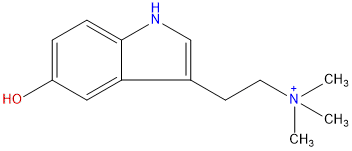


Product name: Bufoteninium
Synonym name: 5-Hydroxy-N,N,N-trimethyl-1H-indole-3-ethanaminium
Catalogue No.: BP4266
Cas No.: 60657-23-0
Formula: C13H19N2O+
Mol Weight: 219.307
Botanical Source: Bufonis Venenum
Type of Compound: Alkaloids
Purity: 95%~99%
Analysis Method: HPLC-DAD or/and HPLC-ELSD
Identification Method: Mass, NMR
Packing: Brown vial or HDPE plastic bottle
Storage: Store in a well closed container, protected from air and light. Put into refrigerate or freeze for long term storage.
The product could be supplied from milligrams to grams
Inquire for bulk scale.
For Reference Standard and R&D, Not for Human Use Directly.
Description:
Cinobufotenine is a potent stimulant of parasympathetic ganglia and its effect are competitively antagonized by hexamethonium.
References:
Br J Pharmacol. 1980 Aug;69(4):597-600.
A comparison of cinobufotenine (the quaternary derivative of 5-HT) and some related compounds with coryneine (the quaternary derivative of dopamine) on the frog rectus, guinea-pig ileum and rat fundus strip preparations.
METHODS AND RESULTS:
1 Coryneine is 2.7 times as active as Cinobufotenine on the frog rectus but on the guinea-pig ileum Cinobufotenine is 1.5 times as active as coryneine. Cinobufotenine is a potent stimulant of parasympathetic ganglia and its effect are competitively antagonized by hexamethonium. 2 The effects of pH on activity relative to a standard whose ionisation is constant (Me4+N or the trimethylammonium analogue of tryptamine) are consistent with the phenate form being weaker than the phenolic form but the changes are smaller than with coryneine because Cinobufotenine is a weaker acid.
CONCLUSIONS:
3 The hydroxyl group makes a large contribution to activity. Cinobufotenine is 9 times as active as the analogue without a hydroxyl on the frog rectus and 12 times as active as it on the ileum. The 5-methoxy analogue is an antagonist on the frog rectus and a very weak partial agonist on the ileum. 4 Cinobufotenine and the quaternary derivative of tryptamine have less than one-thousandth of the activity of 5-hydroxytryptamine on the rat fundus strip.
Storage conditions:Short-term storage at 2~8℃, long-term storage at -20 ~ -80℃
36.0200
-.2952
-.2947
.4655
.3441
9.9371
Low
30.3648
2.5467
No
No
No
No
Yes
No
0.0
No
No
No
No
Bufotennium, also known as N, N, N-trimethylserotonin, is a natural compound with significant biological activity. As a derivative of serotonin (5-hydroxytryptamine, 5-HT) structure, toad serotonin has attracted widespread attention in the field of natural product pharmacology due to its unique molecular structure and multi-target mechanism of action. In recent years, with the deepening of research on the anti-tumor activity of natural products, toad serotonin has gradually become an important candidate molecule for the development of new anti-tumor drugs due to its regulatory role in various tumor related signaling pathways.
The purpose of this article is to systematically review the chemical structure, physicochemical properties, sources, and extraction methods of bufotaxime, with a focus on analyzing its pharmacological activity and mechanism of action, evaluating its pharmacological parameters and pharmacokinetic characteristics, exploring its potential and challenges in clinical applications, and providing scientific basis for subsequent basic research and clinical translation.
The molecular formula of Huafuzi Serotonin is C12H17N2O, with a molecular weight of 219.3080 and a CAS number of 60657-23-0. Its structural feature is the N, N, N-trimethylation modification based on the serotonin skeleton, which endows it with unique chemical properties. Specifically, toad serotonin contains an indole ring system connected to a trimethylated amino side chain, which gives it high affinity and specificity in vivo.
In terms of physical and chemical properties, the LogP value of toad serotonin is -0.2952, indicating its strong hydrophilicity and certain water solubility (0.4655), which has a positive impact on its bioavailability and in vivo distribution. Its polar surface area (TPSA) is 36.02 Å ², indicating that the molecule has moderate polarity, which is conducive to binding with biomolecules. The low permeability of the blood-brain barrier suggests its limited distribution in the central nervous system, reducing the potential risk of neurotoxicity. The hERG channel inhibition experiment result was negative, indicating that the compound has a low risk of cardiac toxicity. The Ames mutagenicity test result is 0.0, indicating a low risk of genetic toxicity and meeting safety requirements.
Hua Fu Se An was initially isolated and identified from the skin secretions of toads such as Bufo bufo, and belongs to the class of toad toxin alkaloids. The skin secretions of toads contain a variety of bioactive amine substances, among which toad serotonin, as an important component, has unique pharmacological activity. In recent years, with the development of biosynthetic technology, this compound can also be obtained through microbial fermentation and chemical synthesis routes to meet the needs of large-scale production.
The extraction methods mainly include organic solvent extraction, column chromatography separation, and high-performance liquid chromatography purification. Generally, methanol or ethanol is used to extract toad skin secretions, followed by crude separation through acid-base regulation, and finally refined using silica gel columns or reverse phase C18 columns. During the extraction process, it is necessary to strictly control the temperature and pH conditions to avoid the degradation of compounds. Modern extraction techniques such as ultrasound assisted extraction and microwave-assisted extraction have also been applied to improve yield and purity.
Huafu serotonin has shown significant anti-tumor activity in various biological models. Its pharmacological effects include inhibition of cell proliferation, induction of apoptosis, inhibition of invasion and migration, and regulation of tumor microenvironment. In vitro experiments showed that bufo gargarizans tryptamine could significantly inhibit the growth of many tumor cell lines, including breast cancer, lung cancer, colorectal cancer and melanoma.
In terms of apoptosis regulation, this compound can downregulate the expression of anti apoptotic proteins MCL1 and BCL2, promoting programmed cell death in tumor cells. At the same time, by inhibiting the activity of signal transduction and transcription activator 3 (STAT3), the proliferation and immune escape mechanisms of tumor cells are blocked. In addition, toad serotonin can also inhibit matrix metalloproteinase 2 (MMP2), reducing the invasion and metastasis ability of tumor cells.
In vivo experiments, Chinese toad serotonin showed good anti-tumor effects, significantly prolonging the survival of tumor model mice, and no significant toxic side effects were observed. Its anti-tumor activity is closely related to multi-target effects, reflecting the advantages of natural products with multiple targets and mechanisms.
The anti-tumor mechanism of Chinese toad serotonin involves multiple signaling pathways and key molecular targets, mainly including:
MCL1 and BCL2 inhibition MCL1 and BCL2 are members of the anti apoptotic protein family, involved in the survival and drug resistance of tumor cells. Hua Bufo's serotonin promotes mitochondrial mediated apoptosis by downregulating its expression.
Regulation of STAT3 signaling pathway STAT3, as a key transcription factor for tumor cell proliferation and immune escape, can be inhibited by toad serotonin for phosphorylation and nuclear translocation, blocking its transcriptional activity and inhibiting tumor growth.
MMP2 activity inhibition MMP2 is involved in the degradation and metastasis of tumor cell matrix, and toad serotonin reduces tumor invasion ability by inhibiting MMP2 activity.
TOP1 and TOP2A regulation Topoisomerase TOP1 and TOP2A are important enzymes for DNA replication and transcription, and the regulation of their activity by toad serotonin affects the proliferation of tumor cells.
HIF1A regulation The hypoxia inducible factor HIF1A plays a crucial role in tumor microenvironment adaptation, and bufotaxime inhibits HIF1A, interfering with tumor angiogenesis and metabolic reprogramming.
MAPK1 and ESR1 signaling pathways MAPK1 is involved in cell proliferation signaling, ESR1 is an estrogen receptor, and its regulation by toad serotonin helps to inhibit the growth of specific tumor types.
CYP19A1 inhibition Aromatase CYP19A1 catalyzes estrogen synthesis in hormone dependent tumors, and the inhibitory effect of bufotaxime on it helps to block hormone driven tumor progression.
In summary, the synergistic effect of Chinese toad serotonin through multiple targets and pathways demonstrates its anti-tumor effect, demonstrating the advantages of the complex mechanism of natural products.
The pharmacological parameters of Huafu Serotonin show that it has good potential for drug development. The molecular weight of 219.3080 is within the ideal range of the drug, and the LogP value of -0.2952 indicates moderate hydrophilicity, which is beneficial for in vivo distribution and absorption. The TPSA is 36.02 Å ², which meets the polarity requirements of drug molecules and supports its effective binding with biological targets.
The water solubility value of 0.4655 indicates that the compound has a certain degree of water solubility, which is beneficial for the development of oral formulations. The low permeability of the blood-brain barrier reduces the risk of central nervous system side effects. HERG channel inhibition is negative and Ames test is non mutagenic, further enhancing its safety evaluation.
In terms of pharmacokinetics, although current research is relatively limited, preliminary in vivo experiments suggest that Chinese toad serotonin has good bioavailability and metabolic stability. Its metabolic pathway may involve the liver cytochrome P450 enzyme system, especially the regulatory role of CYP19A1, suggesting the possibility of complex drug interactions in vivo. In the future, systematic pharmacokinetic and toxicological studies are needed to clarify its absorption, distribution, metabolism, and excretion (ADME) characteristics.
As a multi-target anti-tumor natural product, bufotaxime has shown broad prospects in clinical applications. Its multiple mechanisms of action not only help overcome tumor drug resistance, but may also enhance the efficacy of immunotherapy by regulating the tumor microenvironment. Especially in the adjuvant treatment of common solid tumors, such as breast cancer and lung cancer, bufo gargarizans tryptamine has potential value of combination.
However, the clinical translation of toad serotonin still faces many challenges. Firstly, it is necessary to improve its pharmacokinetics and toxicology research to ensure safety and effective dosage range. Secondly, optimizing its formulation process, improving bioavailability and targeting, is the key to achieving clinical applications. Finally, conducting systematic preclinical and clinical trials to verify its efficacy and safety is a necessary step in promoting it as a new type of anti-tumor drug.
In the future, by combining modern drug design technologies such as structural optimization, nanocarrier delivery, and combination therapy strategies, it is expected to further enhance the clinical application value of bufotaxime. In addition, in-depth analysis of its mechanism of action will provide a theoretical basis for the development of more anti-tumor drugs based on serotonin derivatives.
As a natural derivative of N, N, N-trimethylserotonin, Huafu Serotonin exhibits high potential for drug development due to its unique chemical structure and multi-target anti-tumor activity. Its mechanism of action in regulating tumor cell apoptosis, inhibiting proliferation, and blocking metastasis provides new ideas for the development of anti-tumor drugs. The drug has good pharmacological parameters and positive safety evaluation, supporting further clinical translational research.
In the future, with the deepening of relevant basic and clinical research, bufotaxime is expected to become an important candidate drug in the field of anti-tumor therapy. Continuously focusing on its pharmacological mechanism, optimizing formulation technology, and conducting clinical validation will promote its transition from laboratory to clinical application, bringing new treatment options for cancer patients.
