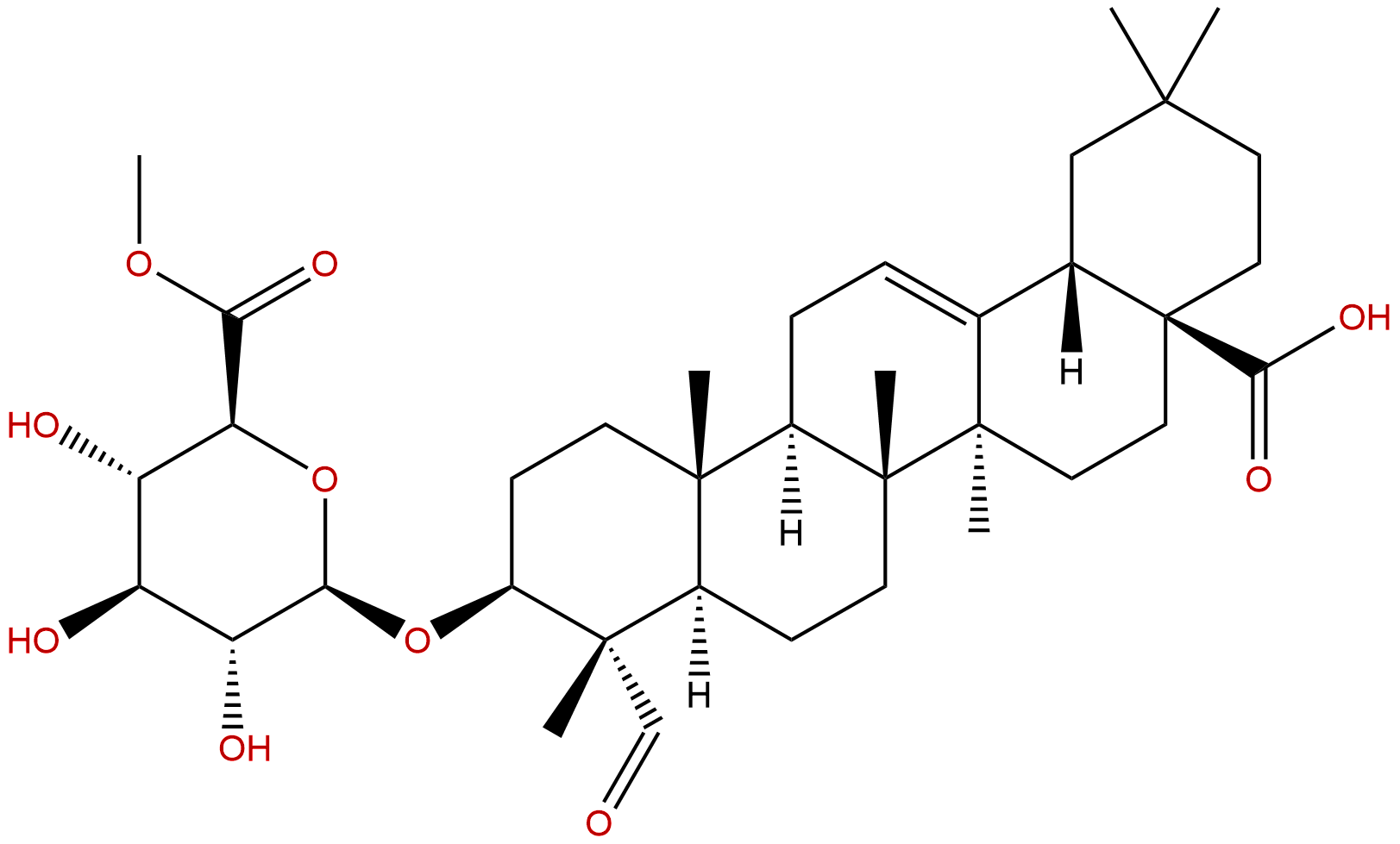


Product name: Gypsogenin 3-O-β-D-glucuronopyranoside
Synonym name: Gypsogenin 3-O-β-D-glucuronopyranoside; Methyl gypsogenin 3-O-beta-D-glucuronopyranoside; Gypsogenin3-O-β-D-glucuronide 6'-methyl ester; Gypsogenin-3-O- β-D-glucuronide methyl ester
Catalogue No.: BP3177
Cas No.: 96553-02-5
Formula: C37H56O10
Mol Weight: 660.845
Botanical Source:
Physical Description: Powder
Type of Compound: Triterpenoids
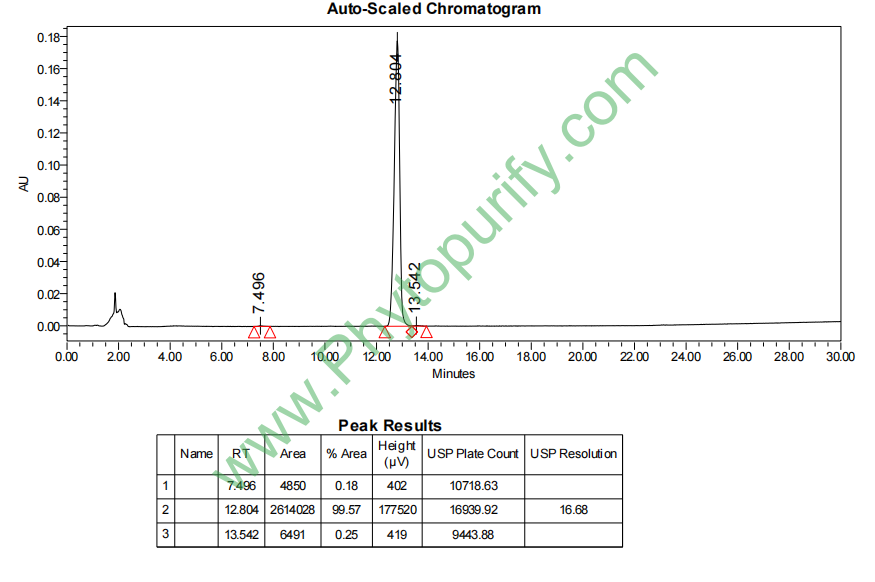
Purity: 95%~99%
Analysis Method: HPLC-DAD or/and HPLC-ELSD
Identification Method: Mass, NMR
Packing: Brown vial or HDPE plastic bottle
The product could be supplied from milligrams to grams. Inquire for bulk scale.
We provide solution to improve the water-solubility of compounds, thereby facilitating the variety of activity tests and clinic uses.
For Reference Standard and R&D, Not for Human Use Directly.
Description:
Gypsogenin 3-O-beta-D-glucuronopyranoside shows inhibitory activity toward pancreatic lipase with IC50 value of 0.29 mM, and the free carboxylic acid groups in position 28 within its chemical structures are required for enhancement of pancreatic lipase inhibition.
References:
Chem. Pharm. Bull. (Tokyo).,2007, 55(7):1087-9.
Pancreatic lipase-inhibiting triterpenoid saponins from fruits of Acanthopanax senticosus.
Sixteen triterpenoid saponins were isolated from the fruits of Acanthopanax senticosus, including a new compound, acanthopanaxoside E (1), which was established as 3-O-beta-D-glucuronopyranosyl echinocystic acid 28-O-beta-D-glucopyranoside on the basis of various spectroscopic analyses and chemical degradation.
METHODS AND RESULTS:
By using a pancreatic lipase-inhibiting assay system, the crude saponin fraction showed inhibitory activity on pancreatic lipase, which is a key enzyme in lipid digestion. Among the isolated compounds, silphioside F (2), copteroside B (3), hederagenin 3-O-beta-D-glucuronopyranoside 6'-O-methyl ester (4) and gypsogenin 3-O-beta-D-glucuronopyranoside (Methyl gypsogenin 3-O-beta-D-glucuronopyranoside,5) showed inhibitory activity toward pancreatic lipase with IC(50) values of 0.22, 0.25, 0.26 and 0.29 mM, respectively, and the free carboxylic acid groups in position 28 within their chemical structures were required for enhancement of pancreatic lipase inhibition.
HPLC of Methyl Gypsogenin 3-O-β-D-glucuronopyranoside
Storage conditions:Short-term storage at 2~8℃, long-term storage at -20 ~ -80℃
159.8200
3.9569
2.0563
.0151
.7531
.4932
Low
88.2254
5.4449
No
No
Yes
No
No
No
0.0
Yes
No
No
No
Methyl Gypsogenin-3-O - β - D-glucuronopyranoside (MG3G), derived from the Caryophyllaceae plant, is a type of saponin in the Caryophyllaceae family(Dianthus deltoides)The isolated oleanane type pentacyclic triterpenoid saponins. Its CAS number is 96553-02-5, molecular formula is C37H56O10, and molecular weight is approximately 660.85 g/mol. As a natural product, it has attracted the attention of researchers in natural medicinal chemistry and pharmacology in recent years due to its unique chemical structure and potential biological activity. In particular, modern pharmacological research has revealed that the compound can act on multiple key targets related to inflammation and autoimmune diseases, including STAT3, TNF, IL17A, IL23, and DEFB4, which are closely related to the pathogenesis of chronic inflammatory skin diseases such as psoriasis. Therefore, MG3G is regarded as a potential anti psoriasis lead compound, and its research not only helps to elucidate the traditional medicinal value of bamboo, but also provides new chemical entities and ideas for the development of novel, multi-target anti-inflammatory and immune regulating drugs. This article will systematically elaborate on its chemical structure, plant origin, pharmacological mechanism, evaluation of medicinal properties, and research prospects.
The chemical structure of MG3G is composed of hydrophobic triterpenoid saponins (Caryophyllum saponins) and hydrophilic glycosides (β - D-glucuronide methyl ester) connected by glycosidic bonds (3-O -). This structure endows it with typical amphiphilic characteristics. The SMILES string provides a detailed description of the stereochemical configuration of the molecule, indicating that it is a complex natural product with multiple chiral centers, and its biological activity is often closely related to specific spatial configurations.
Analyze its physicochemical properties based on the provided pharmacological parameters:
- Molecular weight (MW):660.85 g/mol, Significantly exceeding the recommended value of "less than 500" in Lipinski's Five Rules, indicating that oral absorption may face challenges.
- Lipid water partition coefficient (LogP)The calculated value is 3.96, indicating that the compound has moderate lipophilicity. And LogD (distribution coefficient at pH 7.4) is 2.06, lower than LogP, mainly due to the partial ionization of glucuronic acid groups in the molecule at physiological pH, which increases hydrophilicity. Moderate LogD values are beneficial for the balanced distribution of compounds within living organisms.
- Topological Polarity Surface Area (TPSA)Up to 159.82 Å ², mainly attributed to the presence of multiple polar groups such as hydroxyl, carboxylate, and carbonyl groups in the molecule. High TPSA is usually associated with poor cell membrane permeability, which also confirms the data of low Caco-2 permeability (0.4932 × 10 ⁻⁶ cm/s).
- Water solubility The value is relatively low (0.0151 mg/mL), which belongs to insoluble compounds, which may affect the development of their formulations and in vivo bioavailability.
- Plasma protein binding rate (PPB)As high as 88.23%, it means that most drugs in the blood bind to plasma proteins, which may affect their free drug concentration and efficacy, and may also prolong their half-life.
In summary, MG3G is a natural saponin with a large molecular weight, high polar surface area, poor water solubility, but moderate lipid solubility. These physicochemical properties largely determine its pharmacokinetic behavior and are key optimization issues in subsequent drug development.
The plant source of MG3G is carnation(Dianthus deltoides L.), Commonly known as' maiden pink 'or' maiden pink ', it is a perennial herbaceous plant of the Caryophyllaceae family and the Caryophyllaceae genus. This plant is widely distributed in some parts of Europe and Asia, often growing in grasslands, sandy or rocky areas. Caryophyllum plants have a long history of application in many folk medical systems. For example, in traditional European herbs, plants of the Caryophyllum genus (such as...)Dianthus superbus)The decoction has been used to treat urinary system infections, skin diseases, and as a diuretic and anti rheumatic drug. Although regarding silk, stone, and bamboo(D. deltoides)The literature on specific medicinal records is not as abundant as other species in the same genus, but as a member of the Caryophyllum genus, it is likely to be used in similar folk therapies, especially for symptoms such as skin inflammation and itching.
Modern plant chemistry research has isolated abundant saponin components from various plants in the Caryophyllum genus, which have been proven to have various biological activities such as anti-inflammatory, antibacterial, anti-tumor, and immune regulation. The discovery of MG3G provides a specific material basis for elucidating the traditional medicinal effects of Caryophyllum and even Caryophyllum plants. From traditional experience to modern scientific verification, it reflects the inheritance and innovation of natural product research.
The most notable pharmacological activity of MG3G lies in its regulatory effect on multiple key targets related to psoriasis. Psoriasis is a common, immune-mediated chronic inflammatory skin disease, whose pathological process involves abnormal activation of the innate and adaptive immune systems, forming an inflammatory circuit centered around the TNF - α/IL-23/IL-17 axis.
(1) Core target analysis:
(2) Mechanism of action integration speculation:
Based on the above target information, we can reasonably speculate that MG3G may exert anti psoriasis effects through a multi-target, network regulated approach. Its mechanism of action may be as follows:
MG3G may first inhibit the production of IL-23 and TNF - α by affecting the function of antigen-presenting cells such as dendritic cells. The reduction of IL-23 can hinder the differentiation and functional maintenance of Th17 cells, thereby reducing the production of IL-17A. Meanwhile, direct inhibition of TNF - α can alleviate vascular response and activation of the NF - κ B pathway. On the other hand, the inhibition of STAT3 by MG3G may be a more upstream or synergistic event. The decrease in STAT3 activity can weaken the maintenance signal of IL-23 on Th17 cells, as well as directly inhibit the abnormal response of keratinocytes to IL-17A stimulation, including accelerated proliferation and excessive production of DEFB4. In the end, the synergistic inhibition of these targets broke the "inflammatory circuit" of psoriasis, alleviating pathological features such as excessive epidermal proliferation, incomplete keratinization, immune cell infiltration, and angiogenesis.
It should be pointed out that the above mechanism is based on reasonable speculation of target information, and the specific molecular interaction sites, signaling pathway details, and whether these effects are direct or indirect still need to be verified through rigorous cell and animal experiments (such as reporter gene experiments, Western blot, immunofluorescence, gene knockout/knockdown, etc.).
Drug efficacy assessment aims to predict the likelihood of a compound developing into an oral medication. We combine Lipinski's Rule of Five (Ro5) and the provided parameters to analyze MG3G:
Lipinski Five Rule Compliance:
Interpretation of Key Medicinal Parameters:
Conclusion MG3G is available Pharmacological activity It demonstrates good multi-target anti psoriasis potential at all levels, but druglikeness On the surface, its large molecular weight, high polarity, low permeability, and low water solubility constitute the main obstacles to its development into oral drugs. It is more likely to serve as an excellent lead compound, and future research directions may include:
- Structural modification On the premise of retaining the pharmacophore, modify the sugar or glycoside groups to reduce molecular weight, optimize LogP and TPSA, and improve permeability and oral bioavailability.
- Formulation strategy Develop nano formulations (such as liposomes, nanocrystals, polymer micelles), prodrugs, or use transdermal delivery systems (for psoriasis lesions) to overcome their solubility and permeability bottlenecks.
- Explore non oral administration routes For topical application (for psoriasis lesions) or injection administration.
At present, there may be relatively limited public research literature on MG3G, and its activity data is likely to come from high-throughput screening or preliminary in vitro studies. The existing information indicates that it has been successfully isolated and identified from a traditional medicinal plant, and its position as an anti psoriasis lead compound has been established through activity screening of key psoriasis targets.
Research status The current research may be at Early detection stage Given its chemical structure, plant origin, and preliminary target binding or inhibitory activity data. But further mechanism research, such as efficacy validation, dose-response relationship, preliminary pharmacokinetics, and safety evaluation in psoriasis cell models (such as HaCaT cells, THP-1 cell co culture system) and animal models (such as the mouse psoriasis like model induced by imiquimod), may be the next step that needs to be carried out.
Application Prospects:
1. As a lead compound for novel anti psoriasis drugs Its multi-target action characteristics are in line with new strategies for modern treatment of complex immune diseases, and may have better efficacy or lower resistance risk than single target drugs. Through rational drug chemistry optimization, it is expected to develop new small molecule immunomodulators with independent intellectual property rights.
2. As a development of topical dermatological drugs In view of the challenge of its oral development, it may be a faster and safer transformation path to develop cream, gel, foam and other topical preparations by taking advantage of its local effects to directly act on psoriasis lesions. It is necessary to study its transdermal permeability and local irritancy.
3. Elucidate the pharmacological substance basis of Caryophyllum plants The research on MG3G can enrich the pharmacological connotation of saponins in Caryophyllum plants and provide scientific basis for the quality control and modern development of related traditional medicines.
4. Explore other indications Given that its targets (such as STAT3, TNF, IL-17) are also widely involved in other autoimmune diseases such as rheumatoid arthritis, inflammatory bowel disease, and multiple sclerosis, the potential applications of MG3G and its derivatives may not be limited to psoriasis.
In summary, Polygonatum sibiricum sapogenin-3-O - β - D-glucuronate methyl ester (MG3G) is a natural triterpenoid saponin derived from traditional medicinal plants with clear multi-target anti psoriasis activity. Despite facing challenges in terms of drug efficacy, it is undoubtedly a valuable lead compound that provides an important starting point for the development of innovative drugs. Future research requires interdisciplinary collaboration in chemistry, pharmacology, pharmacy, and other fields. Through structural optimization, formulation innovation, and in-depth exploration of the mechanism of action, it is possible to fully tap into its therapeutic potential and ultimately bring new treatment options for psoriasis patients.
