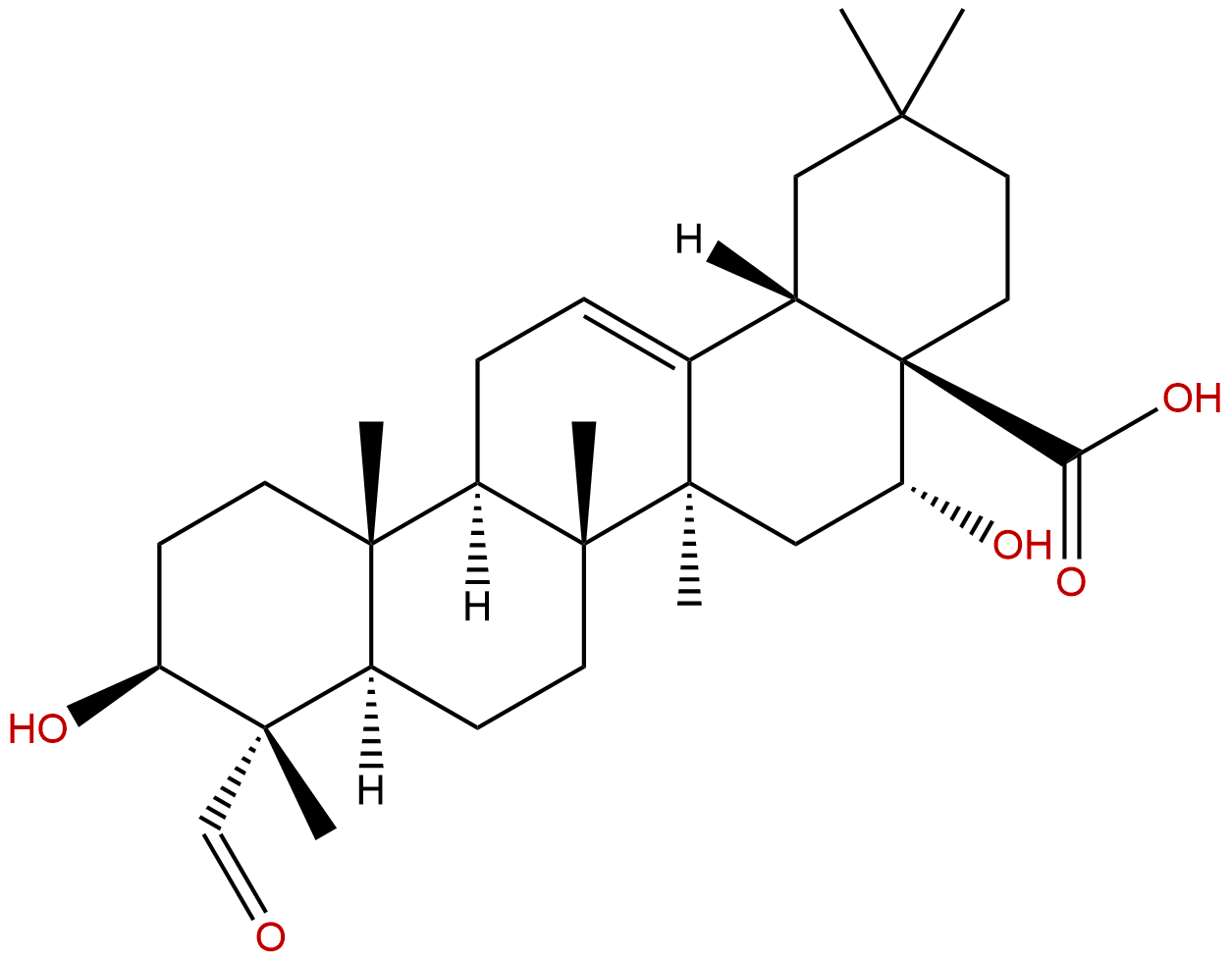


Product name: Quillaic acid
Synonym name: Quillaja sapogenin
Catalogue No.: BP3341
Cas No.: 631-01-6
Formula: C30H46O5
Mol Weight: 486.693
Botanical Source:
Physical Description:
Type of Compound: Triterpenoids
Purity: 95%~99%
Analysis Method: HPLC-DAD or/and HPLC-ELSD
Identification Method: Mass, NMR
Packing: Brown vial or HDPE plastic bottle
The product could be supplied from milligrams to grams. Inquire for bulk scale.
We provide solution to improve the water-solubility of compounds, thereby facilitating the variety of activity tests and clinic uses.
For Reference Standard and R&D, Not for Human Use Directly.
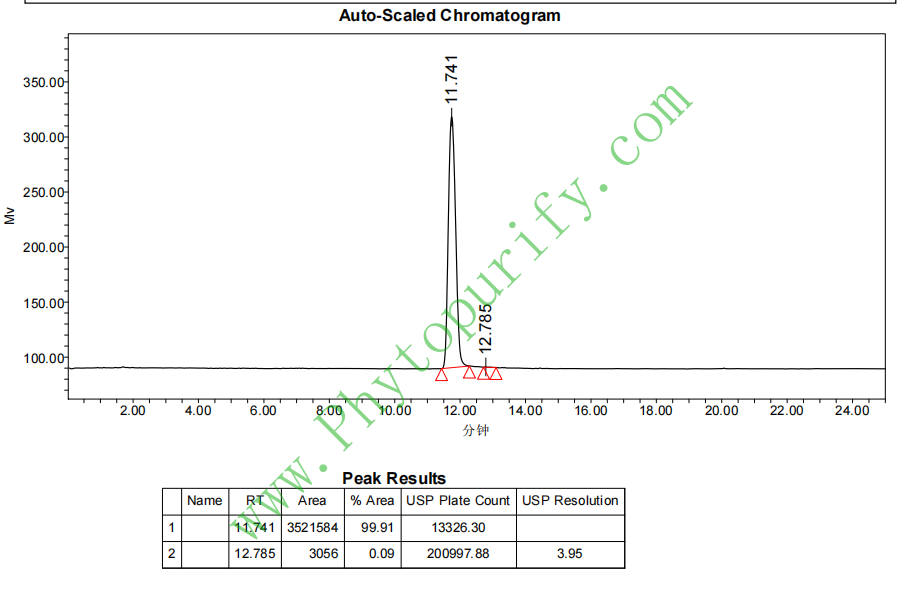
HPLC of Quillaic acid
Storage conditions:Short-term storage at 2~8℃, long-term storage at -20 ~ -80℃
94.8300
4.7434
2.8336
.0085
3.9763
2.8654
Low
90.7712
5.0466
No
No
No
No
No
No
0.0
No
No
Yes
No
Natural products, as an important treasure trove for drug discovery and development, play an irreplaceable role in the long history of human fight against diseases. Among them, triterpenoids have always been a hot topic in medicinal chemistry and pharmacology research due to their structural diversity and wide range of biological activities. Quillaic acid (CAS number: 631-01-6), as a triterpenoid saponin derived from the Quillaja saponaria tree, has attracted much attention in recent years due to its significant anti-tumor activity. Traditionally, soap bark extracts rich in soap acids, such as Quillaja saponin, have been widely used due to their surface activity and immune adjuvant properties. However, the direct pharmacological effects of its glycoside - soapberry acid itself, especially its anti gastric cancer and anti proliferative effects, have not been fully revealed until recent years. Research has shown that soap peel acid can exert anti-tumor effects through various mechanisms such as inducing cancer cell apoptosis and inhibiting key signaling pathways, while also possessing analgesic and anti-inflammatory activities. This article aims to systematically review the chemical structure, plant origin, pharmacological activity, molecular mechanism of action, pharmacological characteristics, and clinical application prospects of soap peel acid, in order to provide comprehensive scientific references for the deep development of this natural product and the research of anti-tumor drugs.
Soap peel acid, with chemical names of 3 β, 16 α, 21 β, 22 α, 28 pentahydroxyolean-12-ene, is a pentacyclic triterpenoid compound belonging to oleanane type sapogenins. Its molecular formula is C30H46O5 and its molecular weight is 486.6930. Its core structure consists of five fused rings (A/B/C/D/E rings), with a typical Δ 12 ene bond and multiple hydroxyl groups connected at C-3, C-16, C-21, C-22, and C-28 positions, with C-28 often existing in the form of carboxyl groups, which is why it is classified as an acidic sapogenin. These rich oxygen-containing functional groups are an important structural basis for their biological activity.
From the analysis of physicochemical parameters related to drug properties, the lipid water partition coefficient (LogP) of soap peel acid is 4.74, indicating its high lipophilicity. Its topological polar surface area (TPSA) is 94.83 Å ², which is relatively moderate. However, its water solubility is extremely low, only 0.0085 mg/mL, mainly due to its rigid and hydrophobic triterpenoid skeleton. This low water solubility is one of the main challenges it faces in formulation development and in vivo delivery. In the early screening of drug safety, soap peel acid did not show hERG potassium channel inhibitory activity (hERG inhibition: No), indicating a low potential risk of cardiac toxicity. Meanwhile, the actual Ames test result was 0.0, indicating that it has no direct genetic toxicity. In addition, its ability to cross the blood-brain barrier is predicted to be 'low', which means its direct effect on central nervous system related diseases may be limited, but it may also reduce potential neurological side effects.
Soap peel acid mainly comes from the unique soap peel tree (Quillaja saponaria Molina) found in Chile and Peru, belonging to the Rosaceae family. The bark and wood of this tree are rich in a series of structurally complex saponins, collectively known as Quillaja saponins, and soapberry acid is the common glycoside of these saponins.
The traditional extraction method mainly targets total saponins. Usually, after crushing the dried soap bark, water or alcohol water solutions (such as methanol, ethanol) are used for heating reflux or ultrasound assisted extraction. After filtration and concentration, the obtained crude extract can be preliminarily purified using macroporous adsorption resins (such as D101, AB-8) to remove impurities such as sugars and proteins. To obtain soap peel acid monomers, further acid hydrolysis or enzymatic hydrolysis steps are required. Specifically, the purified total saponins are heated and refluxed under acidic conditions (such as dilute hydrochloric acid or sulfuric acid solution), causing the sugar chains of the saponins to break and releasing glycoside soap peel acid. After extraction with organic solvents such as ethyl acetate and chloroform, the hydrolysis products are separated and purified using a series of chromatographic techniques, including silica gel column chromatography, reverse phase high performance liquid chromatography (RP-HPLC), etc. In recent years, green technologies such as supercritical CO2 extraction have also been explored for the extraction of saponins from soapberry trees, but the subsequent hydrolysis and purification steps still need to be optimized to obtain high-purity soapberry acid.
Soap peel acid exhibits various pharmacological activities, among which the most prominent is its anti-tumor effect, as well as its analgesic and anti-inflammatory activities.
1. Antitumor activity
Numerous in vitro and in vivo studies have confirmed that soap peel acid has significant inhibitory effects on proliferation and induces apoptosis in various cancer cell lines, particularly exhibiting potent activity against gastric cancer cells. Research has shown that soap peel acid can dose dependently inhibit the activity of human gastric cancer cells (such as SGC-7901, MKN-45), with a half maximal inhibitory concentration (IC50) in the micromolar range. In animal models, soap peel acid administration significantly inhibited the growth of gastric cancer xenografts without showing significant systemic toxicity. Its anti-tumor spectrum is not limited to gastric cancer, but also shows certain inhibitory effect on breast cancer, liver cancer, colon cancer and other cells. Its characteristic function is to selectively induce apoptosis of cancer cells, while its toxicity to normal cells is relatively low.
2. Analgesic and anti-inflammatory activity
In addition to its anti-tumor effect, soap peel acid also exhibits central and peripheral analgesic activity. In classic hot plate and acetic acid writhing experiments, soap peel acid can significantly increase the pain threshold of mice and reduce pain responses. Its analgesic mechanism may involve both the central opioid system and non opioid system. Meanwhile, soap peel acid showed clear local anti-inflammatory effects in acute inflammation models such as carrageenan induced paw swelling in rats, reducing tissue edema and inflammatory cell infiltration. This suggests that soap peel acid may exert its effect by regulating the release of inflammatory mediators such as prostaglandins and cytokines.
The anti-tumor effect of soap peel acid involves a complex regulatory network of multiple targets and pathways, with the core being the key link in inducing cancer cell apoptosis and inhibiting tumor progression.
1. Inducing cell apoptosis
This is the core anti-cancer mechanism of soap peel acid. It mainly initiates mitochondrial apoptosis pathway by regulating Bcl-2 protein family members. Research has shown that soap peel acid can significantly downregulate anti apoptotic proteins MCL1 and BCL2 At the same time, it may upregulate the expression of pro apoptotic proteins (such as Bax), leading to a decrease in mitochondrial membrane potential, release of cytochrome C, and activation of the caspase cascade reaction, ultimately resulting in cell apoptosis.
2. Inhibit the signal transduction and transcription activator 3 (STAT3) pathway
STAT3 It is an important oncogenic transcription factor that is continuously activated in various tumors. Soap peel acid can effectively inhibit the phosphorylation (activated form) of STAT3, block its nuclear translocation and the transcription of downstream target genes (such as Survivor, Cyclin D1), thereby inhibiting cell proliferation, promoting apoptosis, and weakening tumor invasion ability.
3. Inhibit matrix metalloproteinases (MMPs) and tumor invasion and metastasis
Soap peel acid can be downregulated MMP2 Expression and activity of matrix metalloproteinase 2. MMP2 is a key enzyme that degrades the extracellular matrix (ECM) and basement membrane, and is closely related to tumor invasion and metastasis. By inhibiting MMP2, soap peel acid can effectively reduce the migration and invasion ability of cancer cells.
4. Affects the activity of DNA topoisomerases (TOPs)
Soap peel acid has been proven to inhibit TOP1 and TOP2A The activity. Topoisomerases are crucial in DNA replication, transcription, and repair, and are targets of many chemotherapy drugs such as irinotecan and etoposide. Soap peel acid interferes with the function of these enzymes, causing DNA damage and replication fork arrest, thereby triggering cell death.
5. Regulating hypoxia inducible factor-1 α (HIF1A) and tumor microenvironment
In the hypoxic microenvironment of tumors,HIF1A Stability and activation promote angiogenesis and metabolic reprogramming. Soap peel acid can inhibit the accumulation of HIF1A and the expression of downstream vascular endothelial growth factor (VEGF), which may inhibit tumor angiogenesis.
6. Regulating mitogen activated protein kinase (MAPK) and estrogen signaling pathway
Soap peel acid MAPK1 The ERK2 pathway has a regulatory effect and is involved in the transmission of cell proliferation and survival signals. In addition, studies suggest that soap peel acid may interfere with ESR1(Estrogen receptor alpha) or its effects CYP19A1(aromatase) activity to interfere with the growth of estrogen dependent tumors (such as some breast cancer).
In summary, soap peel acid forms a synergistic anti-tumor effect by simultaneously acting on multiple key targets and pathways such as apoptosis regulation, signal transduction, extracellular matrix degradation, DNA metabolism, and tumor microenvironment, providing a potential advantage for overcoming the resistance problem of single target drugs.
Although soap peel acid has shown good biological activity in vitro, its pharmacological development still faces challenges, and related pharmacokinetic studies are not yet sufficient.
Advantage aspects The molecular weight of soap peel acid is moderate and conforms to the rules of drug properties. It has no hERG inhibition or Ames mutagenicity risk, and its preliminary safety profile is good. The multi-target mechanism of action may lead to more lasting therapeutic effects and lower drug resistance.
Main challenges:
1. Solubility and permeability Extremely low water solubility (0.0085 mg/mL) and high LogP value may result in extremely low bioavailability. This belongs to Class II (low solubility and high permeability) or Class IV (low solubility and low permeability) compounds in the Biopharmaceutical Classification System (BCS), with poor oral absorption.
2. Pharmacokinetic properties unknown Currently, there is very limited systematic research on the in vivo absorption, distribution, metabolism, and excretion (ADME) of soap peel acid. The key parameters such as plasma protein binding rate, metabolic stability (possibly metabolized by liver CYP450 enzymes), half-life, and main excretion pathways urgently need to be clarified.
3. Difficulties in formulation To improve its solubility, it may be necessary to develop advanced drug delivery systems such as nanocrystals, liposomes, micelles, cyclodextrin inclusion complexes, or prodrug strategies.
Future research needs to focus on systematic preclinical pharmacokinetic and toxicological evaluations, and actively explore new delivery technologies to overcome the bioavailability bottleneck caused by their physicochemical properties.
As a natural product with clear multi-target anti-tumor activity, soap peel acid has broad clinical application prospects, but solid research work is still needed for its transformation.
Potential application directions:
1. Development of anti-tumor drugs Especially for gastric cancer, it may be developed as a novel chemotherapy or targeted drug. We can explore combination therapy with existing chemotherapy drugs such as cisplatin and 5-fluorouracil to enhance efficacy, reduce dosage, and minimize toxic side effects.
2. Analgesic and anti-inflammatory adjuvant drugs Its inherent analgesic and anti-inflammatory activity can be considered for the development of drugs to treat cancer pain or inflammation related diseases, or as an adjuvant ingredient in anti-tumor therapy to improve patients' quality of life.
3. Structural optimization and derivative development Using it as the parent nucleus for structural modification (such as glycosylation, esterification, synthesis of amino acid conjugates), aiming to improve water solubility, enhance targeting, enhance activity, or reduce toxicity, is an important direction in pharmaceutical chemistry research.
Challenges and Prospects Faced:
1. In depth mechanism research It is necessary to use proteomics, chemical proteomics and other technologies to more accurately identify its direct target and elucidate the network regulatory relationships between its multiple targets.
2. Comprehensive evaluation of drug properties Pre clinical ADME and toxicology studies of the system must be completed to clarify its treatment window.
3. Innovative delivery system Developing nano formulations or prodrugs suitable for soap peel acid is a key step in promoting its clinical application.
4. Explore combination therapy Based on its unique mechanism of action, designing a combination therapy strategy with immune checkpoint inhibitors, other targeted drugs, etc. may result in synergistic effects.
Sapindac acid is a triterpenoid sapogenin of oleanane type isolated from the traditional medicinal plant Sapindaceae, which has important research value. In recent years, its anti-tumor activity, especially its anti gastric cancer effect, has been fully confirmed by pharmacological research. It effectively induces cancer cell apoptosis, inhibits proliferation and invasion by synergistically targeting multiple key targets such as MCL1, BCL2, STAT3, MMP2, TOP1/2A, demonstrating the potential of multi-target anti-tumor drugs. Although its extremely low water solubility and unclear pharmacokinetic properties are currently the main obstacles to its development, its good preliminary safety and clear biological activity have laid a solid foundation for its subsequent research. In the future, through in-depth mechanism exploration, rational structural optimization, and advanced drug delivery technology, soap peel acid is expected to be successfully transformed from a potential natural active molecule into a new candidate drug for clinical treatment, especially for gastric cancer treatment, providing new ideas and directions for the modernization of natural products and the development of anti-tumor drugs.
