


Product name: Marmesin
Synonym name:
Catalogue No.: BP0924
Cas No.: 13849-08-6
Formula: C14H14O4
Mol Weight: 246.262
Botanical Source: Peucedanum decursivum.(Miq.)Maxim.
Physical Description:
Type of Compound: Coumarins
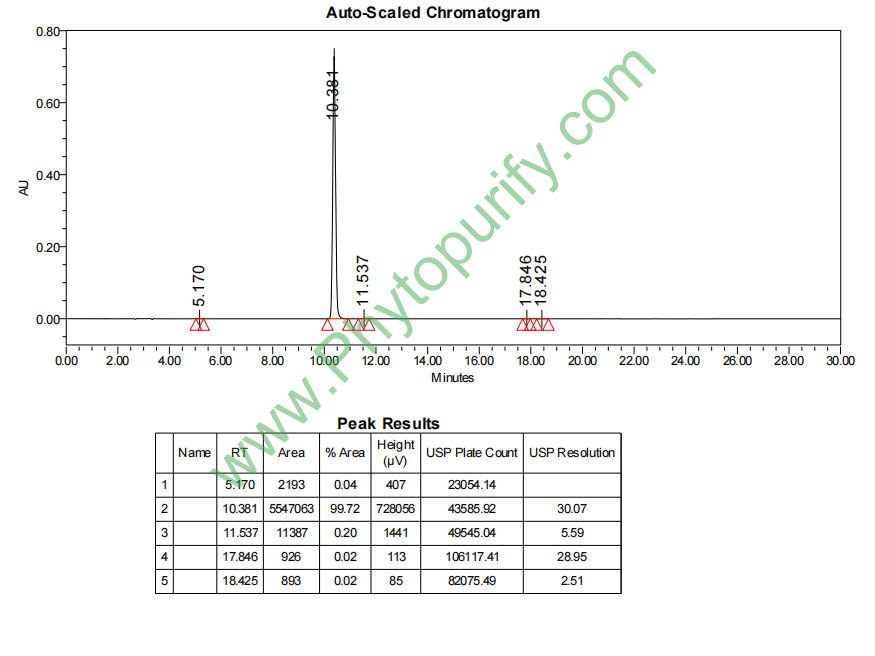
Purity: 95%~99%
Analysis Method: HPLC-DAD or/and HPLC-ELSD
Identification Method: Mass, NMR
Packing: Brown vial or HDPE plastic bottle
Storage: Store in a well closed container, protected from air and light. Put into refrigerate or freeze for long term storage.
Whenever possible, you should prepare and use solutions on the same day. However, if you need to make up stock solutions in advance, we recommend that you store the solution as aliquots in tightly sealed vials at -20℃. Generally, these will be useable for up to two weeks.
The product could be supplied from milligrams to grams
Inquire for bulk scale.
Chengdu Biopurify Phytochemicals Ltd. is a leading company in the research, development, manufacture and marketing of High Quality Phytochemicals and Extracts(especially Active Ingredients from Traditional Chinese Medicine,TCM), Natural Active Pharmaceutical Ingredients worldwide.
The main services:
A. Supply active ingredients and reference standards of TCM, from mgs to kgs scale
B. Custom extraction and purification, target Herb Active Ingredients
C. Custom synthesis and semi-synthesis for Natural Active Ingredients
D. CR(contract research), CM(contract manufacture) and PD(process development) services from lab scale, pilot scale to commercial scale(GMP is also available)
E. TCM compounds library for drug screen,more than 3000 compounds available, many of them are rare and unique.
HPLC of Marmesin
Storage conditions:Short-term storage at 2~8℃, long-term storage at -20 ~ -80℃
Marmesin, a natural product with significant pharmacological activity, belongs to the class of furan coumarins and is widely present in plants of the Umbelliferae family. As an enantiomer of Nodakenetin, isoquercetin has attracted widespread attention in the field of natural product pharmacology in recent years due to its unique chemical structure and diverse biological activities. Especially in the prevention and treatment of breast cancer and other tumor diseases, Peucedantoin shows significant anti-cancer potential, involving multiple cell signaling pathways and key molecular targets. This article will provide a systematic review of the chemical structure and physicochemical properties, plant sources and extraction methods, pharmacological activity and mechanism of action, pharmacological evaluation and pharmacokinetic characteristics of isoquercetin, and explore its clinical application prospects and future research directions.
The chemical name of isoquercetin is (+) - isoquercetin, with a CAS number of 13849-08-6, a molecular formula of C13H-14O5, and a molecular weight of 246.2620. Its structure belongs to the class of furan coumarins, with a core skeleton composed of coumarins fused with furan rings, exhibiting typical furan coumarin lactone structural characteristics. Isoquercetin is an enantiomer of nodakenetin, and there are differences in spatial configuration between the two, which may affect their biological activity and binding affinity to targets.
In terms of physical and chemical properties, the LogP value of isoquercetin is 2.0735, indicating that it has moderate lipid solubility and is beneficial for membrane penetration. Its topological polar surface area (TPSA) is 59.6700, indicating that the molecule has certain polar groups that facilitate the formation of hydrogen bonds and other interactions with biomolecules. Low water solubility (0.0502 mg/mL) indicates limited solubility in the aqueous phase, but this is somewhat advantageous for oral absorption. The compound has a high ability to penetrate the blood-brain barrier, indicating that it may have pharmacological activity related to the central nervous system. The negative result of hERG channel inhibition experiment indicates a low risk of cardiac toxicity. The Ames test score is 0.9, indicating a low risk of genotoxicity and a good safety foundation.
Isocyanuric acid mainly exists in plants of the Umbelliferae family, such as Peucedanum praeruptorum and Angelica dahurica, which are traditional Chinese medicinal herbs. These plants are commonly used in traditional Chinese medicine for dispelling wind, relieving pain, and anti-inflammatory effects. As one of their active ingredients, isoquercetin plays an important role in drug efficacy.
The extraction method often uses solvent extraction combined with chromatographic separation technology. Traditional extraction methods often use ethanol or methanol as solvents to obtain crude extracts through reflux extraction or ultrasound assisted extraction. Subsequently, high-purity isoquercetin was obtained through separation and purification techniques such as silica gel column chromatography and reverse phase high performance liquid chromatography (RP-HPLC). In recent years, supercritical fluid extraction and membrane separation techniques have also been applied to the extraction of isoquercetin, improving extraction efficiency and purity.
During the extraction process, parameters such as temperature, solvent polarity, and extraction time have a significant impact on yield and purity. Optimizing the extraction process not only helps to increase the yield of isoquercetin, but also lays the foundation for its large-scale production and drug development.
Isoprotein has shown extensive biological activity in various disease models, particularly in the field of anti-tumor effects. Its main pharmacological activities include:
Anti breast cancer effect
Breast cancer is one of the most common malignant tumors in women. Peucedantoin regulates the proliferation, apoptosis, migration and invasion of breast cancer cells through multiple targets and pathways. In vitro cell experiments showed that Peucedantoin could inhibit the proliferation of breast cancer cell lines (such as MCF-7, MDA-MB-231), and induce cell cycle arrest and apoptosis. In animal models, isoquercetin significantly inhibits tumor growth and reduces metastatic potential.
Anti inflammatory and antioxidant activity
Isoprotein exhibits excellent anti-inflammatory and antioxidant effects by inhibiting the release of inflammatory mediators and regulating oxidative stress response. This has potential value for regulating the tumor microenvironment and treating chronic inflammation related diseases.
Neuroprotective effect
Due to its excellent blood-brain barrier penetration ability, isoquercetin has shown certain neuroprotective effects in neurodegenerative disease models, possibly by regulating oxidative stress and inflammatory responses.
Other potential activities
The study also found that isoquercetin has a regulatory effect on multidrug resistance related proteins, suggesting its potential in overcoming tumor resistance.
The mechanism of action of isoquercetin involves multiple signaling pathways and key molecular targets, mainly including:
AMPK(PRKAA1)
As a regulator of cellular energy metabolism, the activation of AMPK helps to inhibit metabolic reprogramming in tumor cells. Peucedanolide inhibits the proliferation and migration of breast cancer cells by activating AMPK signaling pathway.
BCL2(BCL2)
BCL2 family proteins regulate cell apoptosis, and isoquercetin can downregulate the expression of anti apoptotic protein BCL2, promoting cancer cell apoptosis.
STAT3(STAT3)
The STAT3 signaling pathway plays a crucial role in the proliferation, survival, and immune escape of tumor cells. Isoquercetin inhibits the phosphorylation of STAT3, blocks its transcriptional activity, and suppresses tumor growth.
ESR2(ESR2)
Estrogen receptor β (ER β) has tumor inhibitory effect in breast cancer. Peucedanolide may affect the hormone dependent growth of breast cancer cells by regulating the expression of ESR2.
ABCB1 and ABCG2 (ABCB1, ABCG2)
These two ATP binding cassette transporters are closely related to tumor multidrug resistance. Isoprotein can inhibit the function of these two transporters, enhance the intracellular accumulation of chemotherapy drugs, and overcome drug resistance.
PRKCA(PRKCA)
Protein kinase C α plays an important role in cell signaling, and isoquercetin affects cell proliferation and apoptosis by regulating PRKCA activity.
MAPT(MAPT)
The microtubule associated protein Tau is involved in the stability of the cytoskeleton, and isoquercetin may affect cell migration and invasion ability by regulating MAPT.
MMP2(MMP2)
Matrix metalloproteinase-2 participates in the degradation of extracellular matrix in tumor cells and promotes metastasis. Isoprotein inhibits MMP2 activity and reduces tumor invasion.
LCK(LCK)
LCK is a Src family tyrosine kinase involved in immune regulation and tumor signaling. Isoprotein affects the tumor immune microenvironment by regulating LCK signaling.
To sum up, Peucedantoin achieves comprehensive regulation on breast cancer cells through multiple targets and multiple pathways, showing good anti-tumor potential.
The pharmacological parameters of isoquercetin indicate that it has certain potential for drug development. LogP is 2.0735, which meets the requirements of Lipinski rule for lipid solubility and is beneficial for oral absorption and cell membrane penetration. The TPSA is 59.67, and moderate polarity is beneficial for binding to the target and improving bioavailability. Low water solubility suggests the need to consider solubility improvement strategies in formulation design, such as nanocarrier or solid dispersion technology.
The high blood-brain barrier penetration suggests that isoquercetin may be used for the treatment of central nervous system diseases, but potential central neurotoxicity should also be considered. HERG inhibition negative and low mutagenicity in Ames test indicate low cardiac safety and genetic toxicity risk, providing safety assurance for clinical application.
In terms of pharmacokinetics, there are few existing literature reports, and it is speculated that it may be metabolized by the liver in vivo, mainly through pathways such as oxidation and hydroxylation. Due to its moderate lipid solubility and good oral absorption rate, its bioavailability may be limited by first pass effects. Further pharmacokinetic and toxicological studies are needed in the future to clarify its absorption, distribution, metabolism, and excretion (ADME) characteristics.
As a kind of natural furan coumarin compounds, Isopatrium praeruptorum lactone shows broad clinical application prospects with its multi target anti breast cancer activity. Its regulatory effect on key molecular targets of breast cancer provides an important lead compound for the development of new anti-cancer drugs. Especially in overcoming multidrug resistance and regulating the tumor microenvironment, isoquercetin has unique advantages.
In addition, its good safety and blood-brain barrier penetration ability make it potentially valuable in the treatment of neurological and inflammation related diseases. In the future, combining modern drug design technologies such as structural optimization, drug carrier system development, and targeted drug delivery strategies is expected to further enhance its efficacy and bioavailability.
However, the clinical research on isoquercetin is still in its infancy and lacks systematic clinical trial data. In the future, its pharmacokinetics, toxicology, and preclinical safety evaluation should be strengthened, and multi center, multi-stage clinical trials should be conducted to verify its clinical efficacy and safety.
As a natural product with unique structure and diverse biological activities, Peucedantoin shows great potential in the treatment of breast cancer and other diseases. Its multi-target and multi mechanism mode of action provides rich scientific basis for the development of new drugs. Although there are still certain challenges in pharmacokinetics and clinical applications, with the support of modern drug development technology, isoquercetin is expected to become an important candidate for future natural anti-cancer drugs. Future research should focus on in-depth analysis of its mechanism of action, optimization of drug properties, and clinical translation, in order to achieve its widespread application in clinical practice.
