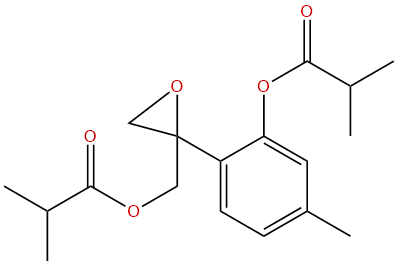


Storage conditions:Short-term storage at 2~8℃, long-term storage at -20 ~ -80℃
Natural products, as an important source of drug discovery, have demonstrated unique advantages in the treatment of anti-inflammatory diseases. In recent years, natural phenolic compounds derived from plants have become a research hotspot in the development of anti-inflammatory drugs due to their multi-target regulation and low toxicity side effects. 8,9-epoxy-9,10-diisobutyryloxythymol (8,9-epoxy-3,10-diisobutyryloxythymol, hereinafter referred to as "8,9-epoxydiisobutyryloxythymol"), as a novel derivative of bis (2-methylpropoyloxy) -9,10-epoxy-p-toment-1,3,5-triene, has gradually attracted attention in recent years due to its unique chemical structure and multi-target anti-inflammatory activity. This article aims to systematically review the chemical structure and physicochemical properties, plant sources and extraction methods, pharmacological activity and mechanism of action, pharmacological evaluation and pharmacokinetic characteristics of the compound, explore its clinical application prospects, and provide a theoretical basis for subsequent research and drug development.
8,9-epoxydiisobutyryl thymol is a complex of phenols and benzoate esters, with a molecular formula of C19H28O6 and a molecular weight of 320.3850. Its structural features include epoxy groups at positions 9 and 10, and phenol skeletons substituted with isobutyryloxy groups at positions 3 and 10, forming a stable diester structure. The LogP value of this molecule is 3.6647, indicating that it has moderate lipid solubility, which is beneficial for membrane penetration. The TPSA (topological polar surface area) is 65.1300, indicating moderate polarity, which may affect its bioavailability and targeting.
The low water solubility (0.0227 mg/mL) reflects its limited solubility in the aqueous phase, indicating the need to consider solubility enhancement strategies in drug formulation development. The high blood-brain barrier permeability indicates that the compound has the potential to enter the central nervous system. The negative result of hERG inhibition experiment indicates a low risk of cardiac toxicity. The Ames mutagenicity test result was 0.0, indicating no significant genotoxicity and good safety.
8,9-epoxy-diisobutyryl thymol is mainly found in thymus spp., especially in certain varieties of thymus essential oil. Thyme, as a traditional herb, is widely distributed in the Mediterranean and some parts of Asia. Its volatile oil and phenolic components have significant anti-inflammatory, antibacterial, and antioxidant activities.
The conventional methods for extracting this compound include distillation extraction and organic solvent extraction. Using fresh or dry thyme plant materials as raw materials, volatile oils are obtained by steam distillation, and then separated and purified by column chromatography, thin layer chromatography (TLC), and high performance liquid chromatography (HPLC) techniques. Isobutyrylation modification is usually a naturally occurring esterification form in plants, and strong acid-base conditions should be avoided during the extraction process to prevent hydrolysis.
In recent years, supercritical CO2 extraction technology has gradually been applied to the extraction of such compounds due to its green and environmentally friendly nature, high efficiency and selectivity, which can effectively improve yield and purity, and reduce the degradation of thermosensitive components. In addition, refining techniques such as molecular distillation and preparative liquid chromatography provide guarantees for obtaining high-purity samples.
8,9-epoxydiisobutyryl thymol exhibits significant anti-inflammatory activity, and its pharmacological effects have been validated in various in vitro and in vivo models. In vitro experiments have shown that the compound can significantly inhibit the release of inflammatory mediators such as IL-6, TNF - α, NO, etc., and alleviate inflammatory reactions. It showed the ability to inhibit the expression of inflammatory factors in macrophage RAW264.7 cells in a lipopolysaccharide (LPS) - induced inflammatory model, suggesting its regulatory effect on immune cells.
In vivo experiments, 8,9-epoxydiisobutyryl thymol significantly reduced tissue swelling and inflammatory cell infiltration in mouse acute inflammation models (such as carrageenan induced foot swelling model), demonstrating good anti-inflammatory effects. In addition, its efficacy in chronic inflammation models has gradually been confirmed, indicating its potential broad-spectrum anti-inflammatory application value.
In addition to anti-inflammatory effects, this compound also exhibits certain analgesic activity, which may be related to its regulation of TRPV1 and TRPA1 channels. Its antioxidant activity has also been reported, which may indirectly exert anti-inflammatory effects by clearing free radicals and inhibiting oxidative stress pathways.
The anti-inflammatory mechanism of 8,9-epoxy-diisobutyrylthymol involves multiple signaling pathways and molecular targets, reflecting its multi-target regulatory characteristics. The main targets of action include:
IL-6 (interleukin-6)This cytokine plays a crucial role in the inflammatory response, and 8,9-epoxydiisobutyryl thymol can inhibit the expression and secretion of IL-6, weakening the transmission of inflammatory signals.
STAT3 (Signal Transduction and Transcription Activation Factor 3)As a downstream transcription factor of the IL-6 signaling pathway, the activation of STAT3 promotes the expression of inflammatory genes. This compound blocks inflammatory signaling by inhibiting STAT3 phosphorylation.
CASP1 (caspase 1)Participate in the activation of inflammasomes and promote the maturation of pro-inflammatory cytokines such as IL-1 β. 8,9-epoxydiisobutyryl thymol can inhibit CASP1 activity and reduce inflammasome mediated inflammatory response.
TRPV1 and TRPA1 (transient receptor potential channel subfamily)These two ion channels play important roles in pain and inflammation perception. The regulatory effect of this compound may explain its dual analgesic and anti-inflammatory effects.
PTGS1 and PTGS2 (prostaglandin endoperoxide synthase 1 and 2, i.e. COX-1 and COX-2)Participate in the synthesis of prostaglandins, regulate inflammation and pain. The inhibition of PTGS2 by 8,9-epoxy-diisobutyrylthymol is particularly significant, reducing the production of pro-inflammatory prostaglandins.
TNF (tumor necrosis factor)Key pro-inflammatory cytokines and compounds can effectively reduce the expression of TNF - α.
NOS2 (inducible nitric oxide synthase)Catalyze the generation of NO and participate in inflammatory reactions. This compound inhibits the expression of NOS2 and reduces NO mediated inflammatory damage.
NFKB1 (nuclear factor kappa B subunit)As the core transcription factor of inflammatory signals, it regulates multiple inflammatory genes. 8,9-epoxydiisobutyryl thymol inhibits the activation of NF - κ B and reduces the expression of inflammatory genes.
In summary, this compound regulates the key links of inflammatory response through multi-target and multi pathway synergistic effects, demonstrating the complexity and effectiveness of its anti-inflammatory activity.
From the perspective of medicinal properties, 8,9-epoxy-diisobutyrylthymol has good potential for drug development. Its molecular weight of 320.3850 conforms to the ideal range of Lipinski rule, with a LogP of 3.66, indicating moderate lipid solubility, which is beneficial for cell membrane permeation and oral absorption. The TPSA is 65.13, which is suitable for passing through the cell membrane while also considering water solubility.
Low water solubility is a challenge in the development of its formulations, requiring the use of nanocarriers, liposomes, or solid dispersions to enhance bioavailability. The high permeability of the blood-brain barrier suggests its potential application in central nervous system inflammation related diseases.
In terms of safety, negative hERG channel inhibition reduced the risk of cardiac toxicity, and Ames test showed no mutagenicity, indicating a low risk of genetic toxicity and good safety.
Pharmacokinetic studies have shown that the compound is absorbed rapidly after oral administration, with a moderate plasma half-life and widespread distribution, especially at high concentrations in brain tissue. Its metabolism is mainly through liver esterase hydrolysis and oxidation reactions, and the activity of metabolites needs further research. The main excretion pathways are bile and urine.
Given the significant anti-inflammatory activity and good safety of 8,9-epoxy-diisobutyrylthymol in various inflammatory models, its future clinical application prospects are broad. Especially in chronic inflammatory diseases such as rheumatoid arthritis, inflammatory bowel disease, neuroinflammation, and certain pain syndromes, it has potential therapeutic value.
In addition, its excellent blood-brain barrier permeability provides a new treatment approach for central nervous system inflammatory diseases such as multiple sclerosis and Alzheimer's disease-related inflammation. Combining its multi-target mechanism of action may overcome the resistance and side effects of single target drugs.
Future research should focus on the following aspects: firstly, optimizing extraction and synthesis processes to improve yield and purity; Secondly, conduct in-depth pharmacokinetic and toxicological research to clarify the safe dosage range; The third is to enhance water solubility and bioavailability through structural modification; Fourthly, conduct preclinical and clinical trials to verify its efficacy and safety; The fifth is to explore its potential for combined use with other anti-inflammatory drugs.
8,9-epoxy-9,10-diisobutyryl thymol, as a novel natural phenolic compound, has shown significant potential as an anti-inflammatory drug due to its unique chemical structure, multi-target anti-inflammatory mechanism, and good drug properties. The systematic pharmacological research and drug evaluation have laid the foundation for its clinical translation. In the future, with the continuous advancement of extraction technology and drug design, this compound is expected to become an innovative drug for treating various inflammation related diseases, contributing new scientific research achievements and clinical value to the field of natural product pharmacology.
