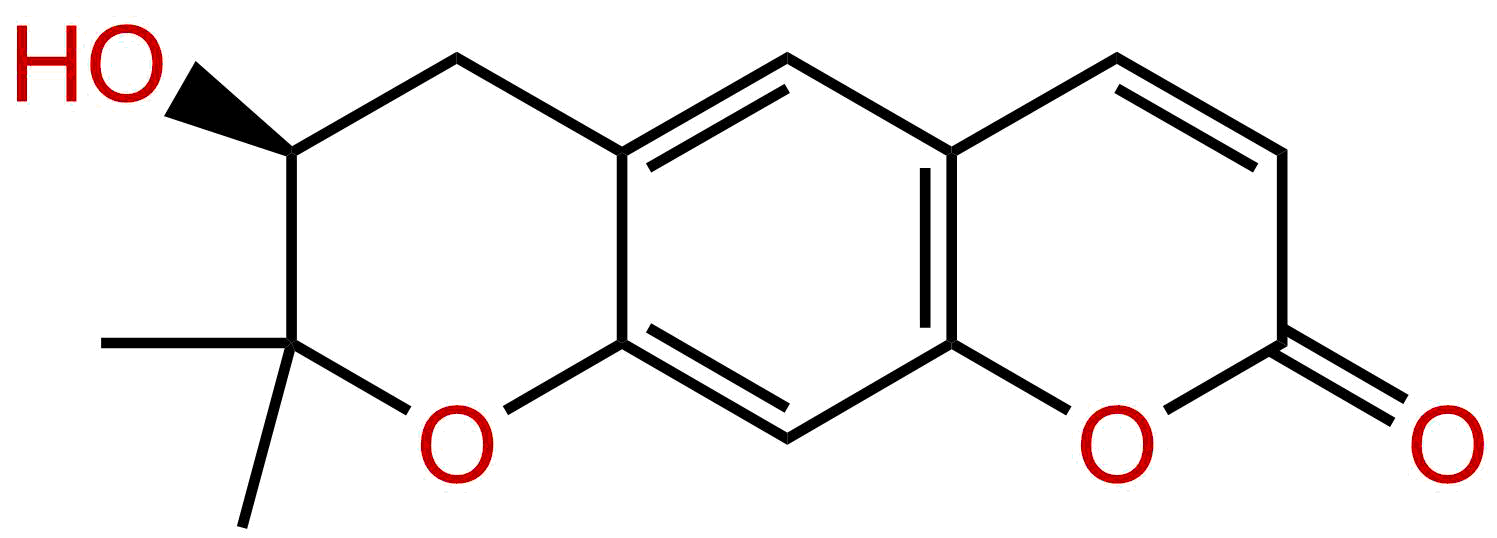


Product name: Decursinol
Synonym name: 3',4'-dihydro-3'-hydroxy-Xanthyletin; Smyrinol; 5993-18-0
Catalogue No.: BPF2775
Cas No.: 23458-02-8
Formula: C14H14O4
Mol Weight: 246.262
Botanical Source:
Physical Description:
Type of Compound: Coumarins
Purity: 95%~99%
Analysis Method: HPLC-DAD or/and HPLC-ELSD
Identification Method: Mass, NMR
Packing: Brown vial or HDPE plastic bottle
Storage: Store in a well closed container, protected from air and light. Put into refrigerate or freeze for long term storage.
Whenever possible, you should prepare and use solutions on the same day. However, if you need to make up stock solutions in advance, we recommend that you store the solution as aliquots in tightly sealed vials at -20℃. Generally, these will be useable for up to two weeks.
The product could be supplied from milligrams to grams
Inquire for bulk scale.
For Reference Standard and R&D, Not for Human Use Directly.
Description:
Decursinol may be a beneficial antimetastatic agent, targeting MMPs and its upstream signaling molecules; it inhibits the proliferation and invasion of CT-26 colon carcinoma cells, might via downregulated ERK and JNK phosphorylation. Aspirin-decursinol has neuroprotective effects, may be closely related to the attenuation of ischemia-induced gliosis and maintenance of antioxidants.
References:
Planta Med. 2013 Nov;79(16):1536-44.
In vitro metabolism of pyranocoumarin isomers decursin and decursinol angelate by liver microsomes from man and rodents.
The aim of this study is to investigate and compare the metabolic rate and profiles of pyranocoumarin isomers decursin and Decursinol angelate using liver microsomes from humans and rodents, and to characterize the major metabolites of decursin and Decursinol angelate in human liver microsomal incubations using LC-MS/MS.
METHODS AND RESULTS:
First, we conducted liver microsomal incubations of decursin and Decursinol angelate in the presence or absence of NADPH. We found that in the absence of NADPH, decursin was efficiently hydrolyzed to Decursinol by hepatic esterase(s), but Decursinol angelate was not. In contrast, formation of Decursinol from Decursinol angelate was mediated mainly by cytochrome P450(s). Second, we measured the metabolic rate of decursin and Decursinol angelate in liver S9 fractions from mice and humans. We found that human liver S9 fractions metabolized both decursin and Decursinol angelate more slowly than those of the mouse. Third, we characterized the major metabolites of decursin and Decursinol angelate from human liver microsomes incubations using HPLC-UV and LC-MS/MS methods and assessed the in vivo metabolites in mouse plasma from a one-dose PK study. Decursin and Decursinol angelate have different metabolite profiles.
CONCLUSIONS:
Nine metabolites of decursin and nine metabolites of Decursinol angelate were identified in human liver microsome incubations besides Decursinol using a hybrid triple quadruple linear ion trap LC-MS/MS system, and many of them were later verified to be also present in plasma samples from rodent PK studies.
PLoS One. 2015 Feb 19;10(2):e0114992.
Single oral dose pharmacokinetics of decursin and decursinol angelate in healthy adult men and women.
The ethanol extract of Angelica gigas Nakai (AGN) root has promising anti-cancer and other bioactivities in rodent models. It is currently believed that the pyranocoumarin isomers decursin (D) and Decursinol angelate (DA) contribute to these activities. We and others have documented that D and DA were rapidly converted to Decursinol (DOH) in rodents. However, our in vitro metabolism studies suggested that D and DA might be metabolized differently in humans.
METHODS AND RESULTS:
To test this hypothesis and address a key question for human translatability of animal model studies of D and DA or AGN extract, we conducted a single oral dose human pharmacokinetic study of D and DA delivered through an AGN-based dietary supplement Cogni.Q (purchased from Quality of Life Labs, Purchase, NY) in twenty healthy subjects, i.e., 10 men and 10 women, each consuming 119 mg D and 77 mg DA from 4 vegicaps. Analyses of plasma samples using UHPLC-MS/MS showed mean time to peak concentration (Tmax) of 2.1, 2.4 and 3.3 h and mean peak concentration (Cmax) of 5.3, 48.1 and 2,480 nmol/L for D, DA and DOH, respectively. The terminal elimination half-life (t1/2) for D and DA was similar (17.4 and 19.3 h) and each was much longer than that of DOH (7.4 h). The mean area under the curve (AUC0-48h) for D, DA and DOH was estimated as 37, 335 and 27,579 h∙nmol/L, respectively. Gender-wise, men absorbed the parent compounds faster and took shorter time to reach DOH peak concentration. The human data supported an extensive conversion of D and DA to DOH, even though they metabolized DA slightly slower than rodents.
CONCLUSIONS:
Therefore, the data generated in rodent models concerning anti-cancer efficacy, safety, tissue distribution and pharmacodynamic biomarkers will likely be relevant for human translation.
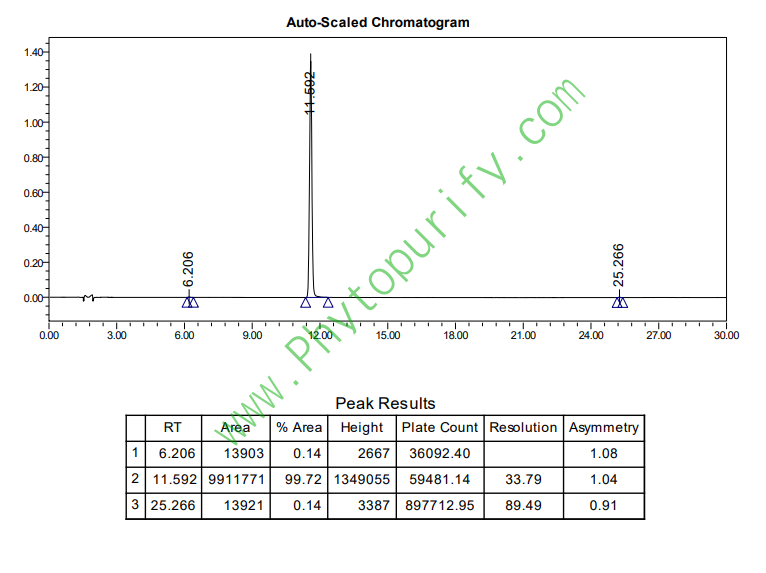
HPLC of Decursinol
Storage conditions:Short-term storage at 2~8℃, long-term storage at -20 ~ -80℃
59.6700
2.0521
2.0521
.0455
2.0626
13.3071
High
70.9454
3.1265
Yes
No
No
No
Yes
Yes
0.9
Yes
No
Yes
Yes
Natural products, as an important source of drug discovery, play an irreplaceable role in the long history of human fight against diseases. Isolating and identifying active ingredients from traditional Chinese medicine, and elucidating their pharmacological mechanisms of action, has always been an important direction in modern medicinal chemistry and pharmacology research. Angelica sinensis(Angelica sinensis)As a commonly used blood tonifying and blood activating medicine in traditional Chinese medicine, its chemical composition is complex and diverse, among which coumarin compounds are one of its main active ingredients. Decursinol, a typical pyranocoumarin compound, was first isolated from the roots of Angelica sinensis and has attracted widespread attention due to its unique chemical structure and significant biological activity.
The chemical name of purple flowered Peucedanol is 7,8-dihydro-2H, 6H-pyrano [3,2-g] chromene-2-one, and its molecular skeleton is composed of a coumarin core fused with a pyran ring, belonging to organic heterocyclic compounds. This compound contains a β - hydroxyl group at position 7 and is substituted by two methyl groups at position 8. This unique substitution pattern endows it with unique physicochemical properties and biological activity. Since its discovery, it has been confirmed that resveratrol has acetylcholinesterase inhibitory activity and has shown potential application value in multiple pharmacological fields such as anti-inflammatory, analgesic, and anti-tumor.
With the continuous advancement of modern pharmacological research methods, the multi-target action characteristics of resveratrol have gradually been revealed. Especially, significant progress has been made in the study of its mechanism of action in the anti-inflammatory field, involving multiple key inflammation related targets such as IL-6, STAT3, CASP1, TRPV1, RELA, PTGS1, TNF, TRPA1, IKBKB, NOS2, etc. These findings not only deepen our understanding of the pharmacological effects of resveratrol, but also provide important lead compounds for the development of novel anti-inflammatory drugs based on natural products. This article will provide a systematic review of the research progress of resveratrol from the aspects of chemical structure, plant origin, pharmacological activity, mechanism of action, medicinal evaluation, and clinical application prospects.
Zihuaqianhu alcohol belongs to the class of pyranocoumarin compounds, and its core skeleton is a tricyclic system formed by the fusion of coumarin (benzo α - pyranone) and a dihydropyran ring. Specifically, its structure can be described as 7,8-dihydro-2H, 6H-pyrano [3,2-g] chromene-2-one. There is a β - hydroxyl group (- OH) attached to the 7th position of the coumarin parent nucleus, while the 8th position is replaced by two methyl groups (- CH3). This unique substitution pattern gives purple flowered resveratrol a high structural recognition in natural coumarin compounds.
From the perspective of stereochemistry, the β configuration of the 7-hydroxyl group is an important structural feature of resveratrol. The presence of this chiral center not only affects the spatial conformation of the molecule, but is also closely related to its interaction with biological targets. The saturated structure of the pyran ring (7,8-dihydro) gives the entire molecule a certain degree of flexibility while maintaining the planarity of the coumarin parent nucleus. This combination of rigidity and flexibility facilitates the binding of the molecule to different target proteins.
According to computational chemistry and experimental measurement data, the molecular weight of Peucedanol is 246.2620 g/mol, which belongs to the category of small molecule compounds. Its lipid water partition coefficient (LogP) is 2.0521, indicating that the compound has moderate lipophilicity, which can maintain a certain solubility in a lipid environment and also has a certain water solubility. The topological polar surface area (TPSA) is 59.6700 Å ², which is below the threshold of 60 Å ², indicating that the compound has good cell membrane permeability.
The water solubility of purple flowered resveratrol is 0.0455 mg/mL, making it a poorly soluble compound. This characteristic to some extent limits its oral bioavailability and the choice of administration route. However, its moderate LogP value also indicates that the compound has good solubility in organic solvents, providing possibilities for formulation development. It is worth noting that resveratrol has a high blood-brain barrier penetration ability, which is of great significance for the development of therapeutic drugs for central nervous system diseases.
In terms of safety assessment, the hERG inhibition prediction result was negative, indicating a low risk of the compound causing cardiac QT interval prolongation. The Ames test result is 0.9, indicating a low risk of mutagenicity and preliminary good genetic toxicity safety. These pharmacological parameters provide favorable conditions for the further development of purple flowered resveratrol.
Purple flowered Houttuynia cordata was originally derived from the Umbelliferae plant Angelica sinensis(Angelica sinensis(Oliv. Diels) was isolated from the roots. Danggui, as a commonly used blood tonifying and blood activating herb in traditional Chinese medicine, has a history of several decades in the study of its chemical composition. In addition to Angelica sinensis, purple flowered Peucedanum alcohol is also distributed in other Umbelliferae plants, such as purple flowered Peucedanum(Peucedanum decursivum Maxim.)、 Bai Zhi(Angelica dahurica(Fisch. ex Hoffm. Benth. et Hook. f.) and others. It is worth noting that the scientific name of purple clover includes "decorsifum", which is also the origin of the English name "Decursinol" for purple clover alcohol.
In terms of distribution within the plant body, purple flowered resveratrol mainly exists in the roots of plants, which is consistent with the traditional medicinal parts of medicinal herbs such as Angelica sinensis. There are significant differences in the content of resveratrol in plant materials from different origins and harvesting seasons. Research has shown that the content of resveratrol in the roots of Angelica sinensis with longer growth years is relatively higher, which may be related to the accumulation pattern of secondary metabolites.
The traditional method for extracting alcohol from purple clover mainly uses organic solvent extraction. Common extraction solvents include ethanol, methanol, and their aqueous solutions. Due to its moderate lipophilicity, purple flowered resveratrol is usually extracted by reflux with 70% -95% ethanol or methanol. Factors such as extraction temperature, time, and solid-liquid ratio can all affect extraction efficiency. Research has shown that using 80% ethanol for reflux extraction at 60 ℃ for 2 hours can achieve a higher extraction rate.
With the development of modern separation technology, new technologies such as ultrasound assisted extraction, microwave-assisted extraction, and supercritical fluid extraction have also been applied to the extraction of resveratrol from purple flowers. These technologies have the advantages of short extraction time, low solvent usage, and high extraction efficiency. Especially the supercritical CO ₂ extraction technology has shown good application prospects in the field of natural product extraction due to its green and environmentally friendly characteristics and good selectivity.
In terms of separation and purification, silica gel column chromatography is the most commonly used method. Usually, solvent systems such as chloroform methanol or petroleum ether ethyl acetate are used for gradient elution. In addition, preparative high-performance liquid chromatography (HPLC) has also been used for the preparation of high-purity resveratrol. In recent years, new separation technologies such as high-speed countercurrent chromatography (HSCCC) have also been successfully applied to the separation and purification of Peucedanol, which has the advantages of high separation efficiency and good sample recovery rate.
The earliest reported pharmacological activity of purple flowered resveratrol was its inhibitory effect on acetylcholinesterase (AChE, EC 3.1.1.7). Acetylcholinesterase is an important hydrolytic enzyme in the nervous system, responsible for degrading the neurotransmitter acetylcholine. Inhibiting acetylcholinesterase activity can increase the concentration of acetylcholine in synaptic cleft, thereby enhancing cholinergic neurotransmission. This mechanism of action is of great significance in the treatment of neurodegenerative diseases such as Alzheimer's disease.
Research has shown that resveratrol has significant inhibitory activity on acetylcholinesterase, with an IC ₅₀ value at the micromolar level. Compared with classical acetylcholinesterase inhibitors such as donepezil and lismin, although the inhibitory activity of resveratrol is relatively weak, its natural source and low toxicity make it a potential lead compound for the development of new anti Alzheimer's disease drugs. Further enzyme kinetics studies have shown that the inhibition type of purple flowered resveratrol on acetylcholinesterase is mixed inhibition, which can bind to the active site of the enzyme or interact with allosteric sites.
In recent years, the anti-inflammatory activity of purple flowered resveratrol has become a research hotspot. Multiple in vitro and in vivo experiments have confirmed that resveratrol can significantly inhibit inflammatory responses. In the lipopolysaccharide (LPS) - induced macrophage inflammation model, resveratrol can dose dependently inhibit the production of pro-inflammatory cytokines such as tumor necrosis factor - α (TNF - α) and interleukin-6 (IL-6). At the same time, it also has a significant inhibitory effect on the expression of inducible nitric oxide synthase (iNOS, NOS2) and cyclooxygenase-2 (COX-2, PTGS1).
In animal models, resveratrol has shown therapeutic effects on various inflammatory diseases. In the rat paw swelling model induced by carrageenan, resveratrol can significantly reduce inflammatory response, and its effect is comparable to that of the positive control drug. In colitis models, resveratrol can alleviate intestinal inflammation, reduce levels of inflammatory factors, and improve histopathological changes in tissues. These research results indicate that resveratrol has the potential to be developed into a novel anti-inflammatory drug.
The analgesic activity of purple flowered resveratrol is closely related to its anti-inflammatory effect. In the classic acetic acid writhing test and hot plate test, purple pre humol showed significant analgesic effects. It is worth noting that its analgesic mechanism involves multiple targets, including the regulation of transient receptor potential vanillic acid subtype 1 (TRPV1) and transient receptor potential anchor protein 1 (TRPA1) channels. These ion channels play a crucial role in pain signal transduction, and resveratrol may exert analgesic effects by regulating the activity of these channels.
The anti-tumor activity of purple flowered resveratrol has also received widespread attention. In vitro experiments showed that Peucedanol could inhibit the proliferation of many tumor cell lines, including liver cancer cells, breast cancer cells, lung cancer cells, etc. Its anti-tumor mechanism involves multiple aspects: inducing cell apoptosis, blocking cell cycle, inhibiting angiogenesis, etc. Especially the inhibition of the signal transduction and transcription activator 3 (STAT3) signaling pathway is considered one of the important mechanisms by which resveratrol exerts its anti-tumor effects. STAT3 is continuously activated in various tumors, promoting the proliferation and survival of tumor cells. Zihuaqianhu alcohol can block its signal transduction by inhibiting the phosphorylation of STAT3, thereby inhibiting tumor growth.
The anti-inflammatory mechanism of purple flowered resveratrol involves multiple signaling pathways and molecular targets. The nuclear factor kappa B (NF - κ B) signaling pathway is one of the core regulatory pathways of inflammatory response. Research has shown that resveratrol can inhibit the activity of I κ B kinase β (IKBKB), prevent the phosphorylation and degradation of I κ B α, and thus inhibit the nuclear translocation and transcriptional activity of NF - κ B. RELA (p65), as an important subunit of NF - κ B, inhibition of its activity is a key link in the anti-inflammatory effect of resveratrol.
In addition to the NF - κ B pathway, resveratrol also has a regulatory effect on the STAT3 signaling pathway. STAT3 plays an important role in inflammatory response, and its activation can promote the expression of various pro-inflammatory factors. Purple flowered resveratrol can block the signal transduction of STAT3 by inhibiting its phosphorylation, thereby downregulating the expression of inflammatory factors such as IL-6. In addition, resveratrol can regulate the activity of cysteine containing aspartic acid protease 1 (CASP1), affecting the assembly and function of inflammasomes, and thereby regulating the maturation and secretion of inflammatory factors such as IL-1 β.
The analgesic effect of purple flowered resveratrol is closely related to TRPV1 and TRPA1 channels. TRPV1 is a non selective cation channel that can be activated by capsaicin, thermal stimulation, acidic environment, etc., and plays an important role in pain signaling. TRPA1 is mainly involved in pain responses caused by chemical stimuli. Research has shown that resveratrol can exert analgesic effects by regulating the activity of these channels, and its specific mechanism may involve changes in the phosphorylation status of channel proteins or direct interactions with channel proteins.
The multi-target action characteristic of purple flowered resveratrol is an important feature of its pharmacological activity. In addition to the above targets, resveratrol can also act on cyclooxygenase-1 (COX-1, PTGS1) and inducible nitric oxide synthase (iNOS, NOS2), inhibiting the synthesis of prostaglandins and nitric oxide. As an important pro-inflammatory factor, TNF - α expression is also regulated by resveratrol. This multi-target action characteristic makes resveratrol potentially advantageous in the treatment of complex diseases, but it also increases the complexity of its mechanism of action research.
Based on computational chemistry and experimental data, the pharmacological parameters of purple clover alcohol show certain advantages and disadvantages. Its molecular weight (246.2620 Da) meets the requirement of molecular weight less than 500 in the "Five Rules for Drugs". The LogP value (2.0521) is within the ideal range, ensuring good lipid solubility and avoiding metabolic problems caused by excessive lipophilicity. The TPSA value (59.6700 Å ²) is below the threshold of 140 Å ², indicating good oral absorption potential.
However, the water solubility of purple flowered resveratrol is poor (0.0455 mg/mL), which may be the main factor limiting its oral bioavailability. In the development of formulations, appropriate solubilization techniques such as cyclodextrin inclusion, solid dispersion, nano formulations, etc. need to be used to improve their solubility and bioavailability. In addition, although its high blood-brain barrier penetration ability is beneficial for the treatment of central nervous system diseases, it may also increase the risk of central nervous system side effects.
At present, there is insufficient systematic research on the pharmacokinetics of resveratrol in purple flowers. Preliminary studies suggest that resveratrol may undergo extensive metabolism in the body, with major metabolic pathways including hydroxylation and glucuronic acid binding. Further research is needed on key parameters such as half-life and bioavailability. It is worth noting that resveratrol has no inhibitory effect on hERG channels, and the Ames test result is negative, indicating a low risk of cardiac and genetic toxicity, which provides a safety guarantee for its further development.
The acetylcholinesterase inhibitory activity and high blood-brain barrier penetration ability of purple flowered resveratrol make it potentially valuable for the treatment of neurodegenerative diseases such as Alzheimer's disease. Compared with existing acetylcholinesterase inhibitors, resveratrol, as a natural product, may have better safety and tolerability. Future research can focus on its synergistic effects with other anti Alzheimer's drugs, as well as the safety evaluation of long-term use.
Based on its multi-target anti-inflammatory mechanism, resveratrol has potential for development in the treatment of chronic inflammatory diseases such as rheumatoid arthritis, inflammatory bowel disease, and asthma. Especially its dual inhibitory effect on STAT3 and NF - κ B signaling pathways may provide new therapeutic strategies for treating these complex inflammatory diseases. However, there are still many challenges from laboratory research to clinical application, including formulation development, optimization of administration routes, and validation of clinical efficacy.
The analgesic activity of resveratrol, especially its regulatory effect on TRPV1 and TRPA1 channels, provides ideas for the development of new analgesic drugs. Compared to traditional opioid analgesics, resveratrol may have lower addictive and respiratory depression risks. Future research can explore its therapeutic effects in different types of pain, such as neuropathic pain and inflammatory pain, as well as its combination application with other analgesic drugs.
Despite the various pharmacological activities and promising prospects of purple flowered resveratrol, its development still faces many challenges. Firstly, the production of naturally sourced purple pre humol is limited, making it difficult to meet large-scale production and clinical needs. The development of chemical synthesis and biosynthetic pathways is the key to solving this problem. Secondly, the problem of poor water solubility needs to be improved through formulation technology. In addition, in-depth pharmacokinetic studies and toxicological evaluations are also important steps in promoting its clinical translation.
As a natural pyranose coumarin compound isolated from the traditional Chinese medicine Angelica sinensis, purple flowered resveratrol has attracted widespread attention for its unique chemical structure and multifaceted pharmacological activities. From the discovery of acetylcholinesterase inhibitory activity to the revelation of multiple pharmacological effects such as anti-inflammatory, analgesic, and anti-tumor effects, the research process of resveratrol reflects the classic paradigm of natural product drug discovery. Its multi-target action characteristics, especially its regulation of inflammation related signaling pathways such as IL-6, STAT3, NF - κ B, provide important lead compounds for the development of novel anti-inflammatory drugs.
In terms of medicinal properties, purple flowered Peucedanum alcohol exhibits good drug like properties, including moderate molecular weight, reasonable lipid water partition coefficient, low cardiac toxicity, and low genetic toxicity risk. However, issues such as poor water solubility and limited natural sources still need to be addressed through chemical modification, formulation techniques, and synthetic biology. With further research, resveratrol is expected to play an important therapeutic role in neurological diseases, inflammatory diseases, and pain management.
Looking ahead to the future, research on purple flowered resveratrol should focus on the following aspects: firstly, to deeply elucidate its interaction mechanism with various targets, providing theoretical guidance for structural optimization; The second is to develop efficient chemical or biological synthesis methods to solve the problem of raw material supply; Thirdly, conduct systematic pharmacokinetic and toxicological studies to evaluate their clinical development potential; The fourth is to explore its synergistic effects with other drugs and develop compound formulations. I believe that with the continuous deepening of research, the natural product of purple flowered resveratrol will demonstrate greater value in modern drug development.
