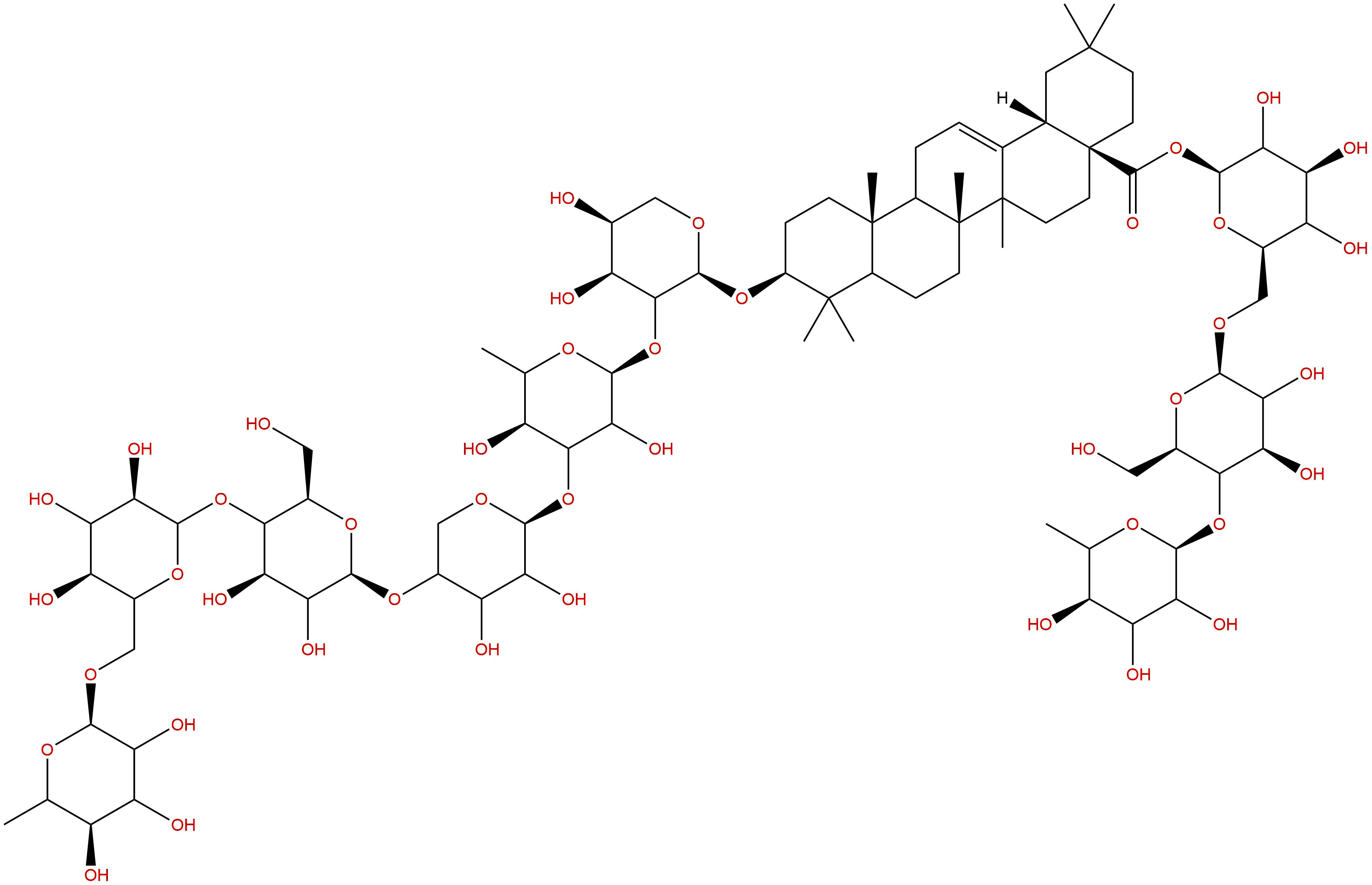


Product name: Clematichinenoside AR
Synonym name:
Catalogue No.: BP3862
Cas No.: 761425-93-8
Formula: C82H134O43
Mol Weight: 1807.93
Botanical Source:
Physical Description:
Type of Compound:
Purity: 95%~99%
Analysis Method: HPLC-DAD or/and HPLC-ELSD
Identification Method: Mass, NMR
Packing: Brown vial or HDPE plastic bottle
The product could be supplied from milligrams to grams
Inquire for bulk scale.
For Reference Standard and R&D, Not for Human Use Directly.
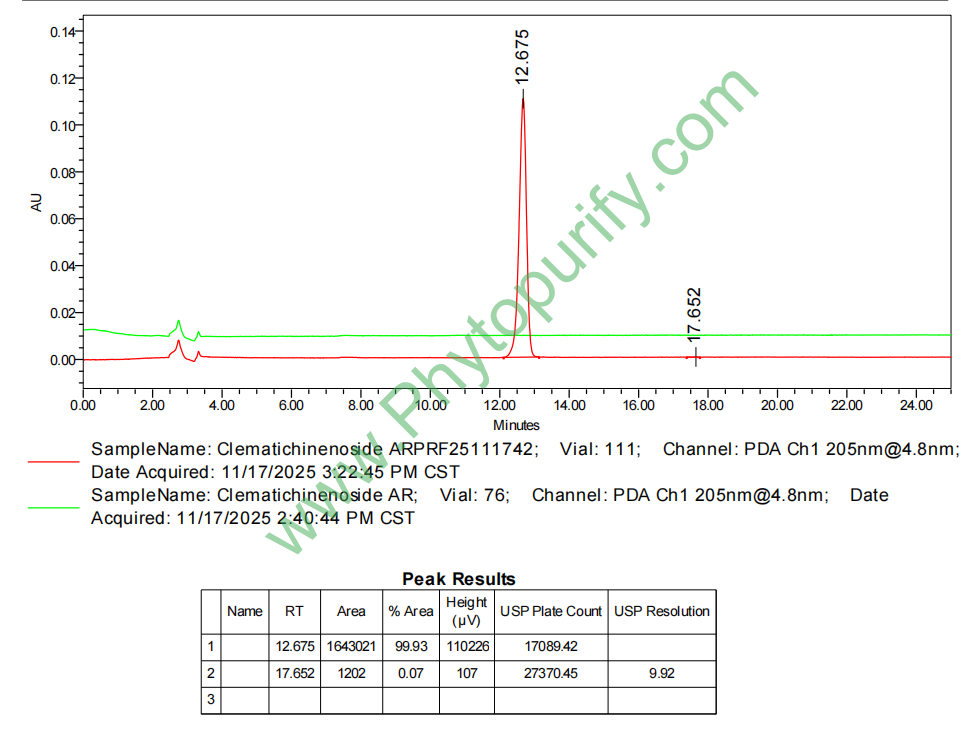
HPLC of Clematichinenoside AR
Storage conditions:Short-term storage at 2~8℃, long-term storage at -20 ~ -80℃
668.7300
1.2213
1.2212
2.4303
.4686
.1682
Low
61.4011
7.9460
Yes
No
No
No
No
No
0.0
Yes
No
No
Yes
Natural products, as an important source of drug discovery, play an irreplaceable role in the long history of human struggle against diseases. Traditional Chinese medicine contains rich active chemical components, providing a valuable lead compound library for modern pharmacological research. Weiling Xian(Clematis chinensis Osbeck, as a commonly used traditional Chinese medicine, was first recorded in the "Shennong Bencao Jing" and has the effects of dispelling wind and dampness, unblocking collaterals and relieving pain. It is widely used in clinical practice to treat rheumatism, numbness of limbs, and injuries caused by falls. Modern pharmacological research has revealed that the various pharmacological activities of Clematis chinensis are closely related to the triterpenoid saponins it contains. Among them, Clematihinenoside AR (abbreviated as AR), as an oleane type triterpenoid saponin isolated from the roots and rhizomes of Clematis chinensis, has attracted widespread attention from scholars at home and abroad in recent years due to its significant and diverse biological activities, especially anti-inflammatory, immune regulatory, and cardiovascular protective effects.
The discovery and in-depth research of Lingxian new glycoside not only provide modern scientific basis for explaining the traditional efficacy of Clematis chinensis, but also reveal its great potential in treating chronic inflammatory diseases, autoimmune diseases, atherosclerosis and other complex diseases. Atherosclerosis (AS), as a chronic inflammatory vascular disease, is the main pathological basis of cardiovascular and cerebrovascular events (such as myocardial infarction, stroke). Although traditional lipid-lowering therapy can reduce risks, residual inflammation risk remains a clinical challenge. Lingxianoside regulates inflammatory reaction through multiple targets and pathways, showing its unique advantages in intervening the occurrence and development of atherosclerosis. In addition, its protective effects in models such as rheumatoid arthritis, neuropathic pain, and acute lung injury have also been reported. This article aims to systematically review the research progress on the chemical structure, plant origin, pharmacological activity, mechanism of action, and medicinal properties of Lingxianxin glycoside, in order to provide reference for the in-depth development and clinical translation of this natural product.
The chemical structure of Lingxianxin glycoside is the basis for its biological activity. According to existing research, Lingxianxin glycoside belongs to the oleane type pentacyclic triterpenoid saponin. Its glycoside is oleanolic acid, which is connected to complex sugar chains at positions C-3 and C-28, respectively. Specifically, the sugar chain at position C-3 is usually composed of monosaccharides such as glucose, xylose, and xylose connected by specific glycosidic bonds; The sugar chain at position C-28 is connected to the aglycone through ester bonds, forming disaccharide chain saponins. This complex sugar chain structure not only determines the polarity and solubility of its molecules, but also plays a crucial role in its interaction with target proteins in the body. The complete molecular structure analysis usually relies on high-resolution mass spectrometry (HR-MS) and one-dimensional/two-dimensional nuclear magnetic resonance spectroscopy (1D/2D NMR) techniques, such as HMBC, HSQC, NOESY, etc., to determine the sugar linkage sequence, position, and configuration.
From the perspective of physical and chemical properties, the molecular weight of Lingxianxin glycoside is as high as 1807.9310 Da, which belongs to the category of large molecule natural products. Its lipid water partition coefficient (LogP) is 1.2213, indicating that it has a certain hydrophilicity, which is consistent with the sugar chain structure containing multiple hydroxyl groups in the molecule. The topological polar surface area (TPSA) is as high as 668.7300 Å ², far exceeding the recommended upper limit of 140 Å ² for oral drugs, indicating poor transmembrane permeability and potential challenges in oral bioavailability. Its water solubility parameter is 2.4303, indicating a certain solubility in water, which provides a basis for its dissolution and transport in physiological environments. In addition, according to existing data, the blood-brain barrier (BBB) penetration ability of Lingxianxin glycoside is relatively low, suggesting that its central nervous system function may mainly rely on peripheral mechanisms or be achieved through indirect regulation. These physicochemical properties provide important clues for subsequent formulation design and route of administration selection.
The main plant source of Lingxian New Glycoside is the Clematis plant in the Ranunculaceae family, which belongs to the genus Clematis(Clematis chinensis Osbeck)。 In addition, other plants of the same genus, such as cotton ball and iron wire lotus(Clematis hexapetala Pall. and Northeast Iron Lotus(Clematis manshurica Rupr.), It may also contain this ingredient, but the content may vary. The medicinal parts of the medicinal herb Weilingxian are its dried roots and rhizomes, which are usually harvested in autumn, removed of sediment, and dried before being used as medicine.
The classic method for extracting Lingxianxin glycoside is mainly based on its high polarity. Due to its multiple sugar groups, Lingxianxin glycoside is easily soluble in polar solvents such as water, methanol, and ethanol, but difficult to dissolve in non-polar solvents such as petroleum ether and chloroform. Therefore, commonly used extraction solvents include ethanol of different concentrations (such as 70% ethanol or 95% ethanol) or methanol. The extraction methods often use reflux extraction or ultrasound assisted extraction to improve efficiency and reduce the degradation of thermosensitive components. After vacuum concentration of the extract, it is usually purified using macroporous adsorption resins (such as D101, AB-8), and eluted with water and different concentrations of ethanol gradient. The saponin rich fraction is usually concentrated in the 30% -70% ethanol eluted fraction.
Further separation and purification require the combination of multiple chromatographic techniques. Positive phase silica gel column chromatography is a commonly used method for separating triterpenoid saponins, using solvent systems such as chloroform methanol water for gradient elution. For saponins with similar structures, reversed-phase silica gel (such as ODS) column chromatography, Sephadex LH-20 gel column chromatography and preparative high-performance liquid chromatography (Pre HPLC) are more effective. Through repeated column chromatography and recrystallization, high-purity Lingxianxin glycoside monomers can ultimately be obtained. In recent years, new separation technologies such as high-speed countercurrent chromatography (HSCCC) have also been applied to the separation of saponin components, demonstrating advantages such as high separation efficiency and minimal sample loss. Establishing a stable, efficient, and reproducible extraction and purification process is the foundation for ensuring the subsequent pharmacological research and drug development of Lingxianxin glycoside.
The pharmacological activity research of Lingxianxin mainly focuses on its anti-inflammatory, immune regulation and protective effects on cardiovascular system, especially in the field of atherosclerosis.
1. Anti inflammatory and immune regulatory activity
Inflammation is the common pathological basis of various diseases. Lingxianxin glycoside has shown strong anti-inflammatory activity in various inflammatory models. In a macrophage model stimulated by lipopolysaccharide (LPS), AR can significantly inhibit the production of pro-inflammatory cytokines such as tumor necrosis factor - α (TNF - α), interleukin-6 (IL-6), and nitric oxide (NO). In vivo, AR has significant therapeutic effects on collagen induced arthritis (CIA) rat models, reducing joint swelling, bone erosion, and synovial inflammation. Its mechanism of action is related to inhibiting the NF - κ B signaling pathway and regulating Th17/Treg cell balance. In addition, AR also showed protective effects in models such as acute lung injury and ulcerative colitis, indicating its broad-spectrum anti-inflammatory potential.
2. Anti atherosclerosis effect
Atherosclerosis is regarded as a chronic inflammatory disease. The intervention effect of Lingxianxin glycoside on AS is one of its research hotspots. Research has shown that AR can inhibit the progression of AS through multiple pathways:
- Protecting vascular endothelial cells Oxidative low-density lipoprotein (ox LDL) is a key factor leading to endothelial injury and initiation of atherosclerosis. AR can inhibit ox LDL induced apoptosis and dysfunction of human umbilical vein endothelial cells (HUVECs), reduce the expression of adhesion molecules such as VCAM-1 and ICAM-1, and thus inhibit monocyte adhesion to the endothelium.
- Inhibition of foam cell formation The uptake of ox LDL by macrophages to form foam cells is the core of AS. AR can down regulate the expression of scavenger receptors (such as SR-A, CD36), reduce the uptake of ox LDL by macrophages, and promote cholesterol efflux, thus inhibiting the formation of foam cells.
- Inhibition of proliferation and migration of vascular smooth muscle cells The abnormal proliferation and migration of vascular smooth muscle cells (VSMCs) are important reasons for the progression of atherosclerotic plaques and vascular remodeling. AR can inhibit platelet-derived growth factor (PDGF) - induced VSMC proliferation and migration, which may be related to intervention in the MAPK and PI3K/Akt signaling pathways.
3. Analgesic and neuroprotective effects
Based on the traditional efficacy of Weilingxian, the analgesic effect of Lingxianxin glycoside has also been confirmed. AR showed significant analgesic effects in both formalin induced inflammatory pain and chronic compressive injury (CCI) - induced neuropathic pain models. The mechanism may be related to the inhibition of microglial activation at the spinal cord level, as well as the downregulation of transient receptor potential vanillic acid subtype 1 (TRPV1) and transient receptor potential anchor protein subtype 1 (TRPA1) expression. In addition, AR has also shown certain neuroprotective potential in neurodegenerative disease models such as Parkinson's disease and Alzheimer's disease.
4. Other activities
Preliminary studies have also found that Lingxianxin glycoside has anti-tumor activity, which can inhibit the proliferation of various cancer cells and induce apoptosis; At the same time, it also shows a certain protective effect on the liver and kidneys, which can alleviate chemical liver damage and renal fibrosis.
The pharmacological activity of Lingxianxin glycoside is not the result of a single target action, but rather a network pharmacology feature achieved by regulating multiple signaling pathways and molecular targets. The core mechanism mainly revolves around the regulation of inflammatory response.
1. Regulating the NF - κ B signaling pathway
NF - κ B is the core transcription factor of inflammatory response. Lingxianxin glycoside can effectively inhibit the phosphorylation of I κ B kinase (IKBKB), prevent the degradation of I κ B α, and thus inhibit the nuclear translocation and transcriptional activity of NF - κ B (p65/RELA). This directly leads to downregulation of downstream target genes, including pro-inflammatory cytokines (TNF - α, IL-6), chemokines, adhesion molecules, as well as inducible nitric oxide synthase (NOS2) and cyclooxygenase-2 (PTGS2/COX-2) expression. This is one of the core mechanisms by which AR exerts anti-inflammatory effects.
2. Regulating the JAK/STAT3 signaling pathway
The IL-6/STAT3 signaling pathway plays a crucial role in chronic inflammation and autoimmune diseases. Research has shown that Lingxianxin glycoside can inhibit IL-6-induced phosphorylation of STAT3 (Tyr705 site), thereby blocking STAT3 dimerization and nuclear translocation, and reducing the expression of its target genes (such as VEGF, Bcl-2, Cyclin D1). This mechanism is particularly important in the inhibition of rheumatoid arthritis synovitis and tumor cell proliferation by AR.
3. Regulating NLRP3 inflammasome
NLRP3 inflammasome is a key protein complex that mediates the maturation and secretion of IL-1 β and IL-18, and is associated with various inflammatory diseases. Lingxianxin glycoside has been found to inhibit the assembly and activation of NLRP3 inflammasomes. The mechanism may include inhibiting the production of reactive oxygen species (ROS), blocking potassium ion efflux, or directly interacting with NLRP3 protein, thereby inhibiting the activation of CASP1 (Caspase-1) and reducing the maturation and release of IL-1 β. This is of great significance in atherosclerosis, gout and other disease models.
4. Regulating transient receptor potential (TRP) channels
TRPV1 and TRPA1 are key ion channels mediating pain and neurogenic inflammation. Lingxianxin glycoside can directly or indirectly inhibit the activity of these two channels. Research has shown that AR can inhibit the calcium influx mediated by TRPV1 and TRPA1 induced by agonists such as capsaicin and mustard oil, thereby exerting analgesic and anti itch effects. This may be related to the interaction between the sugar chain structure in AR molecules and the extracellular domain of channel proteins.
5. Other targets and pathways
In addition to the core mechanisms mentioned above, Lingxianxin glycoside has also been reported to inhibit the phosphorylation of MAPK (such as p38, ERK, JNK) signaling pathways, activate the Nrf2/ARE antioxidant pathway, and regulate the expression of apoptosis related proteins (Bax, Bcl-2). The synergistic effects of these multiple targets and pathways together form a complex pharmacological network of Lingxianxin glycosides.
To convert Lingxianxin glycoside from an active natural product into a clinical drug, a systematic evaluation of its pharmacological properties is necessary. Its physicochemical properties (high molecular weight, high TPSA) suggest that its oral absorption may be poor, which is the main challenge facing its drug development.
1. Pharmacokinetic characteristics
The existing pharmacokinetic studies (mainly based on animal experiments) indicate that the oral bioavailability of Lingxianxin glycoside is low. This is consistent with its large molecule and high polarity structural characteristics, making it difficult for it to pass through gastrointestinal epithelial cells through passive diffusion. After oral administration, the concentration of the prototype drug detected in the plasma is very low, and most of the drugs may be excreted in the form of prototypes or metabolites in the feces. However, studies have found that after oral administration of AR, its metabolites (such as deglycosylated secondary glycosides or aglycones) may enter the systemic circulation and exert pharmacological effects. In addition, gut microbiota is also crucial for the metabolic transformation of AR, which may convert it into more active metabolites. Intravenous injection can achieve higher blood drug concentrations. At present, research on the distribution, metabolism (especially the involvement of liver metabolic enzyme CYP450), and excretion pathways of AR in the body is not sufficient and further in-depth studies are needed.
2. Safety evaluation
The preliminary safety evaluation results are relatively optimistic. Based on the Ames test results (0.0), Lingxianxin glycoside showed no mutagenicity. The hERG inhibition test result was negative, indicating a low risk of causing QT interval prolongation and apical torsion type ventricular tachycardia in the heart. In acute toxicity experiments, the LD50 of AR is relatively high, indicating a good safety window. However, the evaluation of long-term toxicity, reproductive toxicity, and immunogenicity still needs to be improved.
3. Formulation optimization strategy
Given the issue of low oral bioavailability, the development of novel drug delivery systems is key to promoting the clinical translation of Lingxianxin glycoside. Possible strategies include:
- Nano drug delivery system Liposomes, polymer nanoparticles, solid lipid nanoparticles, etc. can encapsulate AR, increase its solubility, protect it from gastrointestinal degradation, and promote absorption through lymphatic system transport or endocytosis.
- Phospholipid complex Forming a complex with phospholipids can increase the lipid solubility of AR and improve its transmembrane ability.
- Prodrug design Introducing specific functional groups, such as amino acid esters or phosphate esters, onto the sugar chains or hydroxyl groups of AR, utilizing in vivo enzymatic hydrolysis or transporter mediated uptake to enhance oral absorption.
- Change the route of administration For certain indications such as rheumatoid arthritis and neuropathic pain, the development of transdermal drug delivery formulations or injections (such as lipid microsphere injections) may be considered to bypass oral absorption barriers.
Lingxianxin glycoside, as a natural product with multi-target and multi pathway effects, has shown broad application prospects in the treatment of various diseases.
1. Atherosclerosis and related cardiovascular and cerebrovascular diseases
This is the most promising application direction of AR. In view of its anti AS mechanism through multiple mechanisms such as anti-inflammatory, endothelial protection, inhibition of foam cell formation and VSMC proliferation, AR is expected to be developed into a new class of "anti inflammatory and anti atherosclerosis" drugs. Especially for patients who are intolerant to statins or at risk of residual inflammation, AR may provide a new treatment option. Large scale, long-term, randomized controlled clinical studies are needed in the future to validate their benefits in cardiovascular endpoint events such as myocardial infarction, stroke, and cardiovascular death.
2. Chronic inflammatory diseases
Including rheumatoid arthritis, osteoarthritis, ulcerative colitis, etc. AR has shown comparable efficacy to first-line drugs such as methotrexate in animal models, and may have fewer side effects. It is expected to become an effective drug for treating these diseases by inhibiting NF - κ B, STAT3, and NLRP3 inflammasomes, while regulating immune cell balance.
3. Pain management
Especially chronic inflammatory pain and neuropathic pain. AR provides a new analgesic strategy for non opioid and nonsteroidal anti-inflammatory drugs (NSAIDs) by inhibiting TRPV1/TRPA1 channels and spinal microglial activation, which is expected to avoid the addictive nature of opioid drugs and the gastrointestinal and cardiovascular risks of NSAIDs.
4. Future research directions
- In depth mechanism research Using chemical biology, structural biology and other methods, clarify the direct binding sites and binding modes of AR with key target proteins (such as TRPV1, NLRP3, STAT3).
- Study on Structure Activity Relationship By comparing the activity differences between AR and its analogues (such as saponins with different sugar chain structures), the key functional groups that exert key pharmacological effects are identified, providing guidance for structural optimization.
- Systematic pharmacokinetic study Establish a sensitive LC-MS/MS detection method to comprehensively elucidate the absorption, distribution, metabolism, and excretion (ADME) processes of AR and its metabolites in vivo, especially the role of gut microbiota metabolism.
- Clinical translational research After completing comprehensive preclinical pharmacodynamic and toxicological evaluations, design a reasonable clinical trial plan and first explore its safety and preliminary efficacy in specific indications (such as rheumatoid arthritis).
Lingxian Xin glycoside, as an oleane type triterpenoid saponin derived from the traditional Chinese medicine Weilingxian, has become a remarkable new star in the field of natural product pharmacology due to its unique chemical structure and significant anti-inflammatory, immune regulatory, and cardiovascular protective activities. Through regulating several key molecular targets such as NF - κ B, STAT3, NLRP3 inflammasome and TRP channel, it shows great potential in the treatment of atherosclerosis, rheumatoid arthritis, neuropathic pain and other complex diseases. Despite the challenges posed by its large molecular weight and high polarity physicochemical properties for oral administration, modern pharmaceutical methods such as nanomedicine and prodrug design have the potential to overcome this bottleneck. In the future, with the in-depth elucidation of its mechanism of action, structure-activity relationship, and pharmacokinetic characteristics, as well as the steady progress of clinical research, Lingxianxin glycoside and its derivatives are highly likely to become a new type of natural medicine with independent intellectual property rights, contributing to human health. The charm and value of natural product drug development lies in discovering new active molecules from ancient Chinese medicine and transforming them into clinical drugs through modern scientific methods.
