


Product name: Beta-Ecdysterone
Synonym name: Ecdysterone; crustecdysone
Catalogue No.: BP0262
Cas No.: 5289-74-7
Formula: C27H44O7
Mol Weight: 480.642
Botanical Source: Cyanotis arachnoides C.B.Clarke
Physical Description: Powder
Type of Compound: Steroids
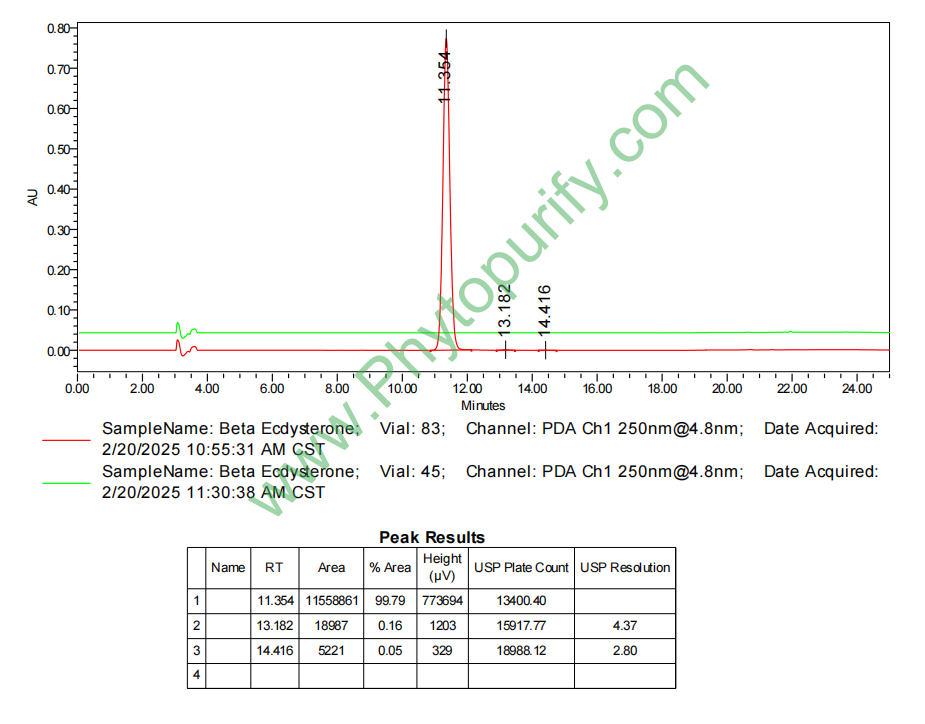
Purity: 95%~99%
Analysis Method: HPLC-DAD
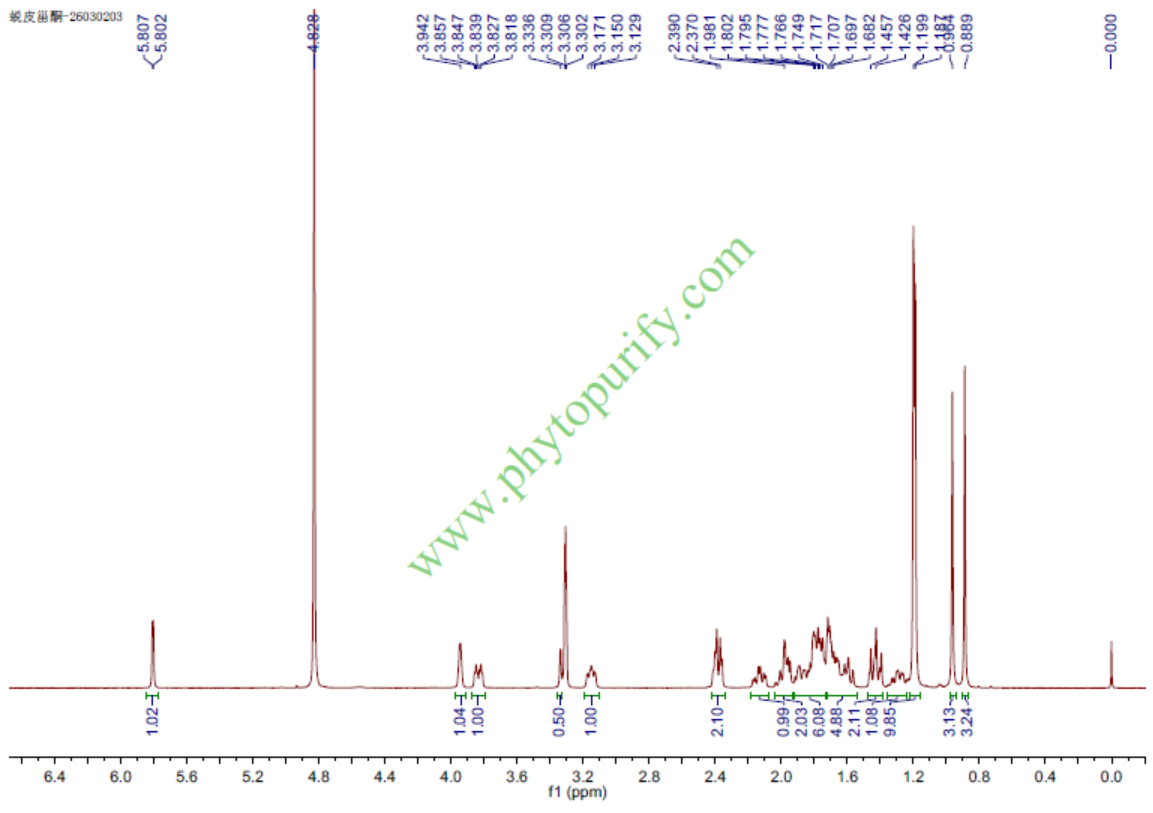
Identification Method: Mass, NMR
Packing: Brown vial or HDPE plastic bottle
Storage: Store in a well closed container, protected from air and light. Put into refrigerate or freeze for long term storage.
Whenever possible, you should prepare and use solutions on the same day. However, if you need to make up stock solutions in advance, we recommend that you store the solution as aliquots in tightly sealed vials at -20℃. Generally, these will be useable for up to two weeks.
The product could be supplied from milligrams to grams, up to kilograms
Inquire for bulk scale.
Descriptions:
Beta-Ecdysterone slowly reduces food consumption and then indirectly induces a state of starvation resulting in the elevation of the mRNA levels of InR , IRS , PI3K110 , and PDK in the Bombyx fat body during molting and pupation, and Beta-Ecdysterone inhibits innate immunity in the fat body during Bombyx postembryonic development.[1,2]
Beta-Ecdysterone acts as both a positive and a negative regulator of EDG transcription, sequences in the promoter regions of two of the EDGs are similar to an ecdysone response element and may play a role in negative regulation.[3]
Beta-Ecdysterone can block TORC1 activity for autophagosome initiation, and upregulates Atg genes to induce autophagy in the Bombyx fat body.[4]
References:
[1] Ling T, Guo E, Diao Y, et al. Bmc Genomics, 2010, 11(1):1-12.
[2] Yan L, Zhou S, Li M, et al. J Insect Physiol, 2010, 56(10):1436-44.
[3] Apple R T, Fristrom J W. Dev Biol, 1991, 146(2):569-82.
[4] Tian L, Ma L, Guo E, et al. Autophagy, 2013, 9(8):1172-87.
[5] Kim J H, Kim J M, Kang D H. ResearchGate, 2008, 23(1).
HPLC of Beta-Ecdysterone
HNMR of Beta-Ecdysterone
Storage conditions:Short-term storage at 2~8℃, long-term storage at -20 ~ -80℃
Beta Ecdysterone, also known as 20 hydroxyecdysterone, is a natural steroid hormone widely found in insects, plants, and some invertebrates. As an important member of the molting hormone family, β - ecdysterone plays a crucial role in regulating insect molting and development processes. In recent years, with the in-depth study of its biological activity and pharmacological effects, β - ecdysterone has gradually become a research hotspot in the field of natural product pharmacology due to its diverse physiological regulatory functions and good safety. The potential therapeutic value, especially in muscle atrophy, metabolic regulation, and antioxidant properties, has attracted widespread attention from both academia and industry.
This review aims to systematically summarize the chemical structure and physicochemical properties, plant sources and extraction methods, pharmacological activity and mechanism of action, pharmacological evaluation and pharmacokinetic characteristics of β - ecdysterone, and explore its clinical application prospects and future research directions in combination with its molecular targets in related diseases such as muscle atrophy. It is expected to provide theoretical reference and practical guidance for the research of natural product pharmacology and related fields.
The chemical name of β - ecdysterone is 20 hydroxyecdysteroid, with a molecular formula of C27H44O7 and a molecular weight of approximately 480.63. Its structure is based on a typical steroid skeleton, consisting of four fused rings (A, B, C, D rings) with hydroxyl substituents at multiple positions, mainly including hydroxyl groups at positions 3 β, 14 α, 20, 22, and 25. This structure combines the lipophilicity of sterols and the hydrophilicity of polyhydroxy compounds, endowing it with unique physicochemical properties.
In terms of physicochemical parameters, the LogP value of β - ecdysterone is about 1.3, indicating its moderate lipid solubility, which is beneficial for transmembrane absorption but not excessively lipid soluble and affects bioavailability. The polar surface area (TPSA) is 126.87 Å ², indicating its high molecular polarity, which may limit its ability to pass through the blood-brain barrier, consistent with its low blood-brain barrier permeability. There are 7 hydrogen bond receptors in the molecule, which enhance its binding ability to protein targets. Toxicological indicators show that the LD50 is as high as 2000 mg/kg, and there is no hepatotoxicity, cardiotoxicity, or hERG channel inhibition. The Ames mutagenicity test is also negative, indicating good safety and high potential for drug development.
β - ecdysterone is widely present in various plants, especially in some medicinal and traditional health plants such as Acanthopanax senticosus, Rhodiola rosea, Spinacia oleracea, and certain ferns. The content of β - ecdysterone in plants varies significantly depending on the species, growth environment, harvesting time, and treatment method.
The extraction methods mainly include solvent extraction, ultrasound assisted extraction, microwave-assisted extraction, and supercritical fluid extraction. Traditional solvent extraction often uses methanol, ethanol, or their aqueous solutions as solvents to extract β - ecdysterone from plants through reflux or impregnation. Ultrasound assisted extraction has become the mainstream technology in recent years due to its high efficiency and energy-saving characteristics, which can significantly improve the extraction rate and shorten the time. After concentration, separation and purification (such as silica gel column chromatography and reverse phase high-performance liquid chromatography), high-purity β - ecdysterone can be obtained from the extract.
In addition, the study of biosynthetic pathways provides a theoretical basis for the large-scale production of β - ecdysterone through bioengineering methods, and is expected to achieve green and sustainable industrial production in the future.
The pharmacological activities of β - ecdysterone cover multiple aspects such as muscle protection, metabolic regulation, antioxidant, anti-inflammatory, and neuroprotection, especially in the field of muscle atrophy prevention and treatment.
Muscle protection and promotion of synthesis
Numerous in vitro and in vivo studies have shown that β - ecdysterone can promote skeletal muscle protein synthesis, inhibit muscle protein degradation, and effectively improve muscle atrophy. Its mechanism of action involves activating the PI3K/AKT signaling pathway, promoting muscle cell proliferation and differentiation, and enhancing the synthesis and metabolism of muscle fibers. In animal models, β - ecdysterone significantly enhances muscle mass and strength, demonstrating potential performance enhancing effects.
Antioxidant and anti-inflammatory effects
β - ecdysterone has the ability to scavenge free radicals and alleviate oxidative stress. It can regulate the activity of various antioxidant enzymes (such as superoxide dismutase and glutathione peroxidase) and slow down the process of cell damage. Meanwhile, its inhibitory effect on inflammatory factors such as TNF - α and IL-6 helps alleviate chronic inflammation and indirectly protect muscles and other tissues.
metabolic regulation
β - ecdysterone plays an active role in regulating glucose and lipid metabolism, can improve insulin sensitivity, promote the balance of glucose and lipid metabolism, and has potential adjuvant treatment value for metabolic syndrome, diabetes and other diseases.
neuroprotection
Although β - ecdysterone has low blood-brain barrier permeability, some studies suggest that it indirectly exerts neuroprotective effects by regulating the peripheral nervous system and inflammatory response, especially showing certain therapeutic effects in neuromuscular disease models.
β - ecdysterone exerts its pharmacological effects through multiple targets and pathways, especially in the signal network related to muscle atrophy, where it has significant regulatory effects.
AKT1 (protein kinase B)
AKT1 is a key kinase that regulates cell growth, metabolism, and survival. β - ecdysterone activates AKT1, promotes protein synthesis in muscle cells, inhibits protein degradation, and enhances the survival and function of muscle cells.
MSTN (muscle growth inhibitor)
MSTN is a factor that negatively regulates muscle growth. β - ecdysterone can inhibit MSTN expression, relieve its inhibitory effect on muscle synthesis, and promote muscle proliferation.
IGF1 (insulin-like growth factor 1)
IGF1 plays an important role in muscle growth and repair. β - ecdysterone increases IGF1 levels, activates downstream signaling pathways, and promotes muscle cell proliferation and differentiation.
FOXO1 (forkhead box protein O1)
FOXO1 regulates the expression of genes related to muscle protein degradation. β - ecdysterone inhibits FOXO1 activity, reduces muscle protein breakdown, and maintains muscle mass.
MYOD1 (myogenic differentiation factor 1)
MYOD1 is a transcription factor that regulates the differentiation of muscle cells. β - ecdysterone enhances MYOD1 expression and promotes the differentiation of muscle precursor cells into myoblasts.
In addition, β - ecdysterone is also involved in regulating signaling pathways such as AMPK and mTOR, synergistically regulating energy metabolism and protein synthesis, reflecting its multidimensional regulatory mechanism.
The pharmacological evaluation of β - ecdysterone shows that it has good safety and suitable pharmacokinetic characteristics:
safety
Toxicological studies have shown that the oral LD50 of β - ecdysterone is as high as 2000 mg/kg, with no significant liver toxicity, cardiac toxicity, or hERG channel inhibition. The Ames mutagenicity test is negative, indicating that its long-term use is safe.
pharmacokinetics
β - ecdysterone has good oral absorption, but its role in the central nervous system is limited due to its high molecular polarity and low blood-brain barrier permeability. Its metabolism in the body is mainly carried out through the liver enzyme system, and the metabolites are relatively diverse with a moderate half-life, making it suitable for development as an oral preparation. The current systematic research on its bioavailability and metabolic pathways is still limited, and further in-depth research is urgently needed.
Drug efficacy indicators
Moderate LogP values and high TPSA indicate that β - ecdysterone has certain solubility and membrane permeability when administered orally, but may be limited by intestinal absorption and first pass effects. Its multi hydroxyl structure facilitates stable binding with target proteins and enhances drug efficacy.
In summary, β - ecdysterone has great potential for drug development and is suitable for further optimization of formulations and administration methods to enhance its clinical application value.
β - ecdysterone has shown broad application prospects in areas such as muscle atrophy, exercise rehabilitation, and metabolic diseases. Its role in promoting muscle synthesis and inhibiting muscle protein degradation is particularly suitable for clinical needs such as age-related muscle atrophy, chronic disease-related muscle depletion, and sports injury recovery. In addition, its antioxidant and anti-inflammatory effects provide a theoretical basis for the adjuvant treatment of various chronic diseases.
Currently, β - ecdysterone has entered some health and sports nutrition markets, but strict clinical trial data is not yet sufficient. Future research should focus on:
Through interdisciplinary collaboration, β - ecdysterone is expected to become an important drug candidate molecule in the field of natural product pharmacology, promoting the treatment progress of muscle atrophy and related diseases.
β - ecdysterone, as a natural ecdysteroid with unique structure and diverse functions, has demonstrated excellent pharmacological activity in muscle protection, metabolic regulation, and antioxidant properties, and has broad clinical application potential. Its mechanism of action covers multiple key molecular targets, especially in the regulation of muscle atrophy related signaling pathways, providing new ideas for the treatment of related diseases.
Although fruitful results have been achieved in the research of β - ecdysterone, there is still a need to strengthen systematic studies on its pharmacokinetics, clinical efficacy, and safety, and promote its transition from laboratory to clinical application. In the future, with the advancement of biotechnology and drug development technology, β - ecdysterone is expected to become a star molecule in the field of natural product pharmacology, benefiting more patients.
In summary, β - ecdysterone is a natural product with important research value and application prospects. Its in-depth research and development will provide a solid scientific foundation and practical guidance for the innovation of natural medicines and the treatment of diseases such as muscle atrophy.
