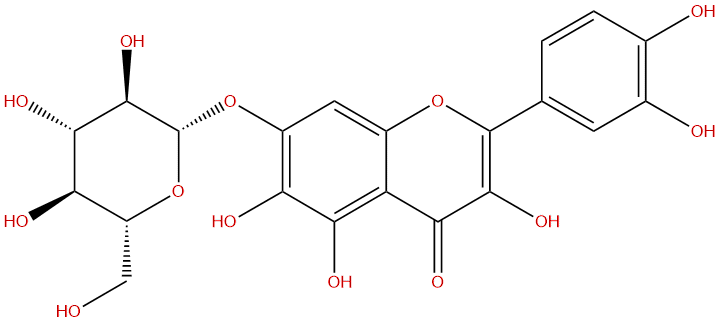


Product name: Quercetagitrin
Synonym name: Quercetagetin 7-glucoside;Quercetagetin 7-O-β-D-glucosi
Catalogue No.: BP4113
Cas No.: 548-75-4
Formula: C21H20O13
Mol Weight: 480.378
Botanical Source: Tagetes erecta L
Physical Description:
Type of Compound: Flavonoids
Purity: 95%~99%
Analysis Method: HPLC-DAD or/and HPLC-ELSD
Identification Method: Mass, NMR
Packing: Brown vial or HDPE plastic bottle
Storage: Store in a well closed container, protected from air and light. Put into refrigerate or freeze for long term storage.
The product could be supplied from milligrams to grams
Inquire for bulk scale.
For Reference Standard and R&D, Not for Human Use Directly.
Description:
Quercetagetin-7-O-glucoside, a potent inhibitor of beta-glucuronidase and lysozyme release, shows anti-inflammatory activity, can significantly inhibit arachidonic acid release from membranes.
References:
Z Naturforsch C. 1994 Mar-Apr;49(3-4):235-40.
Influence of anti-inflammatory flavonoids on degranulation and arachidonic acid release in rat neutrophils.
We assessed the effects of 24 flavonoid derivatives, reported as anti-inflammatory, on lysosomal enzyme secretion and arachidonic acid release in rat neutrophils.
METHODS AND RESULTS:
Amentoflavone, Quercetagetin-7-O-glucoside, apigenin, fisetin, kaempferol, luteolin and quercetin were the most potent inhibitors of beta-glucuronidase and lysozyme release. The first compound was also able to inhibit basal release. These flavonoids besides chrysin and to a reduced extent, naringenin, significantly inhibited arachidonic acid release from membranes.
CONCLUSIONS:
A correlation between degranulation and arachidonic acid release was found for this series of compounds. Structure-activity relationships and implications for the anti-inflammatory effects of these flavonoids were discussed.
Storage conditions:Short-term storage at 2~8℃, long-term storage at -20 ~ -80℃
Quercetagitrin (CAS number: 548-75-4) is a compound derived from African marigolds(Tagetes erecta)Natural flavonoid glycosides isolated from the middle. As one of the derivatives of Quercetin, Quercetin Marigold Glycoside has received widespread attention in recent years due to its significant biological activity, especially in anti-inflammatory, antioxidant, and neuroprotective potential. This compound not only has a regulatory effect on the pathological process related to neurodegenerative diseases such as Alzheimer's disease (AD), but also has a positive impact on type 2 diabetes (T2DM) by regulating the glucose metabolism pathway. Its multi-target mechanism of action and good safety make it a research hotspot in the fields of natural product pharmacology and new drug development.
This article provides a systematic review of the chemical structure and physicochemical properties, plant sources and extraction methods, pharmacological activity and mechanism of action, pharmacological evaluation and pharmacokinetic characteristics of Quercus acutissima glycoside. Finally, it explores its potential and future development directions in clinical applications, aiming to provide theoretical basis and reference for the in-depth research and drug development of this natural product.
The chemical name of Quercetagetin-7-O-glucoside is Quercetagetin-7-O-glucoside, with a molecular formula of C21H20O13 and a molecular weight of 480.3780. Its structure is based on the Quercetagetin core, which forms an O-glycosidic bond with glucose through the 7-hydroxyl group to form flavone-7-O-glucoside. This structure endows it with strong hydrophilicity, with a LogP value of -0.2782, indicating strong hydrophilicity and a water solubility of 1.0713. It has good water solubility, which is conducive to absorption and distribution in vivo.
Its topological polar surface area (TPSA) is as high as 230.74 Å ², reflecting that the molecule has more polar groups, especially multiple hydroxyl and glycoside moieties, which enhance its binding ability with biomolecules. The blood-brain barrier permeability of Quercetin Marigold Glycosides is relatively low, indicating limited direct penetration ability in the central nervous system. However, there is a high possibility that it indirectly exerts neuroprotective effects by regulating peripheral or brain targets. The negative result of hERG channel inhibition experiment indicates a low risk of cardiac toxicity; The Ames mutagenicity test value is 1.2, indicating a low risk of genotoxicity and good safety.
Quercet marigold glycosides mainly come from African marigolds(Tagetes erecta)This is a herbaceous plant widely distributed in tropical and subtropical regions, commonly used in horticulture and traditional medicine. African marigolds are rich in various flavonoids, among which the content of quercetin is relatively abundant.
The common methods for extracting quercetin and marigold glycosides include:
In recent years, new technologies such as supercritical CO ₂ extraction and microwave-assisted extraction have also been attempted to improve extraction efficiency and purity, promoting the large-scale preparation of quercetin and marigold glycosides.
The pharmacological activities of Quercetin Marigold Glycosides cover multiple aspects such as anti-inflammatory, antioxidant, neuroprotective, and metabolic regulation.
Research has shown that quercetin can significantly inhibit the release of inflammatory mediators and the activation of inflammatory signaling pathways. It exhibits good anti-inflammatory effects by inhibiting the activation of the nuclear factor kappa B (NF - κ B) signaling pathway, reducing the expression of pro-inflammatory cytokines such as TNF - α, IL-1 β, and IL-6. In the P301S Tau transgenic mouse model, quercetin can reverse neuroinflammatory responses and alleviate cognitive impairment, indicating its potential application value in neuroinflammatory related diseases.
Quercetin marigold glycoside can inhibit the abnormal accumulation of Tau protein and slow down neuronal damage. Abnormal phosphorylation and aggregation of Tau protein are pathological features of Alzheimer's disease and other neurodegenerative diseases. Quercetin marigold glycosides regulate related signaling pathways, alleviate pathological changes in Tau, protect neuronal function, and improve cognitive ability.
As a flavonoid compound, quercetin has significant antioxidant capacity. It can activate the nuclear factor erythroid 2-related factor 2 (NRF2) signaling pathway, promote the expression of downstream antioxidant enzymes such as superoxide dismutase (SOD1, SOD2), catalase (CAT), glutathione peroxidase (GPX1), and heme oxygenase 1 (HMOX1), eliminate excess reactive oxygen species (ROS), and alleviate oxidative stress damage to cells.
Quercetin marigold glycoside can enhance glucose uptake in mature C2C12 myoblasts, indicating its potential in regulating glucose metabolism and insulin sensitivity. This feature has attracted much attention in the adjuvant treatment of type 2 diabetes.
The multi-target mechanism of action of Quercetin marigold glycoside is the basis for its diversified pharmacological activities.
Quercetin marigold glycoside is a dual target inhibitor of protein tyrosine phosphatases PTPN6 and PTPN9, with IC50 values of 1 μ M and 1.7 μ M, respectively. PTPN6 and PTPN9 are involved in various cellular signal transduction processes, regulating immune responses and cellular metabolism. By inhibiting these two targets, quercetin can regulate inflammatory response and metabolic homeostasis, exerting anti-inflammatory and metabolic regulatory effects.
NF - κ B is a key transcription factor that regulates inflammation and immune responses. Quercetin marigold glycoside inhibits the phosphorylation and degradation of I κ B α, suppresses NF - κ B nuclear translocation, reduces the expression of pro-inflammatory genes, and thus alleviates the inflammatory response.
Quercetin marigold glycoside can activate the NFE2L2/NRF2 signaling pathway, induce the expression of antioxidant enzyme genes, and enhance cellular antioxidant defense ability. In addition, it may also maintain extracellular matrix stability, slow down tissue inflammation and damage by regulating matrix metalloproteinases MMP1 and MMP3.
Quercetin marigold glycoside can inhibit abnormal aggregation of Tau protein, possibly by regulating the phosphorylation status of Tau and promoting its degradation, reducing neuronal toxicity, and improving cognitive function.
The pharmacological parameters of Quercetin Marigold Glycosides indicate that they have certain potential for drug development:
At present, there is limited pharmacokinetic data on quercetin and marigold glycosides. Given its high polarity and glycosidic structure, it is speculated that its oral absorption may be limited, and in vivo metabolism may involve glycosidic hydrolase mediated glycosidic bond cleavage, releasing active quercetin. Further research on in vivo absorption, distribution, metabolism, and excretion (ADME) is needed in the future to clarify its pharmacokinetic characteristics and the biological activity of metabolites.
Due to its multi-target and multi mechanism pharmacological activity, Quercetin Marigold Glycosides have shown broad application prospects in the fields of neurodegenerative and metabolic diseases.
The pathogenesis of Alzheimer's disease is complex, involving multiple pathological processes such as abnormal accumulation of Tau protein, neuroinflammation, and oxidative stress. Quercetin marigold glycoside exhibits potential neuroprotective effects by inhibiting Tau accumulation, reducing neuroinflammation, and enhancing antioxidant capacity. Its effectiveness in the P301S Tau transgenic mouse model provides strong support for its clinical translation. In the future, drug delivery technology can be combined to enhance the effective concentration in the brain and improve the therapeutic effect.
Quercetin marigold glycoside enhances the glucose uptake ability of myoblasts, suggesting that it may improve insulin resistance and regulate blood glucose levels. Combined with its anti-inflammatory and antioxidant effects, it is expected to become an auxiliary therapeutic agent for type 2 diabetes and its complications. Further preclinical and clinical studies will help clarify its efficacy and safety.
The anti-inflammatory and antioxidant properties of Quercetin Marigold Glycosides make them potentially valuable in the fields of inflammatory diseases, cardiovascular diseases, and tumors. Especially in regulating immune response and cellular signaling pathways, it provides possibilities for its multidisciplinary development.
Quercetin marigold glycoside, as a natural flavonoid glycoside derived from African marigold, exhibits rich pharmacological activity and good safety. Its multi-target inhibition of PTPN6 and PTPN9, regulation of NF - κ B and NRF2 signaling pathways, inhibition of Tau protein accumulation, enhancement of glucose uptake, and construction of its multiple mechanisms of anti-inflammatory, antioxidant, neuroprotective, and metabolic regulation. Although its blood brain barrier permeability is low, quercetin still has the potential to become a candidate drug for treating Alzheimer's disease, type 2 diabetes and other diseases by optimizing the drug delivery strategy and structural modification.
Future research should focus on its pharmacokinetic characteristics, in vivo metabolic pathways, and long-term safety evaluation, while exploring its combination therapy and structural optimization strategies to promote the clinical application of Quercus marigold glycosides. In summary, quercetin not only enriches the research content of natural product pharmacology, but also provides new ideas and candidate molecules for the treatment of related diseases.
