


Synonym name: Kaempferol 3,7-dirhamnoside; Lespedin
Catalogue No.: BP0819
Cas No.: 482-38-2
Formula: C27H30O14
Mol Weight: 578.523
Botanical Source: Cinnamomum sieboldii, Indigofera arrecta, Lespedeza cyrtobotrya and many other plant spp.
Purity: 95%~99%
Analysis Method: HPLC-DAD or/and HPLC-ELSD
Identification Method: Mass, NMR
Packing: Brown vial or HDPE plastic bottle
Can be supplied from milligrams to grams.
For Reference Standard and R&D, Not for Human Use Directly.
Inquire for bulk scale.
HPLC of Kaempferitrin
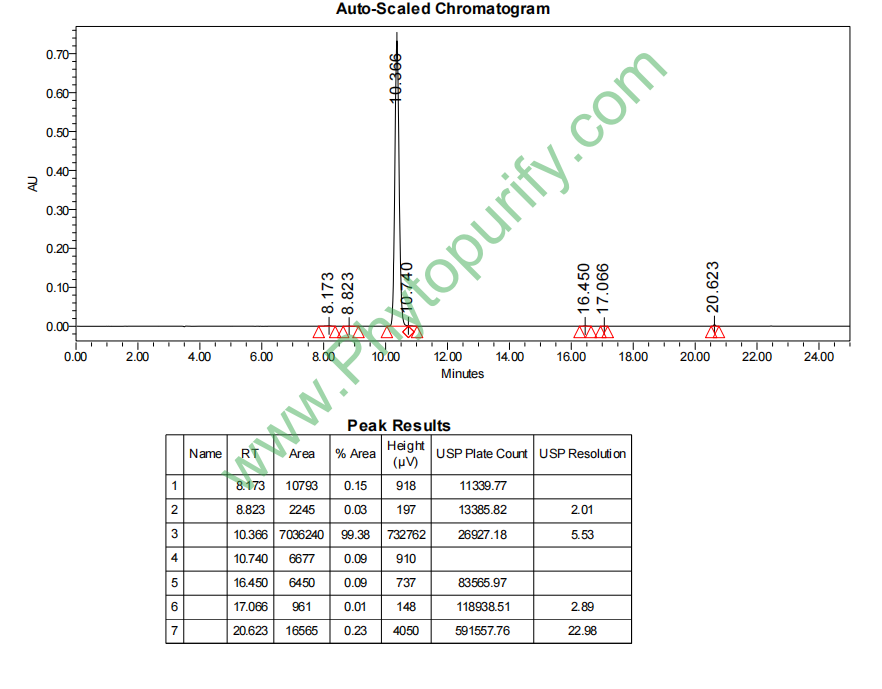
Storage conditions:Short-term storage at 2~8℃, long-term storage at -20 ~ -80℃
Kaempferirin (CAS number: 482-38-2) is a natural flavonoid glycoside compound widely found in various plants, especially in the aboveground parts of Vicia faba and Nelumbo nucifera. As a dual glycoside derivative of Kaempferol, kaempferol has attracted much attention in traditional medicine due to its diverse biological activities. In recent years, with the development of natural product pharmacology, kaempferide has become a research hotspot because of its significant pain relief, anti-inflammatory, anti diabetes, anti-tumor and adjuvant effects of chemotherapy. It exhibits broad pharmacological potential by activating the insulin signaling pathway and regulating various cellular signaling molecules. In addition, the role of kaempferol in antidepressant, bone density maintenance, immune regulation, and antioxidant damage has gradually been revealed, providing theoretical basis for its clinical application. This article will provide a systematic review of the chemical structure, plant origin, pharmacological activity, and mechanism of action of kaempferol, and evaluate its pharmacological properties and future clinical application prospects.
The chemical structure of kaempferol is kaempferol 3,7-di-O - α - L-rhamnoside, which means that the kaempferol molecule is connected to two α - L-pyranose rhamnoside residues through glycosidic bonds at the 3rd and 7th hydroxyl groups, respectively. Its molecular formula is C27H30O15, with a molecular weight of 578.5230, and it belongs to the typical glycosylated flavonoid compounds. Structurally, kaempferol retains the flavonoid skeleton of kaempferol, and the introduction of sugar groups significantly increases its water solubility (about 1.4906), making its dispersibility in the aqueous phase superior to non glycosylated flavonoids.
In terms of physicochemical properties, the LogP value of kaempferol glycoside is 0.2896, indicating its strong hydrophilicity and low lipid solubility, which has a significant impact on its bioavailability and in vivo distribution. Its topological polar surface area (TPSA) is 228.97 Å ², and higher TPSA values are usually associated with lower cell membrane permeability, especially lower blood-brain barrier permeability (low blood-brain barrier permeability), indicating limited direct action in the central nervous system. In terms of safety, kaempferol did not exhibit hERG channel inhibition and the Ames mutagenicity test was negative, demonstrating good safety characteristics.
Kaempferol is mainly isolated from the aboveground parts of plants such as Vicia faba and Nelumbo nucifera. As a traditional edible and medicinal plant, fava beans contain abundant flavonoid glycosides in their leaves and stems; Lotus flowers are widely used in traditional Chinese medicine due to their medicinal value and abundant flavonoid components.
The extraction method usually uses organic solvent extraction combined with column chromatography separation technology. Common extraction solvents include methanol, ethanol, and their aqueous solutions. Due to the hydrophilicity of kaempferol, a 50% -70% ethanol aqueous solution is the ideal choice. The extraction process generally includes:
In recent years, ultrasound assisted extraction and microwave-assisted extraction techniques have also been applied to the efficient extraction of kaempferol, improving extraction efficiency and purity.
The pharmacological activities of kaempferin cover a variety of biological effects, mainly including anti-inflammatory, anti diabetes, anti-tumor, antidepressant, antioxidant and immune regulation. The specific studies are as follows:
Multiple in vitro and in vivo studies have confirmed that kaempferol significantly alleviates inflammatory responses by inhibiting the release of inflammatory mediators (such as TNF - α, IL-6, IL-1 β) and downregulating the NF - κ B signaling pathway. It has shown good anti-inflammatory effects in models such as arthritis and inflammatory bowel disease, with minimal side effects.
Kaempferol can activate the insulin signaling pathway, promote glucose uptake and metabolism, and improve insulin resistance. Related studies have shown that kaempferol enhances insulin receptor substrate (IRS) and protein kinase B (Akt) phosphorylation, increases cell sensitivity to insulin, and reduces blood glucose levels. In addition, it also has a protective effect on diabetes complications such as diabetes nephropathy and retinopathy.
Kaempferol has shown inhibitory effects on proliferation, induces apoptosis, and blocks the cell cycle in various tumor cell lines. The mechanism involves activating the mitochondrial pathway to induce apoptosis, inhibiting the PI3K/Akt/mTOR signaling pathway, and regulating immune cell activity in the tumor microenvironment. In animal models, kaempferol adjuvant chemotherapy can enhance drug sensitivity and reduce drug resistance.
Although kaempferol has low blood-brain barrier permeability, it indirectly exerts antidepressant effects by regulating peripheral immune inflammatory responses and antioxidant effects. Some studies suggest that kaempferol can regulate neurotransmitter metabolism and neuroinflammation, and improve symptoms of depression.
Kaempferol significantly enhances the body's antioxidant defense system, increases the activity of antioxidant enzymes such as superoxide dismutase (SOD), catalase (CAT), and glutathione peroxidase (GPX), reduces reactive oxygen species (ROS) levels, and alleviates oxidative stress damage. It activates the NFE2L2/NRF2 signaling pathway, induces downstream antioxidant enzyme expression, and protects cells from oxidative damage.
Kaempferol can regulate immune cell function, balance Th1/Th2 cell ratio, inhibit excessive immune response, and prevent the occurrence of autoimmune diseases. It has shown the potential to enhance the body's immunity and anti infection ability in animal models.
Research has shown that kaempferol promotes bone formation and inhibits bone resorption by regulating the activity of osteoblasts and osteoclasts, which is beneficial for the prevention and treatment of osteoporosis.
The multiple pharmacological effects of kaempferol are attributed to its regulation of multiple cellular signaling pathways and key molecules, mainly including:
Kaempferol activates the NFE2L2 (nuclear factor erythroid 2-related factor 2, NRF2) signaling pathway, promotes the expression of antioxidant enzymes such as SOD1, SOD2, CAT, GPX1, and HMOX1, enhances cellular antioxidant capacity, and reduces cellular damage caused by oxidative stress.
Kaempferol promotes phosphorylation of insulin receptors and IRS, activates the PI3K/Akt pathway, enhances the expression and transport of glucose transporter 4 (GLUT4), improves insulin sensitivity, and lowers blood glucose levels.
By inhibiting the NF - κ B and MAPK signaling pathways, kaempferol reduces the production of pro-inflammatory factors and alleviates inflammatory reactions.
Kaempferol regulates the expression of Bcl-2 family proteins, promotes mitochondrial dependent cell apoptosis, and inhibits tumor cell proliferation.
Regulate the proportion of T cell subsets and cytokine secretion to maintain immune homeostasis.
The pharmacological evaluation of kaempferol glycoside shows that it has certain advantages and challenges:
Given the significant pharmacological activity exhibited by kaempferol in various disease models, its clinical development potential is enormous. Especially in the fields of diabetes and its complications, chronic inflammatory diseases, tumor adjuvant treatment and osteoporosis, kaempferide is expected to become a new natural drug or functional health care product ingredient.
However, clinical research on kaempferol is still in its early stages and lacks systematic clinical trial data. Future research should focus on:
In addition, based on its low blood-brain barrier permeability, the application of kaempferol in central nervous system diseases may need to be improved through structural modification or nanocarrier technology.
As a multifunctional natural flavonoid glycoside, kaempferol has shown potential as a candidate drug for the treatment of various diseases due to its wide pharmacological activity and good safety. Its mechanism of action in anti inflammation, anti diabetes, anti-tumor and anti-oxidation has gradually become clear, providing rich examples for natural product pharmacology research. In the future, through in-depth pharmacokinetic research, formulation optimization, and clinical validation, kaempferol is expected to achieve the transformation from laboratory research to clinical application, promoting the application and development of natural products in modern medicine.
