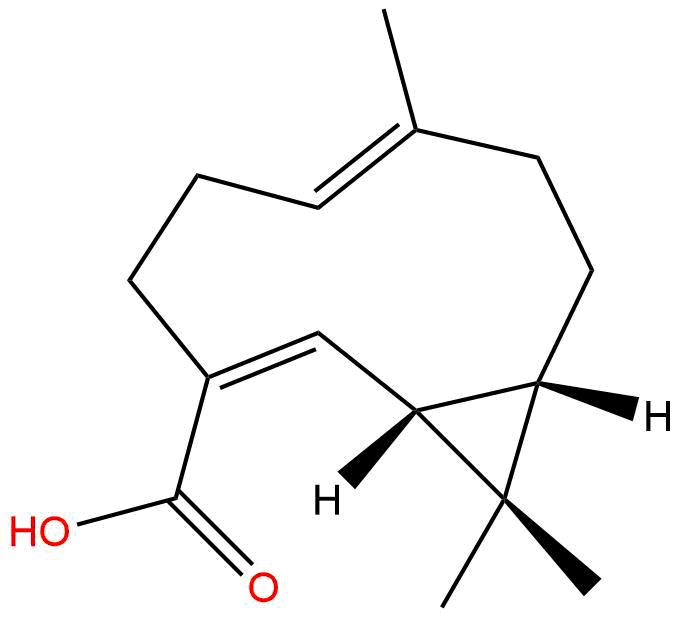


Product name: Volvalerenic acid A
Synonym name:
Catalogue No.: BP2202
Cas No.: 1247014-34-1
Formula: C15H22O2
Mol Weight: 234.339
Botanical Source:
Type of Compound:
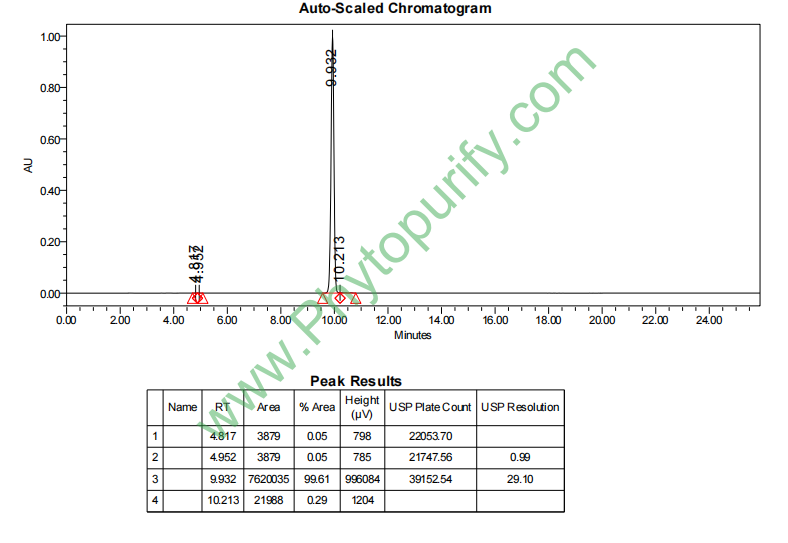
Purity: 95%~99%
Analysis Method: HPLC-DAD or/and HPLC-ELSD
Identification Method: Mass, NMR
Packing: Brown vial or HDPE plastic bottle
Storage: Store in a well closed container, protected from air and light. Put into refrigerate or freeze for long term storage.
Whenever possible, you should prepare and use solutions on the same day. However, if you need to make up stock solutions in advance, we recommend that you store the solution as aliquots in tightly sealed vials at -20℃. Generally, these will be useable for up to two weeks.
The product could be supplied from milligrams to grams
Inquire for bulk scale.
For Reference Standard and R&D, Not for Human Use Directly.
HPLC of Volvalerenic acid A
Storage conditions:Short-term storage at 2~8℃, long-term storage at -20 ~ -80℃
37.3000
3.8646
1.3011
.1481
5.7011
8.9761
High
91.2644
4.1730
No
Yes
No
No
No
No
0.0
No
Yes
Yes
Yes
With the increasing importance of natural products in new drug development, sesquiterpenes have become a hot topic in pharmacological research due to their structural diversity and significant biological activity. Volvalenic acid A (Chinese name: Volvalenic acid A) is a novel sesquiterpene, originally derived from the traditional medicinal plant Valerian(Valeriana officinalis var. latifolia)Separated from the roots. In recent years, with the in-depth study of its biological activity and potential pharmacological mechanisms, the application prospects of Volvalerenic acid A in the field of anti-tumor, especially in the treatment of lung cancer, have gradually emerged.
Lung cancer, as one of the malignant tumors with the highest incidence rate and mortality in the world, urgently needs to develop therapeutic drugs with new mechanisms of action and low side effects. Existing studies have shown that Volvalerenic acid A exhibits excellent anti lung cancer activity by regulating multiple signaling pathways and key molecular targets. This article will provide a systematic review of the chemical structure and physicochemical properties, plant sources and extraction methods, pharmacological activity and mechanism of action, pharmacological evaluation and pharmacokinetic characteristics of VolValerenc acid A, and explore its clinical application prospects and future development directions.
Volvalenic acid A belongs to the sesquiterpene class, with a molecular formula of C15H26O3 and a molecular weight of 234.3390. Its structural feature is a typical sesquiterpene skeleton, containing polar functional groups such as carboxyl and hydroxyl groups, which endow it with certain polarity and biological activity. Its LogP value is 3.8646, indicating good lipid solubility, which is beneficial for membrane penetration and in vivo distribution. The polarization surface area (TPSA) is 37.3 Å ², indicating moderate polarity and facilitating binding with biomolecules.
Low water solubility (0.1481 mg/mL) suggests limited solubility in the aqueous phase, but this can be improved to some extent through formulation techniques. It is worth noting that Volvalenic acid A has a high blood-brain barrier permeability, indicating its potential application value in central nervous system diseases. The negative result of hERG channel inhibition experiment indicates a low risk of cardiac toxicity. The Ames test result is 0.0, indicating no significant mutagenicity and good safety.
In summary, the physicochemical properties of Volvalenic acid A have laid a solid foundation for its further pharmacological research and drug development.
Volvalerenic acid A mainly exists in valerian plants(Valeriana officinalis var. latifolia)The root. Valerian, as a traditional herb, is widely used to treat anxiety, insomnia, and neurological diseases. Its roots are rich in various active ingredients of sesquiterpenes. The discovery of Volvalerenic acid A has enriched the chemical composition spectrum of Valeriana officinalis and provided a new perspective for its pharmacological activity research.
The common methods for extracting Volvalenic acid A include solvent extraction, ultrasound assisted extraction, and column chromatography separation. Ethanol or methanol are generally used as extraction solvents, combined with ultrasound assisted technology to improve extraction efficiency. After concentration, the extraction solution is purified using silica gel column chromatography or high-performance liquid chromatography (HPLC) to obtain high-purity Volvalerenic acid A.
In recent years, green extraction techniques such as supercritical CO2 extraction and microwave-assisted extraction have also been applied to the extraction of this compound, which not only improves the extraction efficiency but also reduces the use of organic solvents, in line with the environmental trend of modern natural product extraction.
The pharmacological activity research of Volvalenic acid A mainly focuses on its anti-tumor effect, especially its performance in lung cancer models. In vitro cell experiments have shown that the compound can significantly inhibit the proliferation of various lung cancer cell lines, induce cell apoptosis, and suppress cell migration and invasion ability.
Specifically, Volvalenic acid A exhibits dose-dependent cytotoxicity towards non-small cell lung cancer cells such as A549 and H1299. Flow cytometry analysis showed that the compound can induce cell cycle arrest and promote mitochondrial mediated apoptosis. Western blot analysis showed that the expression of anti apoptotic protein BCL2 was downregulated, while the activation of pro apoptotic protein CASP9 was significant, indicating its role in regulating apoptosis related proteins.
In addition, Volvalenic acid A has shown potential for regulating the tumor microenvironment and immune regulation. For example, its inhibitory effect on the STAT3 signaling pathway helps to block the immune escape mechanism of tumor cells and enhance anti-tumor immune response.
In terms of animal experiments, Volvalenic acid A significantly inhibited tumor growth in a mouse model of lung cancer xenografts, and no significant toxic side effects were observed, demonstrating good in vivo anti-tumor activity and safety.
The anti lung cancer effect of Volvalenic acid A involves multiple signaling pathways and key molecular targets, reflecting its pharmacological characteristics of multi-target and multi mechanism.
BCL2 family protein regulation
BCL2, as an important anti apoptotic protein, plays a crucial role in the survival of lung cancer cells. Volvalenic acid A downregulates BCL2 expression, disrupts intracellular anti apoptotic balance, promotes changes in mitochondrial membrane permeability, activates CASP9 and downstream caspase cascade reactions, and ultimately triggers cell apoptosis.
STAT3 signaling pathway inhibition
STAT3 plays an important role in the proliferation, survival, and immune regulation of tumor cells. Volvalenic acid A can inhibit the phosphorylation and nuclear translocation of STAT3, block its transcriptional activity, reduce the expression of tumor promoting genes, inhibit tumor growth and immune escape.
Regulation of PI3K/AKT/mTOR pathway
By acting on PIK3CG and PIK3CA, Volvalenic acid A interferes with the PI3K signaling pathway, inhibits AKT activation, blocks cell proliferation and survival signals, and enhances cell sensitivity to apoptotic stimuli.
MAPK signaling pathway regulation
MAPK1 and MAPK8 are key signaling molecules that regulate cell proliferation and stress response. The regulation of these two pathways by Volvalenic acid A helps to inhibit the proliferation and migration ability of tumor cells.
Hormone receptor regulation
ESR2 (estrogen receptor beta) plays a complex role in the occurrence and development of lung cancer. Volvalenic acid A may exert anti-tumor effects by regulating ESR2 activity, affecting the endocrine environment of tumor cells.
Microtubule protein MAPT regulation
MAPT (microtubule associated protein Tau) plays a role in cytoskeletal stability and cell division. The regulation of MAPT by Volvalenic acid A may affect the mitosis of tumor cells and inhibit their proliferation.
Potassium channel KCNA5 regulation
KCNA5 is involved in regulating cell membrane potential and signaling apoptosis. The effect of Volvalenic acid A on this channel may promote the apoptosis process of tumor cells.
In summary, Volvalenic acid A exhibits a complex and effective anti-tumor mechanism by intervening in the proliferation, apoptosis, migration, and immune regulation of lung cancer cells through multi-target synergistic effects.
The evaluation of drug properties is an important step in the development of natural product drugs. Volvalenic acid A exhibits ideal characteristics in this regard.
Molecular weight and lipid solubility
The molecular weight of 234.3390 conforms to Lipinski's rule, with a LogP of 3.86, indicating moderate lipid solubility, which is beneficial for oral absorption and cell membrane penetration.
Polarization surface area (TPSA)
The TPSA value of 37.3 Å ² is relatively low, which helps molecules pass through the cell membrane and blood-brain barrier, indicating its good bioavailability and potential for distribution in the central nervous system.
Water solubility
The water solubility is 0.1481 mg/mL, and lower water solubility may limit its bioavailability, but it can be improved through formulation optimization (such as nanocarriers, solid dispersions).
Blood-brain barrier permeability
The high blood-brain barrier permeability provides potential applications for it in neurological diseases, while paying attention to possible central neurotoxicity.
safety indicator
HERG channel inhibition is negative, reducing the risk of cardiac toxicity; The Ames test is non mutagenic and has high safety.
pharmacokinetics
At present, there is limited in vivo pharmacokinetic data on Volvalenic acid A. Preliminary animal experiments have shown that it is well absorbed orally and widely distributed in the body. Its metabolism is mainly through the liver enzyme system, and its excretion pathways include bile and urine. In the future, further systematic research is needed on its absorption, distribution, metabolism, and excretion (ADME) characteristics to guide clinical formulation design and dosing regimens.
Volvalenic acid A, as a sesquiterpene natural product derived from traditional medicinal plants, has shown broad clinical application prospects due to its multi-target anti lung cancer effects and good drug properties.
New candidate drugs for the treatment of lung cancer
At present, the treatment of lung cancer is facing challenges such as drug resistance and side effects. Volvalenic acid A, through its synergistic effect in multiple pathways, is expected to break through the limitations of traditional single target drugs and become a new candidate for anti lung cancer drugs.
Potential for combination therapy
Its combination with existing chemotherapy drugs or targeted drugs may enhance efficacy, reduce dosage, and alleviate toxic side effects, which is worthy of further research.
Potential applications of central nervous system diseases
Due to its high blood-brain barrier permeability, the potential applications of Volvalerenic acid A in neurodegenerative diseases, brain tumors, and other fields also need to be explored.
Safety and Toxicology Research
Further systematic safety evaluation and long-term toxicology research are key to its clinical translation, ensuring its safety in human applications.
Formulation development and administration route
Developing new drug delivery systems (such as liposomes and nanoparticles) to address its low water solubility will enhance its bioavailability and therapeutic efficacy.
Clinical trial design
In the future, mechanism based preclinical research should be conducted, gradually advancing to clinical trials to verify its efficacy and safety, and promote its clinical application.
Volvalenic acid A, as an emerging sesquiterpene natural product, exhibits significant pharmacological activity and good drug properties due to its unique chemical structure and multi-target anti lung cancer effects. Its potential in the treatment of lung cancer has been preliminarily validated and has a good foundation for clinical translation. In the future, through in-depth pharmacological mechanism research, systematic pharmacokinetic and toxicological evaluation, as well as innovative formulation development, Volvalerenic acid A is expected to become an important candidate molecule for anti-tumor drug development, bringing new therapeutic hope to lung cancer patients. Meanwhile, its potential applications in fields such as neurological diseases also deserve further exploration. The continuous development of pharmacology of natural products will provide more solid scientific support for the research and application of Volvalenic acid A.
