| Catalog No | Package | Original Price | Price | Inventory | Quantity | Operating |
|---|---|---|---|---|---|---|
| BP4809-5mg | 5mg | $590.00 | Sign in |
|


Storage conditions:Short-term storage at 2~8℃, long-term storage at -20 ~ -80℃
290.0500
.1364
.1364
.6761
.5446
.3497
Low
50.6780
6.2413
No
No
No
No
Yes
No
0.0
Yes
No
No
Yes
Cardiac glycosides are a type of natural product with a long history and significant clinical value. Their core structural feature is the connection of an unsaturated lactone ring to the steroid nucleus, which is linked to the glycosyl group through glycosidic bonds. These compounds exert positive inotropic effects by specifically inhibiting Na ⁺/K ⁺ - ATPase on the cell membrane, and have long been first-line drugs for treating congestive heart failure and certain arrhythmias. However, traditional cardiac glycosides such as digoxin and digoxin have a narrow therapeutic window and significant toxic side effects, especially the risk of arrhythmia, which greatly limits their clinical application. Therefore, the search for novel structures, better therapeutic effects, and higher safety cardiac glycosides has always been a hot topic in natural product pharmacology research.
Thevetin A, derived from the Apocynaceae family and the Apocynaceae genus, is a yellow flowered oleander(Cascabela, former name Thevetia)Plant cardiac glycosides have attracted widespread attention from researchers in recent years. Its CAS number is 37933-66-7, mainly from Cascabela thevetioides Separated from methanol extract of seeds. Huangjia Glycoside A not only has the classic cardiac glycoside skeleton, but also exhibits unique characteristics that distinguish it from classic drugs such as digoxin due to its unique sugar composition and potential pharmacological activity. Preliminary studies have shown that Huangjia glycoside A may have different target binding modes or pharmacokinetic characteristics while exerting cardiotonic effects, providing valuable lead compounds for the development of new and safer cardiovascular drugs. This article aims to comprehensively review the chemical structure, plant origin, extraction process, pharmacological activity, mechanism of action, medicinal characteristics, and clinical application prospects of Huangjiazhijia, in order to provide a systematic scientific basis for the in-depth research and development of this natural product.
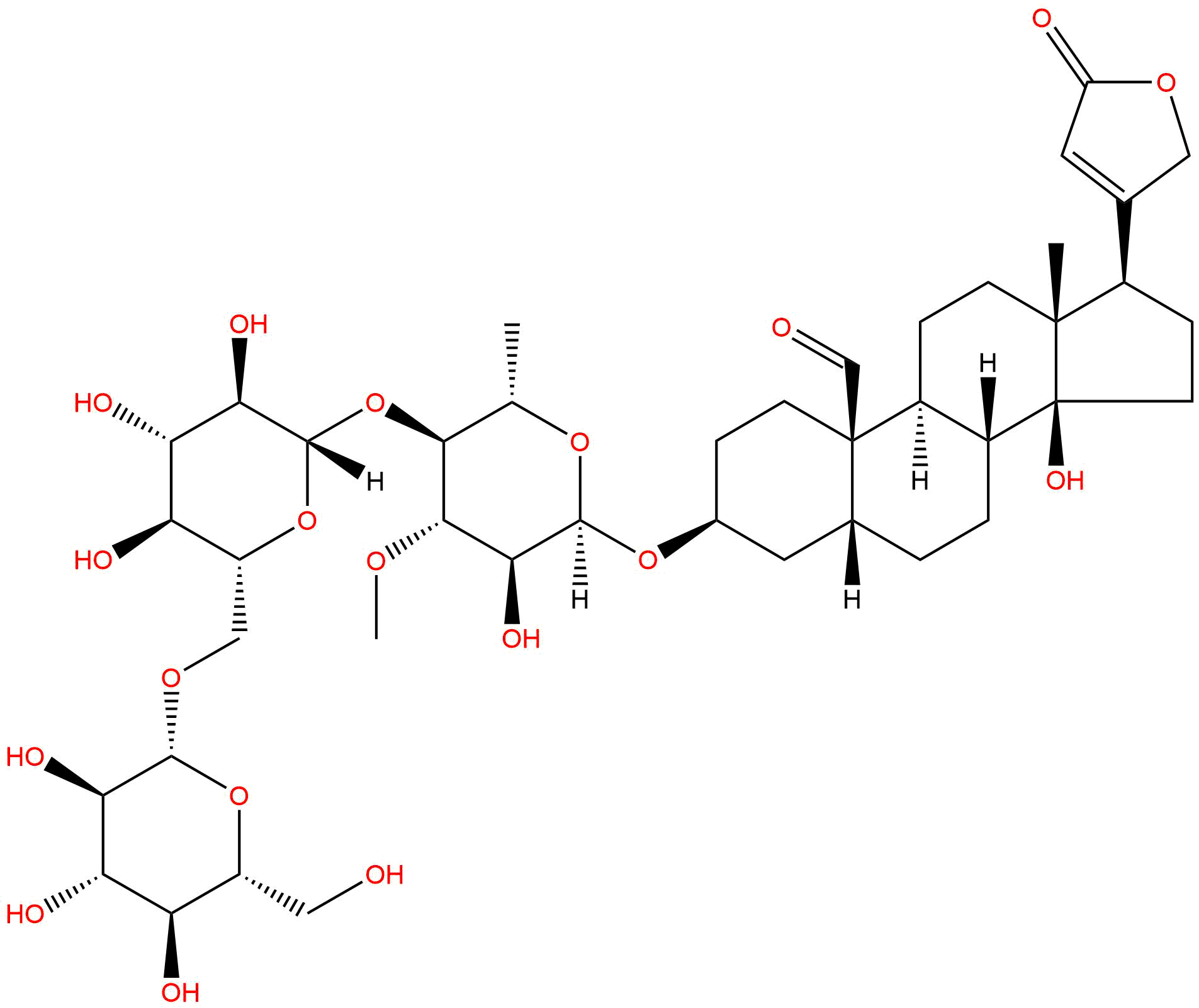
The molecular formula of Thevetin A is C ₄₂ H ₆₄ O ₁₉, with a molecular weight of 872.9550 Da, making it a typical cardiac glycoside compound. Its chemical structure consists of three parts: a steroid glycoside (Genin), an unsaturated lactone ring, and a sugar chain.
From the perspective of structural analysis, the aglycone of Huangjia Glycoside A is of the Cardenolide type, which means that a five membered unsaturated lactone ring (Butenolide) is connected to the C-17 position of the steroid nucleus. This is the key pharmacophore for all cardiac glycosides to exert pharmacological activity. Compared with the aglycone of digoxin (digoxigenin), the hydroxyl substitution pattern of Huangjia glycoside A on the steroid skeleton may differ, which directly affects its binding affinity and selectivity with target proteins. The sugar chain of Huangjia Glycoside A is usually composed of multiple sugar groups, which are connected to the C-3 hydroxyl group of the aglycone through β - glycosidic bonds. Unlike digoxin, which contains three digitatoxose sugars, the sugar chain composition of Huangjia Glycoside A is more complex and may include glucose, digitatoxose, or other rare deoxysugars. The difference in sugar groups is a key factor determining its water solubility, membrane permeability, metabolic stability, and oral bioavailability.
In terms of physicochemical properties, Huangjia Glycoside A exhibits typical cardiac glycoside characteristics. Its calculated lipid water partition coefficient (LogP) is 0.1364, indicating that it has lower lipophilicity and is more inclined to be distributed in aqueous environments. This characteristic is significantly lower compared to digoxin (LogP of approximately 1.26), suggesting that Huangjia Glycoside A may have better water solubility. Its topological polar surface area (TPSA) is as high as 290.0500 Å ², mainly attributed to the large number of hydroxyl and ether oxygen atoms in the molecule. A high TPSA value usually means that molecules have difficulty penetrating cell membranes, especially the blood-brain barrier. The prediction results show that the blood-brain barrier penetration ability of Huangjiaguanjia is "low", which to some extent reduces its risk of toxic side effects in the central nervous system. The predicted value of its water solubility is 0.6761 mg/mL, which belongs to moderate solubility. In addition, the Ames test result was 0.0, indicating that it did not show significant mutagenicity in the bacterial recovery mutation test, and the preliminary genetic toxicity risk was low. These physical and chemical properties together outline the molecular profile of Huangjia Glycoside A as a highly polar, water-soluble, and low-permeability molecule in the central nervous system.
Yellow oleander A is mainly derived from plants of the Apocynaceae family and the Apocynaceae genus. This plant species is native to tropical America and has been widely introduced and cultivated in many tropical and subtropical regions around the world. among which,Cascabela thevetioides(Also known as) Thevetia thevetioides)And Cascabela thevetia Yellow flowered oleander, also known as Thevetia peruviana)They are the two most extensively studied species. These plants are toxic throughout the plant, and their seeds, bark, and milk are rich in various cardiac glycosides, among which Huangjia Jia is one of the main active ingredients. Traditionally, these plants have been used in folk medicine to treat heart disease, but their toxicity also severely limits their application.
The extraction of Huangjia Glycoside A usually uses plant seeds as raw materials. The classic extraction process includes the following key steps:
It is worth noting that due to the coexistence of Huangjia glycoside A with structurally similar compounds (such as Huangjia glycoside B, Thevetin B) in plants, achieving efficient separation of the two is a difficult point in the extraction process. Modern chromatographic techniques, especially reverse phase high-performance liquid chromatography, provide reliable guarantees for obtaining high-purity single compounds.
The core pharmacological activity of Huangjia Glycoside A is its cardiotonic activity, which is also its fundamental characteristic as a cardiac glycoside compound. Its activity is mainly reflected in the following aspects:
Positive inotropic effect This is the most classic function of cardiac glycosides. Numerous in vitro and in vivo experiments have shown that Huangjia glycoside A can significantly enhance myocardial contractility. In ex vivo cardiac perfusion models (such as the Langendorff model) or myocardial cell experiments, Huangjiaguanjia can increase the amplitude and rate of myocardial contraction in a concentration dependent manner. This effect is not dependent on the release of catecholamines, nor is it affected by beta adrenergic receptor blockers, indicating that its mechanism of action is directly on myocardial cells. Compared with digoxin, Huangjia glycoside A exhibits a better therapeutic index (i.e. the ratio of effective dose to toxic dose) in some models, suggesting that it may have a wider safety window.
Negative frequency effect While enhancing myocardial contractility, Huangjia Jia Jia usually causes a decrease in heart rate (negative frequency effect). This is advantageous for patients with heart failure, as slowing heart rate can prolong the diastolic phase, increase the perfusion time of coronary arteries, improve the oxygen supply to the myocardium, and thus enhance the efficiency of the heart. Its negative frequency effect may be related to increased vagal tone and decreased sinus node autonomy.
Effects on electrophysiology Strong cardiac glycosides have complex effects on cardiac electrophysiological activity. Huangjia glycoside A can affect the action potential duration and refractory period of myocardial cells. At therapeutic doses, it may stabilize myocardial electrical activity by affecting ion channels such as potassium channels. However, when excessive, its inhibition of Na ⁺/K ⁺ - ATPase can lead to intracellular sodium and calcium ion overload, thereby inducing delayed afterdepolarizations (DADs), which is the main mechanism of cardiac glycoside induced arrhythmia. At present, there is insufficient specific assessment data on the risk of arrhythmia caused by Huangjia glycoside A, but based on its structural characteristics, this risk cannot be ignored.
Other potential pharmacological activities In addition to its cardiotonic effect, recent studies have also revealed other potential activities of Huangjiaguanjia. For example, some cardiac glycosides have been reported to have anti-tumor activity, and their mechanisms may be related to inhibiting tumor cell proliferation, inducing apoptosis, or regulating immune responses. It is worth further exploring whether Huangjia Glycoside A also has similar anti-tumor activity and whether its mechanism of action is related to the classical Na ⁺/K ⁺ - ATPase inhibition. In addition, studies have shown that certain cardiac glycosides have anti-inflammatory and antiviral activities, providing a new research direction for the non cardiovascular applications of Huangjiaguanjia.
The core molecular mechanism by which Huangjia Glycoside A exerts cardiotonic effects is the inhibition of Na ⁺/K ⁺ - ATPase on the myocardial cell membrane. This enzyme is a transmembrane protein complex responsible for pumping out three sodium ions inside the cell and two potassium ions outside the cell, maintaining a normal ion concentration gradient inside and outside the cell. Huangjia glycoside A specifically binds to the alpha subunit of Na ⁺/K ⁺ - ATPase through its steroid nucleus and butenolide ring, thereby inhibiting its enzymatic activity.
This inhibition process triggered a series of cascade reactions:
1. Elevated intracellular sodium ions After the inhibition of Na ⁺/K ⁺ - ATPase activity, the intracellular sodium ion concentration increased.
2. Changes in the activity of sodium calcium exchangers The high sodium environment inside the cell can inhibit or reverse the activity of the sodium calcium exchanger (SLC8A1, also known as NCX1) on the cell membrane. Under normal circumstances, NCX1 utilizes the electrochemical gradient of sodium ion influx to expel calcium ions from cells. When the intracellular sodium ions increase, the calcium excretion ability of NCX1 decreases and may even switch to a reverse mode, transporting extracellular calcium ions into the cell.
3. Intracellular calcium ion overload The ultimate result is a significant increase in intracellular calcium ion concentration in myocardial cells.
4. Increased release of sarcoplasmic reticulum calcium Elevated cytoplasmic calcium ions stimulate calcium release channels on the sarcoplasmic reticulum (Ryanodine receptors, RyR2), Triggering calcium induced calcium release (CICR) further amplifies the calcium signal.
5. Enhanced contraction force A large amount of calcium ions bind to troponin, releasing the inhibitory state of actin and myosin, promoting the formation of transverse bridges, and thus producing stronger myocardial contractions.
The molecular target network of Huangjia Glycoside A is not limited to Na ⁺/K ⁺ - ATPase itself. According to the provided target information, its action involves multiple subtypes and related proteins:
In summary, the mechanism of action of Huangjia Glycoside A is a complex network involving multiple ion channels and transporters, with inhibition of Na ⁺/K ⁺ - ATPase as the core. A deep understanding of its interactions with different target subtypes is key to elucidating its pharmacological and toxicological properties.
The pharmacological evaluation of Huangjia Glycoside A is based on its physicochemical properties, pharmacokinetic characteristics, and preliminary safety data.
Analysis of drug properties parameters:
- molecular weight:872.9550 Da, Far exceeding the threshold of molecular weight less than 500 in Lipinski's Rule of Five, it indicates that the molecule is relatively large and oral absorption may be poor.
- LogP 0.1364, low lipophilicity, good water solubility, conducive to injection administration, but not conducive to oral absorption and membrane permeability.
- TPSA 290.0500 Å ², much higher than the threshold of 140 Å ², indicates extremely low oral bioavailability and difficulty in penetrating cell membranes.
- blood-brain barrier Low, this is a favorable feature that can reduce the risk of central neurotoxicity.
- HERG inhibition: No. HERG potassium channel inhibition is the main risk factor for drug-induced QT interval prolongation and fatal arrhythmias (apical torsion ventricular tachycardia) in the heart. The result is negative, indicating that the risk of cardiac toxicity of Huangjiaguanjia at the hERG channel level is low, which is an important safety advantage.
- Ames test 0.0 indicates no genetic toxicity.
Pharmacokinetic characteristics:
Based on the above physicochemical properties, it can be reasonably inferred that the pharmacokinetic characteristics of Huangjia Glycoside A are:
1. absorb Poor oral absorption and extremely low bioavailability. Its high polarity, high molecular weight, and high TPSA make it difficult to passively diffuse through gastrointestinal epithelial cells. Therefore, intravenous injection may be its main route of administration.
2. distribution Due to its good water solubility, Huangjia glycoside A is mainly distributed in extracellular fluid and plasma. Its organizational distribution may be limited, especially difficult to access the central nervous system. The plasma protein binding rate needs to be experimentally determined.
3. Metabolism The metabolism of cardiac glycosides mainly occurs in the liver through hydrolysis, oxidation, and binding reactions. The sugar chain of Huangjia Glycoside A may be hydrolyzed by gut microbiota or liver enzymes to produce secondary glycosides or aglycones, which may have different pharmacological activities. Its metabolic pathways and enzymes (such as CYP450 enzyme system) still need to be clarified.
4. excretion Heart strengthening glycosides and their metabolites are mainly excreted through the kidneys and bile. The high water solubility of Huangjia Glycoside A may cause it to be mainly excreted through renal filtration in its original form or as a metabolite. Patients with renal insufficiency should be particularly cautious when using it to avoid accumulation poisoning.
safety evaluation:
Although the Ames test and hERG inhibition prediction results were negative, the core safety issues of Huangjiaguanjia, as a cardiac glycoside, remain narrow treatment window and risk of arrhythmia. The mechanism by which it induces arrhythmia is similar to that of digoxin, which leads to intracellular calcium overload and induces DADs by inhibiting Na ⁺/K ⁺ - ATPase. Therefore, in preclinical studies, it is necessary to evaluate the dose threshold and type of arrhythmia through in vivo and in vitro model systems. In addition, its gastrointestinal toxicity (nausea, vomiting) is also a common adverse reaction, which is related to the stimulation of the medullary emetic chemoreceptors.
Huangjia Glycoside A, as a structurally unique cardiac glycoside, has both promising and challenging clinical applications.
Potential application areas:
1. Heart Failure Treatment This is the most classic application field of cardiac glycosides. If Huangjiaguanjia can demonstrate a better therapeutic index than digoxin in preclinical studies (i.e. stronger positive inotropic effect and lower risk of arrhythmia), it is expected to become a new choice for the treatment of chronic heart failure, especially in patients with atrial fibrillation. Its low hERG inhibition risk is a significant potential advantage.
2. Arrhythmia treatment Although excessive use can lead to arrhythmia, in certain circumstances, cardiac glycosides can be used to control the ventricular rate of atrial fibrillation. The application value of Huangjia Glycoside A in this area needs to be evaluated.
3. Anti tumor research Given that many cardiac glycosides have anti-tumor activity, the structure of Huangjia glycoside A may provide a lead for the development of novel anti-tumor drugs. Future research can explore its inhibitory effect on the proliferation of different tumor cell lines and elucidate whether it works by inhibiting Na ⁺/K ⁺ - ATPase on tumor cells or through other non classical mechanisms.
Challenges faced and future research directions:
1. Oral bioavailability issue This is the biggest obstacle to the development of Huangjia Glycoside A. Its extremely low oral absorption rate makes it unsuitable for development as an oral medication. Future research directions include: developing novel drug delivery systems, such as liposomes, nanoparticles, or prodrug designs, to enhance their oral absorption and bioavailability; Alternatively, it can be developed directly as an intravenous injection for short-term treatment of acute heart failure.
2. Accurate evaluation of treatment window Rigorous in vitro and in vivo experiments need to be designed to systematically compare the dose-response relationship between Huangjiaguanjia and digoxin in terms of positive inotropic effects, arrhythmogenic effects, gastrointestinal toxicity, etc., in order to accurately calculate their therapeutic indices. Especially to evaluate its selectivity towards different Na ⁺/K ⁺ - ATPase alpha subtypes, which may be key to improving safety.
3. In depth analysis of the mechanism of action Using techniques such as molecular docking and surface plasmon resonance (SPR), investigate the binding modes of different subtypes of Huangjia glycoside A complexes with Na ⁺/K ⁺ - ATPase, and explain their functional characteristics at the atomic level. At the same time, using gene knockout or knock in models, the specific contributions of different target subtypes in the pharmacological and toxicological effects of Huangjiaguanjia were verified.
4. Pharmacokinetic and Toxicological Studies Conduct comprehensive preclinical pharmacokinetic studies to clarify its absorption, distribution, metabolism, and excretion characteristics in animal bodies. Conduct long-term toxicity tests to evaluate its chronic toxicity, reproductive toxicity, and carcinogenicity.
5. Research on Structure Modification and Structure Activity Relationship Using Huangjia glycoside A as the lead compound, structural modifications are carried out on its sugar chain, steroid skeleton, or lactone ring through chemical synthesis or biotransformation, aiming to obtain derivatives with higher activity, lower toxicity, and better pharmacokinetic properties. Systematically study its structure-activity relationship to provide theoretical guidance for the design of novel cardiac glycoside drugs.
Huangjia Glycoside A, as a natural plant derived cardiac glycoside, has demonstrated unique value in the field of cardiovascular drug development due to its unique chemical structure and potential pharmacological activity. Its high molecular weight, high polarity, good water solubility, low blood-brain barrier penetration, preliminary genetic toxicity, and low risk of hERG inhibition are the characteristics of drug development, which not only constitute its potential as an injection, but also expose its shortcomings in poor oral absorption. Its inhibitory effect on Na ⁺/K ⁺ - ATPase and its complex interaction network with multiple ion channels and transporters are the common basis for its cardiotonic effect and toxicity.
Future research should focus on addressing the core issue of low oral bioavailability, and through in-depth structure-activity relationship studies and mechanism of action analysis, accurately evaluate its therapeutic window and explore its potential advantages over digoxin. Meanwhile, exploring its applications in non cardiovascular fields such as anti-tumor therapy may also open up new avenues for its development. In summary, Huangjia Glycoside A is a natural product lead compound worthy of in-depth study. Systematic and rigorous modern pharmacological research on it not only helps to clarify its medicinal value, but also provides important scientific insights for the development of new and safer cardiac glycoside drugs.
Batch can search by a CAS number,one per line
