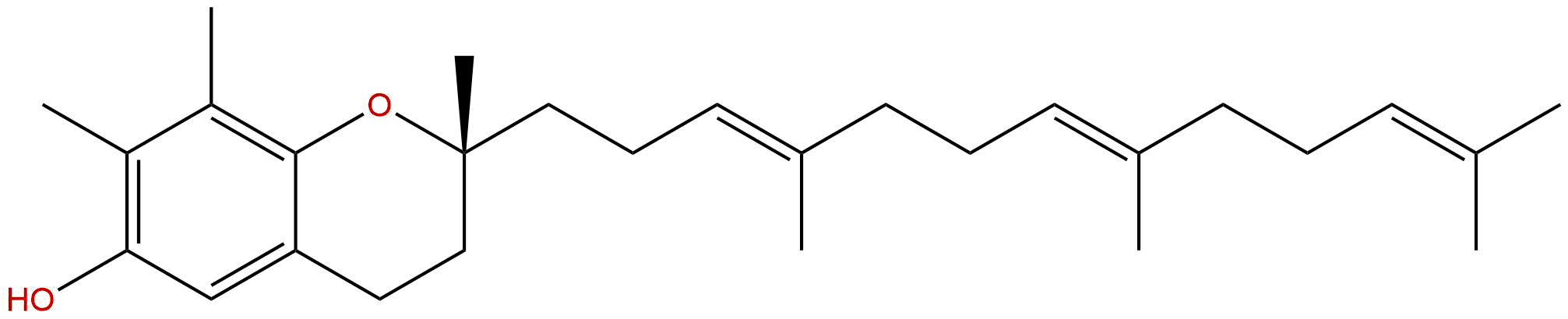


Product name: D-γ-Tocotrienol
Synonym name: Plastochromanol 3; γ-Tocotrienol
Catalogue No.: BP5332
Cas No.: 14101-61-2
Formula: C28H42O2
Mol Weight: 410.642
Botanical Source:
Type of Compound: Tocopherols
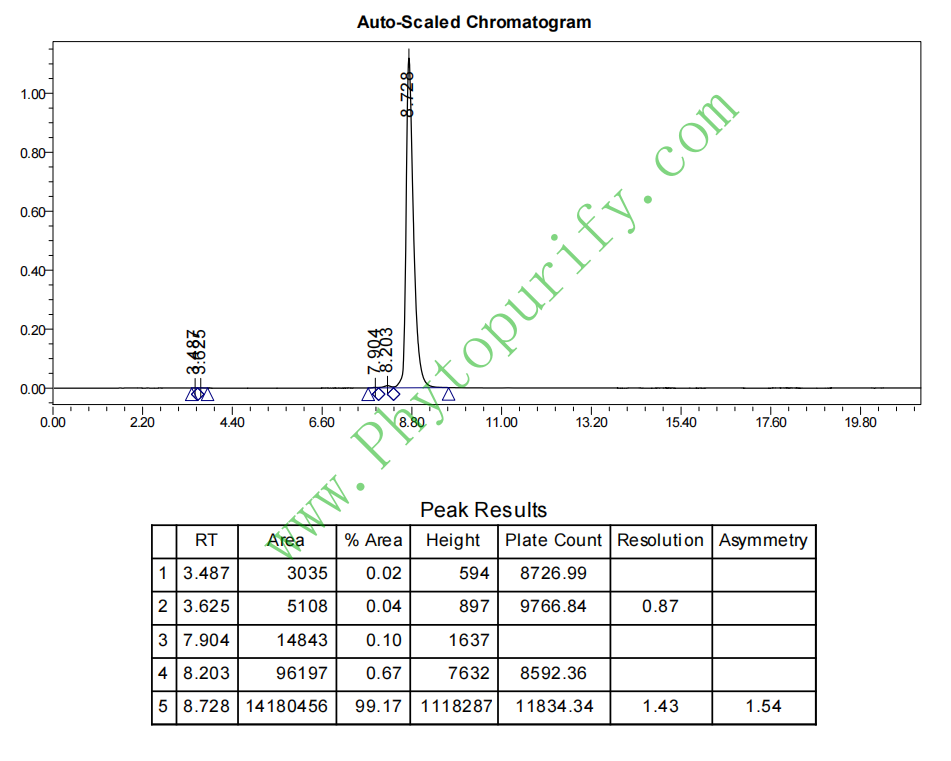
Purity: 95%~99%
Analysis Method: HPLC-DAD or/and HPLC-ELSD
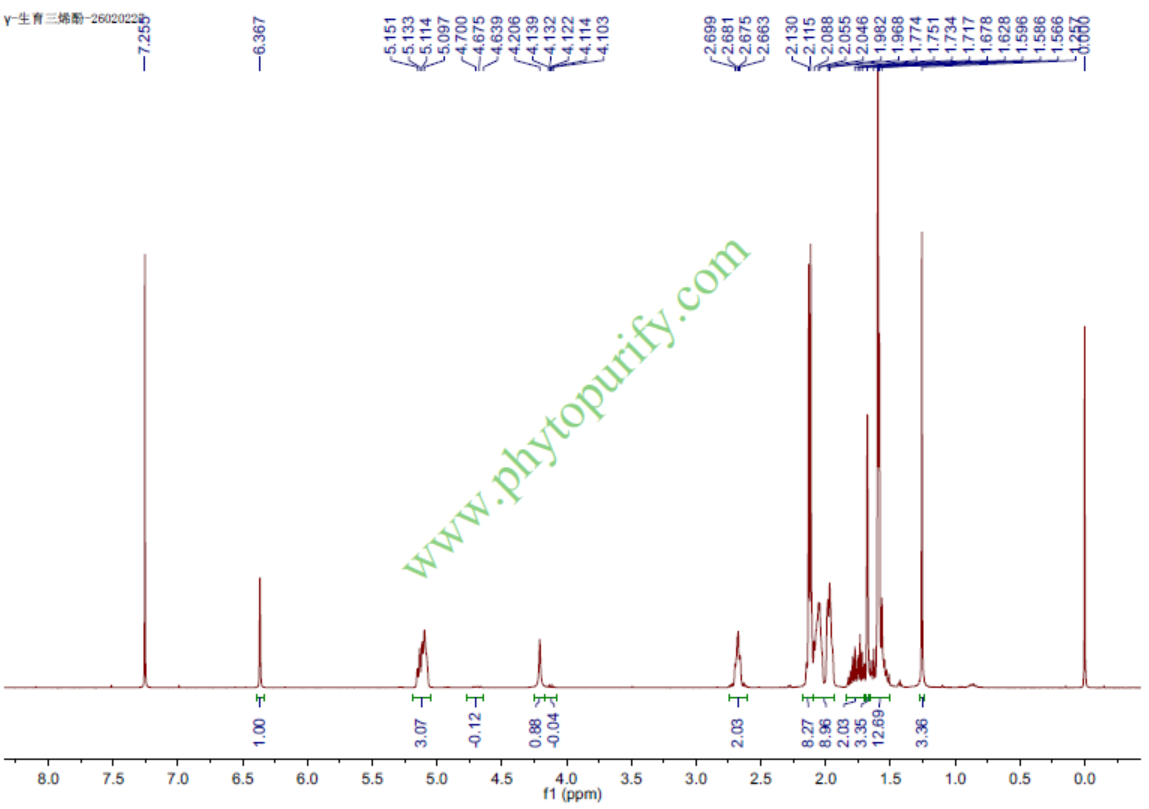
Identification Method: Mass, NMR
Packing: Brown vial or HDPE plastic bottle
Storage: Store in a well closed container, protected from air and light. Put into refrigerate or freeze for long term storage.
Whenever possible, you should prepare and use solutions on the same day. However, if you need to make up stock solutions in advance, we recommend that you store the solution as aliquots in tightly sealed vials at -20℃. Generally, these will be useable for up to two weeks.
The product could be supplied from milligrams to grams
Inquire for bulk scale.
For Reference Standard and R&D, Not for Human Use Directly.
HNMR-D-γ-Tocotrienol
HPLC of D-γ-Tocotrienol
Storage conditions:Short-term storage at 2~8℃, long-term storage at -20 ~ -80℃
29.4600
9.2288
9.2265
.0009
5.2534
10.0735
High
92.8372
3.6184
Yes
Yes
Yes
No
No
No
0.0
No
Yes
No
No
The vitamin E family has long been regarded as essential fat soluble vitamins for maintaining body health, and its classic member alpha tocopherol has attracted much attention due to its strong antioxidant activity. However, with the continuous deepening of research, another important member of the vitamin E family, Tocotrienols, has gradually entered the field of researchers and demonstrated unique biological activities beyond traditional tocopherols. Among the four homologues of tocotrienols (α, β, γ, δ), γ - tocotrienol (γ - T3) has become a research hotspot in the field of natural product pharmacology due to its excellent pharmacological activities such as anti-cancer, antioxidant, neuroprotective, and radiation protection.
Gamma tocotrienol (CAS number: 14101-61-2) is a benzodihydropyranol derivative with a farnesyl side chain, and its chemical structure determines its unique biofilm affinity and signaling pathway regulation ability. Compared with alpha tocopherol, gamma tocotrienol exhibits stronger proliferation inhibition and apoptosis induction effects in various tumor cell lines, and has lower toxicity to normal cells. This selective anti-tumor property makes it a highly promising natural anti-cancer candidate compound. In addition, gamma tocotrienol has shown broad application prospects in cardiovascular protection, metabolic disease intervention, and radiation injury protection.
This article will provide a systematic review of the research progress of γ - tocotrienol from the aspects of chemical structure, plant origin, pharmacological activity, molecular mechanism, medicinal evaluation, and clinical application prospects, aiming to provide theoretical basis for the in-depth development and transformation application of this natural product.
The chemical name of gamma tocotrienol is 2,7,8-trimethyl-2- (4,8,12-trimethyl-3,7,11-tridecanotrienyl) -6-benzodihydropyranol, with a molecular formula of C ₂ ₈ H ₄ ₂ O ₂ and a molecular weight of 410.6420. Its core structure consists of a benzodihydropyranol core (6-chromanol) and a farnesyl side chain containing three double bonds. Compared with tocopherol, the side chain of tocotrienol has three unsaturated double bonds (located at positions 3 ', 7', and 11 '), which endows tocotrienol with unique conformational flexibility and membrane insertion ability.
The benzene ring of γ - tocotrienol has one methyl substituent at positions 2, 7, and 8, and a phenolic hydroxyl group at position 6. Phenolic hydroxyl groups are key functional groups that exert antioxidant activity and can scavenge free radicals through hydrogen donating. The unsaturated structure of the farnesyl side chain enables it to more effectively insert into the phospholipid bilayer of the cell membrane, affecting membrane fluidity and the formation of signal transduction complexes. Research has shown that the side chain conformation of γ - tocotrienol can adopt multiple folding modes, and this conformational diversity may be closely related to its multi-target regulatory ability.
In terms of physicochemical properties, γ - tocotrienol has high lipid solubility (LogP=9.2288) and extremely low water solubility (0.0009 mg/mL), which determines that its absorption, distribution, and metabolic processes in vivo are highly dependent on lipid carriers. Its topological polar surface area (TPSA) is 29.46 Å ², indicating that the molecule has good membrane permeability. It is worth noting that gamma tocotrienol can cross the blood-brain barrier (BBB penetration is high), which provides the possibility for its application in the treatment of central nervous system diseases. In addition, the prediction result of hERG inhibition is negative (No), indicating a low risk of cardiac toxicity; The Ames test result is 0.0, indicating no significant mutagenicity, and the preliminary safety evaluation is relatively optimistic.
Gamma tocotrienol is widely distributed in nature and mainly exists in various plant oils and grains. Among them, palm oil (Elaeis guineensis) is one of the most abundant sources of γ - tocotrienols, and the content of γ - T3 in its tocotrienol component can reach more than 40% of the total tocotrienols. In addition, rice bran oil (Oryza sativa) is also an important source of γ - tocotrienols, with the main components being γ - T3 and δ - T3. Other plant sources rich in gamma tocotrienols include barley (Hordeum vulgare), oats (Avena sativa), rye (Secale cereale), as well as certain nuts and seed oils.
The methods for extracting γ - tocotrienol from plant raw materials mainly include organic solvent extraction, supercritical fluid extraction, and molecular distillation techniques. Traditional organic solvent extraction methods typically use n-hexane, petroleum ether, or ethanol as extraction solvents to obtain crude extracts through Soxhlet extraction or impregnation. This method is easy to operate and cost-effective, but there are problems such as solvent residue and insufficient selectivity. Supercritical CO ₂ extraction technology has been widely used in the extraction of γ - tocotrienols in recent years due to its advantages of green environmental protection and adjustable selectivity. By adjusting temperature and pressure parameters, selective separation of tocotrienol and tocopherol can be achieved, and the product purity can reach over 90%.
The crude extract after extraction needs to be further purified to obtain high-purity gamma tocotrienol. Common purification methods include silica gel column chromatography, high-performance liquid chromatography (HPLC), and preparative thin layer chromatography. Among them, normal phase silica gel column chromatography utilizes the subtle difference in polarity between tocotrienol and tocopherol to achieve separation, and the mobile phase is usually a n-hexane isopropanol or n-hexane ethyl acetate system. For large-scale production, the combination of molecular distillation technology and crystallization purification can effectively improve the purity of γ - tocotrienol. In recent years, new separation techniques such as molecular imprinting and simulated moving bed chromatography have also been applied to the efficient purification of γ - tocotrienol, showing promising application prospects.
It is worth noting that different plant sources and extraction processes have a significant impact on the isomer composition and biological activity of γ - tocotrienol. Therefore, establishing standardized extraction and purification processes to ensure product consistency and bioequivalence is crucial for the subsequent research and development of gamma tocotrienol.
The anti-tumor activity of γ - tocotrienol is one of its most concerned pharmacological properties. A large number of in vitro and in vivo studies have shown that γ - T3 has significant proliferation inhibition and apoptosis induction effects on a variety of malignant tumor cells, including breast cancer, prostate cancer, colorectal cancer, pancreatic cancer, lung cancer, liver cancer and melanoma.
In the study of breast cancer, γ - T3 can inhibit the proliferation of MCF-7, MDA-MB-231 and other breast cancer cell lines, and its IC ₀ value is usually within the range of 10-50 μ M. It is worth noting that γ - T3 is active on estrogen receptor positive (ER+) and triple negative breast cancer cells, suggesting that its mechanism of action does not depend on hormone receptor signaling pathway. In vivo experiments have shown that γ - T3 can significantly inhibit the growth of transplanted tumors in nude mice, and has a synergistic effect when combined with chemotherapy drugs such as tamoxifen and paclitaxel.
In prostate cancer research, gamma T3 can induce apoptosis in cell lines such as LNCaP, PC-3, and DU-145, and inhibit the androgen receptor signaling pathway. Research on colorectal cancer has shown that gamma T3 can exert anti-tumor effects by inhibiting the Wnt/β - catenin signaling pathway and inducing endoplasmic reticulum stress. In addition, γ - T3 has selective killing effect on pancreatic cancer stem cell like cells, suggesting that it may target tumor initiating cells.
As a member of the vitamin E family, gamma tocotrienol has significant antioxidant activity. Its phenolic hydroxyl group can effectively eliminate reactive oxygen species (ROS) such as peroxy radicals, singlet oxygen, and peroxynitrite, protecting cell membrane lipids, proteins, and DNA from oxidative damage. Compared with alpha tocopherol, gamma T3 has a higher antioxidant efficiency in liposome systems, which may be related to its unsaturated side chains being more easily inserted into membrane structures.
Gamma T3 also regulates the nuclear factor E2 related factor 2 (Nrf2) signaling pathway, induces the expression of antioxidant enzymes such as superoxide dismutase, glutathione peroxidase, heme oxygenase-1, etc., and enhances the endogenous antioxidant defense ability of cells. In addition, gamma T3 can inhibit the activation of nuclear factor kappa B (NF - κ B), reduce the expression of pro-inflammatory cytokines (such as TNF - α, IL-6, IL-1 β) and cyclooxygenase-2 (COX-2), thereby exerting anti-inflammatory effects.
The radiation protective activity of γ - tocotrienol has been an important research direction in recent years. Research has shown that gamma T3 can effectively reduce the damage of ionizing radiation to normal tissues, while enhancing the killing effect of radiation therapy on tumor cells. In animal models, pre-treatment with gamma T3 can significantly improve the survival rate of mice exposed to lethal doses of radiation, alleviate bone marrow suppression and gastrointestinal injury. Its radiation protection mechanism involves clearing free radicals generated by radiation, inhibiting radiation-induced cell apoptosis, promoting DNA damage repair, and regulating immune response.
It is worth noting that the radiation protection effect of γ - T3 on normal cells coexists with its radiation sensitization effect on tumor cells, and this "selective protection" characteristic makes it uniquely valuable in radiotherapy adjuvant therapy. Research suggests that gamma T3 may achieve this selective effect by differentially regulating the p53, NF - κ B, and PI3K/Akt signaling pathways in normal and tumor cells.
In addition to the aforementioned activities, gamma tocotrienol also exhibits various other pharmacological effects. In terms of cardiovascular protection, gamma T3 can reduce the oxidative susceptibility of low-density lipoprotein (LDL), inhibit the proliferation of vascular smooth muscle cells, improve endothelial function, and have antiplatelet aggregation activity. In the field of metabolic diseases, gamma T3 can improve insulin sensitivity, reduce blood glucose and lipid levels, and alleviate the pathological process of non-alcoholic fatty liver disease. In addition, gamma T3 also has neuroprotective effects, which can alleviate the neurotoxicity induced by β - amyloid protein, improve cognitive function, and provide new ideas for the treatment of Alzheimer's disease.
The pharmacological activity of γ - tocotrienol originates from its regulation of multiple molecular targets and signaling pathways. Unlike traditional "single target" drugs, gamma T3 exerts its biological effects through a "multi-target, multi pathway" network regulation mode, which gives it unique advantages in the treatment of complex diseases, especially cancer.
The mechanism by which γ - tocotrienol induces cell apoptosis involves two pathways: endogenous (mitochondrial) and exogenous (death receptor). In the mitochondrial pathway, γ - T3 can promote conformational changes and mitochondrial translocation of Bax/Bak, reduce the expression of anti apoptotic proteins Bcl-2 and Mcl-1, lead to a decrease in mitochondrial membrane potential and release of cytochrome c, thereby activating caspase-9 and caspase-3. Meanwhile, γ - T3 can upregulate the expression of death receptors DR4 and DR5, enhancing the exogenous apoptosis pathway induced by TRAIL. In addition, gamma T3 can promote the transcription of apoptosis related genes by activating the c-Jun N-terminal kinase (JNK) and p38 MAPK signaling pathways.
Gamma tocotrienol has inhibitory effects on multiple oncogenic signaling pathways. In the PI3K/Akt/mTOR pathway, γ - T3 can inhibit Akt phosphorylation, reduce mTOR activity, and thus inhibit protein synthesis and cell proliferation. In the NF - κ B pathway, γ - T3 inhibits the phosphorylation and degradation of I κ B α by suppressing the activity of I κ B kinase (IKK), thereby inhibiting the nuclear translocation and target gene transcription of NF - κ B. In the STAT3 pathway, γ - T3 can inhibit the phosphorylation of JAK2 and STAT3, and downregulate the expression of STAT3 target genes such as Cyclin D1, Survivor, and VEGF.
Recent studies have found that gamma tocotrienol can regulate gene expression through epigenetic mechanisms. Gamma T3 can inhibit the activity of histone deacetylase (HDAC), increase the acetylation levels of histone H3 and H4, and activate the expression of tumor suppressor genes. In addition, gamma T3 can also regulate the expression profile of microRNAs, such as upregulating tumor suppressor miRNAs such as miR-34a and miR-200c, and downregulating carcinogenic miRNAs such as miR-21.
Gamma tocotrienol can interfere with the metabolic reprogramming of tumor cells. Research has shown that gamma T3 can inhibit the expression and activity of key glycolytic enzymes such as hexokinase II and pyruvate kinase M2, reduce glucose uptake and lactate production, thereby suppressing the Warburg effect in tumor cells. Meanwhile, γ - T3 can activate AMP activated protein kinase (AMPK), promote fatty acid oxidation and mitochondrial biosynthesis, and alter the energy metabolism status of cells.
The regulatory effect of γ - tocotrienol on autophagy is cell type dependent. In certain tumor cells, gamma T3 can induce protective autophagy, and inhibiting autophagy can enhance its pro apoptotic effect; In other cells, gamma T3 promotes cell death by inhibiting autophagy. This difference may be related to cellular background and microenvironmental factors, and also provides a theoretical basis for combination therapy strategies.
Based on computational predictions and experimental data, the pharmacological parameters of γ - tocotrienol are as follows: molecular weight 410.64 Da (meeting the requirement of<500 in Lipinski's rule), LogP 9.23 (beyond the range of traditional oral drugs), TPSA 29.46 Å ² (meeting the requirement of<140 Å ²), and extremely low water solubility (0.0009 mg/mL). These parameters indicate that gamma tocotrienol has typical lipid soluble natural product characteristics, and its oral bioavailability may be limited by solubility and permeability. However, the hERG inhibition prediction was negative, and the Ames test result was 0.0, indicating a low risk of cardiac and genetic toxicity, and the preliminary safety evaluation was good.
The pharmacokinetic studies of γ - tocotrienol have been conducted in various animal models and humans. After oral administration, the absorption of γ - T3 depends on lipid carriers and bile acid emulsification. Compared with alpha tocopherol, the absorption efficiency of gamma T3 is lower, and the peak plasma concentration (Cmax) and area under the drug time curve (AUC) are usually smaller. Gamma T3 mainly binds and transports with lipoproteins (especially VLDL and LDL) in plasma, with a large distribution volume, indicating its widespread distribution in tissues and organs.
The metabolism of γ - tocotrienol mainly occurs in the liver, involving the cytochrome P450 enzyme mediated pathways of ω - oxidation and β - oxidation. The main metabolites include carboxylic acid derivatives with shortened side chains and sulfuric acid/glucuronic acid complexes. It is worth noting that the metabolic rate of γ - T3 is faster than that of α - tocopherol, which may be one of the reasons for its shorter half-life in vivo. Gamma T3 and its metabolites are mainly excreted into the intestine through bile, and some can be reabsorbed through the enterohepatic circulation.
Given the low oral bioavailability of gamma tocotrienol, researchers have developed various formulation strategies to improve its absorption. Lipid preparations, such as self emulsifying drug delivery systems and lipid nanoparticles, can significantly enhance the solubility and lymphatic transport of gamma T3, thereby increasing oral absorption. Cyclodextrin inclusion complexes can improve the bioavailability of γ - T3 by increasing its apparent solubility. In addition, when combined with bioavailability enhancers such as piperine, it can inhibit the glucuronic acid binding metabolism of γ - T3 and increase its plasma exposure.
The clinical application prospects of γ - tocotrienol in cancer treatment are broad. As a single drug, gamma T3 has shown good safety and preliminary efficacy in multiple phase I/II clinical trials. In breast cancer patients, oral γ - T3 supplementation can reduce the level of serum vascular endothelial growth factor (VEGF), suggesting its anti angiogenic activity. In prostate cancer patients, gamma T3 can reduce prostate specific antigen (PSA) levels and delay disease progression.
The combination application of gamma tocotrienol and chemotherapy drugs is an important research direction. Preclinical studies have shown that gamma T3 can enhance the anti-tumor effects of chemotherapy drugs such as paclitaxel, cisplatin, and gemcitabine, while reducing their toxic side effects. In the field of radiotherapy, the dual effects of radiation protection and sensitization of gamma T3 make it an ideal adjuvant drug for radiotherapy. Currently, clinical trials of gamma T3 combined with radiotherapy are being conducted in various solid tumors.
The application of gamma tocotrienol in the prevention and treatment of metabolic and cardiovascular diseases is also worthy of attention. Clinical studies have shown that γ - T3 supplementation can reduce fasting blood glucose, glycosylated hemoglobin and insulin resistance index in patients with type 2 diabetes. In patients with non-alcoholic fatty liver disease, gamma T3 can improve liver steatosis and inflammatory markers. In addition, the improvement effect of γ - T3 on blood lipid profile (reducing total cholesterol and LDL-C, increasing HDL-C) provides a basis for its application in the prevention and treatment of atherosclerosis.
The blood-brain barrier penetration of gamma tocotrienol gives it a unique advantage in the treatment of neurodegenerative diseases. Preclinical studies have confirmed the protective effects of gamma T3 on models such as Alzheimer's disease, Parkinson's disease, and multiple sclerosis. Preliminary clinical studies have shown that gamma T3 supplements can improve cognitive function in patients with mild cognitive impairment. However, its efficacy in neurodegenerative diseases still needs to be validated through large-scale clinical trials.
Although gamma tocotrienol has demonstrated various pharmacological activities and clinical application potential, its development still faces many challenges. Firstly, the low oral bioavailability is the main bottleneck restricting its clinical translation, and more efficient delivery systems need to be developed. Secondly, although the multi-target mechanism of action of γ - T3 endows it with broad activity, it also increases the complexity of mechanism of action research and the difficulty of target specificity verification. In addition, the optimal dosage, administration regimen, and combination therapy strategy of gamma T3 in different tumor types and patient populations still need to be systematically optimized.
Future research should focus on the following directions: developing new formulation technologies to improve the bioavailability and targeting of gamma T3; Using systems pharmacology and network pharmacology methods to elucidate its multi-target mechanism of action; Conduct high-quality multicenter clinical trials to validate the efficacy and safety of gamma T3 in specific diseases; Explore the synergistic combination of gamma T3 with other natural products or drugs, and develop multi-component combination therapy plans.
Gamma tocotrienol, as a unique member of the vitamin E family, exhibits diverse pharmacological activities beyond traditional tocopherols due to its unsaturated farnesyl side chain and unique structure of the benzodihydropyranol core. From anti-tumor, antioxidant, anti-inflammatory to radiation protection and neuroprotection, gamma T3 exerts multiple biological effects by regulating multiple signaling pathways and molecular targets. Its selective anti-tumor activity, protective effect on normal tissues, and good safety characteristics make it a highly promising natural candidate drug for development.
Although the challenges of low oral bioavailability and drug development still need to be overcome, with the development of formulation technology and deeper understanding of its mechanism of action, gamma tocotrienol is expected to achieve clinical translation in cancer treatment, metabolic disease intervention, and neuroprotection. In the future, interdisciplinary collaboration and translational medicine research will drive this natural product from the laboratory to clinical applications, contributing to the cause of human health.
