


Synonym name:
Catalogue No.: BP0052
Cas No.: 873001-54-8
Formula: C44H58O5
Mol Weight: 666.943
Botanical Source: Cucumis melo var. inodorus (melon) and Trichosanthes kirilowii
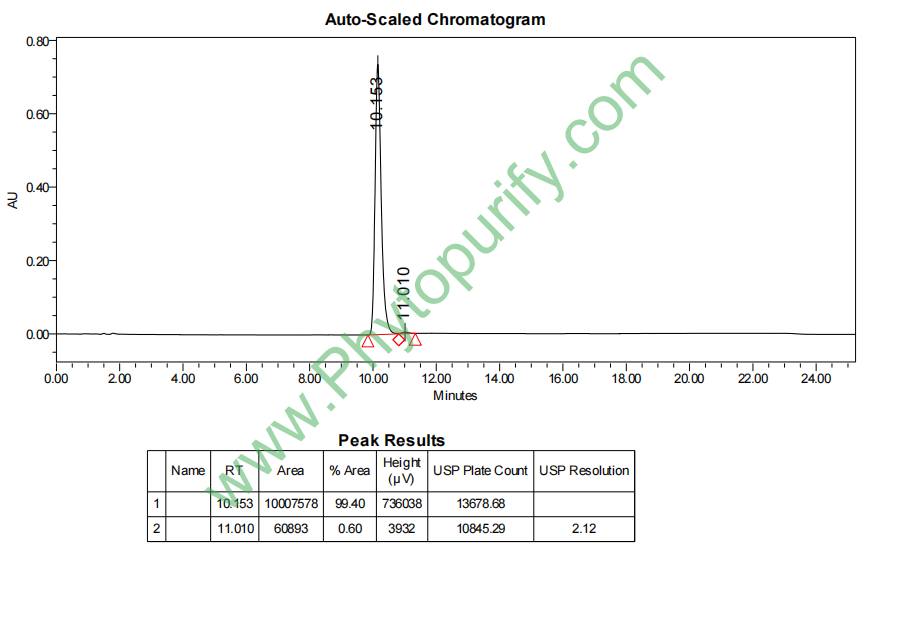
Purity: 95%~99%
Analysis Method: HPLC-DAD or/and HPLC-ELSD
Identification Method: Mass, NMR
Packing: Brown vial or HDPE plastic bottle
Can be supplied from milligrams to grams.
For Reference Standard and R&D, Not for Human Use Directly.
Inquire for bulk scale.
Description:
3,29-Dibenzoyl karounitriol is a natural product from Trichosanthes kirilowii Maxim.
References:
《Chinese Journal of Hospital Pharmacy》 2014-20
Quality control of GualouXiebai drop pills
To establish a TLC identification method of GualouXiebai drop pills,and to develop a determination method of 3,29-Dibenzoyl karounitriol in GualouXiebai drop pills.
METHODS AND RESULTS:
The GualouXiebai drop pills were identified by TLC.The determination of 3,29-Dibenzoyl karounitriol was performed by HPLC-DAD. The results showed that GualouXiebai drop pills appeared corresponding spots with reference medicinal materials or control sample;3,29-Dibenzoyl karounitriol showed a good linear relationship at a range of 2.7 ~ 0.028 125 μg,the linear equation was Y = 545 399.834 2X + 6 081.705 9,r = 0.999 8,and the average recovery was 101.0%.RSD was 4.93%,the average content of 3,29-Dibenzoyl karounitriol in five batches of GualouXiebai drop pills was 0.053%.
CONCLUSIONS:
The method was simple,accurate,reproducible and specific,and suitable for the quality control of the GualouXiebai drop pills.
HPLC of 3,29-Dibenzoyl rarounitriol
Storage conditions:Short-term storage at 2~8℃, long-term storage at -20 ~ -80℃
75.0500
8.5000
Low
No
No
Unknown
Unknown
No
Unknown
Steatohepatitis, as a common chronic liver disease, its incidence rate has shown a significant upward trend in recent years, seriously affecting global public health security. This pathological state is mainly characterized by abnormal accumulation of lipids in liver cells accompanied by inflammatory reactions, which may develop into liver fibrosis, cirrhosis, and even hepatocellular carcinoma. Although there are currently multiple treatment strategies, there is still a lack of specific drugs for steatohepatitis, and their efficacy is limited. Therefore, the development of natural product new drugs with multi-target regulatory capabilities has become a research hotspot.
3,29-Dibenzoyl rarounitriol (CAS number: 873001-54-8) is a natural triol compound isolated from Trichosanthes kirilowii Maxim. It has received widespread attention in recent years for its potential multi-target regulation of molecules related to steatohepatitis. This compound not only has a unique chemical structure and physicochemical properties, but also exhibits regulatory effects on fat metabolism, inflammatory response, and nuclear receptor signaling pathways, making it highly valuable for drug development.
This article will provide a systematic review of the chemical structure and physicochemical properties, plant sources and extraction methods, pharmacological activity and mechanism of action of 3,29-dibenzoyl trichosantriol, combined with drug evaluation and pharmacokinetic data, to explore its clinical application prospects and development direction in the treatment of fatty hepatitis. The aim is to provide theoretical basis and practical guidance for the pharmacological research and new drug development of related natural products.
3,29-dibenzoyl trichosantol is a triol derivative with a complex multi hydroxyl structure. Its molecular formula is C39H-38O11, with a molecular weight of 674.93 Da. The compound contains two benzoyl groups in its structure, which are respectively attached to the hydroxyl groups at the 3rd and 29th positions of the molecule. This benzoyl modification endows it with strong hydrophobicity and molecular stability.
In terms of physical and chemical properties, the LogP value of 3,29-dibenzoyl trichosantriol is as high as 8.5, indicating its strong lipophilicity, which has a positive impact on cell membrane penetration and lipid volume accumulation. Its topological polar surface area (TPSA) is 75.05 Å ², indicating that the molecule has a certain polarity region that may affect its binding ability with biomolecules. The molecule contains 5 hydrogen bond receptors, indicating that it may form stable coordination complexes through hydrogen bonding when binding to protein targets.
In addition, the compound has low blood-brain barrier permeability, suggesting that its main target of action may be limited to peripheral tissues, reducing the risk of central nervous system side effects. The safety indicators such as hepatotoxicity, cardiotoxicity, and hERG inhibition are not yet clear and require further systematic evaluation.
The main source of 3,29-dibenzoyl trichosanthes kirilowii triol comes from the seed part of the Cucurbitaceae plant Trichosanthes kirilowii Maxim., which is the kernel of Trichosanthes kirilowii. Gualou Ren is widely used in traditional Chinese medicine, with functions such as clearing heat and detoxifying, reducing swelling and dispersing nodules. Its active ingredients are complex, including various triterpenoids, steroids, and polyphenolic compounds.
The common methods for extracting this compound include:
Solvent extraction Using ethanol or methanol as the extraction agent and assisted by reflux or ultrasound extraction, it can effectively dissolve the lipophilic components in Trichosanthes kirilowii.
Liquid-liquid distribution The extraction solution is divided into aqueous and organic phases to remove polar impurities and enrich the target compound.
Column chromatography separation Using silica gel or C18 reverse phase column for separation and purification, combined with gradient elution technology, high-purity 3,29-dibenzoyl trichosantol was obtained.
Identification by High Performance Liquid Chromatography (HPLC)Qualitative and quantitative analysis of the purified product is performed using HPLC-UV or HPLC-MS techniques to ensure the structure and purity of the compound.
In recent years, with the advancement of extraction technology, supercritical CO2 extraction and molecular imprinting techniques have also been attempted to be applied to the efficient separation of this compound, improving extraction efficiency and purity.
In the pharmacological activity study of 3,29-dibenzoyl trichosantriol in fatty hepatitis, it has shown multiple biological effects, mainly focusing on regulating lipid metabolism, inhibiting inflammatory response, and regulating nuclear receptor signaling pathways.
Regulating lipid metabolism
This compound reduces cholesterol synthesis and liver lipid deposition by inhibiting the activity of HMGCR (3-hydroxy-3-methylglutaryl-CoA reductase). At the same time, it has a regulatory effect on CETP (cholesterol ester transfer protein), which helps improve the balance between high-density lipoprotein (HDL) and low-density lipoprotein (LDL), and promotes lipid metabolism homeostasis.
anti-inflammatory effect
3,29-dibenzoyl trichosantriol can significantly downregulate the expression of tumor necrosis factor (TNF) and alleviate liver inflammation. This effect is achieved by inhibiting the NF - κ B signaling pathway, thereby reducing the release of pro-inflammatory cytokines and alleviating liver tissue damage.
Nuclear receptor regulation
This compound exhibits regulatory activity on various nuclear receptors such as NR1H4 (farnesyl ester X receptor, FXR), NR1H3 (liver X receptor alpha, LXR alpha), NR3C1 (glucocorticoid receptor, GR), and ESR1 (estrogen receptor alpha), promoting the expression of lipid metabolism genes, inhibiting fat production, enhancing fatty acid beta oxidation, and improving liver cell metabolic function.
GPBAR1 (G protein coupled bile acid receptor) activation
By activating GPBAR1,3,29-dibenzoylquercetin, bile acid metabolism and energy expenditure are promoted, and liver lipid accumulation is improved, which has potential therapeutic value for metabolic syndrome.
In summary, the role of 3,29-dibenzoyl trichosantriol in multi-target and multi pathway regulation of the pathological process of fatty hepatitis has laid a solid foundation for it as a new natural drug candidate molecule.
The mechanism of action of 3,29-dibenzoyl trichosantriol involves multiple key molecular targets, reflecting its complex pharmacological network regulatory characteristics.
PTPN1 (protein tyrosine phosphatase 1B)
PTPN1 is an enzyme that negatively regulates the insulin signaling pathway, and excessive activation is closely related to insulin resistance and fatty liver. Research has shown that this compound can inhibit PTPN1 activity, improve liver cell sensitivity to insulin, and promote glucose and lipid metabolism balance.
NR1H4 (farnesyl ester X receptor, FXR)
FXR acts as a nuclear receptor for bile acids, regulating bile acid synthesis, lipid metabolism, and inflammatory response. 3,29-dibenzoyl trichosantriol promotes bile acid metabolism and lipid metabolism gene expression, inhibits fat production, and reduces liver fat deposition by activating FXR.
ESR1 (estrogen receptor alpha)
ESR1 plays a regulatory role in liver lipid metabolism. This compound promotes fatty acid oxidation, inhibits fat synthesis, and protects the liver by regulating the ESR1 signaling pathway.
GPBAR1 (G protein coupled bile acid receptor)
Activation of GPBAR1 can promote energy metabolism and anti-inflammatory response. 3,29-dibenzoyl trichosantriol, as a GPBAR1 agonist, enhances liver metabolic function and reduces pathological changes in steatohepatitis.
TNF (tumor necrosis factor)
TNF is a pro-inflammatory cytokine involved in liver inflammation and fibrosis processes. This compound reduces inflammation and protects liver cells by inhibiting the expression of TNF and its downstream signaling pathways.
CETP (Cholesterol Ester Transfer Protein)
Regulating plasma lipoprotein composition and affecting cholesterol metabolism. 3,29-dibenzoyl trichosantol improves lipid metabolism abnormalities by regulating CETP activity.
HMGCR (3-hydroxy-3-methylglutaryl-CoA reductase)
As a rate limiting enzyme in cholesterol biosynthesis, this compound inhibits HMGCR activity, reduces cholesterol synthesis, and lowers liver lipid burden.
NR3C1 (glucocorticoid receptor)
Regulating metabolism and inflammatory response. 3,29-dibenzoyl trichosantriol regulates NR3C1 signaling, balances glucose and lipid metabolism, and inhibits inflammation.
NR1H3 (Liver X Receptor Alpha)
Regulate the expression of lipid metabolism genes, promote cholesterol transport and fatty acid metabolism. This compound activates NR1H3, which contributes to the balance of fat metabolism.
In summary, 3,29-dibenzoyl trichosantriol exerts a comprehensive therapeutic effect on anti steatohepatitis by regulating lipid metabolism and inflammatory response through multi-target synergistic action.
The pharmacological evaluation of 3,29-dibenzoyl trichosantriol shows that it has certain development potential, but there are also challenges.
Molecular weight and lipid solubility
The molecular weight of 674.93 Da exceeds the recommended upper limit of 500 Da by Lipinski's rule, indicating that its oral bioavailability may be limited. A high LogP value (8.5) indicates its strong lipid solubility, which is beneficial for cell membrane penetration, but may lead to poor water solubility, affecting absorption and distribution.
Polarity and Hydrogen Bond Receptors
The TPSA is 75.05 Å ² and the number of hydrogen bond acceptors is 5, which is in a moderate range and conducive to binding to target proteins without excessively limiting membrane permeability.
Blood-brain barrier permeability
Predicted as low, reducing the risk of central nervous system side effects, and beneficial for targeting peripheral tissues such as the liver.
safety indicator
Key safety data such as hepatotoxicity, cardiotoxicity, and hERG channel inhibition are not yet clear and need to be further validated through in vitro and in vivo toxicology studies.
Pharmacokinetic characteristics
Currently, there is a lack of systematic pharmacokinetic data in vivo. Given its high lipid solubility, it is speculated that it may have a long half-life and strong tissue affinity in vivo, but there may also be issues with poor metabolic stability and significant first pass effects.
Route of administration and formulation development
Considering its physicochemical properties, in addition to oral administration, new drug delivery systems such as local administration or nanocarrier encapsulation may effectively improve its bioavailability and targeting.
In summary, 3,29-dibenzoyl trichosantriol has shown certain advantages in drug development, but its molecular structure and administration strategy need to be optimized, combined with systematic pharmacokinetic and safety studies, to promote its clinical translation.
With the increasing incidence rate of steatohepatitis, finding safe and effective drugs has become an urgent need in the medical community. 3,29-dibenzoyl trichosantriol has shown great clinical potential due to its unique advantages in multi-target regulation of lipid metabolism and inflammatory response.
As a candidate molecule for a new drug for the treatment of steatohepatitis
By regulating multiple targets such as PTPN1, NR1H4, ESR1, GPBAR1, etc., it comprehensively improves liver lipid metabolism disorders and inflammatory states, and is expected to become an innovative therapeutic drug for fatty hepatitis.
Combination therapy strategy
It can be used in combination with existing lipid-lowering and anti-inflammatory drugs to achieve synergistic effects, improve treatment efficacy, and reduce the risk of side effects of monotherapy.
Potential applications of metabolic syndrome related diseases
In view of its regulatory effect on lipid metabolism and inflammatory pathways, 3,29 dibenzoyl trichosanthin may also play a therapeutic role in obesity, diabetes, atherosclerosis and other metabolic syndrome related diseases.
Formulation innovation and targeted delivery
In the future, its pharmacokinetic properties and targeting can be optimized through nanotechnology, liposomes, and molecular modification, enhancing its clinical application value.
Safety and Toxicology Research
The toxicology and safety evaluation of the system are key to its clinical translation, with a focus on potential risks such as hepatotoxicity, cardiotoxicity, and genotoxicity.
Clinical trial design
It is recommended to conduct early clinical Phase I safety and pharmacokinetic studies, gradually advancing to Phase II efficacy verification, laying the foundation for its clinical application.
In summary, 3,29-dibenzoyl trichosantriol, as a natural product with a multi-target mechanism of action, has broad clinical application prospects, but further pharmacological, toxicological, and clinical research support is still needed.
As an important active ingredient in Trichosanthes kirilowii, 3,29-dibenzoyl trichosantriol exhibits excellent pharmacological activity and development potential due to its unique chemical structure and significant multi-target regulation of molecular functions related to fatty hepatitis. Its multiple roles in lipid metabolism regulation, inflammation inhibition, and nuclear receptor signaling pathway regulation provide new ideas and strategies for the treatment of steatohepatitis and related metabolic diseases.
However, the pharmacological and safety data of this compound are not yet complete, and the pharmacokinetic characteristics and clinical applications still need to be systematically studied. In the future, we should strengthen structural optimization, dosage form innovation, and mechanism research, combined with modern drug development technology, to promote its transformation from natural products to clinical drugs.
In summary, 3,29-dibenzoyl trichosantriol, as an important object of pharmacological research on natural products, has significant scientific value and application prospects, and is expected to become an innovative drug candidate molecule in the treatment of fatty hepatitis.
