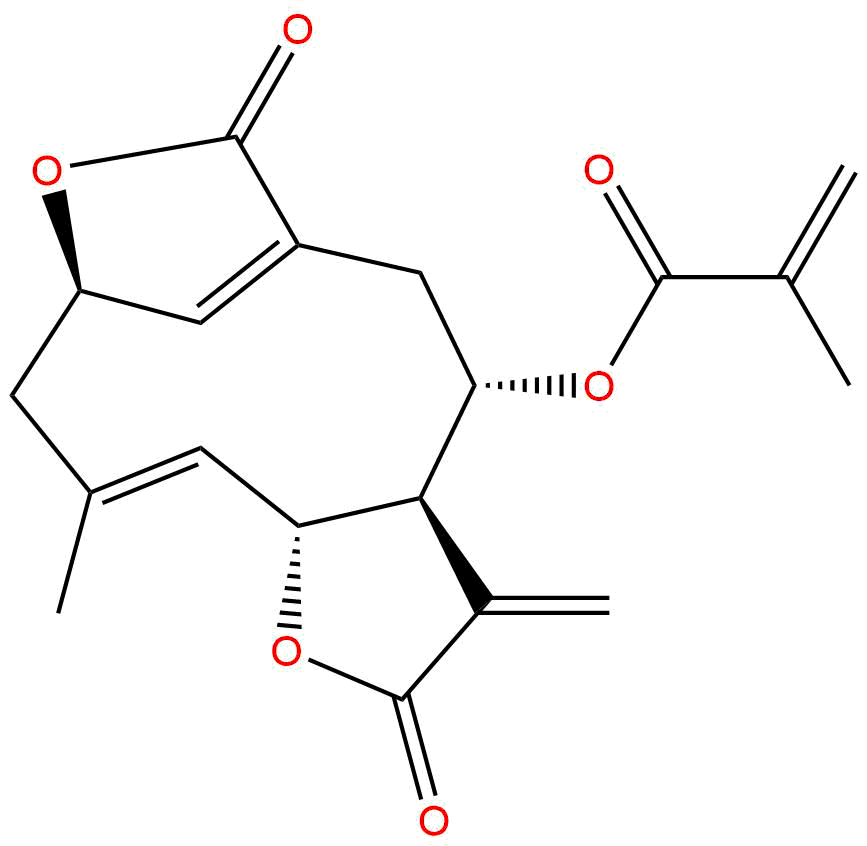


Product name: Deoxyelephantopin
Synonym name: Deoxyelephantopin
Catalogue No.: SBP02295
Cas No.: 29307-03-7
Formula: C19H20O6
Mol Weight: 344.363
Botanical Source:
Physical Description:
Type of Compound: Sesquiterpenoids
Purity: 95%~99%
Analysis Method: HPLC-DAD or/and HPLC-ELSD
Identification Method: Mass, NMR
Packing: Brown vial or HDPE plastic bottle
The product could be supplied from milligrams to grams
Inquire for bulk scale.
The structural types of sesquiterpenes in Elephantopus scaber Linn. mainly involve gimarane-type, guaiacum-type and elemene-type, etc. Ten sesquiterpene compounds were isolated and identified from Elephantopus scaber Linn. Among them, gimarane-type lactones are the main skeleton types of the sesquiterpene lactones of Elephantopus scaber Linn. At present, we isolated and obtained scabertopin,isoxyelephantopin, isoscabertopin with anti-hepatocellular carcinoma cell (SMMC-7721) activity, and deoxyelephantopin, elephantopin, 11,13-dihydrodeoxyelephantopin, and scabertopinol.
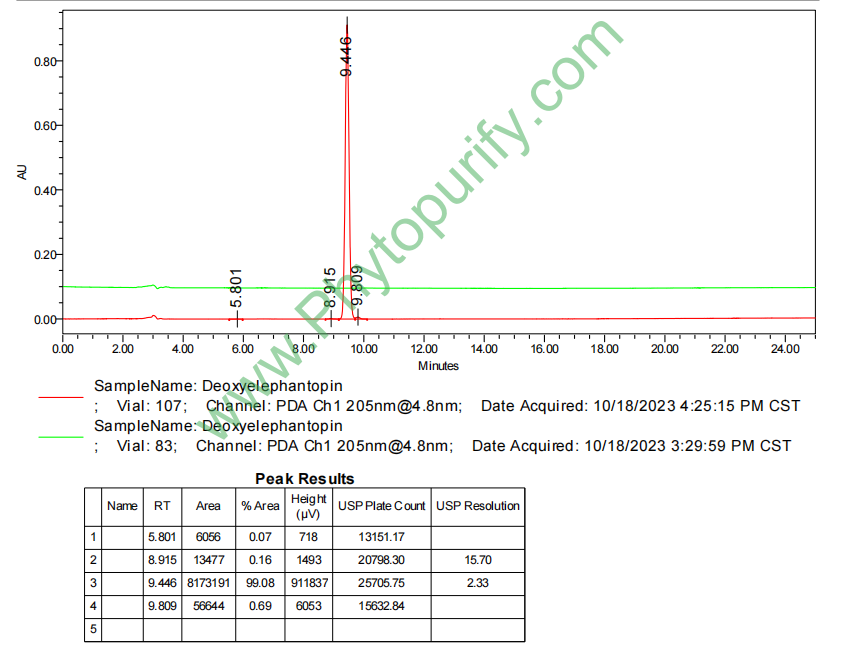
HPLC of Deoxyelephantopin
Storage conditions:Short-term storage at 2~8℃, long-term storage at -20 ~ -80℃
78.9000
1.7460
1.7460
.3299
4.1170
4.7866
High
65.6730
5.8278
No
Yes
No
No
Yes
No
0.0
Yes
Yes
Yes
Yes
Deoxyelephantopine is a natural sesquiterpene lactone compound with significant biological activity. Its CAS number is 29307-03-7, molecular formula is C19H20O6, and molecular weight is 344.3630 g/mol. This compound is mainly derived from the Asteraceae plant Gentiana scabra(Elephantopus scaber L. Separated from it. Gallbladder grass is widely distributed in tropical and subtropical regions of Asia, Africa, and the Americas. It has a long history of application in traditional medical systems in many countries and is commonly used to treat fever, inflammation, infections, and various types of pain.
Modern pharmacological research has revealed that deoxydiglycoside exhibits a wide range of biological activities, among which the most notable is its Antitumor activity Research has shown that it can inhibit the proliferation, invasion, and metastasis of cancer cells and induce cancer cell apoptosis by acting on multiple key cellular signaling pathways and molecular targets. Its mechanism of action involves the regulation of important signaling pathways such as NF - κ B, MAPK, PI3K/Akt/mTOR, Wnt/β - catenin, as well as the regulation of key proteins such as TP53, CASP3, MYC, BAX, CDKN1A, etc. Therefore, deoxydiglycoside has become a hot topic molecule in the field of natural product anti-tumor drug research, providing important lead compounds for the development of new anti-cancer drugs.
Deoxydigastrol belongs to the sesquiterpene lactone class of compounds. Its chemical structure is based on a complex sesquiterpene skeleton and contains one or more lactone rings, which is an important structural basis for its biological activity. From the provided SMILES string (C=C (C) C (=O) O [C @ H] 1CC2=C C@@H It can be inferred that the molecule has multiple chiral centers (represented by the @ symbol), indicating its specific stereoconfiguration, which is crucial for its specific recognition and binding to biological targets.
According to the analysis of drug parameters, its molecular weight (MW) is 344.36 g/mol, which meets the requirement of "molecular weight less than 500" in Lipinski's five rules. The calculated logarithm of the lipid water partition coefficient (LogP/LogD) is approximately 1.75, indicating that the compound has moderate lipophilicity, which is conducive to transmembrane absorption, while also retaining some water solubility (predicted water solubility is 0.33 mg/mL). The topological polar surface area (TPSA) is 78.90 Å ², which is lower than the commonly believed critical value for membrane permeability (about 140 Å ²), indicating its good membrane permeation potential. The predicted permeability value (4.79) and effective permeability coefficient (Peff, 4.12) of Caco-2 cells are both high, further supporting its good intestinal absorption potential. It is worth noting that it The blood-brain barrier (BBB) penetration is predicted to be 'high'This provides a favorable physicochemical basis for its potential application in the treatment of central nervous system related tumors.
The main plant source of deoxydiglycoside is Di Dan Cao Also known as Di Dan Tou, Ku Di Dan, etc. In traditional Chinese medicine theory, the whole herb of Didan Cao is used as medicine, with a bitter, pungent, and cold nature. It belongs to the lung, liver, and kidney meridians and has the effects of clearing heat, purging fire, cooling blood, detoxifying, promoting diuresis, and reducing swelling. Commonly used for treating symptoms such as colds, high fever, sore throat, lung heat cough, redness and swelling of the eyes, abscesses and sores, damp heat jaundice, and edema. In folk medicine in Southeast Asia, India, South America, and other regions, Dichlorperia is also commonly used to treat inflammation, infections, hepatitis, nephritis, and various skin diseases.
Traditional applications provide valuable clues for modern research. Scientists have systematically isolated and identified active ingredients from this medicinal plant, and deoxycholinergic acid is one of the most representative active monomers. The effective combination of traditional knowledge and modern pharmacological research, from the traditional "clearing heat and detoxifying" effect to the modern scientifically proven "anti-inflammatory and anti-tumor" activity, also provides a classic example for the development of new drugs based on natural products.
The core pharmacological activity of deoxydiglycoside is antitumor activity The mechanism is the synergistic effect of multiple targets and pathways.
4.1 Inhibition of key signaling pathways
Research has confirmed that deoxycholic acid can effectively inhibit multiple signaling pathways closely related to tumor occurrence, development, metastasis, and drug resistance:
- NF - κ B pathway NF - κ B is a core transcription factor that regulates inflammatory response and cell survival, and is continuously activated in various cancers. Deoxystrobin inhibits the degradation of I κ B α or nuclear translocation of NF - κ B p65 subunit, blocking its transcriptional activity, thereby downregulating the expression of a series of pro survival, pro proliferation, and pro metastatic genes and inducing cancer cell apoptosis.
- MAPK pathway This pathway (including ERK, JNK, p38) is involved in cell proliferation, differentiation, and stress response. Deoxycholecystokinin can regulate the phosphorylation levels of MAPK family members, such as activating JNK/p38 (pro apoptotic pathway) and inhibiting ERK (pro proliferative pathway), thereby directing cell fate towards apoptosis.
- PI3K/Akt/mTOR pathway This is one of the most important pathways regulating cell growth and metabolism, often overactivated in tumors. Deoxydigastrol can inhibit the activity of this pathway, reduce the phosphorylation levels of Akt and mTOR, leading to downstream inhibition of pro survival and protein synthesis functions, while activating autophagy and apoptosis.
- Wnt/β - catenin pathway The abnormal activation of this pathway is closely related to the characteristics of tumor stem cells, epithelial mesenchymal transition (EMT), and metastasis. Deoxydigastrol can inhibit tumor invasion and metastasis by promoting the degradation of β - catenin or inhibiting its nuclear translocation, downregulating target genes such as c-Myc and Cyclin D1.
4.2 Regulation of Key Target Proteins
The target information provided by the database (TP53, CASP3, MYC, BAX, CDKN1A) accurately points to the core cellular events of deoxycholinergic action:
- Inducing cell cycle arrest: Through upward adjustment CDKN1A(p21) The expression of p21, as a cyclin dependent kinase inhibitor, can cause cell cycle arrest in G1/S or G2/M phase, preventing cancer cells from proliferating indefinitely. This process is usually associated with TP53(p53) The activation of tumor suppressor proteins is related. Deoxycholic acid can stabilize and activate p53, thereby transcribing and activating p21, achieving cell cycle checkpoint control.
- Activate mitochondrial apoptosis pathway Deoxydigastrol can upregulate pro apoptotic proteins BAX At the same time, it may downregulate the anti apoptotic protein Bcl-2. BAX forms pores on the outer membrane of mitochondria, leading to loss of mitochondrial membrane potential and release of cytochrome C. Cytochrome C released into the cytoplasm will form apoptotic bodies with Apaf-1 and caspase-9, thereby activating downstream cells CASP3(caspase-3)Caspase-3 is a key effector caspase, whose activation marks the irreversible execution stage of apoptosis, leading to DNA breakage and cell disintegration.
- Inhibition of oncogene expression:MYC(c-Myc) It is a powerful oncogene that drives cell proliferation, metabolic reprogramming, and immutalization. Deoxydigastrol inhibits the NF - κ B, Wnt/β - catenin and other pathways mentioned above, and may effectively downregulate the expression of c-Myc through other mechanisms, thereby weakening the growth and survival advantages of cancer cells.
In addition, deoxycholic acid can also Regulating oxidative stress Inducing the generation of reactive oxygen species (ROS). Moderate increase in ROS can further damage the mitochondrial function of cancer cells, amplify apoptotic signals, and may affect the aforementioned signaling pathways through oxidative modifications. its Anti inflammatory and immune regulation The activity also has an improving effect on the tumor microenvironment, which may indirectly enhance the anti-tumor effect.
In summary, deoxycholic acid exhibits strong multi-target anti-tumor potential through a sophisticated "network like" mechanism of action, while intervening in the proliferation, survival, cycle progression, and death program of cancer cells. It is particularly helpful in overcoming the problem of resistance to single target drugs.
Based on the provided pharmacological parameters, a preliminary evaluation of the potential of deoxydiglycoside as a drug lead compound can be conducted:
5.1 Analysis based on Lipinski's Rule of Five:
1. Molecular weight (MW): 344.36<500, Comply with。
2. Lipid water partition coefficient LogP: 1.75<5, Comply with。
3. Number of hydrogen bond donors (HBDs): Based on the structural formula, it may be 0 (without OH, NH),Comply with(<5)。
4. Number of hydrogen bond acceptors (HBAs): There are 6 oxygen atoms in the molecular formula, which may serve as HBAs, with a total of 6,Comply with(<10)。
Therefore, deoxycholic acid fully complies with Lipinski's five rules, indicating its potential for good oral bioavailability.
5.2 Analysis of Other Key Parameters:
- Absorption and distribution Moderate LogP, low TPSA, and high predicted Caco-2 permeability all support its good oral absorption properties. The higher BBB penetration prediction is a significant advantage, providing the possibility for the development of drugs for the treatment of brain tumors or brain metastases. The plasma protein binding rate (PPB) is about 65.67%, which is at a moderate level, indicating that a considerable portion of drugs can exert their therapeutic effects in free form.
- Metabolism and toxicity:
- Genotoxicity The Ames test predicts a negative result (0.0), indicating no risk of bacterial reverting mutations. but Chromosome aberration predicted as' present 'This is a signal that requires high vigilance and must be rigorously validated through experiments such as micronucleus tests and chromosomal aberration tests in preclinical studies.
- cardiotoxicity HERG inhibition is predicted as' no ', reducing the risk of causing QT interval prolongation and apical torsion ventricular tachycardia, with good safety.
- Hepatotoxicity Multiple serum markers were predicted to be positive (Ser_LK, Ser_GGT, Ser_ST, Ser_LT were all "yes"), strongly indicating the compound May have the potential for liver damage This is a key safety issue that needs to be studied and addressed on its path to commercialization.
- Other toxicities Skin sensitization (Skid_Sens) is predicted to be positive and also requires attention.
- Feasibility of synthesis The SyneAccess score (5.83) provides a relative reference for synthesis difficulty, with lower values indicating easier synthesis. The score is at a moderate level, indicating that its total synthesis poses certain challenges, but natural extraction or semi synthetic routes may be more feasible.
Summary Deoxydiglycol in Excellent performance in pharmacokinetic properties (ADME)Especially for oral absorption and BBB penetration potential. The core pharmaceutical barrier lies in Potential hepatotoxicity and genetic toxicity (chromosomal aberration)In the subsequent optimization of medicinal chemistry, the focus of structural modification should be on preserving or enhancing its anti-tumor activity while,Significantly reduce its liver toxicity and genetic toxicity And further verify and optimize its drug like properties.
At present, research on deoxycholinergic substances mainly focuses on Preclinical stage Including in vitro cell experiments and in vivo animal experiments. A large number of studies have confirmed that it has significant inhibitory and pro apoptotic effects on a variety of cancer cell lines, such as liver cancer, breast cancer, lung cancer, colon cancer, gastric cancer, leukemia, and so on, and has shown certain anti-tumor effects in the mouse transplantation tumor model. The multi-target mechanism of action is currently the focus of research, and new pathways and targets are constantly being revealed.
However, there are still a series of challenges to develop deoxycholic acid into a true anti-cancer drug:
1. Systematic Toxicological Evaluation As mentioned earlier, its potential hepatotoxicity and genetic toxicity are obstacles that must be overcome. A comprehensive GLP toxicology study is needed to clarify its safety window.
2. Pharmacokinetic optimization Although the predictive properties are good, the actual in vivo ADME characteristics (such as bioavailability, tissue distribution, metabolic pathways, excretion modes) require complete experimental data support. Its high BBB penetration is a double-edged sword, which is advantageous in the treatment of brain tumors, but may also increase potential side effects on the central nervous system.
3. Formulation development Due to its general water solubility, it may be necessary to develop suitable formulations (such as nanoparticles, liposomes, cyclodextrin inclusion complexes, etc.) to improve its solubility, stability, and targeting.
4. Deep exploration of the mechanism of action More precise elucidation of its direct targets (possibly protein-protein interaction interfaces or certain kinases) is crucial for structure based rational drug design.
Future research directions may include:
- Research on Structure Modification and Structure Activity Relationship (SAR)Through chemical synthesis of its derivatives or analogues, search for optimized molecules with higher activity and lower toxicity.
- Combination therapy research Explore the synergistic effect of deoxydiglycoside with existing chemotherapy drugs or targeted drugs to reduce dosage, minimize toxic side effects, and overcome drug resistance.
- Targeted delivery system Develop nano delivery systems that respond to the tumor microenvironment or target specific antigens to achieve precise drug delivery, improve efficacy, and reduce systemic toxicity.
In summary, as a natural active molecule derived from traditional herbal medicine, deoxycholic acid has shown great potential for development due to its unique multi-target anti-tumor mechanism and good drug like basis. Despite the challenges ahead, with the in-depth analysis of its mechanism of action and the continuous advancement of medicinal chemistry technology, it is expected to become an important candidate or lead structure in the future development of anti-cancer drugs, providing new strategies and weapons for cancer treatment.
