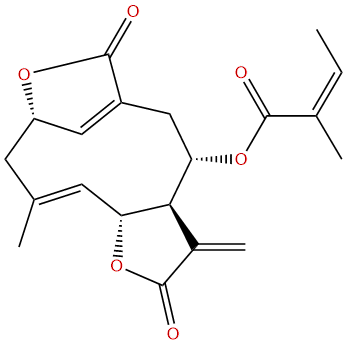


Product name: Scabertopin
Synonym name:
Catalogue No.: SBP02298
Cas No.: 185213-52-9
Formula: C20H22O6
Mol Weight: 358.39
Botanical Source:
Physical Description:
Type of Compound: Sesquiterpenoids
Purity: 95%~99%
Analysis Method: HPLC-DAD or/and HPLC-ELSD
Identification Method: Mass, NMR
Packing: Brown vial or HDPE plastic bottle
Storage: Store in a well closed container, protected from air and light. Put into refrigerate or freeze for long term storage.
Whenever possible, you should prepare and use solutions on the same day. However, if you need to make up stock solutions in advance, we recommend that you store the solution as aliquots in tightly sealed vials at -20℃. Generally, these will be useable for up to two weeks.
The product could be supplied from milligrams to grams
Inquire for bulk scale.
The structural types of sesquiterpenes in Elephantopus scaber Linn. mainly involve gimarane-type, guaiacum-type and elemene-type, etc. Ten sesquiterpene compounds were isolated and identified from Elephantopus scaber Linn. Among them, gimarane-type lactones are the main skeleton types of the sesquiterpene lactones of Elephantopus scaber Linn. At present, we isolated and obtained scabertopin,isoxyelephantopin, isoscabertopin with anti-hepatocellular carcinoma cell (SMMC-7721) activity, and deoxyelephantopin, elephantopin, 11,13-dihydrodeoxyelephantopin, and scabertopinol.
Scabertopin have antitumor effects: Gentiana has inhibitory effects on the proliferation of many tumor cells. Local application of the active part of G. licheniformis (100 mg/kg) was able to delay the formation of papillomas, reduce the average number of papillomas and the average body weight of papillomatous rats; soft tissue tumors induced by subcutaneous injection of 20-methylcholanthrene (20-MCA) were significantly affected by intraperitoneal injection of G. licheniformis active part; soft tissue tumors induced by subcutaneous injection of 20-MCA were significantly affected by intraperitoneal injection of 20-MCA (20-MCA) Chemicalbook. significant effect; compared with 20-MCA-induced control group, the extracts of Dictyostelium inhibited the incidence of sarcoma and reduced the diameter of tumors; after intraperitoneal injection of the active parts of Dictyostelium, it significantly inhibited the growth of solid tumors of subcutaneously transplanted Dauer's lymphatic ascites carcinoma cells (DLA) and Euclid's ascites carcinoma cells (EAC) and increased the survival time of the tumor-bearing rats.
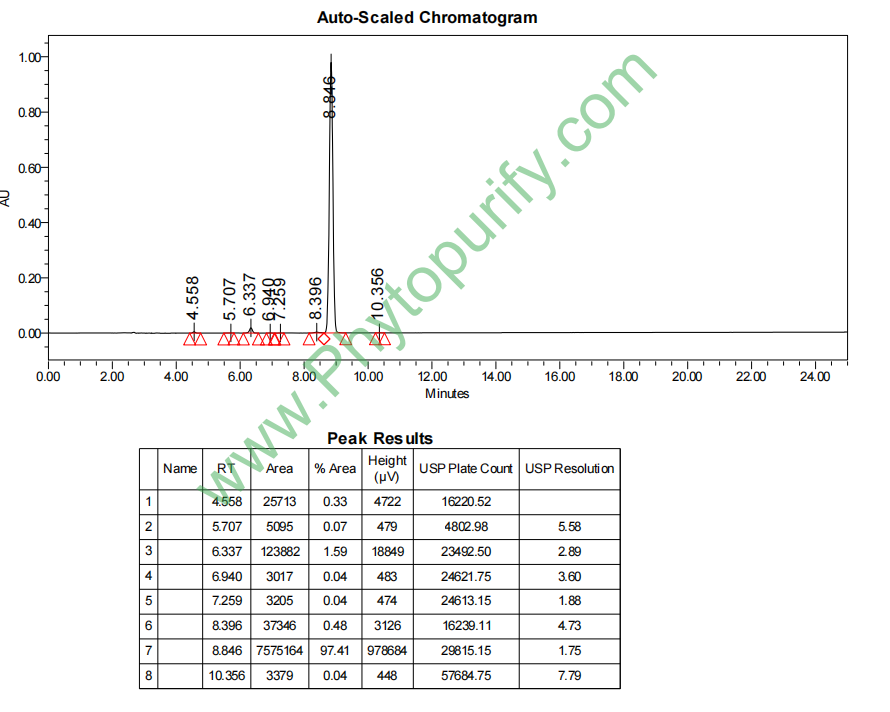
HPLC of Scabertopin
Storage conditions:Short-term storage at 2~8℃, long-term storage at -20 ~ -80℃
78.9000
2.2338
2.2338
.2398
4.0475
4.9630
High
71.4864
5.8688
No
Yes
No
No
Yes
No
0.0
No
Yes
Yes
Yes
Scabertopin (CAS number: 185213-52-9) is a traditional medicinal plant derived from Scabertopin(Elephantopus scaber)Natural sesquiterpene lactones isolated from the middle. Its molecular formula is C20H22O6 and its molecular weight is 358.39 g/mol. As a structurally unique natural product, Scabertopin has attracted widespread attention from researchers in natural product pharmacology and tumor pharmacology in recent years. Preliminary studies have shown that this compound exhibits significant concentration dependent anti-tumor activity in vitro experiments, suggesting that it may become a potential anti-cancer lead compound. In addition, its target proteins involve multiple key proteins closely related to inflammation and tumor development, such as TNF, PTGS2, NFKB1, IL6, IL1B, suggesting that it may have multi-target and multi pathway pharmacological effects. This article will provide a systematic professional science popularization introduction to this natural product with important research value from the aspects of its chemical structure, plant origin, pharmacological activity, mechanism of action, medicinal evaluation, and research prospects.
The chemical structure of Scabertopin belongs to the sesquiterpene lactone class, with a complex skeleton containing multiple chiral centers (determined by the "@" and "@ @" symbols in the SMILES string), lactone rings, double bonds, ester bonds, and other functional groups. This complex stereochemical structure is an important foundation for its biological activity and also poses challenges for its total synthesis.
According to the analysis of drug parameters, its molecular weight (MW) is 358.39, which meets the requirement of "molecular weight less than 500" in Lipinski's five rules. The lipid water partition coefficient (LogP/LogD) is 2.23, indicating that the compound has moderate lipophilicity, which can ensure a certain membrane permeability without causing metabolic or distribution problems due to excessive lipid solubility. The topological polar surface area (TPSA) is 78.9 Å ², which is lower than the empirical threshold commonly believed to be less than 140 Å ² for orally administered drugs. This facilitates their passive diffusion across biofilms.
Its water solubility parameter (water_stolubility) is 0.2398 (unit may be mg/mL or log mol/L, depending on the context, usually a lower value indicates general water solubility), which is consistent with the trend reflected by the LogP value, indicating that it belongs to a compound with moderate solubility. The Caco-2 cell permeability (Caco2_permeability) is 4.9630 (usually measured in units of 10 ⁻⁶ cm/s, with higher values indicating better permeability), indicating its good intestinal absorption potential. The effective penetration rate (Peff) is 4.0475, further supporting its excellent oral absorption properties. It is worth noting that its blood-brain barrier penetrability (BBB-permeability) is marked as "high", which means that Scabertopin may enter the central nervous system, which is a potential advantage for developing drugs that act on the central nervous system (such as therapeutic agents for neuroinflammatory related diseases), but caution should also be exercised about possible neurotoxicity.
The plasma protein binding rate (PPB) is 71.49%, which is at a moderately high level and can affect its free drug concentration and in vivo distribution. In terms of toxicity, the Ames test result is 0.0 (usually indicating no mutagenicity), and hERG inhibition is "no", indicating a low risk of cardiac toxicity. However, the data shows that it has a risk of "chromosomal aberration" and skin sensitization (Skid_Sens). The indicators of serum glutamyl transferase (Ser_GGT), aspartate aminotransferase (Ser_SST), and alanine aminotransferase (Ser_LT) are "yes", indicating that it may have potential genetic toxicity and hepatotoxicity risks, which must be evaluated and optimized in subsequent drug development.
The plant source of Scabertopin is single and clear, namely the plants of the Asteraceae family and the genus Dichlorophyllum Di Dan Cao(Elephantopus scaber L.), Its common English name is Elephant's Foot. Dixincao is a perennial herbaceous plant widely distributed in tropical and subtropical regions, with a long history of application in many traditional medical systems in Asia, Africa, and the Americas.
In traditional Chinese medicine, the whole herb of Didancao is used as medicine, with a bitter and pungent taste, a cold nature, and a return to the lung, liver, and kidney meridians. It has the effects of clearing heat and purging fire, cooling blood and detoxifying, promoting diuresis and reducing swelling. Commonly used for treating diseases such as colds, fever, sore throat, lung heat cough, dysentery, jaundice, edema, and boils. In Southeast Asia, India, and some parts of Africa, Dictygium wilfordii is also used to treat fever, inflammation, infections, stomach pain, kidney disease, and as a deworming agent.
Modern plant chemistry research has isolated and identified various active ingredients from Dichloropsis pilosula, including sesquiterpene lactones, triterpenes, flavonoids, steroids, etc. Among them, sesquiterpene lactones are considered as one of the main material bases for their anti-inflammatory, antibacterial, and anti-tumor activities. As one of the representative sesquiterpene lactones, Scabertopin's discovery links the therapeutic effects of traditional herbs with modern molecular pharmacology, providing important chemical and pharmacological evidence for elucidating the scientific connotation of the "clearing heat and detoxifying" effect of Didan grass.
The existing research description clearly indicates that Scabertopin exhibits significant anti-tumor effects in vitro, and is concentration dependent. A deeper exploration of its mechanism of action can be analyzed starting from its five known potential targets. These targets do not exist in isolation, but together form a complex signaling network closely related to chronic inflammation and cancer.
TNF (tumor necrosis factor)TNF - α is a core pro-inflammatory cytokine that plays a critical role in acute inflammatory responses. However, sustained high levels of TNF - α are closely related to various chronic inflammatory diseases such as rheumatoid arthritis and inflammatory bowel disease, as well as the formation of the tumor microenvironment, tumor cell proliferation, invasion, and metastasis. Inhibiting the excessive activation of TNF is an important anti-inflammatory and anti-tumor strategy.
PTGS2 (prostaglandin endoperoxide synthase 2, also known as COX-2)COX-2 is a key enzyme that catalyzes the production of prostaglandins (PGs) from arachidonic acid, and is induced to be highly expressed during inflammation, pain, and fever. In various cancers, the abnormally high expression of COX-2 is associated with tumor cell proliferation, anti apoptosis, angiogenesis, and immune suppression. COX-2 inhibitors, such as celecoxib, have been used for anti-inflammatory and cancer prevention purposes.
NFKB1 (nuclear factor kappa B subunit 1)NF - κ B is a key transcription factor family that regulates the expression of a large number of genes related to immunity, inflammation, cell survival, proliferation, and apoptosis. In the resting state, NF - κ B binds to its inhibitory protein I κ B and exists in the cytoplasm. Under the stimulation of TNF, IL-1, etc., I κ B is phosphorylated and degraded, and NF - κ B (such as p50/p65 dimer, where p50 is encoded by NFKB1 gene) enters the nucleus to initiate transcription of target genes. The sustained activation of the NF - κ B pathway is one of the hallmark features of chronic inflammation and cancer.
IL6 (interleukin-6) and IL1B (interleukin-1 β)Both are important pro-inflammatory cytokines. IL-6 promotes inflammation and acute phase protein production through pathways such as JAK/STAT, and promotes cell proliferation, inhibits apoptosis, and participates in cachexia in tumors. IL-1 β is a powerful inflammatory mediator that can induce COX-2 expression and prostaglandin production, and activate the NF - κ B pathway, playing an important role in autoimmune diseases and tumor development.
Scientific explanation and correlation of the mechanism of action:
Scabertopin may exert its anti-inflammatory and anti-tumor activities by acting on one or more of the aforementioned targets. A reasonable hypothesis mechanism pathway is as follows:
Anti inflammatory mechanism External stimuli (such as infection, injury) or cellular stress can activate IKK complexes within cells, leading to the degradation of I κ B protein and the release and activation of NF - κ B (involving the target NFKB1). Activated NF - κ B is transferred into the nucleus, initiating gene transcription of a series of pro-inflammatory factors and enzymes including TNF, IL6, IL1B, and PTGS2 (COX-2). These factors (TNF, IL6, IL1B) are secreted outside the cell and further activate the NF - κ B pathway through autocrine or paracrine pathways, forming a positive feedback loop and amplifying the inflammatory response. The increased expression of COX-2 leads to excessive production of inflammatory mediators such as prostaglandins. If Scabertopin can inhibit the activation of NF - κ B (upstream of the signaling pathway), or directly inhibit the activity/production of TNF, IL-6, IL-1 β, or inhibit the enzymatic activity of COX-2, it will effectively interrupt this inflammatory amplification loop and exert anti-inflammatory effects. The database labels its related diseases as "anti-inflammatory" based on their potential regulatory effects on this series of inflammatory core targets.
Antitumor mechanism Chronic inflammation is a catalyst for the occurrence and development of tumors. The above-mentioned inflammation related targets and pathways are also abnormally activated in the tumor microenvironment. The sustained activation of NF - κ B promotes tumor cell proliferation, survival, invasion, and metastasis, and induces the production of angiogenic factors such as VEGF. Cytokines such as TNF, IL-6, IL-1 β play a role as oncogenes in the tumor microenvironment, such as promoting tumor stem cell characteristics, mediating immune escape, and inducing epithelial mesenchymal transition (EMT). Prostaglandins derived from COX-2 can promote tumor cell growth and angiogenesis. Therefore, Scabertopin can achieve the anti-tumor effects observed in its in vitro studies by inhibiting these common inflammation cancer associated targets, which can suppress the malignant behavior of tumor cells on one hand, and improve the tumor microenvironment by inhibiting tumor related inflammation and angiogenesis on the other hand. The characteristic of multi-target action may make it more effective or have the potential to overcome drug resistance compared to single target inhibitors.
It should be emphasized that the above mechanism is based on reasonable speculation of known target information. The exact molecular mechanisms, such as whether Scabertopin directly binds to these target proteins or works indirectly by regulating its upstream signaling molecules, as well as the specific sites and modes of its action, still need to be validated and elucidated through biochemical and cell biology experiments such as molecular docking, surface plasmon resonance (SPR), reporter gene experiments, and kinase activity assays.
Based on the provided pharmacokinetic parameters, we can conduct a preliminary evaluation of Scabertopin's potential as an oral drug candidate molecule, and refer to the well-known Lipinski's Five Rules("Five Principles of Similar Drugs"):
Overall, Scabertopin basically conforms to Lipinski's five rules, indicating that it has good oral absorption potential. This is consistent with the previously analyzed Caco-2 permeability (4.9630) and effective permeability (Peff: 4.0475) data.
Other key parameter analysis:
Comprehensive Assessment Scabertopin is here Pharmacodynamics(Multi target anti-inflammatory and anti-tumor) and pharmacokinetics It exhibits good lead compound characteristics in terms of good oral absorption and compliance with drug regulations. However, it Toxicity risk The most prominent weakness at present is the potential genetic toxicity and liver toxicity. In future pharmaceutical chemistry optimization, researchers are likely to focus on reducing or eliminating its toxicity and improving its safety through structural modifications (such as introducing or altering certain functional groups) while retaining or enhancing its core pharmacophores (such as the key active sites of sesquiterpene lactone skeleton).
At present, research on Scabertopin is still in a relatively early stage. The existing literature mainly focuses on the chemical isolation and identification of its plant origin, preliminary in vitro activity screening (such as anti-tumor cell proliferation experiments), and target prediction based on computational simulation. The exact in vivo efficacy, pharmacokinetic characteristics, detailed mechanism of action, and comprehensive safety evaluation data are still very lacking.
Future research directions may include:
Application Prospects If the above research, especially the toxicity issue, can be effectively addressed, Scabertopin is expected to be developed as a new type of drug for the treatment of certain inflammation related diseases (such as autoimmune diseases) or as an adjuvant therapy for certain cancers closely related to chronic inflammation (such as colon cancer and liver cancer). Even though it is difficult to directly develop into a drug due to toxicity issues, its unique chemical structure and multi-target mode of action make it a valuable resource lead compound This provides important templates and inspiration for pharmaceutical chemists to design and synthesize a new generation of anti-inflammatory and anti-tumor drugs.
In summary, Scabertopin, a natural molecule with significant research value, has been extracted from traditional herbal medicine. It has built a bridge between traditional medical wisdom and modern scientific research, and its subsequent in-depth research not only helps to reveal the traditional pharmacological material basis of Dicommia ulmoides, but also provides new opportunities and challenges for the discovery of innovative drugs.
