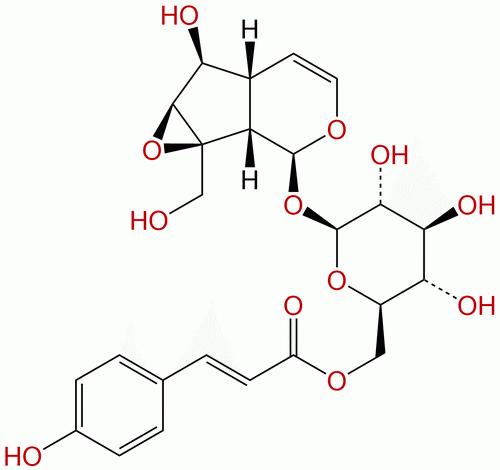


Product name: Picroside IV
Synonym name:
Catalogue No.: BP3895
Cas No.: 211567-04-3
Formula: C24H28O12
Mol Weight: 508.476
Botanical Source:
Physical Description:
Type of Compound:
Purity: 95%~99%
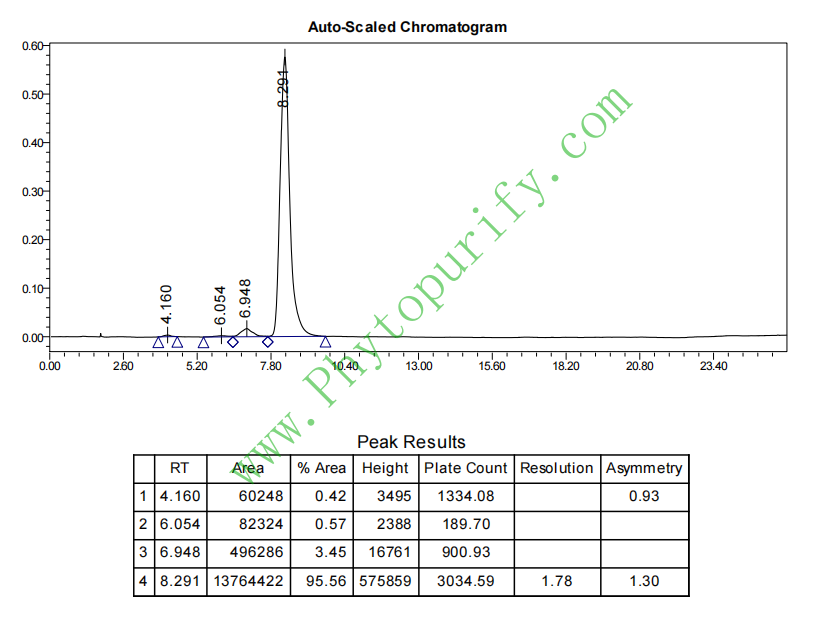
Analysis Method: HPLC-DAD or/and HPLC-ELSD
Identification Method: Mass, NMR
Packing: Brown vial or HDPE plastic bottle
The product could be supplied from milligrams to grams
Inquire for bulk scale.
For Reference Standard and R&D, Not for Human Use Directly.
HPLC of Picroside IV
Storage conditions:Short-term storage at 2~8℃, long-term storage at -20 ~ -80℃
187.9000
-.0978
-.0992
2.7253
.5219
.1989
Low
56.3161
5.0079
Yes
No
No
No
Yes
No
0.0
Yes
Yes
Yes
Yes
Natural products, as an important source of drug discovery, play an irreplaceable role in the long history of human struggle against diseases. Cycloterpenoid glycosides, as a class of monoterpene derivatives widely present in the plant kingdom and possessing a cyclopentane [c] pyran nucleus, have attracted much attention due to their structural diversity and significant biological activity. Among them, it originates from the traditional medicinal plant Huhuanglian(Picrorhiza scrophulariiflora The components of berberine in Pennell, especially Picroside IV, have gradually become one of the hotspots in natural product pharmacology research in recent years.
Huhuanglian, also known as "Honglian" in Tibetan, is a perennial herbaceous plant in the family Scrophulariaceae. Its dried roots and stems are used as medicine, and it is a classic medicinal herb in traditional Chinese medicine and Tibetan medicine for treating liver diseases, fever, indigestion, and inflammation. Modern pharmacological research has confirmed that the main active ingredients of Huhuanglian are a class of iridoid glycosides with Catalpol as the basic skeleton, including Huhuanglian glycosides I, II, III, IV, etc. Picroside IV, as an important member, has a chemical structure that is a derivative of catalpol, namely 6-O-cinnamoyl-8-O-p-hydroxybenzoyl catalpol. Given that its parent compound, Zichun, has been proven to have various pharmacological activities such as neuroprotection, hypoglycemic, anti-inflammatory, anticancer, antispasmodic, antioxidant, and anti hepatitis B virus (HBV) effects, in-depth and systematic research on Huhuanglian glycoside IV will not only help clarify the material basis of the traditional pharmacological effects of Huhuanglian, but also lead to the discovery of candidate compounds with development prospects.
This article aims to comprehensively review the chemical structure, physicochemical properties, plant origin, extraction methods, pharmacological activity, mechanism of action, medicinal properties, and clinical application prospects of Huhuanglian glycoside IV, in order to provide a systematic reference for the subsequent research and development of this natural product.
Picroside IV is a typical iridoid glycoside compound with distinct chemical structures. Structurally, it belongs to the derivatives of Catalpol. The parent nucleus of Zichun is a cyclohexene ether terpene with a bicyclic [4.3.0] nonane structure, with a β - D-glucosyl group attached to the C-1 position and hydroxyl groups at the C-6 and C-8 positions, respectively. The structural modification of Huhuanglian glycoside IV mainly occurs on the hydroxyl groups at positions C-6 and C-8: the hydroxyl group at position C-6 forms an ester bond with trans cinnamic acid, while the hydroxyl group at position C-8 forms an ester bond with p-hydroxybenzoic acid. This double esterification structure endows Huhuanglian glycoside IV with unique chemical properties.
The specific physicochemical parameters are as follows:
- Molecular formula:C₂₅H₂₈O₁₂
- molecular weight:508.4760 Da
- Lipid water partition coefficient (LogP): -0.0978. This value is negative, indicating that Huhuanglian glycoside IV has strong hydrophilicity and better solubility in water than in lipid solvents. This is consistent with the characteristic of containing polyols (glucose groups) and multiple phenolic hydroxyl groups in the molecular structure.
- Topological Polarity Surface Area (TPSA): 187.9000 Å ². TPSA is an important indicator for evaluating the ability of drug molecules to penetrate cell membranes. Generally, molecules with TPSA greater than 140 Å ² have poor oral absorption and are not easily able to cross the blood-brain barrier. The TPSA value of Huhuanglian glycoside IV is as high as 187.9 Å ², indicating that its oral bioavailability may be low and its central nervous system permeability may be poor.
- Water solubility:2.7253 mg/mL。 This value indicates that Huhuanglian glycoside IV has good solubility in water, which provides favorable conditions for its dissolution and transport in organisms.
- Blood-brain barrier (BBB) permeability: Low. Combining its high TPSA and low LogP values, it is predicted that berberine IV is difficult to cross the blood-brain barrier through passive diffusion. This suggests that its pharmacological activity may mainly be concentrated in peripheral tissues, especially the liver, kidneys, and gastrointestinal tract.
- HERG inhibition: No. Inhibition of hERG (human Ether - à - go Related Gene) potassium channels is one of the main causes of drug cardiac toxicity. Huhuanglian glycoside IV does not inhibit hERG channels, indicating that it has a low risk of causing QT interval prolongation and arrhythmia in the heart, and has good cardiac safety.
- Ames test: 0.0. The Ames test is used to detect the mutagenicity of compounds. The result is 0.0, indicating that Huhuanglian glycoside IV did not exhibit genetic toxicity in the standard bacterial recovery mutation test, preliminarily confirming its no mutagenic risk.
In summary, Huhuanglian glycoside IV is a cyclic iridoid glycoside with good water solubility but poor lipid solubility and high polarity. Its physicochemical properties determine that it may not be an ideal candidate molecule for oral medication, but its good water solubility and safety, as well as its unique diester structure, provide a basis for its structural modification in specific routes of administration (such as injection) or as a lead compound.
Huhuanglian glycoside IV is mainly derived from plants of the genus Huhuanglian in the family Scrophulariaceae, with the most significant source being Hu Huanglian(Picrorhiza scrophulariiflora Pennell) and Indian Houttuynia cordata(Picrorhiza kurroa Royle ex Benth.)These two plants are perennial herbs, mainly distributed in the the Himalayas mountains with an altitude of 3000-5000 meters, such as Xizang, Yunnan, Sichuan, India, Nepal and other places in China. Traditionally, medicinal parts are the dried rhizomes and roots of plants.
In the plant body, Huhuanglian glycoside IV does not exist in a single form, but forms a complex secondary metabolite spectrum together with other Huhuanglian glycosides (such as Huhuanglian glycosides I, II, III), catalpol, and various phenolic acid compounds. There are significant differences in its content due to differences in plant species, origin, harvesting season, growth years, and processing methods. Usually, the content of Huhuanglian glycoside IV in wild Huhuanglian is relatively low, while the content in artificially cultivated products may be more stable.
For the extraction of Huhuanglian glycoside IV, the current method mainly combines modern chromatography technology with traditional solvent extraction. The basic process is as follows:
Based on the traditional medicinal value of Huhuanglian and the extensive activity of its parent compound Zichun, pharmacological research on Huhuanglian glycoside IV has gradually deepened in recent years, mainly focusing on the following aspects:
Liver protection is the most classic traditional efficacy of Huhuanglian, and it is also the core of pharmacological research on Huhuanglian glycoside IV. Multiple in vitro and in vivo experiments have confirmed that Huhuanglian glycoside IV has significant protective effects on various chemical liver injury models.
Inflammation is a common pathological basis for various diseases, including liver disease, neurodegenerative diseases, and metabolic diseases. Huhuanglian glycoside IV exhibits broad-spectrum anti-inflammatory activity.
The phenolic hydroxyl group in the molecular structure of Huhuanglian glycoside IV endows it with direct free radical scavenging ability. Research has shown that it can effectively scavenge 1,1-diphenyl-2-trinitrophenylhydrazine (DPPH) free radicals, 2,2 '- bis (3-ethylbenzothiazole-6-sulfonic acid) (ABTS) cationic free radicals, and hydroxyl free radicals. More importantly, it can also exert indirect antioxidant effects by activating the endogenous antioxidant defense system of cells, such as the NRF2/antioxidant response element (ARE) pathway, upregulating the expression of antioxidant enzymes such as SOD, CAT, and glutathione peroxidase (GPX). This dual antioxidant mechanism gives it an advantage in protecting cells from oxidative damage.
The pharmacological activity of Huhuanglian glycoside IV is not achieved through a single mechanism, but through the synergistic action of multiple targets and pathways. The core mechanism can be summarized as follows:
This is the core mechanism by which Huhuanglian glycoside IV exerts hepatoprotective and antioxidant effects. NRF2 is a key transcription factor for cells to cope with oxidative stress. Under normal physiological conditions, NRF2 binds to Kelch like ECH associated protein 1 (Keap1) and is in an inhibited state. When Huhuanglian glycoside IV enters the cell, it may modify the cysteine residue on Keap1, causing NRF2 to dissociate from Keap1 and translocate into the nucleus. After entering the nucleus, NRF2 binds to ARE and initiates the transcription of a series of downstream antioxidant and detoxification genes, including:
- antioxidant enzyme:SOD1、CAT、GPX1。 These enzymes directly clear ROS and reduce oxidative damage.
- Phase II detoxifying enzyme Glutathione S-transferase A1 (GSTA1) and quinone oxidoreductase 1 (NQO1). These enzymes are involved in detoxification and metabolism of heterologous substances.
- Other protective proteins Like heme oxygenase-1 (HO-1).
By activating the NRF2 pathway, berberine IV can significantly enhance the antioxidant defense ability of cells, thereby combating oxidative liver damage induced by various factors such as CCl ₄, alcohol, APAP, etc.
The anti-inflammatory effect of Huhuanglian glycoside IV is mainly achieved by inhibiting two key pro-inflammatory signaling pathways, NF - κ B and MAPK.
- Inhibition of NF - κ B pathway At rest, NF - κ B binds to its inhibitory protein I κ B α. Inflammatory stimuli such as LPS and TNF - α activate I κ B kinase (IKK), leading to phosphorylation and degradation of I κ B α, releasing NF - κ B into the nucleus and initiating transcription of various inflammatory genes. Huhuanglian glycoside IV can inhibit the activity of IKK, prevent the degradation of I κ B α, and thus "trap" NF - κ B in the cytoplasm, preventing it from exerting its transcriptional function. This leads to a significant decrease in the expression of downstream inflammatory mediators such as TNF - α, IL-6, IL-1 β, iNOS, COX-2, etc.
- Inhibition of MAPK pathway The MAPK pathway (including ERK, JNK, p38) also plays a critical role in inflammatory responses. Huhuanglian glycoside IV can inhibit the phosphorylation of these kinases, block the downstream transmission of signals, and thus reduce the production of inflammatory factors.
In anti-tumor and hepatoprotective research, it has been found that berberine IV can affect cell survival and death decisions.
- Inducing apoptosis of tumor cells In liver cancer cells, berberine IV can upregulate the pro apoptotic protein Bax and downregulate the anti apoptotic protein Bcl-2, leading to a decrease in mitochondrial membrane potential, release of cytochrome c, and activation of Caspase-9 and Caspase-3, ultimately triggering cell apoptosis.
- Protect normal liver cells In liver injury models, berberine IV may exert a protective effect by inhibiting excessive apoptosis of liver cells. For example, it can inhibit liver cell apoptosis induced by oxidative stress or inflammatory factors by activating the PI3K/Akt survival signaling pathway. This "bidirectional regulatory" effect, which exhibits opposite effects in tumor cells and normal cells, is an interesting characteristic of its potential as a therapeutic drug.
The hepatoprotective effect also involves the regulation of bile acid homeostasis. Huhuanglian glycoside IV may regulate the synthesis, transport, and excretion of bile acids by activating the farnesol X receptor (FXR). The activation of FXR can inhibit the expression of the bile acid synthesis rate limiting enzyme CYP7A1, while promoting the expression of bile acid salt efflux pump (BSEP) and multidrug resistance associated protein 2 (MRP2) transporters, thereby reducing the accumulation of bile acids in liver cells and alleviating cholestatic liver injury. In addition, regulation of transporters such as ABCG5/G8 may also affect cholesterol excretion.
Based on the aforementioned physicochemical properties and preliminary pharmacological activity, it is crucial to evaluate the pharmacological properties of Huhuanglian glycoside IV.
Although there are challenges in the pharmacological development of Huhuanglian glycoside IV, its unique pharmacological activity and good safety make it have broad application prospects in specific therapeutic fields.
This is the most direct and promising application direction of Huhuanglian glycoside IV. Its powerful hepatoprotective, anti-inflammatory, antioxidant, and bile acid metabolism regulating effects make it a potential candidate drug for treating the following diseases:
- Acute liver injury Such as drug-induced liver injury (especially APAP overdose) and alcoholic liver injury. Can be developed as an injectable emergency medication.
- chronic liver disease Adjuvant therapy for non-alcoholic steatohepatitis (NASH) and chronic viral hepatitis (B, C). Inhibit liver inflammation and fibrosis process through long-term administration.
- cholestatic liver diseases By activating FXR and other nuclear receptors, regulating bile acid homeostasis, and alleviating intrahepatic bile stasis.
Its broad-spectrum anti-inflammatory activity can be used to treat various acute and chronic inflammations, such as:
- Acute pancreatitis Inhibit excessive inflammatory reactions in the pancreas and the whole body.
- Inflammatory bowel disease (IBD)Such as ulcerative colitis and Crohn's disease. Oral preparations (to address absorption issues) or enemas may be effective.
- arthritis Like rheumatoid arthritis, by inhibiting inflammation of the joint synovium.
In view of its antioxidant and insulin resistance improvement potential, we can explore its application in type 2 diabetes and its complications (such as diabetes nephropathy, diabetes retinopathy).
Huhuanglian glycoside IV, as an important iridoid glycoside derived from the traditional Chinese medicine Huhuanglian, has a unique chemical structure and is a diester derivative of catalpol. Modern pharmacological research has confirmed that it has significant multiple pharmacological activities such as liver protection, anti-inflammatory, and antioxidant. Its mechanism of action mainly involves activating the NRF2 antioxidant pathway, inhibiting the NF - κ B/MAPK inflammatory pathway, and regulating cell apoptosis and bile acid metabolism. Relevant molecular targets include NRF2, SOD1, CAT, GPX1, CYP2E1, GSTA1, FXR, etc. These findings provide a solid scientific basis for the traditional hepatoprotective effects of Coptis chinensis.
However, the high polarity and low fat solubility of Huhuanglian glycoside IV result in poor oral bioavailability, which is the main obstacle to its clinical translation. The future research focus should be on improving its pharmacokinetic properties through modern medicinal chemistry and pharmaceutical methods such as prodrug design and nano formulations, and conducting systematic pharmacological, toxicological, and preclinical studies based on this foundation. Despite the numerous challenges ahead, Huhuanglian glycoside IV, as a natural product lead compound with clear pharmacological activity and good safety, still holds enormous potential for development in the treatment of liver and inflammatory diseases. Through in-depth research and rational development, it is expected to not only provide new treatment options for patients with related diseases, but also provide valuable examples for discovering innovative drugs from traditional Chinese medicine.
