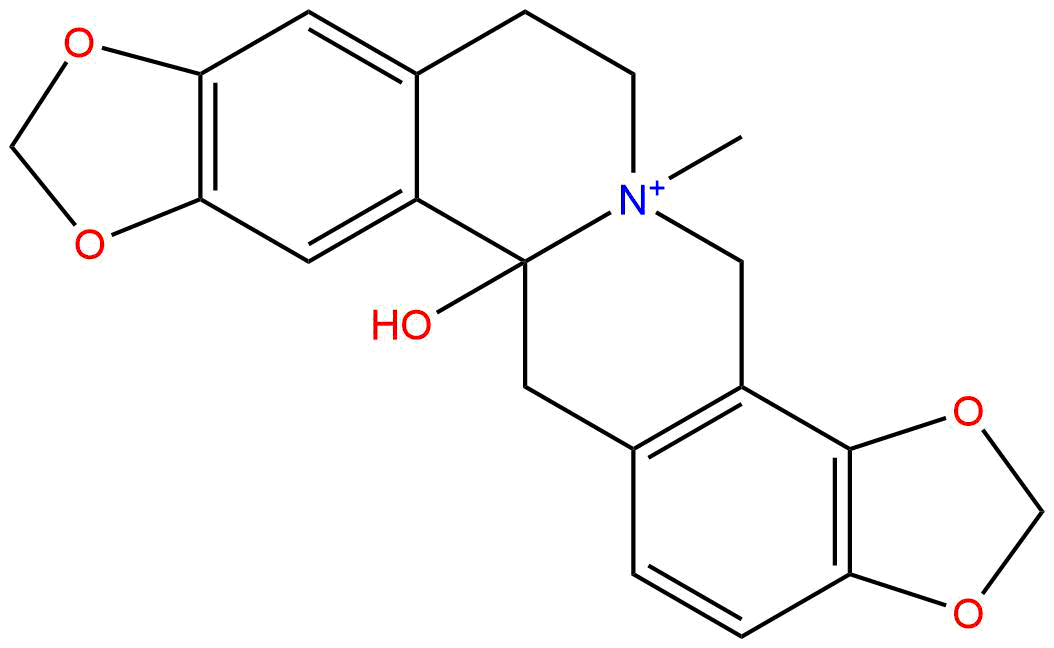


Product name: Hydroprotopine
Synonym name: Hydroprotopine
Catalogue No.: SBP01588
Cas No.: 128397-41-1
Formula: C20H20NO5+
Mol Weight: 354.381
Botanical Source:
Physical Description:
Type of Compound: Alkaloids
Purity: 95%~99%
Analysis Method: HPLC-DAD or/and HPLC-ELSD
Identification Method: Mass, NMR
Packing: Brown vial or HDPE plastic bottle
The product could be supplied from milligrams to grams
Inquire for bulk scale.
For Reference Standard and R&D, Not for Human Use Directly.
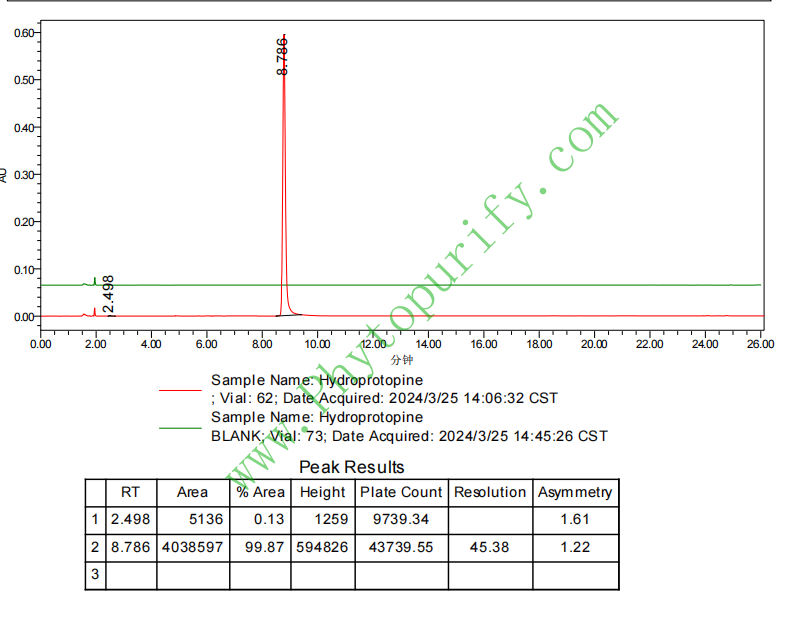
HPLC of Hydroprotopine
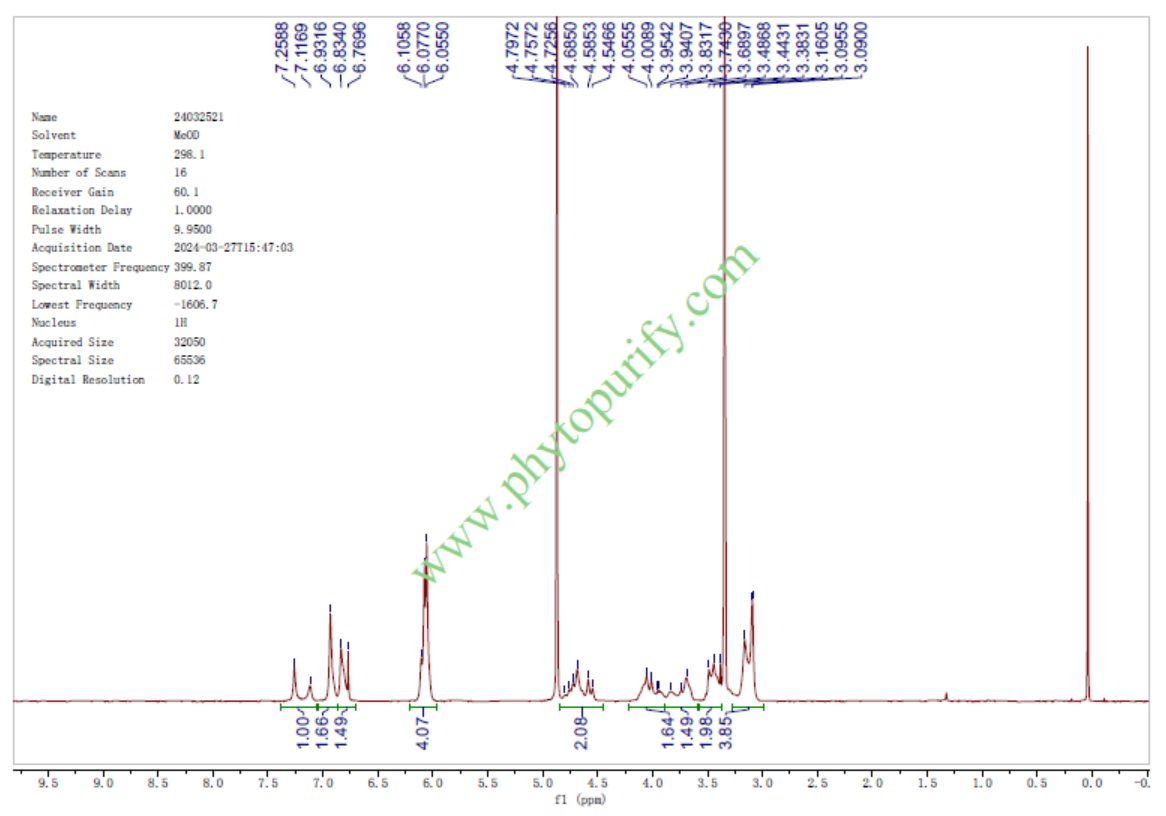
HNMR of Hydroprotopine
Storage conditions:Short-term storage at 2~8℃, long-term storage at -20 ~ -80℃
57.1500
-1.6552
-1.6552
.0250
.8468
9.8438
Low
56.6093
4.1627
No
No
No
No
No
No
1.8
No
No
No
No
Hydroprotopine is an isoquinoline alkaloid with a unique chemical structure and significant biological activity. Its CAS number is 128397-41, molecular formula is C20H20NO5+, and molecular weight is approximately 354.38 g/mol. This compound was originally derived from poppy plants in the family Papaveraceae Hypecoum leptocarpum It was isolated and identified, but subsequent research found that it was present in the famous traditional analgesic Chinese medicine Yanhusuo It also exists in Corydalis yanhusuo. Yanhusuo has a long history of medicinal use in China, mainly used for regulating qi and relieving pain, promoting blood circulation and dispersing blood stasis. Its analgesic effects are recorded in classics such as the Compendium of Materia Medica. Modern pharmacological research has revealed that hydrogenated opioids may be one of the important material bases for the analgesic effect of Corydalis yanhusuo.
The existing research description indicates that hydrogenated protoopioid (also called Leptopidine in some literatures) can inhibit the growth of breast cancer cells and induce cytotoxicity, and its mechanism may be related to the inhibition of the expression of fatty acid synthase. This suggests the potential value of the compound in the field of anti-tumor. However, more in-depth and systematic research has shown that its core pharmacological activity focuses on analgesia field By acting on multiple targets closely related to pain perception and regulation, such as TRPV1 and opioid receptor 1 (OPRD1, OPRM1), hydrogenated opioids demonstrate the potential for multi pathway synergistic analgesia, providing valuable lead compound templates for the development of novel, efficient, and potentially low dependence analgesic drugs. This article will provide a systematic professional popularization of this natural product from its chemical essence, plant origin, multi-target mechanism of action, medicinal evaluation, and future prospects.
Hydrogenated protopine alkaloids belong to the protopine type of isoquinoline alkaloids. The SMILES expression (C [N+] 12CCc3cc4c (cc3C1 (O) Cc1ccc3c (c1C2) OCO3) OCO4) reveals its complex four ring fused skeleton structure. This structure contains a ten membered nitrogen heterocyclic ring and is bridged by two methylenedioxy (- O-CH2-O -) functional groups. It is worth noting that its molecular formula carries a positive charge (C20H20NO5+), indicating that it usually exists in the form of quaternary ammonium salt or protonation under physiological pH conditions, which significantly affects its solubility and membrane permeability.
Analyze its physicochemical properties based on the provided pharmacological parameters:
- Molecular weight (MW)354.3820, meets the criteria for small molecule drugs (usually<500 Da).
- Topological Polarity Surface Area (TPSA): 57.15 Å ². This value is relatively moderate, and compounds with TPSA>140 Å ² usually have poor membrane permeability, while the TPSA of hydrogenated protoopioids indicates a certain polarity, but not extremely high.
- Lipid water partition coefficient (LogP/LogD)All are -1.6552. This is a very negative value, strongly indicating that the compound has Extremely high hydrophilicity and extremely low lipophilicity This is closely related to its ionization state and multiple oxygen atoms in the molecule. High hydrophilicity usually means good water solubility, but may not be conducive to crossing biofilms composed of lipid bilayers (such as the blood-brain barrier).
- Water solubility 0.0250 (unit may be mg/mL or mol/L, usually referring to solubility under certain conditions), combined with its LogP value, confirms its good water solubility characteristics.
- Membrane permeability The permeability value of Caco-2 cells is 9.8438 (units need to be defined according to the database, usually on the order of 10 ⁻⁶ cm/s), combined with its high hydrophilicity, actual intestinal absorption may be slightly lower. The blood-brain barrier (BBB) penetration is labeled as "low", which is consistent with its ionization and hydrophilicity characteristics, indicating that it may not easily enter the central nervous system. This sometimes provides an advantage in reducing central side effects (such as sedation and respiratory depression) for analgesics that primarily target peripheral targets.
An important plant source of hydrogenated opioids is Yanhusuo(Corydalis yanhusuo W. T. Wang), It is a perennial herbaceous plant in the Papaveraceae family, belonging to the genus Corydalis. Yanhusuo, also known as "Yuanhu", is a famous analgesic with a long history in China that promotes blood circulation, removes blood stasis, and promotes qi circulation, using dried tubers as medicine. Its application can be traced back to the Tang Dynasty's "Lei Gong Pao Zhi Lun". In the Ming Dynasty's "Compendium of Materia Medica", Li Shizhen summarized its efficacy as "promoting blood circulation, promoting qi circulation, relieving pain, and promoting urination", and explicitly stated that it "specializes in treating various pains throughout the body". It is widely used for pain symptoms such as chest, abdominal, waist, and knee pain, dysmenorrhea, postpartum blood stasis, and injuries caused by falls and blows.
The analgesic effect of Corydalis yanhusuo has been repeatedly validated in traditional medical practice, but its material basis and mechanism of action have long been unknown. It was not until the rise of modern natural medicinal chemistry that scientists isolated and identified dozens of alkaloids, including hydrogenated opioids, from their complex chemical composition, such as dl tetrahydropalmatine and protopine. These alkaloids are considered to be the active ingredient group for the analgesic effect of Corydalis yanhusuo. As one of them, the discovery of hydrogenated opioids connects traditional medication experience with modern molecular pharmacology, providing a specific basis for interpreting the scientific connotation of "pain relief" in Corydalis yanhusuo. The discovery of hydrogenated opioids from Hypecoum plants to Corydalis yanhusuo also reflects the diversity of chemical structures and conservation of biological activities of natural products.
The pharmacological activity research of hydrogenated opioids mainly focuses on analgesia Function, its characteristics are Multi target synergistic effect The database information suggests that it is related to five key targets: TRPV1, OPRD1, OPRM1, CalcA, and COX-1. These targets cover multiple key links in the generation, transmission, and regulation of pain signals.
1. Acting on transient receptor potential vanillic acid subtype 1 (TRPV1):
TRPV1 is a non selective cation channel widely distributed on sensory neurons, especially nociceptors, and can be activated by nociceptive stimuli such as capsaicin, heat (>43 ° C), and acid (pH<5.9). Activation leads to calcium ion influx, causing depolarization of neurons and generating pain signals. If hydrogenated opiate base is used as TRPV1 Antagonists or modulators It can inhibit the activation of excessive channels caused by inflammatory mediators, heat, or acid, thereby blocking the generation of pain signals in the periphery and their transmission to the spinal cord. This is an important mechanism by which it may exert peripheral analgesic effects.
2. Acting on opioid receptors (OPRD1, OPRM1):
OPRD1 (δ receptor) and OPRM1 (μ receptor) are classic G protein coupled receptors that target endogenous opioid peptides and exogenous opioid analgesics such as morphine. Activating these receptors mainly produces strong central analgesic effects by inhibiting adenylate cyclase, reducing neurotransmitter release, hyperpolarizing neurons, and other pathways. If hydrogenated opioids can act on these receptors, especially the agonistic effect on μ receptors, it may produce analgesic effects similar to opioids. However, its BBB penetration "low" characteristic suggests that its direct effect on central opioid receptors may be limited, and it may be more inclined to act on peripheral nerve endings or spinal cord level opioid receptors, or its analgesic effect is not entirely dependent on the opioid receptor system.
3. Acting on calcitonin gene-related peptide (CalcA):
The CalcA gene encodes calcitonin gene-related peptide (CGRP), a potent vasodilator neuropeptide that plays a central role in migraine and neurogenic inflammation. CGRP is released by sensory neurons and can exacerbate pain and inflammatory responses. Hydrogenated opioids may alleviate neurogenic inflammation and related pain by inhibiting the synthesis or release of CGRP, which is of great significance in the treatment of migraine and chronic inflammatory pain.
4. Acting on cyclooxygenase-1 (COX-1):
COX-1 is a constitutively expressed enzyme responsible for synthesizing prostaglandins that maintain physiological functions such as gastrointestinal mucosal integrity. Traditional nonsteroidal anti-inflammatory drugs (NSAIDs) reduce the production of pain inducing prostaglandins by inhibiting COX (especially COX-2), but at the same time, inhibiting COX-1 can lead to gastrointestinal side effects. The association between hydrogenated opioids and COX-1 suggests that it may affect pain by regulating the prostaglandin pathway, but further research is needed to determine whether it inhibits or regulates, as well as its selectivity. If it can selectively act on pain related pathways without affecting gastrointestinal protective function, it would be more advantageous.
Integration of mechanism of action:
The analgesic effect of hydrogenated opioids may be a "multi pronged" strategy: inhibiting the initial transduction of nociceptive stimuli by antagonizing TRPV1; Enhance endogenous analgesia by regulating the opioid receptor system (possibly at the peripheral or spinal cord level); Reduce neurogenic inflammation by affecting neuropeptides such as CGRP; It may also be involved in the prostaglandin pathway. This multi-target characteristic makes it possible to achieve effective control of complex pain while avoiding the side effects of single target drugs, such as opioid addiction and respiratory depression, and gastrointestinal damage caused by NSAIDs. In addition, its activity of inhibiting breast cancer cell growth (possibly related to inhibiting fatty acid synthase) also reveals its potential application value in anti-tumor, especially in relieving cancer pain.
Based on the provided pharmacological parameters, we can conduct a preliminary evaluation of the potential development of hydrogenated opioids as oral analgesics, and combine it with Lipinski's Five Rules Conduct analysis.
Lipinski Rule of Five Evaluation:
This rule is an empirical rule for evaluating the oral absorption potential of small molecule compounds, typically requiring: ① MW<500; ② LogP < 5; ③ Hydrogen bond donor (HBD)<5; ④ Hydrogen bond acceptor (HBA)<10.
- MW 354.38, compliant (<500).
- LogP-1.6552, meets (<5, and far below 5).
- Hydrogen bond donor and acceptor From the structural formula, its quaternary ammonium salt form does not have typical acidic hydrogen, and HBD may be 0 (or consider hydroxyl hydrogen? The "O" in the structure may exist in ether or hydroxyl form, requiring precise analysis, but based on its ionization characteristics, HBD should be relatively low). The number of HBA (N, O) is relatively high, but it may still be within 10. Overall, it is generally compliant or only slightly violated (such as HBA may be slightly more).
However, the Lipinski rule is not the gold standard, and many successful drugs also have exceptions. For hydrogenated opioids, their The most prominent pharmaceutical challenge lies in its extremely high hydrophilicity (extremely low LogP) and ionization properties。
Conclusion Hydrogenated opioids, as a lead compound, have clear properties Multi target analgesic pharmacological activity and Preliminary safety The main weakness lies in Low membrane permeability and BBB penetration caused by physicochemical properties Future pharmaceutical chemistry optimization work can focus on strategies such as preparing prodrugs (such as esterification to increase lipophilicity and hydrolyze them into active ingredients in vivo), structural modifications (moderately introducing lipophilic groups to regulate LogP while retaining pharmacophores), etc., to improve oral absorption and/or target tissue distribution. If its analgesic effect mainly relies on peripheral targets such as peripheral TRPV1 and peripheral opioid receptors, then the existing low BBB characteristics are actually advantageous, and the research and development focus should be on improving oral bioavailability.
At present, research on hydrogenated opioids is still in progress Preclinical stage Mainly focused on natural product chemistry (separation and identification), preliminary pharmacological activity screening, and mechanism of action exploration. The existing evidence strongly supports its potential in analgesia, especially its unique multi-target mechanism of action, which is in line with the new trend of pursuing synergistic effects and reducing side effects in modern analgesic drug development.
Research status:
1. basic research The plant origin (such as Corydalis yanhusuo), chemical structure, and some physicochemical properties have been identified. The analgesic activity has been preliminarily validated in cell and animal models, and is associated with multiple key targets such as TRPV1 and opioid receptors. The discovery of anti-tumor activity (inhibiting breast cancer cells) broadens its research scope.
2. Mechanism depth The current mechanism of action research is still relatively preliminary, mostly based on target association prediction and a small amount of experimental verification. There is still a lack of systematic and in-depth research on key scientific issues such as the specific binding mode (excitation/antagonism, affinity, selectivity) with each target, downstream events in the signaling pathway, and how multiple targets collaborate.
3. Exploration of medicinal properties There are few publicly reported studies on the pharmacokinetics (absorption, distribution, metabolism, excretion) of the system, comprehensive toxicological evaluation, and structural optimization of its physicochemical shortcomings.
Application prospects and future directions:
1. Lead compounds of novel multi-target analgesic drugs The greatest value of hydrogenated opioids lies in their natural multi-target analgesic backbone. Future research should focus on:
- Thoroughly elucidate the mechanism Using molecular docking, point mutation, functional experiments and other techniques, clarify its precise mode and intensity of action on targets such as TRPV1 and opioid receptors.
- Research on Structural Optimization and Structure Activity Relationship (SAR)This is the core of pushing it towards clinical application. By chemical modification, while maintaining multi-target activity, optimize its LogP, solubility, metabolic stability, and targeting. For example, designing derivatives that selectively act on peripheral rather than central opioid receptors to avoid addiction risks.
- Preclinical development Complete the pharmacological (different pain models), pharmacokinetic, and safety evaluations of the system.
Modernization of Traditional Chinese Medicine and Quality Markers As one of the effective ingredients of Corydalis yanhusuo, the content of hydrogenated opioids can be used as one of the quality markers (Q-Marker) to evaluate the quality of Corydalis yanhusuo medicinal materials and their preparations, which helps to improve the standardization and controllability of traditional Chinese medicine products.
Combination therapy and adjuvant therapy Given its multi-target nature, hydrogenated opioids or their optimized derivatives may be used in combination with existing single target analgesics (such as low-dose opioids, NSAIDs) to achieve synergistic effects, reduce their respective dosages and side effects, especially in the treatment of refractory pain such as chronic neuropathic pain and cancer pain.
Cross border exploration: Its activity of inhibiting fatty acid synthase and breast cancer cell growth is worthy of independent exploration in the field of anti-tumor, especially to study whether it has synergistic effect with analgesic activity for the comprehensive management of cancer pain.
In summary, hydrogenated opioids are a natural compound with a unique chemical structure and novel mechanism of action discovered from the treasure trove of traditional Chinese medicine. Although it still faces challenges in terms of physical and chemical properties on the path of drug development, its multi-target analgesic treatment strategy and preliminary safety features make it an attractive starting point for drug research and development. With the deepening application of modern medicinal chemistry, pharmacology, and formulation technology, hydrogenated opioids are expected to transform from an ancient "herbal" record into a new type of therapeutic drug derived from nature and serving modern human health.
