


Synonym name: 2,3,9,10-Tetramethoxy-13-methylberbine, 8CI; Corydalis A
Catalogue No.: BP0396
Cas No.: 518-69-4
Formula: C22H27NO4
Mol Weight: 369.461
Botanical Source: Alkaloid from Corydalis tuberosa and many other Corydalis spp. (Fumariaceae)
Purity: 95%~99%
Analysis Method: HPLC-DAD or/and HPLC-ELSD
Identification Method: Mass, NMR
Packing: Brown vial or HDPE plastic bottle
Can be supplied from milligrams to grams.
For Reference Standard and R&D, Not for Human Use Directly.
Inquire for bulk scale.
HPLC of Corydaline
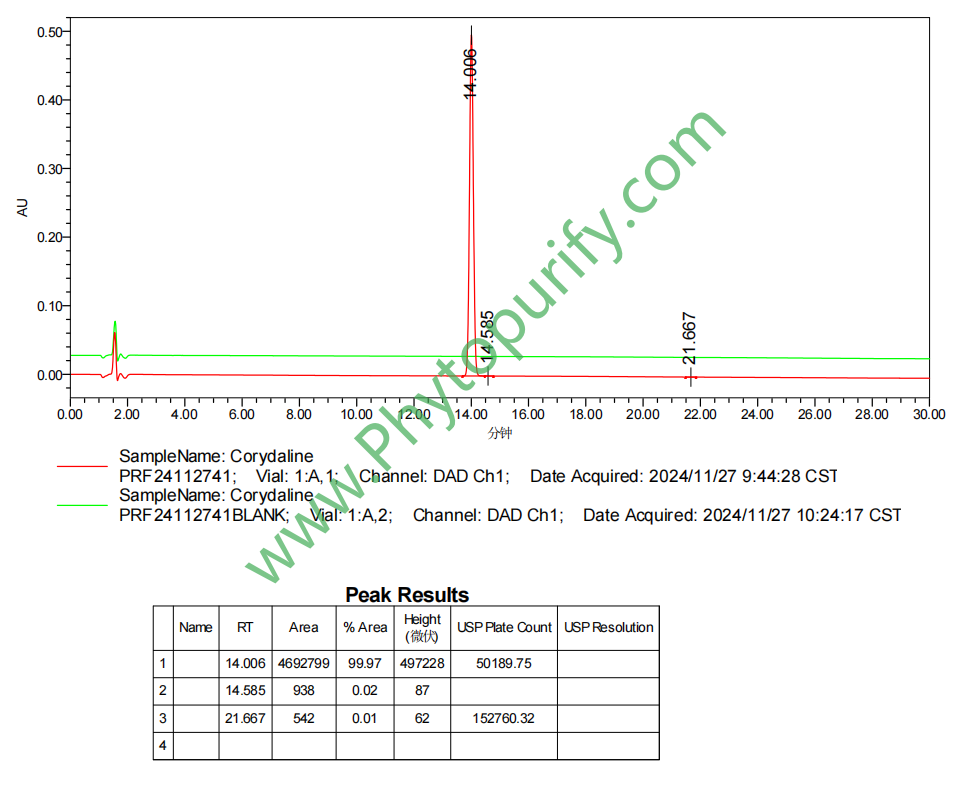
Storage conditions:Short-term storage at 2~8℃, long-term storage at -20 ~ -80℃
Corydaline (CAS number: 518-69-4) is an important natural quinoline alkaloid, mainly isolated from the traditional Chinese medicine Corydalis yanhusuo W.T. Wang. Yanhusuo, as a widely used blood activating and pain relieving herb in traditional Chinese medicine, has undergone decades of research on its active ingredients. Yanhusuo Jia, as one of the key active ingredients, has received widespread attention due to its multi-target and multifunctional pharmacological activities. In recent years, with the in-depth research in the fields of neurological diseases, pain management, and viral infections, Corydalis yanhusuo A has shown unique pharmacological potential, especially in pain relief, opioid receptor regulation, antiviral and anti angiogenic activities, and has become a hot topic in natural product pharmacology research.
This article aims to systematically review the chemical structure and physicochemical properties, plant sources, and extraction methods of Corydalis yanhusuo, with a focus on its pharmacological activity, mechanism of action, and molecular targets. The pharmacokinetic characteristics of the compound are discussed in combination with its pharmacological parameters. Finally, the clinical application prospects and future research directions are discussed, providing theoretical basis and research ideas for natural product pharmacology and new drug development.
Yanhusuo A belongs to the isoquinoline alkaloids, with a molecular formula of C22H27NO4 and a molecular weight of 369.45. Its structural features include a nitrogen-containing isoquinoline skeleton, connecting multiple methoxy and hydroxyl substituents, endowing it with certain polarity and biological activity. The LogP value of Yanhusuo Jia Su is 3.5, indicating that it has moderate lipid solubility and is beneficial for penetrating cell membranes and the blood-brain barrier (BBB). The TPSA (topological polar surface area) is 55.83 Å ², and the number of hydrogen bond receptors is 5, all of which meet the physicochemical parameters required for drug molecule activity in the central nervous system.
The physicochemical properties of Corydalis yanhusuo Jia give it good bioavailability and tissue distribution in vivo, especially its strong permeability to the central nervous system, which lays the foundation for its development as a therapeutic drug for neurological related diseases. However, its safety indicators such as hepatotoxicity, cardiotoxicity, hERG channel inhibition, and genotoxicity (Ames test) are currently unclear and require further systematic evaluation.
The main source of Corydalis yanhusuo is Corydalis yanhusuo, a perennial herbaceous plant in the family Papaveraceae, widely distributed in southern China and Southeast Asia. The root of Corydalis yanhusuo is a traditional Chinese medicinal herb that has the effects of promoting blood circulation, removing blood stasis, and relieving pain. Yanhusuo Jia, as one of its main alkaloid components, is greatly affected by planting environment, harvesting time, and processing technology in terms of its content.
The traditional methods for extracting berberine mainly include organic solvent extraction and chromatographic separation. Common extraction solvents include ethanol, methanol, and their aqueous solutions. Reflux or ultrasound assisted extraction is used to improve extraction efficiency. The extraction solution is purified by acid-base adjustment, liquid-liquid distribution, and column chromatography (such as silica gel column, C18 reverse phase column), and finally identified and quantified by high performance liquid chromatography (HPLC) or mass spectrometry (MS). In recent years, new technologies such as supercritical CO2 extraction and microwave-assisted extraction have also been applied to the extraction of berberine, significantly improving the extraction efficiency and purity.
Yanhusuo Jia exhibits various significant pharmacological activities, covering multiple fields such as nervous system regulation, antiviral, anti angiogenic, and anti allergic effects.
Yanhusuo A, as an agonist of μ - opioid receptor 1 (OPRM1), has a Ki value of 1.23 μ M, indicating its strong opioid activity. By activating the μ - opioid receptor, berberine can regulate central and peripheral pain signal transduction, exerting analgesic effects. In addition, berberine may further alleviate pain and inflammatory reactions by regulating pain related ion channels such as TRPV1 and TRPA1, as well as inhibiting inflammatory mediator synthases such as PTGS1 (COX-1) and PTGS2 (COX-2).
Yanhusuo A has an inhibitory effect on acetylcholinesterase (AChE) with an IC50 of approximately 226 μ M. Although its inhibitory activity is weak, its AChE inhibitory effect suggests its potential application value in cognitive dysfunction and neurodegenerative diseases.
Yanhusuo A has a significant inhibitory effect on enterovirus 71 (EV71) with an IC50 of 25.23 μ M. EV71 is the main pathogen causing hand, foot, and mouth disease and severe neurological complications. Corydalis yanhusuo A exhibits good antiviral potential by interfering with the virus replication process.
Yanhusuo Jia can inhibit the proliferation of endothelial cells and the formation of new blood vessels, demonstrating anti angiogenic activity, which may help regulate the tumor microenvironment and control inflammation. Meanwhile, its anti allergic effect reduces allergic reactions by inhibiting degranulation of mast cells and release of inflammatory mediators.
Yanhusuo Jia promotes gastric emptying and improves gastrointestinal motility disorders, which may be achieved by regulating the contraction of gastrointestinal smooth muscles and neural regulation, and has potential therapeutic value for gastrointestinal dysfunction.
The multi-target mechanism of action of Corydalis yanhusuo is the basis of its multiple pharmacological effects. Its main targets include:
The synergistic effect of these multiple targets enables Corydalis yanhusuo A to exhibit comprehensive therapeutic effects in pain, neuroprotection, and antiviral therapy.
The pharmacological parameters of Corydalis yanhusuo Jia indicate that it has good potential for drug development. The molecular weight of 369.45 conforms to Lipinski's rule, with a LogP of 3.5, indicating moderate lipid solubility and favorable cell membrane permeability and oral absorption. The TPSA is 55.83 Å ², which is lower than 90 Å ², supporting its ability to penetrate the blood-brain barrier and meeting the requirements for central nervous system activity. The number of hydrogen bond receptors is 5, which is suitable for stable binding with target proteins.
At present, there is limited pharmacokinetic data on berberine. Some in vivo studies have shown that its oral bioavailability is good, and it can effectively distribute to brain tissue, supporting its neurological effects. However, key parameters such as liver metabolic pathways, clearance rates, and half-life still require systematic research. In terms of safety, liver toxicity, cardiac toxicity (such as hERG channel inhibition), and genetic toxicity are not yet clear, and comprehensive toxicological evaluation is needed.
Yanhusuo A, as a natural quinoline alkaloid, has broad prospects in clinical applications due to its multi-target and multifunctional pharmacological properties.
Yanhusuosu A exhibits excellent analgesic potential by activating μ - opioid receptors and regulating various pain related targets, especially for the management of chronic pain, neuropathic pain, and inflammatory pain. Its natural sources and multi-target effects are expected to reduce the dependence and side effects of traditional opioid drugs, making it a candidate for new analgesic drugs.
Its AChE inhibitory effect suggests the potential application of berberine in Alzheimer's disease and other cognitive impairment diseases. Combining its anti-inflammatory and neuroprotective effects, Corydalis yanhusuo A is expected to become a multi-target neuroprotective agent.
The inhibitory effect on enterovirus 71 has expanded the research and development direction of antiviral drugs for berberine, especially in the prevention and treatment of hand, foot, and mouth disease and related neurological complications, which has potential value.
The anti angiogenic and anti allergic effects provide new ideas for tumor treatment and allergic diseases. The role of promoting gastric emptying also makes it promising for application in gastrointestinal motility disorders.
Future research should focus on pharmacokinetic optimization, safety evaluation, and preclinical animal model validation of Corydalis yanhusuo Jia, combined with modern drug design techniques such as structural modification and nanocarrier delivery, to enhance its efficacy and safety and promote its clinical translation.
Yanhusuo Jia, as an isoquinoline alkaloid derived from the traditional Chinese medicine Yanhusuo, has shown extensive pharmacological application potential due to its unique chemical structure and multi-target pharmacological activity. Its research progress in pain relief, neuroprotection, antiviral and anti angiogenic fields provides valuable scientific basis for the development of new natural product drugs. Although there is currently incomplete data on its pharmacokinetics and safety, with the development of modern pharmacology and medicinal chemistry techniques, berberine is expected to become an important candidate for future multifunctional drugs. The in-depth mechanism research and preclinical evaluation of the system will be the key to promoting its clinical application, injecting new vitality into the field of natural product pharmacology.
