


Product name: Tetrahydroberberine
Synonym name: (±)-Canadine; (±)-Tetrahydroberberine; dl-Canadine; dl-Tetrahydroberberine;
Catalogue No.: BP1377
Cas No.: 522-97-4
Formula: C20H21NO4
Mol Weight: 339.391
Botanical Source: Corydalis yanhusuo W.T.Wang
Physical Description:
Type of Compound: Alkaloids
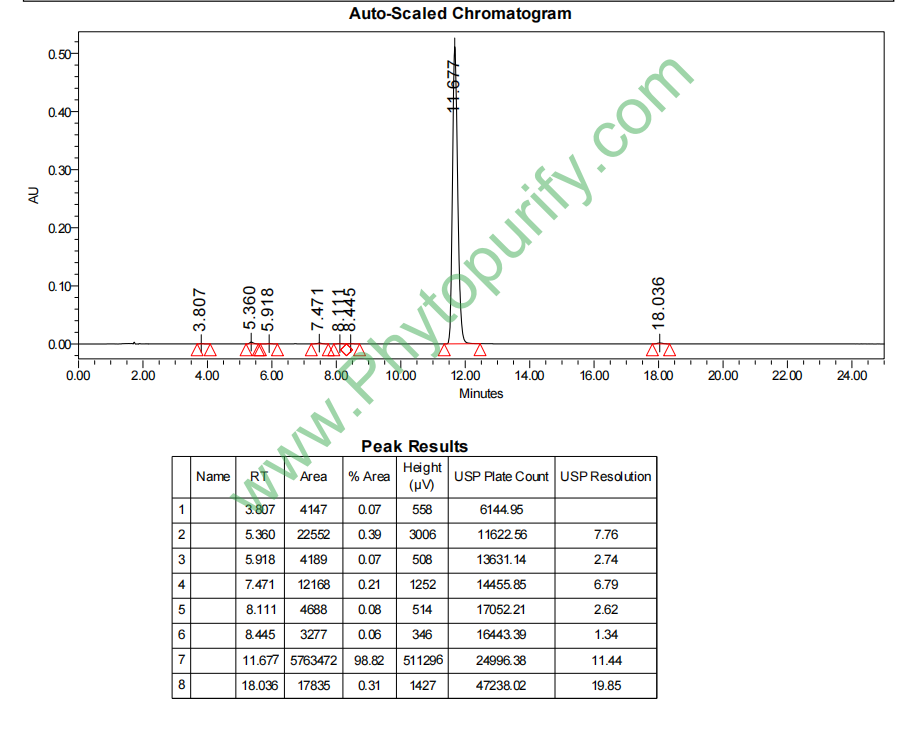
Purity: 95%~99%
Analysis Method: HPLC-DAD or/and HPLC-ELSD
Identification Method: Mass, NMR
Packing: Brown vial or HDPE plastic bottle
Storage: Store in a well closed container, protected from air and light. Put into refrigerate or freeze for long term storage.
Whenever possible, you should prepare and use solutions on the same day. However, if you need to make up stock solutions in advance, we recommend that you store the solution as aliquots in tightly sealed vials at -20℃. Generally, these will be useable for up to two weeks.
The product could be supplied from milligrams to grams
Inquire for bulk scale.
Chengdu Biopurify Phytochemicals Ltd. is a leading company in the research, development, manufacture and marketing of High Quality Phytochemicals and Extracts(especially Active Ingredients from Traditional Chinese Medicine,TCM), Natural Active Pharmaceutical Ingredients worldwide.
The main services:
A. Supply active ingredients and reference standards of TCM, from mgs to kgs scale
B. Custom extraction and purification, target Herb Active Ingredients
C. Custom synthesis and semi-synthesis for Natural Active Ingredients
D. CR(contract research), CM(contract manufacture) and PD(process development) services from lab scale, pilot scale to commercial scale(GMP is also available)
E. TCM compounds library for drug screen,more than 3000 compounds available, many of them are rare and unique.
HPLC of Tetrahydroberberine
Storage conditions:Short-term storage at 2~8℃, long-term storage at -20 ~ -80℃
40.1600
2.8235
2.6938
.0126
6.6645
25.6941
High
88.1854
2.9817
No
No
Yes
No
No
No
0.6
No
No
No
No
Isoquinoline alkaloids are an important treasure trove of natural product chemistry and pharmacology research, among which berberine and its derivatives have attracted much attention due to their extensive biological activities. Tetrahydroberberine, as a reducing derivative of berberine, exhibits unique chemical structures, pharmacological properties, and mechanisms of action. This compound naturally exists in the poppy family plant Corydalis yanhusuo(Corydalis yanhusuo)Among various medicinal plants, it is one of the important material foundations for the analgesic and sedative effects of traditional Chinese medicine. Modern pharmacological research has revealed that tetrahydroberberine not only retains some of the active characteristics of the original berberine skeleton, but also possesses new pharmacological properties due to its structural saturation, especially in the fields of central nervous system and tumors, showing potential for multi-target action. As an orally effective dopamine D2 receptor antagonist and 5-hydroxytryptamine 1A receptor agonist, its application prospects in the treatment of psychiatric disorders have been widely explored. Meanwhile, in recent years, its activities in anti-tumor, neuroprotection, and regulation of gastrointestinal motility have been continuously explored, making it a star molecule that connects the wisdom of traditional Chinese medicine with modern precision medicine. This article aims to systematically review the chemical, pharmacological, mechanistic, and pharmacological research progress of tetrahydroberberine, providing scientific basis for its deep development.
The chemical name of tetrahydroberberine is 2,3,9,10-tetramethoxy-5,8,13,13a-tetrahydro-6H-dibenzo [a, g] quinoline, with a CAS number of 522-97-4. Its molecular formula is C20H23NO4 and its molecular weight is 339.3910. Structurally, tetrahydroberberine belongs to the protoberberine type isoquinoline alkaloids, characterized by the complete saturation of the C-ring (dihydroisoquinoline ring), which is in sharp contrast to the quaternary ammonium salt structure and fully aromatic C-ring of the parent nucleus berberine. This structural difference profoundly affects its physicochemical properties and biological activity.
In terms of physicochemical properties, the lipid water partition coefficient (LogP) of tetrahydroberberine is 2.8235, indicating its moderate lipophilicity, which is conducive to transmembrane transport and absorption. Its topological polar surface area (TPSA) is 40.1600 Å ², which is relatively small, further indicating its good membrane permeability. The water solubility data is 0.0126 mg/mL, which belongs to poorly soluble compounds. This may be one of the key technical bottlenecks that need to be overcome in the development of its oral formulations. Based on its moderate LogP and small TPSA, the computer model predicts that it has a high blood-brain barrier permeability, which is consistent with its pharmacological properties of directly acting on central nervous system targets such as D2 and 5-HT1A receptors. In addition, preliminary safety screening of the drug showed a result of 0.6 in the Ames test (usually considered to be potentially mutagenic positive if>1.5), indicating a low risk of genetic toxicity; At the same time, it has no significant inhibitory effect on hERG potassium channels, indicating that its potential risk of inducing QT interval prolongation in the heart is relatively small, providing preliminary guarantees for its cardiovascular safety.
Tetrahydroberberine is mainly derived from the traditional Chinese medicine Corydalis yanhusuo(Corydalis yanhusuo W. Dried tubers of T. Wang. As a famous medicinal herb for promoting blood circulation, regulating qi, and relieving pain, Corydalis yanhusuo has a complex chemical composition, containing various quinoline alkaloids such as tetrahydroberberine (also known as Corydalis yanhusuo), Corydalis yanhusuo A, and protopine. Tetrahydroberberine is one of the main active ingredients with high content and clear activity. In addition, in the Berberis genus(Berberis)This compound can also be obtained from other plants in the poppy family and some synthetic routes.
The extraction and separation of tetrahydroberberine from plant materials usually follow the conventional process of natural product chemistry. Firstly, the medicinal herb of Corydalis yanhusuo is crushed and subjected to percolation, reflux, or ultrasound assisted extraction using a suitable polar solvent (such as acidic ethanol, methanol, or aqueous ethanol) to fully dissolve the alkaloids. Due to the fact that alkaloids often exist in the form of salts, a small amount of acid (such as hydrochloric acid, acetic acid) is often added to the extraction solvent to improve extraction efficiency. After obtaining the crude extract, the alkaline properties of alkaloids are utilized for preliminary purification through acid-base treatment: the extraction solution is alkalized to isolate the alkaloids or extracted with organic solvents such as chloroform and ethyl acetate; Acidify the aqueous phase, dissolve the alkaloids into salts, and extract them again by alkalization. Repeat this process to improve purity.
Further separation and purification rely on chromatographic techniques. Silica gel column chromatography is the most commonly used method, which uses gradient elution with mixed solvents such as chloroform methanol or dichloromethane methanol in different ratios. Thin layer chromatography (TLC) or high-performance liquid chromatography (HPLC) are commonly used to monitor the separation process. Preparation HPLC can efficiently and high-purity obtain tetrahydroberberine monomer. Structural identification involves the comprehensive use of spectroscopic methods such as mass spectrometry (MS), nuclear magnetic resonance (NMR, including 1H NMR and 13C NMR), and comparison with known standards or literature data for confirmation. Modern extraction techniques such as supercritical fluid extraction and high-speed countercurrent chromatography are also being explored to improve extraction efficiency and product purity.
Tetrahydroberberine exhibits a wide range of pharmacological activities, and its research has expanded from traditional analgesic and sedative methods to modern medical fields such as anti-tumor, neuroprotective, and gastrointestinal regulation.
1. Central nervous system function
This is the core activity of tetrahydroberberine that was first recognized. As a dopamine D2 receptor antagonist and partial agonist of 5-HT1A receptors, it can regulate the functions of the central dopaminergic and serotonergic systems. Animal experiments have shown that tetrahydroberberine has significant sedative, hypnotic, and anti anxiety effects, can prolong pentobarbital induced sleep time, and counteract central excitation caused by caffeine. More importantly, it exhibits clear analgesic effects and has inhibitory effects on chronic persistent pain and neuropathic pain, without the addictive nature of traditional opioid drugs, making it highly valuable in the development of non addictive analgesics. In addition, it has also shown certain therapeutic potential in mental illness models such as depression and schizophrenia.
2. Antitumor activity
In recent years, research has greatly expanded the anti-tumor spectrum of tetrahydroberberine. In vitro experiments have proved that it can inhibit the proliferation and induce apoptosis of many human tumor cell lines, including breast cancer, liver cancer, lung cancer, colon cancer, gastric cancer, etc. Its anti-tumor activity is concentration - and time-dependent. The animal transplantation tumor model further confirms that tetrahydroberberine can effectively inhibit tumor growth and can produce synergistic effects when combined with certain chemotherapy drugs, enhancing efficacy or reducing chemotherapy drug dosage.
3. Neuroprotective effect
Tetrahydroberberine has shown protective effects in neurological disease models such as Parkinson's disease, Alzheimer's disease, and cerebral ischemia-reperfusion injury. It can alleviate neuroinflammatory reactions and inhibit excessive activation of microglia; Reduce oxidative stress damage and increase antioxidant enzyme activity; Inhibit neuronal apoptosis and promote the expression of neurotrophic factors. These effects collectively constitute its multi pathway neuroprotective mechanism.
4. Regulate gastrointestinal function
Traditionally, Corydalis yanhusuo is used for abdominal pain, and tetrahydroberberine is one of its active ingredients. It can enhance the contractility of smooth muscles in the gastrointestinal tract, regulate gastrointestinal motility, and may have therapeutic significance for functional dyspepsia, irritable bowel syndrome, and other conditions.
5. Other activities
The study also suggests that tetrahydroberberine may have potential activities such as anti arrhythmic, hypotensive, and anti fibrotic effects, but related research is still in its preliminary stage.
The pharmacological effects of tetrahydroberberine stem from its interactions with multiple molecular targets, forming a complex network.
1. Central nervous system targets
* Dopamine D2 receptor (DRD2)As an antagonist, tetrahydroberberine affects the midbrain limbic pathway and midbrain cortical pathway by blocking D2 receptors, which is closely related to its antipsychotic, mood regulating, and analgesic effects (especially pain involving the dopaminergic system).
* 5-hydroxytryptamine 1A receptor (HTR1A)As a partial agonist, activation of 5-HT1A receptors can produce anti anxiety, anti depression, and neuroprotective effects. Its analgesic effect may also be partially mediated by the downregulation of the serotonin inhibitory pathway.
2. Anti tumor related targets and pathways
The anti-tumor mechanism of tetrahydroberberine involves multiple links such as inducing apoptosis, inhibiting proliferation, invasion and metastasis, with diverse targets of action:
* Apoptosis regulatory targets It can downregulate the expression of anti apoptotic proteins B cell lymphoma 2 (BCL2) and myeloid leukemia 1 (MCL1), and may also affect mitochondrial membrane potential, thereby initiating endogenous apoptotic pathways.
* signal transduction pathway Tetrahydroberberine can inhibit the phosphorylation and activation of signal transduction and transcription activator 3 (STAT3). STAT3 is an important oncogenic transcription factor, whose sustained activation promotes tumor cell survival, proliferation, and immune escape. Inhibiting the STAT3 pathway is one of its key anti-tumor mechanisms.
* Cell cycle and DNA metabolism Research has shown that it can inhibit the activity of topoisomerase I (TOP1) and topoisomerase II alpha (TOP2A), interfere with DNA replication and repair, leading to DNA damage and cell cycle arrest.
* Invasion and metastasis related targets By downregulating the expression of matrix metalloproteinase-2 (MMP2) and inhibiting extracellular matrix degradation, the invasion and metastasis ability of tumor cells can be weakened.
* Hypoxia and Hormone Signaling Inhibiting the stability of hypoxia inducible factor-1 alpha (HIF1A) affects the ability of tumors to adapt to the hypoxic microenvironment. In addition, it may interfere with the growth signal of estrogen dependent tumors (such as some breast cancer) by acting on estrogen receptor alpha (ESR1) and aromatase (CYP19A1).
* MAPK pathway Inhibition of mitogen activated protein kinase 1 (MAPK1, ERK2) may affect cell proliferation and differentiation signaling.
3. Neuroprotective mechanisms
Its neuroprotective effect is related to inhibiting neuroinflammation mediated by microglia, activating the Nrf2/ARE antioxidant pathway, inhibiting mitochondrial dysfunction, and caspase dependent apoptosis pathway.
4. Gastrointestinal motility regulation mechanism
It may be related to ion channels or receptors that directly act on smooth muscle cells in the gastrointestinal tract, or by regulating neurotransmitter release in the enteric nervous system. The specific target remains to be further elucidated.
Although tetrahydroberberine has a wide range of pharmacological activities, its pharmacological properties still require systematic evaluation. As mentioned earlier, its good lipid solubility and brain permeability are its advantages, but low water solubility is the main factor limiting its oral bioavailability. The study of animal pharmacokinetics provides a preliminary understanding.
absorb After oral administration, tetrahydroberberine is rapidly but incompletely absorbed in the gastrointestinal tract, and its absolute bioavailability is limited by first pass effects and solubility. Formulating nano formulations, solid dispersions, cyclodextrin inclusion complexes, or phospholipid complexes is a common strategy for improving their solubility and oral absorption.
distribution After absorption, it can be widely distributed in various tissues. Due to its high blood-brain barrier permeability, it has a higher concentration in brain tissue, which directly supports its central activity. The plasma protein binding rate data is not yet complete and further research is needed.
Metabolism Tetrahydroberberine is mainly metabolized in the liver. The cytochrome P450 enzyme system (especially CYP2D6, CYP3A4) may be involved in its oxidative metabolism, producing products such as hydroxylation and demethylation. Understanding its metabolic pathways is crucial for predicting drug interactions.
excretion The prototype drug and its metabolites are mainly excreted in urine through the kidneys, and some are excreted in feces through bile.
safety The acute toxicity test showed that its toxicity is relatively low. Long term toxicity studies require a systematic evaluation of their potential effects on major organs. The negative hERG inhibition and low-risk Ames test are important early safety signals, but comprehensive preclinical safety pharmacology evaluation is still needed.
The clinical application prospects of tetrahydroberberine are broad, but the road ahead is long.
1. Treatment field
* pain management Developing non addictive, non steroidal new analgesics is one of its most attractive directions, especially for chronic pain and neuropathic pain.
* Mental and neurological disorders As a multi-target regulator, it has potential in the adjuvant treatment of anxiety disorders, depression, insomnia, as well as neurodegenerative diseases such as Parkinson's disease and Alzheimer's disease.
* tumor therapy: It can be used as an adjuvant chemotherapy drug or developed as a multi target anti-tumor drug for the treatment of breast cancer, liver cancer and other solid tumors. Its sensitization and toxicity reduction effects are worth exploring.
* Gastrointestinal dysfunction Used to treat functional gastrointestinal diseases, such as hypokinetic functional dyspepsia.
2. Challenges faced
* Solubility and bioavailability This is the first technological barrier to push it into clinical practice, requiring innovative pharmaceutical strategies.
* Complexity of mechanism of action The multi-target characteristic is both an advantage and a challenge, requiring more precise elucidation of its main targets and pathways in specific diseases to avoid off target effects.
* Lack of clinical evidence At present, the vast majority of research is still in the preclinical stage, and there is an urgent need to design rigorous clinical trials to verify its effectiveness, safety, and optimal dosing regimen in humans.
* Intellectual Property and Development Path As known natural products, patent protection for their compounds is difficult and requires the construction of intellectual property barriers through novel uses, formulations, derivatives, or combinations.
3. Future research directions
* Structural modification Through chemical synthesis, its structure is modified with the aim of improving activity, selectivity, solubility, and metabolic stability, and developing better derivatives or prodrugs.
* Precision delivery system Develop brain targeted and tumor targeted nano delivery systems to increase drug concentration at the lesion site and reduce systemic side effects.
* Systems Biology Research Using omics techniques (proteomics, metabolomics) to comprehensively reveal its functional network and biomarkers.
* Research on the Integration of Traditional Chinese and Western Medicine In depth exploration of its role and synergistic mechanism in compound traditional Chinese medicine, providing an example for the modernization of traditional Chinese medicine.
Tetrahydroberberine, as an isoquinoline alkaloid derived from traditional Chinese medicine, has become a hot molecule in natural product pharmacology research due to its unique dual central mechanism of dopamine D2 receptor antagonism and 5-HT1A receptor activation, as well as its multi-target anti-tumor and neuroprotective activities that have been continuously revealed in recent years. The research process of tetrahydroberberine, from the traditional analgesic effects of Corydalis yanhusuo to the in-depth interpretation of modern molecular targets, is a microcosm of the modernization exploration of traditional Chinese medicine. Although there are still challenges in developing drug properties, especially in terms of solubility and systematic clinical validation, its clear pharmacological effects, multiple mechanism networks, and good preliminary safety characteristics have laid a solid scientific foundation for its further development as a potential drug for the treatment of pain, psychiatric disorders, and tumors. In the future, through interdisciplinary integration, combined with modern medicinal chemistry, pharmacy, and systems biology methods, tetrahydroberberine is expected to transform from an ancient plant component into a new drug lead compound serving modern precision medicine, demonstrating the sustained vitality of natural products in innovative drug research and development.
