


Product name: Protopine
Synonym name: Fumarine; Corydalis C; Corydinine; Biflorine; Macleyine
Catalogue No.: BP1158
Cas No.: 130-86-9
Formula: C20H19NO5
Mol Weight: 353.374
Botanical Source: Corydalis yanhusuo W.T.Wang
Physical Description:
Type of Compound: Alkaloids
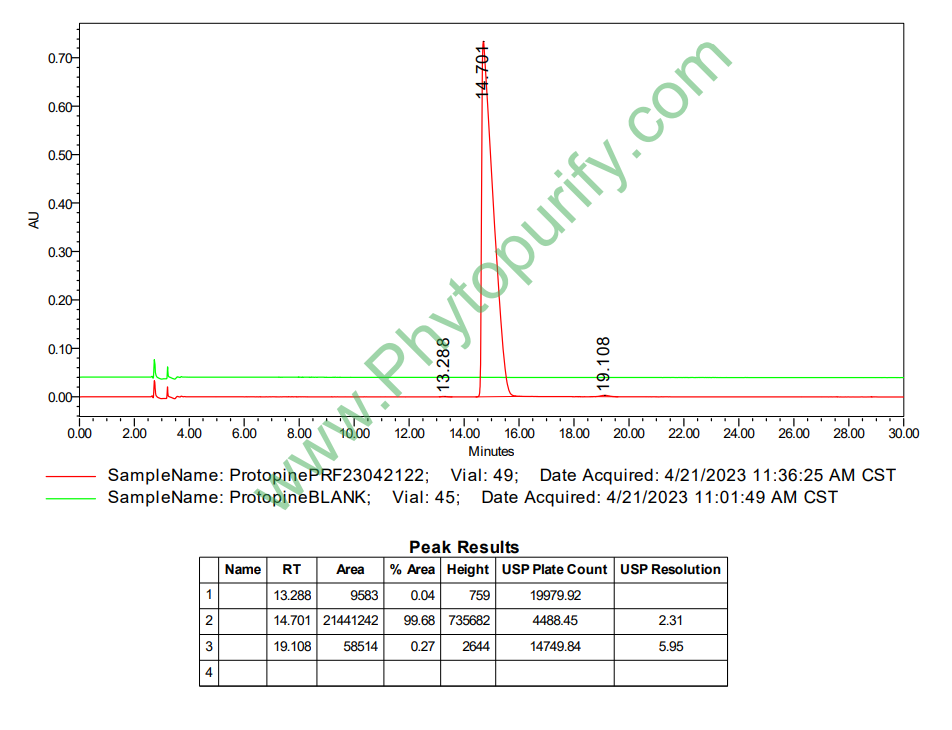
Purity: 95%~99%
Analysis Method: HPLC-DAD or/and HPLC-ELSD
Identification Method: Mass, NMR
Packing: Brown vial or HDPE plastic bottle
Storage: Store in a well closed container, protected from air and light. Put into refrigerate or freeze for long term storage.
Whenever possible, you should prepare and use solutions on the same day. However, if you need to make up stock solutions in advance, we recommend that you store the solution as aliquots in tightly sealed vials at -20℃. Generally, these will be useable for up to two weeks.
The product could be supplied from milligrams to grams
Inquire for bulk scale.
Chengdu Biopurify Phytochemicals Ltd. is a leading company in the research, development, manufacture and marketing of High Quality Phytochemicals and Extracts(especially Active Ingredients from Traditional Chinese Medicine,TCM), Natural Active Pharmaceutical Ingredients worldwide.
The main services:
A. Supply active ingredients and reference standards of TCM, from mgs to kgs scale
B. Custom extraction and purification, target Herb Active Ingredients
C. Custom synthesis and semi-synthesis for Natural Active Ingredients
D. CR(contract research), CM(contract manufacture) and PD(process development) services from lab scale, pilot scale to commercial scale(GMP is also available)
E. TCM compounds library for drug screen,more than 3000 compounds available, many of them are rare and unique.
HPLC of Protopine
Storage conditions:Short-term storage at 2~8℃, long-term storage at -20 ~ -80℃
57.2300
2.2174
2.1318
.0226
6.0050
21.4091
High
83.3537
3.1889
No
No
Yes
No
Yes
No
1.8
No
Yes
No
Yes
Isoquinoline alkaloids, as an important member of the natural product chemical treasure trove, have long been highly regarded for their structural diversity and extensive biological activity. Protopine, also known as Corydinine, is a class of isoquinoline alkaloids with a unique four ring skeleton. Since its first isolation and identification from poppy plants, this compound has sparked sustained research interest due to its name being associated with "opioids". However, unlike classical opioid alkaloids, protoopioid alkaloids do not exert their main effects on opioid receptors, and their pharmacological spectrum is more extensive and complex. Modern pharmacological research has revealed that protopine is a specific, reversible, and competitive acetylcholinesterase inhibitor, which lays the theoretical foundation for its application in the field of neurodegenerative diseases. In addition, a large number of studies have confirmed that it has significant multiple biological activities such as anti-inflammatory, antimicrobial, anti angiogenic, and anti-tumor effects, transforming it from a classic phytochemical molecule into a lead compound with multi-target therapeutic potential. This article aims to provide a systematic review of the chemical properties, plant sources, pharmacological activities, molecular mechanisms of action, pharmacological evaluation, and clinical application prospects of opioids, in order to provide comprehensive academic references for the in-depth research and development of this compound.
The chemical name of protopine is 4,6,7,14-tetrahydro-5-methyl-di [1,3] benzodioxolano [4,5-c: 5 ', 6' - g] azelaid-13 (5H) - one, with the molecular formula C20H19NO5 and CAS number 130-86-9. The core of its molecular structure is a four ring system that combines isoquinoline and benzodioxolane (methylenedioxy), and this rigid skeleton is a key feature that distinguishes it from other simple isoquinoline alkaloids such as berberine and papaverine. The lactam (ketone) structure in the molecule is an important functional group.
From the analysis of physical and chemical properties, the molecular weight of the original opioid base is 353.3740. The calculated lipid water partition coefficient (LogP) is 2.2174, indicating that the molecule has moderate lipophilicity, which facilitates its penetration into the cell membrane. The topologically polar surface area (TPSA) is 57.23 Å ², which is relatively low and further supports its excellent membrane permeation potential. The water solubility data obtained from the experiment is 0.0226 mg/mL, which belongs to the category of slightly soluble to poorly soluble. This suggests that solubilization strategies may need to be considered in formulation development. It is worth noting that, based on its physicochemical properties, opioids have a high blood-brain barrier permeability, which is highly consistent with their activity as central nervous system acetylcholinesterase inhibitors and is a favorable attribute for their use in the treatment of central diseases such as Alzheimer's disease.
Protoalkaloids are widely distributed in nature, mainly found in various plants such as Papaveraceae, Fumariaceae (now mostly merged into Papaveraceae), Rutaceae, and Ranunculaceae. In poppy plants, such as poppies(Papaver somniferum)Wild poppy(Papaver nudicaule)And various types of Boluo Hui(Macleaya)The content is relatively high in plants. In traditional Chinese medicine, Corydalis yanhusuo(Corydalis yanhusuo Belonging to the family Paeoniaceae, it is an important source of protopine and often coexists with other alkaloids.
The extraction of primary opioid alkaloids from plant materials usually follows the general extraction process for alkaloids. Classic methods include solvent extraction: using methanol, ethanol, or acidic water (such as 0.5-1% hydrochloric acid or sulfuric acid) to extract or percolate dried and crushed plant materials. After extraction with acidic water, alkaloids are freed by alkalization (such as ammonia water), and then extracted with organic solvents such as chloroform, dichloromethane, or ethyl acetate. Modern technology often uses ultrasound assisted extraction or microwave-assisted extraction to improve efficiency and yield. After obtaining the crude extract, further purification relies on column chromatography technology, often using silica gel, alumina, or macroporous adsorption resin as the stationary phase, and gradient elution with different ratios of chloroform methanol or petroleum ether ethyl acetate solvent systems. High performance liquid chromatography (HPLC), especially preparative HPLC, has become a key means of obtaining high-purity monomers of opioids. The optimization goal of the extraction process is to improve the yield and purity of the original opioid alkaloids, while minimizing the co extraction and interference of other structurally similar alkaloids as much as possible.
Decades of pharmacological research have fully confirmed that protopine is an active molecule with multiple targets and functions.
1. Analgesic activity: Analgesia is one of the earliest activities of opioids that received attention. Although its name implies an association with opioids, its analgesic mechanism is not solely dependent on μ - opioid receptors. Animal experiments have shown that proopioid alkaloids exhibit significant analgesic effects in various acute and chronic pain models, such as acetic acid writhing test, formalin test, hot plate test, and neuropathic pain model, and their analgesic effects may be partially mediated by activation of kappa - and delta opioid receptors (OPRK1, OPRD1). In addition, its inhibitory ability on cyclooxygenase (PTGS1/COX-1, PTGS2/COX-2) suggests its dual anti-inflammatory and analgesic properties.
2. Neuroprotection and anticholinesterase activity: Proto opioid alkaloids have been identified as a reversible and competitive acetylcholinesterase (AChE) inhibitor. It can effectively inhibit AChE activity, increase acetylcholine levels in synaptic cleft, and thus improve cholinergic neurotransmission. This characteristic makes it of significant value in the treatment research of Alzheimer's disease. Both in vitro and in vivo studies have shown that opioids can improve learning and memory impairments induced by scopolamine or beta amyloid protein.
3. Anti inflammatory and immune regulatory activity: Original opioid alkaloids have shown good inhibitory effects on both acute and chronic inflammation models. It can significantly inhibit the production of nitric oxide (NO), prostaglandin E2 (PGE2), as well as pro-inflammatory factors such as tumor necrosis factor - α (TNF - α) and interleukin-6 (IL-6) in macrophages induced by lipopolysaccharide (LPS). Its anti-inflammatory effect is closely related to the inhibition of the activation of nuclear factor kappa B (NF - κ B) and mitogen activated protein kinases (MAPKs) signaling pathways.
4. Antitumor and anti angiogenic activity: Studies have shown that protoopioid can inhibit the proliferation of many tumor cell lines (such as liver cancer, breast cancer, lung cancer, colon cancer, leukemia, etc.), and can induce cell cycle arrest and apoptosis. Its anti-tumor mechanism involves activation of mitochondrial pathways, triggering of caspase cascade reactions, and regulation of Bcl-2 family proteins. In addition, the original opioid alkaloids can effectively inhibit endothelial cell migration, angiogenesis, and in vivo angiogenesis induced by vascular endothelial growth factor (VEGF), demonstrating their potential for anti angiogenesis. This provides a basis for their development as anti-tumor metastasis drugs.
5. Antimicrobial activity: Proto opioid alkaloids exhibit certain inhibitory activity against various bacteria and fungi, especially against certain drug-resistant strains, but their antibacterial spectrum and efficacy are usually weaker than specialized antibiotics. Their antibacterial mechanism may be related to the destruction of microbial cell membrane integrity or interference with their metabolism.
6. Cardiovascular system activity: Some studies have reported that opioids have anti arrhythmic, vasodilatory, and anti platelet aggregation effects, but their specific mechanisms and strengths still need to be further explored.
The multiple pharmacological activities of protopine stem from its interactions with multiple molecular targets, forming a complex network.
1. Pain related target network: Its analgesic effect is a multi-target synergistic process. In addition to the partial excitatory effects on the kappa - and delta opioid receptors (OPRK1, OPRD1) mentioned earlier, as well as the inhibition of cyclooxygenase PTGS1/2, studies also suggest that it may act on transient receptor potential vanillic acid subtype 1 and anchoring protein subtype 1 (TRPV1, TRPA1), which are key molecules involved in pain signal transmission. In addition, the potential regulation of dopamine D2 receptor (DRD2) and 5-hydroxytryptamine transporter (SLC6A4) may also be involved in their regulation of pain emotion components. Cannabinoid receptor 1 (CNR1) is also considered one of its possible targets, which together form its complex analgesic mechanism network.
2. Acetylcholinesterase (AChE): This is the confirmed direct molecular target of the original opioid alkaloid. It competitively binds to the catalytic active site of AChE, preventing the hydrolysis of substrate acetylcholine and enhancing cholinergic signaling. This is the core mechanism for improving cognitive function.
3. Inflammation and tumor related signaling pathways: Original opioid alkaloids do not directly bind to a single 'anti-inflammatory target', but exert their effects through upstream intervention of key signaling pathways. It can inhibit the activity of I κ B kinase (IKK), prevent the degradation of I κ B protein, thereby inhibiting the translocation of NF - κ B transcription factors to the nucleus and the expression of downstream inflammatory genes. Meanwhile, it can also inhibit the phosphorylation activation of MAPK family members such as p38, JNK, ERK. In terms of anti-tumor activity, in addition to inducing changes in apoptosis related proteins such as caspase-3 and Bax/Bcl-2, their inhibition of the VEGF signaling pathway is the core of their anti angiogenic activity, which may involve interference with the VEGF receptor 2 (VEGFR2) and its downstream PI3K/Akt and ERK signaling pathways.
The preliminary pharmacological evaluation of the original opioid alkaloids revealed their advantages and challenges as drug candidate molecules.
Advantage:
- Good security potential: The Ames test result is 1.8, indicating a low risk of mutagenicity. There is no significant inhibitory effect on hERG potassium channels, indicating a low risk of causing QT interval prolongation in the heart, which is a key toxicological issue for many drug development failures.
- High brain exposure: As mentioned earlier, its physicochemical properties predict its high blood-brain barrier permeability, which is crucial for the treatment of central nervous system diseases.
- Clear mechanism of action: As a reversible AChE inhibitor, its mechanism of action is similar to that of marketed drugs such as donepezil, and its target is clear.
Challenges and unknowns:
- Poor solubility: Low water solubility is the main physical and chemical barrier affecting its oral bioavailability and formulation development.
- Pharmacokinetic data is relatively lacking: At present, there is still insufficient research on the systematic pharmacokinetics of opioids in vivo, including detailed parameters of absorption, distribution, metabolism, and excretion. Limited animal studies have shown that the degree of oral absorption, first pass effects, in vivo metabolic pathways (presumably involving oxidative metabolism of the liver CYP450 enzyme system), and major metabolites still need to be fully elucidated. Key parameters such as plasma protein binding rate, tissue distribution characteristics (excluding the brain), and elimination half-life need to be obtained through standardized preclinical pharmacokinetic studies.
- The complexity of multi-target effects: The multi-target characteristic is both an advantage and a potential source of risk, requiring precise evaluation of its strength of action on each target at therapeutic doses to avoid unexpected off target effects.
Based on existing pharmacological activities, the original opioid alkaloids have shown promising application prospects in multiple disease fields, but their transformation still needs to overcome many challenges.
1. Neurodegenerative diseases: As an AChE inhibitor, proopioid alkaloids are potential candidate drugs for the treatment of Alzheimer's disease (AD). Compared with existing drugs, it may have a dual effect of neuroprotection (anti-inflammatory, anti apoptotic) and cognitive improvement. Future research can explore its efficacy when used alone or in combination with existing AD drugs, and evaluate its impact on other pathological features of AD, such as Tau protein hyperphosphorylation.
2. Pain management: Especially suitable for chronic inflammatory pain and neuropathic pain. Its multi-target analgesic mechanism may bring better efficacy and lower addiction risk compared to traditional opioid drugs. Developing optimized derivatives targeting pain specific target combinations is a direction worth exploring.
3. Tumor adjuvant therapy: Its anti angiogenesis and direct inhibition of tumor cell growth activity make it a potential adjuvant drug for chemotherapy or targeted therapy to suppress tumor growth and metastasis. Further research is needed to investigate its role in the tumor microenvironment and its synergistic effects with standard therapies.
4. Inflammatory diseases: The anti-inflammatory mechanisms of diseases such as rheumatoid arthritis and inflammatory bowel disease provide a theoretical basis for their application.
Outlook and Future Research Directions:
- Structural modification and optimization: Reasonable chemical structural modifications are carried out to address its poor water solubility and potential metabolic instability, with the aim of improving its bioavailability, target selectivity (such as enhancing selectivity for AChE or designing molecules targeting specific pain targets), and metabolic stability.
- Development of a new drug delivery system: Using nanotechnology (such as liposomes, polymer nanoparticles), solid dispersions, or cyclodextrin inclusion techniques to improve their solubility and oral absorption, or to construct targeted delivery systems.
- Pre clinical evaluation of the system: Comprehensive preclinical studies must be conducted in accordance with international standards, including in-depth pharmacokinetics, safety pharmacology (comprehensive cardiovascular, respiratory, central nervous system safety evaluation), and long-term toxicology studies, to clarify their treatment window.
- Deep analysis of the mechanism of action: Using chemical biology methods such as affinity fishing and proteomics to search for its yet to be discovered direct targets, and using gene edited animal models to verify its exact nodes of action in complex disease networks.
- Exploring combination therapy strategies: Given its multi-target nature, exploring its combination with other drugs with a single mechanism of action may result in synergistic effects and reduced side effects.
As a classic isoquinoline alkaloid discovered from traditional medicinal plants, protopine alkaloids have surpassed their initial chemical labeling, exhibiting rich and diverse pharmacological activities and clear multi-target mechanisms of action. From specific inhibition of acetylcholinesterase to regulation of complex pain and inflammation networks, to inhibition of tumor angiogenesis, its biological functional map is constantly being drawn and improved. Despite facing challenges such as solubility in drug development, its excellent blood-brain barrier permeability, low early safety risks, and clear core target function make it a highly valuable lead compound for development. Future research should focus on overcoming its physical and chemical shortcomings through modern medicinal chemistry and pharmacy methods, and fully verifying its therapeutic potential in major diseases such as neurological and psychiatric disorders, pain, and tumors through systematic and rigorous preclinical and clinical studies, ultimately promoting the transformation of this ancient natural molecule into modern drugs that benefit human health.
