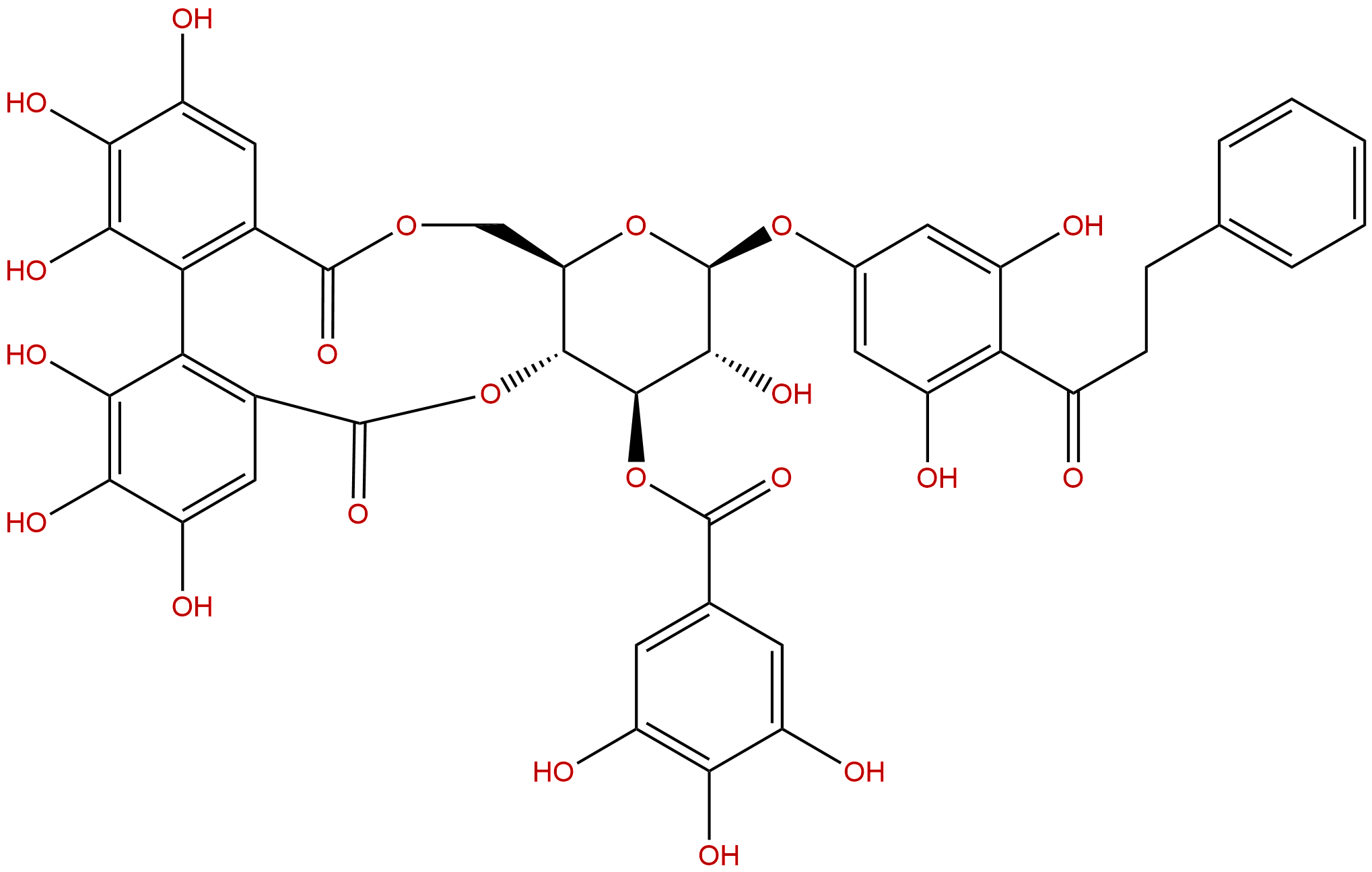


Product name: Thonningianin A
Synonym name:
Catalogue No.: BP3389
Cas No.: 271579-11-4
Formula: C42H34O21
Mol Weight: 874.713
Botanical Source:
Physical Description: Powder
Type of Compound: Chalcones
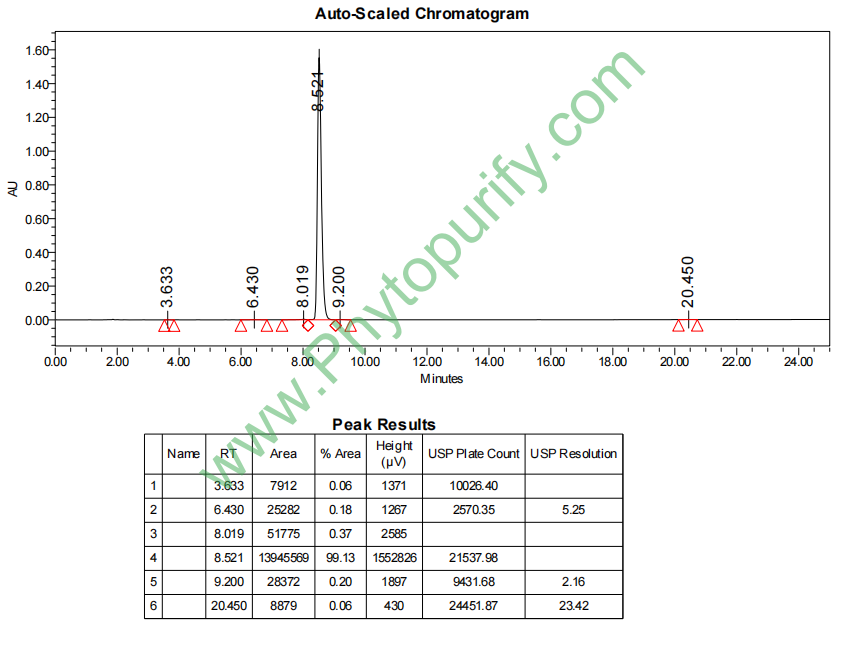
Purity: 95%~99%
Analysis Method: HPLC-DAD or/and HPLC-ELSD
Identification Method: Mass, NMR
Packing: Brown vial or HDPE plastic bottle
The product could be supplied from milligrams to grams. Inquire for bulk scale.
We provide solution to improve the water-solubility of compounds, thereby facilitating the variety of activity tests and clinic uses.
For Reference Standard and R&D, Not for Human Use Directly.
HPLC of Thonningianin A
Storage conditions:Short-term storage at 2~8℃, long-term storage at -20 ~ -80℃
357.1900
2.5520
2.5524
.0060
.5987
.6942
Low
91.0245
5.5201
Yes
No
No
No
No
No
0.6
Yes
No
Yes
No
Natural products have long been an important source of innovative drug discovery, among which polyphenolic compounds have attracted much attention due to their wide range of biological activities. Thonningianin A (CAS number: 271579-11-4), as a tanning compound isolated from traditional medicinal plants, has gradually become a hot topic in natural product pharmacology research in recent years due to its significant antioxidant and anticancer activities, especially its potential application value in liver protection. This compound was originally derived from the traditional African herb, lotus root(Thonningia sanguinea)Obtained from methanol extract, its unique chemical structure endows it with powerful antioxidant properties such as free radical scavenging, anti superoxide generation, and metal chelation. With the development of modern molecular biology technology, the mechanism of action of rush yellow grass glycoside A has been continuously studied. It has shown great potential in combating liver pathological processes such as oxidative stress, inflammation, and fibrosis by regulating key targets such as nuclear factor E2 related factor 2 (NRF2), matrix metalloproteinase 9 (MMP9), and transforming growth factor beta 1 (TGFB1). This article aims to systematically review the chemical properties, plant sources, pharmacological activities, molecular mechanisms of action, pharmacological evaluation, and clinical application prospects of glyphosate A, in order to provide comprehensive scientific references for the in-depth research and future drug development of this compound.
Ganhuangcao glycoside A is a complex polyphenolic compound with a molecular weight of 874.7130 Da. Its structural core is tannic acid, which is connected to sugar units through glycosidic bonds, forming a macromolecular structure with multiple phenolic hydroxyl groups. This structure is the material basis for its strong antioxidant activity. A large number of phenolic hydroxyl groups make it easy to provide hydrogen atoms or electrons, neutralize free radicals, and chelate transition metal ions (such as Fe ² ⁺, Cu ² ⁺), thereby blocking the Fenton reaction and inhibiting the generation of reactive oxygen species (ROS) such as hydroxyl radicals.
From the analysis of physical and chemical properties, the logarithmic (LogP) value of the lipid water partition coefficient of glyphosate A is 2.5520, indicating that it has a certain degree of lipophilicity, but not highly hydrophobic. Its topological polar surface area (TPSA) is as high as 357.1900 Å ², mainly attributed to the numerous polar hydroxyl and sugar moieties in the molecule. High TPSA values are usually associated with strong intermolecular hydrogen bonding abilities, but may also affect their transmembrane permeability. Its water solubility parameter is 0.0060, indicating low solubility in water, which poses a challenge to its formulation development and in vivo bioavailability. Taking into account its molecular weight, LogP, and TPSA values, Ganhuangcao glycoside A basically meets multiple criteria in the five rules for generic drugs, but its higher molecular weight and TPSA may affect its oral absorption and cell permeability.
Ganhuangcao Glycoside A mainly comes from the traditional medicinal plant, Lianhua Zizania, which is widely distributed in sub Saharan Africa(Thonningia sanguinea Vahl.), Belonging to the Balanophoraceae family. This plant is commonly used in African folk medicine to treat various diseases such as malaria, diarrhea, inflammation, and liver diseases. Its medicinal value provides a traditional basis for the biological activity research of glyphosate A.
The separation of glyphosate A from plant materials usually involves organic solvent extraction combined with various chromatographic purification techniques. The classic process begins with drying the aboveground parts or whole plants, first using polar solvents such as methanol or ethanol for crude extraction. Methanol is often chosen as the initial extraction solvent due to its good solubility in polyphenolic compounds. The crude extract obtained is then concentrated under reduced pressure and preliminarily enriched using liquid-liquid distribution method (such as extraction with petroleum ether, ethyl acetate, and n-butanol in sequence). Huangcao glycoside A is mostly concentrated in the ethyl acetate or n-butanol fraction. Further purification depends on column chromatography technology. Silica gel, Sephadex LH-20 gel or reverse C18 material are often used as stationary phases to elute with different proportions of chloroform methanol or methanol water gradient. High performance liquid chromatography (HPLC) or preparative thin layer chromatography (PTLC) is the key step in obtaining high-purity glyphosate A monomer. Modern technologies such as high-speed countercurrent chromatography (HSCCC) have also been applied to the separation of such natural products due to their high efficiency and avoidance of irreversible adsorption. Optimization of extraction processes, such as ultrasound assisted extraction or microwave-assisted extraction, can help improve the yield of target compounds.
A large number of in vitro and in vivo pharmacological studies have confirmed that glyphosate A has various biological activities, among which antioxidant and liver protective effects are the most prominent, and its anti-cancer activity also shows good prospects.
antioxidant activity Huangcao Glycoside A is a potent broad-spectrum antioxidant. In vitro experiments have shown that it exhibits significant dose-dependent activity in DPPH radical scavenging, ABTS cation radical scavenging, superoxide anion (O ₂⁻ •) scavenging, and iron ion reduction/antioxidant capacity (FRAP) assays. Its antioxidant efficacy is superior to or equivalent to common antioxidants such as ascorbic acid (vitamin C) and quercetin. More importantly, it can effectively chelate metal ions such as Fe ² ⁺ that promote oxidation, thereby inhibiting the generation of ROS from the source.
Liver protective activity This is the core field of pharmacological research on rush yellow grass glycoside A. In various experimental liver injury models, including acute liver injury induced by carbon tetrachloride (CCl ₄), acetaminophen (APAP), and D-galactosamine, as well as liver fibrosis models induced by bile duct ligation or thioacetamide, pre-treatment or treatment with glyphosate A showed significant protective effects. It manifests as a significant decrease in serum transaminase (ALT, AST), alkaline phosphatase (ALP), and total bilirubin levels; Improve pathological changes in liver tissue, such as reducing hepatocyte necrosis, ballooning, and inflammatory cell infiltration; In the fibrosis model, it can inhibit collagen deposition and reduce the formation of fibrous septa.
anticancer activity Preliminary studies have shown that glyphosate A has growth inhibitory and apoptosis inducing effects on various human cancer cell lines. Its anti-cancer mechanism may involve inducing cell cycle arrest, activating caspase cascade reactions, and regulating the balance of pro apoptotic/anti apoptotic proteins. Its powerful antioxidant properties may play a dual role in anti-cancer: on the one hand, it protects normal cells by clearing ROS; On the other hand, in certain cancer cells, it may exert a pro apoptotic effect by interfering with their ROS dependent survival signaling pathway.
Other activities Based on its antioxidant and anti-inflammatory properties, glyphosate A has also shown potential research value in anti-inflammatory, neuroprotective, and cardiovascular protection, but there are relatively few related reports and further exploration is needed.
The liver protection and other pharmacological effects of Ganhuangcao glycoside A are not achieved through a single pathway, but involve a complex multi-target regulatory network, whose core lies in combating oxidative stress, regulating inflammatory response, and inhibiting fibrosis process.
Activate NRF2/ARE antioxidant defense pathway This is the key mechanism by which glyphosate A exerts antioxidant and cell protective effects. NRF2 is a core transcription factor that regulates cellular oxidative stress response. Ganhuangcao glycoside A can promote the dissociation and translocation of NRF2 from the cytoplasmic chaperone protein Keap1 to the nucleus, where it binds to antioxidant response elements (ARE), thereby initiating the transcriptional expression of a series of downstream phase II detoxifying enzymes and antioxidant proteins. Research has confirmed that glyphosate A can be significantly upregulated:
Inhibition of TGF - β 1/Smad pro fibrotic pathway The activation and proliferation of hepatic stellate cells (HSCs) are the central processes of liver fibrosis. Transforming growth factor beta 1 (TGFB1) is the strongest pro fibrotic cytokine. Ganhuangcao glycoside A has been shown to downregulate the expression of TGFB1 and inhibit the phosphorylation of its downstream Smad signaling pathway, thereby suppressing the activation, proliferation, and transformation of HSCs into myofibroblasts. At the same time, it can reduce the expression of activated HSC marker alpha smooth muscle actin (ACTA2) and decrease excessive deposition of extracellular matrix (mainly collagen).
Inhibit MMP9 and other proteolytic enzymes Matrix metalloproteinase 9 (MMP9) is overexpressed in liver injury and inflammation, participating in extracellular matrix degradation and inflammatory cell recruitment. The inhibition of MMP9 by rush yellow grass glycoside A helps stabilize tissue structure during acute injury and may indirectly affect inflammatory response.
anti-inflammatory effect In addition to producing anti-inflammatory mediators through HMOX1, glyphosate A can also inhibit the activation of pro-inflammatory signaling pathways such as nuclear factor kappa B (NF - κ B), reduce the production of inflammatory factors such as tumor necrosis factor - α (TNF - α) and interleukin-6 (IL-6), and thus alleviate liver inflammatory damage.
In summary, the synergistic antioxidant, anti-inflammatory, and anti fibrotic effects of Huangcao Glycoside A through a "multi-target, multi pathway" approach constitute the molecular basis for its powerful liver protective effect.
Although Huanghuangcao glycoside A exhibits excellent pharmacological activity, its drug like and pharmacokinetic properties are key factors determining its successful development as a drug.
Based on the provided pharmacological parameters and known studies, a preliminary evaluation can be conducted:
* Absorption and permeability The molecular weight (874.7) is relatively high, and the TPSA (357.2) is extremely high, indicating that its passive transmembrane diffusion ability may be weak, and oral bioavailability may face challenges. The low water solubility (0.0060) further limits its dissolution and absorption in gastrointestinal fluids. The predicted permeability of the blood-brain barrier (BBB) is "low", which is in line with its high polarity macromolecule characteristics, and also means that it may not easily produce central nervous system side effects or be used to treat brain diseases.
* Distribution, metabolism, and excretion At present, there is a lack of systematic research on the specific metabolic pathways, distribution volume, and excretion characteristics of rush yellow grass glycoside A in the body. As a polyphenolic glycoside, it may undergo hydrolysis (deglycosylation) under the action of gut microbiota or liver enzymes, producing glycosides or other metabolites. The activity and pharmacokinetic behavior of these products need further clarification.
* Preliminary Safety Assessment The hERG channel inhibition experiment result is' no ', which is a positive signal indicating a low risk of potential cardiac toxicity (causing long QT syndrome). The Ames test result is 0.6 (usually negative if the mutation rate is less than 2.0), indicating that it has no significant genetic toxicity. However, this is only a preliminary screening, and comprehensive preclinical safety evaluations (such as acute toxicity, chronic toxicity, reproductive toxicity, etc.) still need to be conducted.
* Formulation Challenge Due to its low water solubility and low fat solubility (moderate LogP), developing suitable drug delivery formulations is a key focus of future research. Possible strategies include making nanocrystals, liposomes, cyclodextrin inclusion complexes, or prodrugs to enhance their solubility and bioavailability.
In summary, Huanghuangcao glycoside A performed well in the preliminary safety screening, but its large molecular weight, high polarity, and low solubility are the main obstacles in its drug conversion process. Future research needs to focus on its pharmacokinetic optimization and the development of novel delivery systems.
As a natural compound with clear liver protective activity, the clinical application prospects of Ganhuangcao glycoside A mainly focus on the prevention and treatment of liver related diseases.
Potential indications:
Development Challenges and Prospects:
Ganhuangcao Glycoside A is a bioactive tanning compound isolated from the traditional medicinal plant Lianhua Zizania. Its strong antioxidant capacity, as well as anti-inflammatory and anti fibrotic effects mediated by key targets such as NRF2, TGFB1, MMP9, constitute the scientific connotation of its excellent liver protective activity. Although it has shown potential in fields such as anti-cancer, the current research focus and most valuable application prospects undoubtedly lie in the prevention and treatment of liver diseases. However, its large molecular weight, high polar surface area, and low water solubility pose significant challenges to its drug development. Future research needs to focus on elucidating its molecular mechanism while addressing its pharmacokinetic bottlenecks, and improving its bioavailability through structural optimization or novel formulation strategies. Only by crossing the gap from "active compounds" to "candidate drugs" can Ganhuangcao Glycoside A potentially move from the laboratory to clinical practice, ultimately benefiting liver disease patients and realizing its potential value as a natural product treasure.
