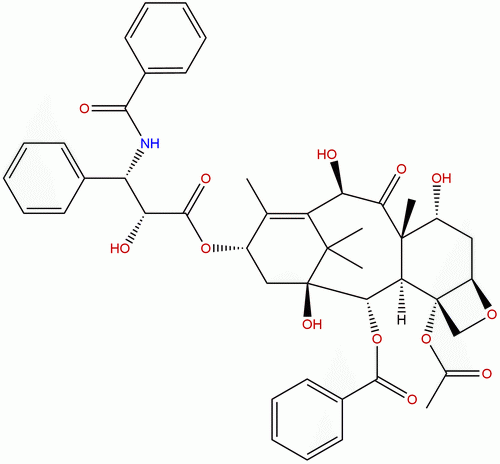


Product name: 10-Deacetyl-7-epipaclitaxel
Synonym name: Ormosin VI; Paclitaxel Related Compound B;7-Epi-10-deacetyltaxol
Catalogue No.: SBP03777
Cas No.: 78454-17-8
Formula: C45H49NO13
Mol Weight: 811.881
Botanical Source:
Physical Description:
Type of Compound: Diterpenoids
Purity: 95%~99%
Analysis Method: HPLC-DAD or/and HPLC-ELSD
Identification Method: Mass, NMR
Packing: Brown vial or HDPE plastic bottle
The product could be supplied from milligrams to grams
Inquire for bulk scale.
For Reference Standard and R&D, Not for Human Use Directly.
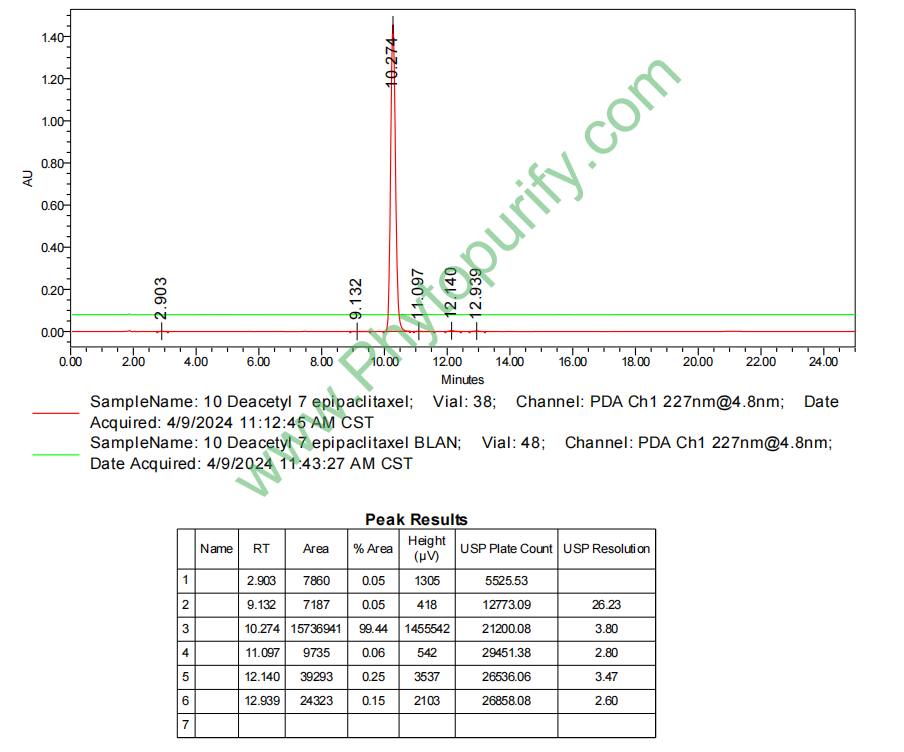
HPLC of 10-Deacetyl-7-epipaclitaxel
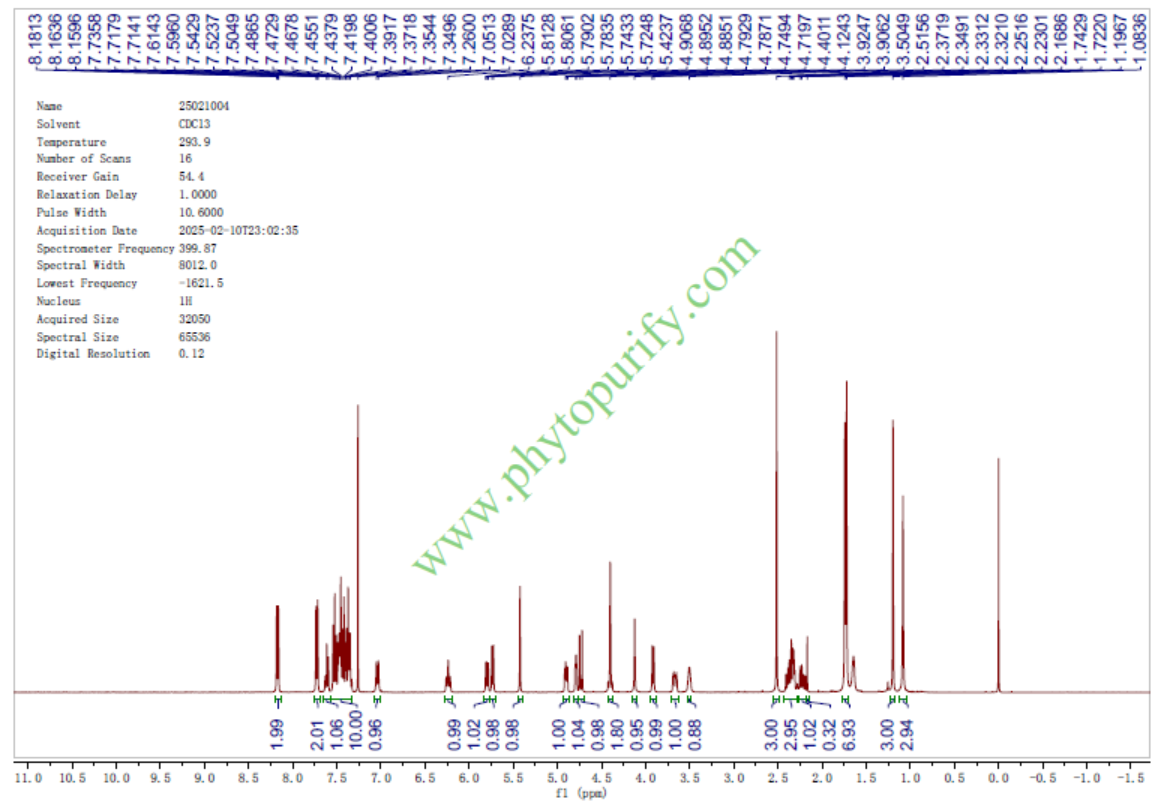
HNMR of 10-Deacetyl-7-epipaclitaxel
Storage conditions:Short-term storage at 2~8℃, long-term storage at -20 ~ -80℃
215.2200
3.0993
3.0994
.0064
.6399
.5995
Low
88.6919
5.8232
Yes
No
No
No
No
No
0.0
Yes
No
Yes
Yes
10-Deacetyl-7-epicalitaxel (CAS number: 78454-17-8) is a natural taxane diterpenoid compound isolated from plants of the Taxus genus. As a structural analogue of the famous anti-cancer drug Paclitaxel, it forms a unique molecular structure through specific chemical modifications - i.e., deacetylation at the 10th position of the paclitaxel core and isomerization at the 7th position. The molecular formula of this compound is C45H49NO13, with a molecular weight of 811.8810 g/mol and product number SBP03777. Although it is not a directly marketed drug, as a biosynthetic precursor or metabolite of paclitaxel, it has important value in natural product chemistry, medicinal chemistry, and tumor pharmacology research. Research has shown that 10-deacetyl-7-epoxypaclitaxel shares some key pharmacological targets with paclitaxel and exhibits potential anti-tumor activity, making it an important model molecule for exploring novel anti-tumor lead compounds or studying the structure-activity relationship of paclitaxel. Currently, in-depth research on it not only helps to understand the mechanism of action of taxane compounds, but also provides new ideas for developing anticancer drugs with lower toxicity and higher selectivity through structural modification.
The chemical structure of 10-deacetyl-7-eptaxel is based on the classical tetracyclic taxane skeleton (6/8/6/4 ring system), and its SMILES string describes in detail its complex stereochemical configuration:CC(=O)O[C@@]12CO[C@@H]1C[C@@H](O)[C@@]1(C)C(=O)[C@H](O)C3=C(C)[C@@H](OC(=O)[C@H](O)[C@@H](NC(=O)c4ccccc4)c4ccccc4)C[C@@](O)([C@@H](OC(=O)c4ccccc4)[C@H]21)C3(C)CThe structure contains multiple chiral centers, among which the stereoisomeric configuration ("epigenetic" configuration) of the 7-hydroxyl group is one of its key features that distinguishes it from paclitaxel. In addition, there are three benzoyl groups and one side chain attached to the molecule, which have a significant impact on its biological activity and solubility.
According to the analysis of drug parameters, its molecular weight (MW) is 811.88 Da, far exceeding the upper limit of 500 Da for conventional small molecule drugs. The calculated topological polar surface area (TPSA) is as high as 215.22 Å ², indicating strong molecular polarity and the presence of a large number of hydrogen bond donors and acceptors (mainly from multiple hydroxyl and ester groups). Its lipid water partition coefficient (LogP) is 3.10, and its LogD (at physiological pH) is 3.10, indicating that the molecule has a certain degree of lipophilicity, but not extremely high. These parameters collectively determine their extremely low water solubility (water_stolubility: 0.0064, usually measured in mg/mL or mol/L, with extremely low values indicating poor solubility in water), which is a common challenge faced by taxane compounds. A higher plasma protein binding rate (PPB: 88.69%) means that most of it binds to proteins in the blood, which may affect the concentration and distribution of free drugs. The low values of in vitro Caco-2 cell permeability (0.5995 × 10 ⁻⁶ cm/s) and effective permeability (Peff: 0.6399) suggest that its oral absorption may be poor. The blood-brain barrier (BBB) penetration is evaluated as' low ', which is consistent with high molecular weight and high polarity surface area, meaning it is not easily accessible to the central nervous system. Overall, its physicochemical properties tend to require intravenous administration (such as clinical formulations of paclitaxel), and formulation techniques (such as the use of solubilizers) are crucial for its drug development.
10-deacetyl-7-elutitol is mainly derived from Taxus chinensis Separated from the middle. The Chinese yew belongs to the Taxaceae family and is a slow growing evergreen tree or shrub widely distributed in China, the Himalayas, and other regions. Taxus plants are not mainstream medicinal herbs in traditional medicine, but their bark, branches, leaves, and seeds have been sporadically used in some folk therapies. However, modern pharmacological research has completely changed the fate of the Chinese yew. In the 1960s, paclitaxel, discovered from the bark of Taxus brevifolia, became a landmark drug for the treatment of ovarian cancer, breast cancer, non-small cell lung cancer and other solid tumors because of its unique mechanism of promoting tubulin polymerization and stability.
As an endemic species in China, Taxus chinensis is also rich in various taxane compounds, including paclitaxel, 10 deacetylbaccatin III, and the 10-deacetyl-7-e-epidtaxane that this article focuses on. These compounds may exist as intermediates or branched metabolites in the biosynthesis pathway of paclitaxel in plants. The chemical research on Taxus chinensis resources is not only aimed at finding alternative plant sources of paclitaxel to alleviate the pressure on primitive tree species (paclitaxel is initially extracted from bark and causes great damage to trees), but also to discover novel and uniquely active taxane analogues. The discovery of 10-deacetyl-7-eptaxel is one of the achievements of systematic plant chemistry research, which expands the structural diversity library of taxane compounds and provides valuable raw materials or inspiration for semi synthetic modifications.
According to the provided target information, the mechanism of action of 10-deacetyl-7-eptaxel may go beyond classical microtubule targeting and involve a wider range of cellular signaling pathway regulation, which is related to the biological property changes brought about by its structural modifications. Its core pharmacological activity focuses on antitumor。
Main target analysis:
BCL2 and BAX BCL2 is an important anti apoptotic protein, while BAX is a pro apoptotic protein, both of which jointly regulate cell apoptosis through the mitochondrial pathway. Many tumor cells resist apoptosis by overexpressing BCL2. Research has shown that some taxane derivatives can inhibit the function of BCL2 or promote the activation of BAX, thereby relieving the inhibition of apoptosis and inducing tumor cell death. 10-deacetyl-7-eptaxel may interfere with the balance of BCL2/BAX, promote increased mitochondrial outer membrane permeability, release cytochrome C, initiate caspase cascade reaction, and ultimately lead to cell apoptosis.
TP53 and CDKN1A The p53 protein encoded by the TP53 gene is a well-known "guardian of the genome" that is activated under conditions such as DNA damage and cellular stress, and can induce cell cycle arrest, DNA repair, or apoptosis. The CDKN1A gene encodes p21 protein, which is a key downstream effector molecule of p53 and mainly mediates G1 phase arrest of the cell cycle. This compound may upregulate the expression of p21 by activating or stabilizing p53 protein, causing tumor cells to stagnate at cell cycle checkpoints and creating conditions for repair or apoptosis. This may be particularly important for tumor types where p53 function is still present.
ESR1 ESR1 encodes estrogen receptor alpha (ER alpha). Although paclitaxel is not mainly used in hormone dependent tumors, some studies have found that some taxanes may regulate the estrogen receptor signaling pathway, which may affect the growth of hormone sensitive tumor cells such as breast cancer. Whether it acts as an agonist, antagonist, or through non genomic effects requires further experimental verification.
Integration of mechanism of action:
The anti-tumor effect of 10-deacetyl-7-eptaxel may be a synergistic result of multiple targets and pathways. The core may lie in:
- Direct microtubule interference As a paclitaxel analogue, it is likely to retain a certain degree of ability to bind to microtubule proteins, promote microtubule stability, and inhibit their depolymerization, leading to cell mitosis arrest in the G2/M phase. This is the classic mechanism of action of taxane drugs.
- Inducing cell apoptosis By inhibiting the anti apoptotic protein BCL2, activating the pro apoptotic protein BAX, and possibly synergizing with the p53/p21 pathway, the intracellular apoptosis program is strongly initiated. The cell cycle arrest and spindle checkpoint activation caused by microtubule stability are also strong apoptotic induction signals.
- cell cycle regulation By activating the p53-p21 axis and setting checkpoints in the G1/S phase, a dual insurance is formed with G2/M phase blockade, which comprehensively inhibits tumor cell proliferation.
This multi mechanism effect may help overcome drug resistance caused by a single target (such as microtubule specific site mutations), but it also makes its spectrum of action and potential toxicity more complex, requiring detailed research.
Based on the provided pharmacokinetic parameters, we evaluated the potential of 10-deacetyl-7-elutitol as a drug from the perspective of medicinal chemistry, and referred to classical methods Lipinski's Five Rules("Five Principles of Similar Drugs"):
Obviously, 10-deacetyl-7-eptaxel seriously violates three of Lipinski's rules (MW, HBD, HBA), which strongly suggests its Oral bioavailability is likely to be extremely low Other parameters support this judgment: extremely low water solubility, low Caco-2 permeability, low BBB penetration. Therefore, if it is developed into a drug,Intravenous administration may be the only practical way This is consistent with the clinical use of paclitaxel.
Other key parameter analysis:
- Toxicity warning Ames test (0.0, usually negative), chromosomal aberration (no), hERG inhibition (no), skin and respiratory sensitization (no), phototoxicity (no), etc. are all negative or low-risk,Preliminary indications suggest that its genetic toxicity and cardiotoxicity risks are relatively low This is a favorable signal. However, serological indicators suggest that there may be an impact on the liver (Ser_SST/ALT: Yes), and liver toxicity needs to be closely monitored in preclinical studies.
- Pharmacokinetic prediction High plasma protein binding rate (88.69%) can affect free drug concentration and tissue distribution. The moderate synthetic accessibility (SyneAccessibility: 5.82) indicates that its chemical synthesis poses certain challenges, but it is not impossible to achieve. Currently, most of them are still extracted from natural sources or used as semi synthetic intermediates.
- Maximum Recommended Treatment Dose (MRTD)Marked as' Yes' indicates the existence of an acceptable therapeutic dose window in the database evaluation system.
Summary The pharmacological evaluation of 10-deacetyl-7-eptaxel exhibits typical "natural product" characteristics: clear activity, but its physicochemical properties (large molecule, high polarity, low solubility) severely limit its potential as an oral drug. Its more likely value lies in: 1) serving as lead compound By simplifying the structure and modifying it (such as preparing prodrugs and nano formulations) to improve its properties; 2) As Pharmacological tool molecules, used to study the non microtubule targeting mechanism of taxane compounds; 3) As Semi synthetic intermediates Used to prepare other derivatives with better activity.
At present, there are relatively fewer independent and systematic research literature on 10-deacetyl-7-elutitol compared to its "star relative" paclitaxel. Most studies report it as an entry for the identification of chemical components in Taxus chinensis or as an intermediate in the biosynthesis pathway/metabolic transformation of paclitaxel. The specific in vitro and in vivo anti-tumor activity intensity, lineage selectivity, and detailed mechanism of action network still require further pharmacological and cell biology research to clarify.
Research Status:
- Chemistry and Separation A method has been established for extracting, isolating, and purifying the compound from Taxus chinensis plant materials, and its structure has been confirmed by spectroscopic methods.
- Activity screening Based on target database prediction and preliminary cell experiments, it suggests that it has the potential to regulate apoptosis and cell cycle related proteins, but lacks large-scale cell panel screening and animal model efficacy verification data.
- Structure Activity Relationship (SAR) Study As a 7-isomer and 10 deacetylated derivative of paclitaxel, it provides key information for the study of structure-activity relationships of taxane compounds. The changes in the 7-position configuration and the loss of the 10 position acetyl group affect their binding to microtubules and interactions with other targets such as BCL2, which is a scientific question worthy of further investigation.
Application prospects and future directions:
1. The source of novel anti-tumor lead compounds It is particularly important to screen non classical taxane structures in order to overcome tumor multidrug resistance and search for low toxicity drugs. The unique structure of 10-deacetyl-7-elutitol may lead to a spectrum of action or toxicity profile different from paclitaxel, which is worth evaluating in more tumor cell lines (especially paclitaxel resistant cells) and animal models.
2. Explorer of Combination Therapy Strategies If its mechanism of action does involve pathways such as p53 and BCL2, it may have a synergistic effect with existing chemotherapy drugs, targeted drugs, or immunotherapy, and its value in combination therapy regimens is worth exploring.
3. Challenges and Opportunities of Drug Delivery Systems Its extremely poor water solubility and oral absorption are precisely the areas where new drug delivery technologies, such as albumin nanoparticles, liposomes, polymer micelles, and prodrug strategies, have shown great potential. Improving its solubility, targeting, and pharmacokinetic behavior through pharmaceutical methods is a key step towards advancing its clinical application.
4. Synthetic Biology and Green Production With the gradual elucidation of the biosynthetic pathway of paclitaxel, it has become possible to use synthetic biology techniques to selectively and efficiently produce specific taxane intermediates (including 10-deacetyl-7-epoxypaclitaxel) in microbial or plant cells, providing a green pathway for sustainable acquisition of this compound for research and development.
In summary, 10-deacetyl-7-epoxypaclitaxel, as a complex chemical structure gifted by nature, carries rich chemical and biological information. Although it faces many challenges in terms of physical and chemical properties on its direct path to drug development, it undoubtedly has important research value and application potential in revealing new mechanisms of taxane drugs, providing new ideas for structural modification, and challenging advanced formulation technologies. Future research requires interdisciplinary collaboration such as chemistry, pharmacology, and pharmacology to fully explore this natural molecular treasure hidden within the Chinese yew.
