


Synonym name: 10-DAB III; 10-Deacetylbaccatin III
Catalogue No.: BP0011
Cas No.: 32981-86-5
Formula: C29H36O10
Mol Weight: 544.597
Botanical Source: Taxus baccata; Taxus mairei SY Hu.
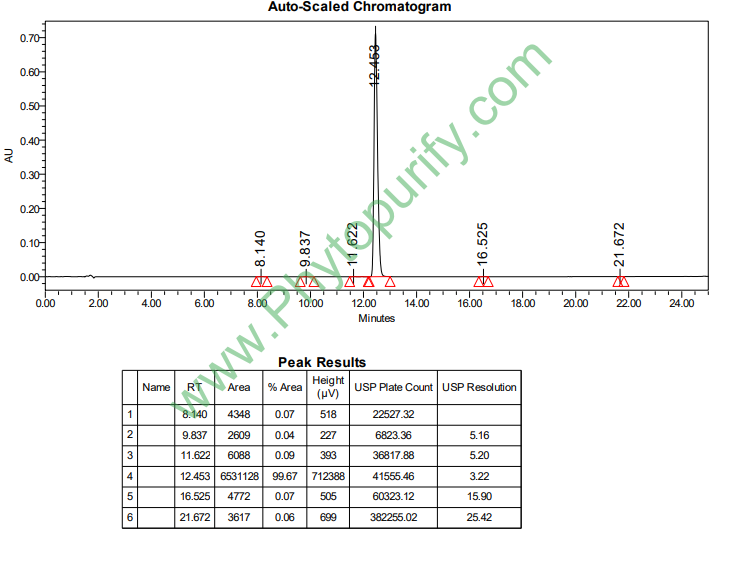
Purity: 99%
Analysis Method: HPLC-DAD
Identification Method: Mass, NMR
Packing: Brown vial or HDPE plastic bottle
Can be supplied from milligrams to grams, up to kilograms.
Inquire for bulk scale, GMP is available on request.
Except supply the 10-DAB III for R&D and reference standard, we also supply the 10-DAB III for intermediate of API, GMP is available on request.
Profiles
10-Deacetyl Baccatin III or 10-DAB III is a crucial intermediate for Paclitaxel & Docitaxel, two of the best anti-cancer drugs ever invented. Natural Paclitaxel was once isolated in very small quantities from the Yew tree (Taxus species) resulting in the large-scale destruction of its natural habitat. By extracting the pre-cursor 10-DAB III in large quantites from the Taxus baccata leaf, many subsequent semi-syntheses can be carried out. The esterification of 10-DAB III also causes an enhancement in the kinetics, and in the pharmacological profile of these important chemo-therapeutic agents.
HPLC of 10-deacetylbaccatin III
Storage conditions:Short-term storage at 2~8℃, long-term storage at -20 ~ -80℃
180.7900
1.3700
.7600
Low
.6500
No
No
No
Unknown
No
Unknown
10 deacetylbaccatin III (10-DAB III) is an important natural product belonging to the taxane class of tetracyclic diterpenes. It has attracted much attention due to its key intermediate position in the synthesis of paclitaxel. As a widely used anti-tumor drug, paclitaxel's complex structure and low abundance make natural extraction and semi synthetic routes a research hotspot. Due to its unique chemical structure and biological activity, 10-DAB III is not only a precursor of paclitaxel, but also exhibits various potential pharmacological activities, especially in the application potential of anti parasitic and liver disease treatment. This article provides a systematic review of the chemical structure, plant origin, pharmacological activity, mechanism of action, pharmacological evaluation, and clinical application prospects of 10 deacetylbaccatin III. The aim is to provide theoretical basis and research direction for natural product pharmacology research and new drug development.
10 deacetylbaccatin III is a secondary alpha hydroxy ketone and tetracyclic diterpenoid compound with the molecular formula C29H36O13 and a molecular weight of 536.59. Its structure is based on the taxane skeleton, containing multiple hydroxyl and ester groups, and has high polarity. The LogP value of 10-DAB III is approximately 1.37, indicating its moderate lipophilicity, which facilitates cell membrane permeability but is not prone to excessive accumulation. Its extremely high polarity is manifested in a TPSA (topological polar surface area) of up to 180.79 Å ² and a hydrogen bond acceptor number of 10, indicating that the molecule can form hydrogen bond interactions with various biomolecules, enhancing its biological activity and selectivity.
Structurally, 10-DAB III lacks the 10 acetyl group on the paclitaxel molecule, making it a key intermediate in paclitaxel synthesis. The secondary α - hydroxyketone group endows the molecule with strong reactivity, making it easy to introduce other functional groups through chemical modification, expanding its pharmacological activity and drug design diversity.
10 deacetylbaccatin III mainly comes from the dried needles and twigs of Taxus baccata in Europe. Taxus plants are widely distributed in temperate regions of the Northern Hemisphere, especially in Europe, North America, and parts of Asia. Taxus baccata is the main natural source of 10-DAB III due to its rich content of taxane diterpenes.
The extraction method usually uses organic solvent extraction combined with multi-step chromatographic separation technology. Common extraction techniques include:
In recent years, supercritical fluid extraction and membrane separation technologies have also been introduced, improving extraction efficiency and environmental friendliness. In addition, the study of plant cell culture and biosynthetic pathways provides new ideas for the sustainable production of 10-DAB III.
10 deacetylbaccatin III, as a precursor of paclitaxel, has relatively little natural activity research, but existing studies have shown that it has multiple potential pharmacological activities, especially in the fields of anti parasitic and liver disease, showing significant effects.
Leishmaniasis is a type of tropical parasitic disease caused by Leishmania parasites, which seriously threatens global public health. Research has shown that 10-DAB III exhibits significant inhibitory effects on Leishmania parasites and can interfere with their metabolism and proliferation processes, demonstrating potential value in the development of antiparasitic drugs.
10-DAB III interacts with various liver disease related targets, including ABCB1, PRKCA, IDH1, PRKCD, NFE2L2, CASP1, PIK3CG, TRPV1, SHBG, and HIF1A, which play key roles in liver metabolism, oxidative stress, inflammatory response, and cell apoptosis. 10-DAB III may have a protective effect on pathological processes such as liver fibrosis, hepatitis, and liver cell damage by regulating these molecular pathways.
Partial in vitro and in vivo experiments suggest that 10-DAB III may have anti-inflammatory, antioxidant, and cell protective effects, but the relevant mechanisms and clinical significance still need further verification.
The mechanism of action of 10 deacetylbaccatin III mainly depends on its interaction with multiple biological targets, especially its regulatory role in liver disease related signaling pathways.
ABCB1 is an important transmembrane transporter involved in drug efflux and multidrug resistance formation. 10-DAB III may affect the accumulation and metabolism of drugs in liver cells, improve drug efficacy, and reduce toxicity by regulating the expression or function of ABCB1.
PRKCA and PRKCD, members of the protein kinase C family, play important roles in cell signal transduction, proliferation, and apoptosis. 10-DAB III may regulate the activity of these two kinases, affect the survival and repair process of liver cells, and alleviate liver damage.
IDH1 is involved in cellular metabolism and redox balance, and mutations or functional abnormalities are associated with liver disease. 10-DAB III may improve liver cell metabolic status and alleviate oxidative stress by regulating IDH1 activity.
NFE2L2 is a key transcription factor that regulates antioxidant responses. 10-DAB III activates the NFE2L2 signaling pathway, enhances cellular antioxidant capacity, and protects liver cells from free radical damage.
CASP1 is involved in the activation of inflammasomes and inflammatory responses. 10-DAB III may alleviate liver inflammation and promote liver tissue repair by inhibiting CASP1 activity.
PIK3CG regulates cell proliferation and survival signaling. 10-DAB III regulates PIK3CG activity, helps maintain liver cell homeostasis, and prevents abnormal proliferation.
TRPV1 is involved in inflammation and pain signaling. 10-DAB III may alleviate liver inflammation related symptoms by regulating TRPV1.
SHBG regulates the levels of sex hormones in the body and affects liver metabolism. The regulatory effect of 10-DAB III on SHBG may indirectly improve liver function.
HIF1A regulates the adaptive response of cells to hypoxia. 10-DAB III contributes to the survival and repair of liver tissue in hypoxic environments by regulating HIF1A.
In summary, 10-DAB III exhibits complex biological effects through multi-target and multi pathway synergistic effects, providing a theoretical basis for its application in liver disease and other diseases.
The pharmacological parameters of 10 deacetylbaccatin III show that it has certain potential for drug development:
In terms of pharmacokinetics, there is currently limited systematic research on 10-DAB III. Its high polarity may lead to limited oral absorption, and its distribution in the body is mainly concentrated in the liver and kidneys. The metabolic pathways may involve the esterase and oxidase systems in the liver, and the metabolites and their activities require further research. The main excretion pathways are speculated to be bile and urine.
In the future, it is necessary to optimize the administration route and dosage form design through in vitro and in vivo pharmacokinetic studies (ADME) and toxicological evaluations, in order to enhance the feasibility of its clinical application.
As an important intermediate in the synthesis of paclitaxel, 10 deacetylbaccatin III occupies a core position in the anti-tumor drug industry chain. Its natural sources are abundant and its structure is suitable for chemical modification, making it an ideal precursor for the semi synthesis of paclitaxel and its derivatives, promoting the large-scale production of anticancer drugs.
In addition, the anti Leishmania activity exhibited by 10-DAB III itself provides new ideas for the development of anti parasitic drugs. Considering the global burden of leishmaniasis and the issue of drug resistance to existing drugs, 10-DAB III and its derivatives are expected to become candidate molecules for novel antiparasitic drugs.
In the field of liver disease treatment, 10-DAB III has shown potential liver protective effects by regulating liver metabolism, inflammation, and oxidative stress through multiple targets. In the future, modern drug design technology can be combined to develop new drugs targeting liver fibrosis, hepatitis, and liver cell damage. Its low blood-brain barrier permeability and good safety indicators provide a basic guarantee for clinical application.
However, the current clinical research on 10-DAB III is still in its infancy, and there is an urgent need for systematic pharmacological and toxicological evaluation, pharmacokinetic studies, and preclinical model validation. Multidisciplinary collaboration, structural modification, and dosage form innovation will be the key to promoting its clinical translation.
10 deacetylbaccatin III, as an important member of taxane natural products, has shown broad application prospects in the fields of natural product pharmacology and new drug development due to its unique chemical structure and diverse biological activities. Its industrial value as an intermediate for the synthesis of paclitaxel has been widely recognized, and its own anti Leishmania activity and multi-target regulatory effects related to liver disease provide new directions for its pharmacological research and clinical applications.
In the future, in-depth analysis of the mechanism of action of 10-DAB III, optimization of its pharmacokinetic properties, systematic safety evaluation, and preclinical research will lay a solid foundation for its transformation into an effective therapeutic drug. With the advancement of natural product research technology, 10 deacetylbaccatin III is expected to become an important bridge connecting traditional natural medicines with modern precision medicine.
