


Synonym name:
Catalogue No.: BP0012
Cas No.: 78432-77-6
Formula: C45H49NO13
Mol Weight: 811.881
Botanical Source: Taxus wallichiana, Taxus mairei and Cephalotaxus mannii
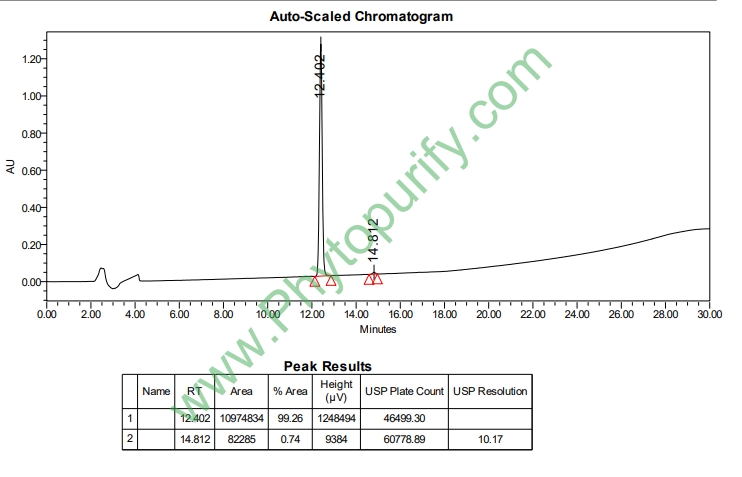
Purity: 95%~99%
Analysis Method: HPLC-DAD or/and HPLC-ELSD
Identification Method: Mass, NMR
Packing: Brown vial or HDPE plastic bottle
Can be supplied from milligrams to grams.
For Reference Standard and R&D, Not for Human Use Directly.
Inquire for bulk scale.
Description:
10-Deacetyltaxol and cephalomannine have cytotoxicity in human glial and neuroblastoma cell-lines, the tumors of the central and peripheral nervous system are sensitive to 10-deacetyltaxol and cephalomannine and these drugs are less toxic than taxol but remain within a therapeutic range.
References:
Int. J.Oncol., 1993, 2(2):297-9.
Cephalomannine and 10-deacetyltaxol cytotoxicity in human glial and neuroblastoma cell-lines.
METHODS AND RESULTS:
The cytotoxic effects of taxol, 10-Deacetyltaxol, and cephalomannine at concentrations of 0.1 mug/ml to 10.0 mug/ml for one and 24 hours exposure were determined in two human glioblastoma multiforme and two neuroblastoma cell lines using the MTT method. The neuroblastoma cell lines were established from previously treated patients, while the glioblastomas were from untreated patients. There was a proportionate concentration-toxicity relationship for all four cell lines. The neuroblastoma SK-N-FI was consistently the most resistant to all three drugs. The order of potency after a one hour exposure was taxol, 10-Deacetyltaxol and cephalomannine. Cephalomannine contained 1.5% taxol impurity and 10-Deacetyltaxol, 4.5% taxol hence the contribution of taxol to these substances' toxic effects was minimal.
CONCLUSIONS:
We conclude that tumors of the central and peripheral nervous system are sensitive to 10-Deacetyltaxol and cephalomannine and these drugs are less toxic than taxol but remain within a therapeutic range.
HPLC of 10-Deacetyltaxol
Storage conditions:Short-term storage at 2~8℃, long-term storage at -20 ~ -80℃
224.2200
3.5000
3.5000
Low
Unknown
Unknown
Unknown
Unknown
No
Unknown
Unknown
Paclitaxel, as a classic taxane based anti-tumor drug, has become an important drug for clinical tumor chemotherapy since its discovery in the late 1970s due to its unique microtubule stabilization mechanism and significant anticancer activity. The continuous deepening of research on the structural modification and pharmacological activity of derivatives of paclitaxel has promoted the development of new anti-tumor drugs. 10 Deacetyl paclitaxel (CAS number 78432-77-6) is a paclitaxel derivative isolated from Taxus spp. and belongs to the taxane diterpenoid class. This compound not only exhibits the ability to promote microtubule polymerization and inhibit microtubule depolymerization in vitro, but also shows significant cytotoxicity to various tumor cell lines, especially to human glioblastoma and neuroblastoma cells.
In recent years, with the in-depth study of the pathogenesis and molecular targets of liver disease, the potential role of 10 deacetylpaclitaxel in liver disease-related targets has attracted widespread attention. Its association with multiple key proteins such as ABCB1, PRKCA, IDH1, PRKCD, NFE2L2, CASP1, PIK3CG, TRPV1, SHBG, and HIF1A provides a theoretical basis for its application in the treatment of liver disease. This article aims to provide a systematic review of the chemical structure, plant origin, pharmacological activity, mechanism of action, pharmacological evaluation, and clinical application prospects of 10 deacetylpaclitaxel, with the hope of providing reference for further research and drug development of this natural product.
10 deacetylpaclitaxel is a diterpenoid compound of paclitaxel, with a molecular formula of C47H51NO14 and a molecular weight of 811.8700. Its structure is based on the core skeleton of paclitaxel, with the difference being that the acetyl group at position 10 is removed to form a hydroxyl substituent, resulting in an increase in molecular polarity. This structural change has a significant impact on its biological activity and pharmacokinetic properties.
In terms of physical and chemical properties, the LogP value of 10 deacetylpaclitaxel is 3.5, indicating moderate lipid solubility and facilitating membrane penetration. The topological polar surface area (TPSA) is 224.22 Å ², indicating that the molecule has high polarity and 13 hydrogen bond receptors, which may limit its ability to pass through the blood-brain barrier, consistent with its low blood-brain barrier permeability. The water solubility of this compound is low, and its bioavailability needs to be improved through organic solvent or formulation technology.
At present, the safety indicators of 10 deacetylpaclitaxel, such as hepatotoxicity, cardiotoxicity, hERG channel inhibition, and mutagenicity (Ames test), have not been clearly defined, indicating that future research needs to focus on its safety evaluation.
10 deacetylated paclitaxel mainly comes from plants of the Taxus genus, especially Pacific Taxus brevifolia and European Taxus baccata. As an important natural resource of paclitaxel and its derivatives, Taxus chinensis contains various taxane diterpenes. 10 deacetyl paclitaxel, as one of the secondary metabolites, exists in the bark, leaves, and cell cultures of plants.
The extraction process usually adopts organic solvent extraction combined with separation and purification technology. The typical process includes:
In recent years, research on cell culture and biosynthetic pathways has provided new ideas for the sustainable production of 10 deacetylpaclitaxel, especially through genetic engineering of Taxus cell lines to increase yield and reduce dependence on wild resources.
The pharmacological activity of 10 deacetylpaclitaxel is mainly reflected in its ability to regulate microtubules and its anti-tumor effect. It can promote the polymerization of microtubule proteins, stabilize microtubule structures, and inhibit microtubule depolymerization processes induced by cold or calcium ions. This mechanism of action is similar to paclitaxel, but due to structural differences, its cytotoxicity and efficacy may differ.
In vitro experiments have shown that 10 deacetylpaclitaxel has significant cytotoxicity against glioma and neuroblastoma cells. By inducing cell cycle arrest and promoting apoptosis, it inhibits the proliferation and migration of tumor cells. Some studies suggest that the compound may have a better effect than paclitaxel in tumor cells, especially exhibiting certain activity in drug-resistant cell lines.
In recent years, the potential of 10 deacetylpaclitaxel in the treatment of liver disease has gradually been recognized. It interacts with multiple target proteins related to liver disease, suggesting that it may exert a protective effect by regulating the signaling pathway of liver cells. Specifically manifested as:
Although there is currently limited in vitro and in vivo research on liver disease, the discovery of these molecular targets lays the foundation for further exploration of pharmacological mechanisms in the future.
The main mechanism of action of 10 deacetylpaclitaxel is based on its stabilizing effect on microtubules. Microtubules, as an important component of the cytoskeleton, participate in cell division, material transport, and signal transduction. This compound promotes microtubule protein polymerization, prevents microtubule depolymerization, causes cell cycle arrest in the G2/M phase, and ultimately induces cell apoptosis.
In terms of molecular targets, 10 deacetylpaclitaxel not only acts on microtubules, but also has potential regulatory relationships with various liver related proteins:
In addition, the regulation of targets such as PIK3CG, TRPV1, and SHBG suggests that this compound has multiple roles in cell signaling, inflammatory response, and endocrine regulation, and is worthy of further research.
The pharmacological evaluation of 10 deacetylpaclitaxel involves its physicochemical properties, safety, and pharmacokinetic characteristics.
At present, there is no systematic report on key safety indicators such as hepatotoxicity, cardiotoxicity, hERG channel inhibition, and genotoxicity (Ames test) of 10 deacetylpaclitaxel. Given the common toxic side effects of paclitaxel drugs, future research needs to focus on evaluating their toxicological characteristics to ensure the safety of clinical applications.
10 deacetylpaclitaxel, as a derivative of paclitaxel, has good anti-tumor activity and potential therapeutic value for liver disease. Its cytotoxicity in glioma and neuroblastoma cells suggests its potential application in the treatment of neurological tumors. Despite the low permeability of the blood-brain barrier, appropriate drug delivery systems such as nanocarriers and liposomes are expected to improve the efficacy of the central nervous system.
In the field of liver disease, 10 deacetylpaclitaxel has the potential to regulate liver cell function, antioxidant and anti-inflammatory effects through multi-target regulation. In the future, molecular targeted drug design may become a candidate drug for diseases such as liver fibrosis, hepatitis, and liver cancer.
However, current research is still in the in vitro and early animal model stage, lacking systematic preclinical and clinical data support. Future research should focus on:
Through interdisciplinary integration research, 10 deacetylpaclitaxel is expected to become an important member in the development of natural product drugs.
10 deacetyl paclitaxel, as a natural product of taxane diterpenes derived from Taxus chinensis, exhibits extensive pharmacological activity and good development potential due to its unique microtubule stabilization and multi-target regulatory properties. Its application prospects in anti-tumor and liver disease treatment have attracted attention, but further pharmacological mechanism analysis and systematic safety evaluation are still needed. In the future, combining modern medicinal chemistry, molecular biology, and drug delivery technology, 10 deacetylpaclitaxel is expected to become a new generation of natural product drugs, providing new strategies and choices for clinical disease treatment.
