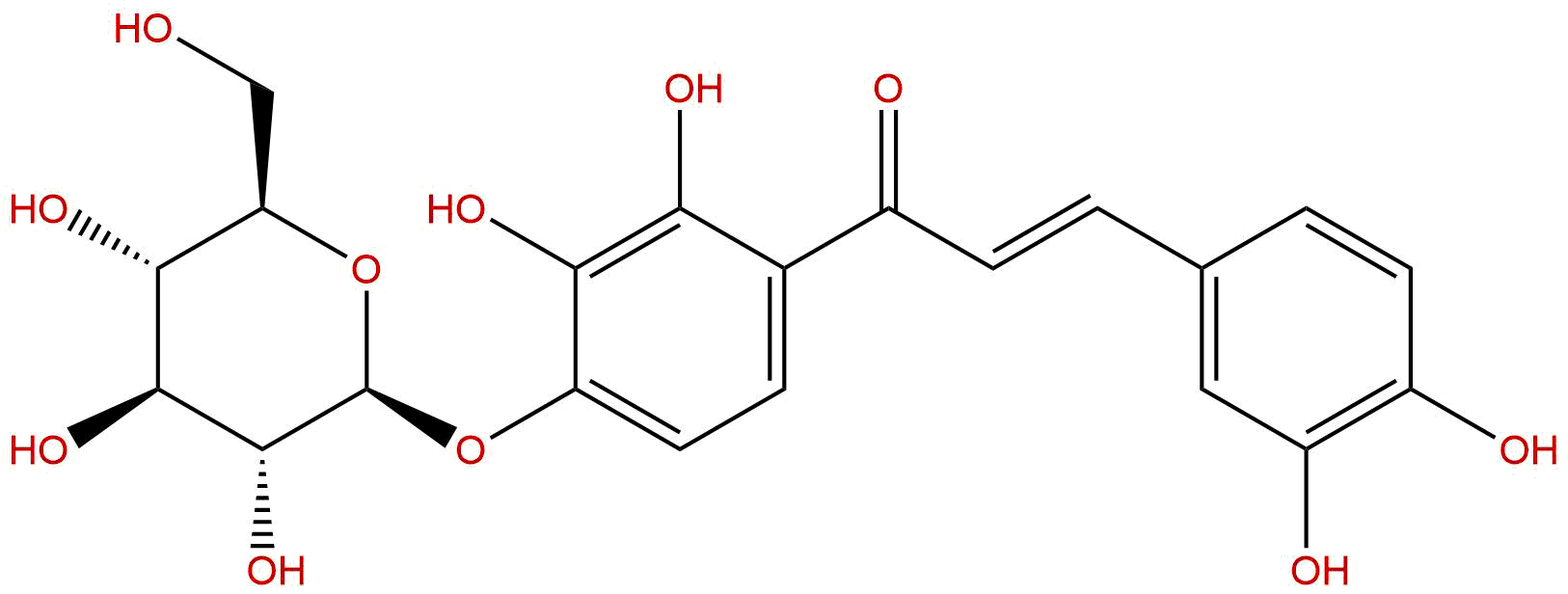


Product name: Marein
Synonym name: Okanin 4'-O-β-D-Glucopyranoside
Catalogue No.: BP2136
Cas No.: 535-96-6
Formula: C21H22O11
Mol Weight: 450.396
Botanical Source: Coreopsis tinctoria Nutt.
Type of Compound: Flavonoids
Purity: 95%~99%
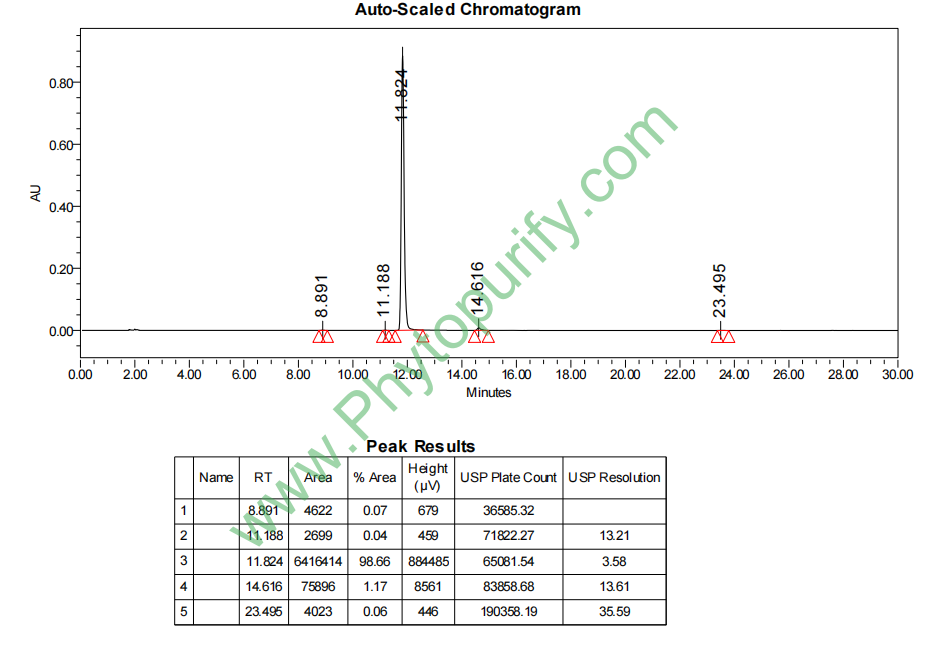
Analysis Method: HPLC-DAD or/and HPLC-ELSD
Identification Method: Mass, NMR
Packing: Brown vial or HDPE plastic bottle
Storage: Store in a well closed container, protected from air and light. Put into refrigerate or freeze for long term storage.
The product could be supplied from milligrams to grams
Inquire for bulk scale.
For Reference Standard and R&D, Not for Human Use Directly.
Description:
Marein shows neuroprotective effect on PC12 cell damage induced by methylglyoxal, which is due to a reduction of damage to mitochondria function and activation of the AMPK signal pathway, it may be a potent compound for preventing/counteracting diabetic encephalopathy. Marein can improve insulin resistance induced by high glucose in HepG2 cells through CaMKK/AMPK/GLUT1 to promote glucose uptake, through IRS/Akt/GSK-3β to increase glycogen synthesis, and through Akt/FoxO1 to decrease gluconeogenesis. Marein shows antioxidant activity, it shows Histone deacetylase enzymes (HDACs) inhibitory activity and it also can inhibit TNFα-induced NF-κB activation.
References:
Free Radic Res. 2016;50(11):1173-1187.
Marein protects against methylglyoxal-induced apoptosis by activating the AMPK pathway in PC12 cells.
Diabetic encephalopathy, which is characterized by cognitive decline and dementia, commonly occurs in patients with long-standing diabetes. Previous studies have suggested that methylglyoxal (MG), an endogenous toxic compound, plays an important role in diabetic complications such as cognitive impairment. MG induces neuronal apoptosis.
METHODS AND RESULTS:
To clarify whether Marein, a major compound from the hypoglycemic plant Coreopsis tinctoria, prevents PC12 cell damage induced by MG, we cultured PC12 cells in the presence of MG and Marein. Marein attenuated MG-induced changes in the mitochondrial membrane potential (ΔΨm), mitochondrial permeability transition pores (mPTPs), intracellular Ca2+ levels, the production of reactive oxygen species (ROS), glutathione (GSH)/glutathione disulfide (GSSG) and adenosine triphosphate (ATP), and the increase in the percentage of apoptotic cells. Marein also increased glyoxalase I (Glo1) activity, phospho-AMPKα (Thr172) and Bcl-2 expression and diminished the activation of Bax, caspase-3 and inhibitor of caspase-activated deoxyribonuclease (ICAD). Importantly, pretreatment of cells with Marein diminished the compound C-induced inactivation of p-AMPK. Molecular docking simulation showed that Marein interacted with the γ subunit of AMPK.
CONCLUSIONS:
In conclusion, we found for the first time that the neuroprotective effect of Marein is due to a reduction of damage to mitochondria function and activation of the AMPK signal pathway. These results indicate that Marein may be a potent compound for preventing/counteracting diabetic encephalopathy.
J Food Sci. 2016 Sep;81(9):C2218-23.
Rapid Identification and Comparison of Compounds with Antioxidant Activity in Coreopsis tinctoria Herbal Tea by High-Performance Thin-Layer Chromatography Coupled with DPPH Bioautography and Densitometry.
A simple and efficient method based on high-performance thin-layer chromatography coupled with 2,2-diphenyl-1-picrylhydrazyl (DPPH) bioautography (HPTLC-DPPH) was established for the screening and comparison of antioxidants in different parts of Coreopsis tinctoria herbal tea from different origins and other related herbal tea materials, which used Chrysanthemum morifolium cv. "Gongju" and "Hangju" in this study.
METHODS AND RESULTS:
Scanning densitometry after DPPH derivatization was applied for the determination of antioxidant capacities of isolated compounds in each sample. It is considered that ethanol extracts of C. tinctoria had stronger antioxidant activity and more characteristic bands than those of 2 compared samples, C. morifolium cv. "Gongju" and "Hangju." Chemometric analysis results showed that the combination of hierarchical clustering analysis and principal component analysis based on determined antioxidant capacities could be used for the discrimination of different parts of C. tinctoria and C. morifolium. Results showed that 7 compounds made up the major contributions of antioxidant activity in C. tinctoria, including okanin, isookanin, Marein, flavanoMarein, 5,7,3',5'-tetrahydroxyflavanone-7-O-glucoside, 3,5-dicaffeoylquinic acid, and chlorogenic acid. Therefore, 7 compounds were identified as major antioxidant biomarkers for quality control of C. tinctoria.
CONCLUSIONS:
Results demonstrated that the established method could be applied for the identification of C. tinctoria, and were beneficial for the bioactivity-based quality control of C. tinctoria.
HPLC of Marein
Storage conditions:Short-term storage at 2~8℃, long-term storage at -20 ~ -80℃
197.3700
.3788
.0725
2.7086
.7935
.0959
Low
75.6929
3.9274
Yes
No
No
No
Yes
No
0.6
Yes
No
Yes
Yes
Marein (CAS number: 535-96-6) is a natural product with multiple pharmacological activities, widely present in various traditional medicinal plants. In recent years, with the increasing incidence of metabolic diseases and neurodegenerative diseases, Mariside has attracted great attention from the scientific community because of its significant anti diabetes, neuroprotective and antioxidant effects. It demonstrates good therapeutic potential by regulating multiple signaling pathways and improving cellular metabolic function. This article aims to provide a systematic review of the chemical structure, plant origin, pharmacological activity, mechanism of action, drug properties, and clinical application prospects of Malian glycosides, in order to provide theoretical basis and reference for subsequent research and clinical development.
Maridine is a flavonoid compound with a molecular formula of C21H22O11 and a molecular weight of 450.3960. Its structural feature is the combination of flavonoid skeleton and glycosidic group, which endows it with high polarity and water solubility. The LogP value is 0.3788, indicating strong hydrophilicity, and the TPSA (topological polar surface area) is 197.37 Å ², suggesting a good distribution of polar groups, which is conducive to interactions with biomolecules. The water solubility is 2.7086, indicating that Maridine has a certain solubility in aqueous medium, which is conducive to the absorption of oral administration. The low permeability of the blood-brain barrier suggests that its direct action in the central nervous system may be limited, but it can still exert neuroprotective effects by regulating peripheral metabolic pathways. The negative result of hERG channel inhibition experiment indicates a low risk of cardiac toxicity. The Ames test result is 0.6, indicating that Maridine has a low genetic toxicity risk and meets safety requirements.
Malin is mainly found in various traditional Chinese medicinal herbs, especially in Asteraceae plants such as Coreopsis tinctoria and certain flavonoid rich plants. Its content is greatly affected by plant species, growth environment, and harvesting period. Common extraction methods include solvent extraction, ultrasound assisted extraction, and high-performance liquid chromatography (HPLC) separation and purification. Generally, ethanol or methanol is used as the extraction solvent, combined with liquid-liquid distribution and column chromatography techniques for separation, and the purity is finally confirmed by HPLC or mass spectrometry. In recent years, the introduction of supercritical CO2 extraction and membrane separation technology has further improved extraction efficiency and purity, reduced residual organic solvents, and promoted the industrial production of malicin.
Mariside showed significant activity in anti diabetes. In vitro studies have shown that Maridine can significantly improve high glucose induced insulin resistance in HepG2 cells. The mechanism mainly involves activating the AMPK signaling pathway, promoting glucose uptake and glycogen synthesis, while inhibiting gluconeogenesis. Specifically, the CaMKK/AMPK/GLUT1 pathway enhances glucose transport, the IRS/Akt/GSK-3 β signaling axis promotes glycogen synthesis, and the Akt/FoxO1 pathway inhibits gluconeogenesis gene expression, effectively regulating intracellular glucose metabolism balance. In addition, Mariside also has a regulatory effect on a variety of diabetes related targets, such as PPARG, DPP4, SGLT2, etc., which shows its potential of multi target synergistic anti diabetes.
Maridine exerts neuroprotective effects by reducing mitochondrial dysfunction, alleviating oxidative stress, activating the AMPK signaling pathway. Related studies have shown that Malian glycosides can effectively alleviate oxidative damage to nerve cells, inhibit neuroinflammatory reactions, promote nerve cell survival, and have potential therapeutic value for neurodegenerative diseases such as Alzheimer's disease and Parkinson's disease.
Maridine has excellent antioxidant capacity, which can clear free radicals, inhibit lipid peroxidation, and protect cells from oxidative damage. At the same time, its regulatory effect on inflammatory mediators has been widely reported, which can reduce the expression of inflammatory factors, alleviate inflammatory reactions, and protect tissue function.
Animal experiments have shown that Maridine can lower blood pressure and lipid levels, and improve cardiovascular function by regulating the activity of vasodilators and lipid metabolism related enzymes. These effects provide theoretical support for its application in metabolic syndrome and cardiovascular disease.
The multiple pharmacological effects of Malian glycosides are mainly achieved by regulating multiple key molecular targets. Its core mechanism involves the following aspects:
AMPK signaling pathway activation
AMPK, as a key regulatory factor in cellular energy metabolism, is activated by Malian glycoside through CaMKK, promoting glucose uptake and energy metabolism, improving insulin sensitivity, and alleviating metabolic stress.
Regulation of sugar metabolism related signaling pathways
By promoting glycogen synthesis through the IRS/Akt/GSK-3 β pathway and inhibiting Akt/FoxO1 mediated gluconeogenesis gene expression, Maridine effectively regulates glucose metabolism in liver cells and alleviates hyperglycemia.
HDAC inhibitory effect
Maridine, as an HDAC inhibitor with an IC50 of approximately 100 μ M, can regulate gene expression, affect the transcription of cell cycle, apoptosis, and metabolism related genes, and further exert anti-inflammatory, antioxidant, and metabolic regulatory effects.
Antioxidant and anti-inflammatory mechanisms
By clearing ROS and inhibiting inflammatory signaling pathways such as NF - κ B, Maridine reduces oxidative stress and inflammatory response, protecting cellular function.
Multi target synergistic effect
Maridine has regulatory effects on various metabolic targets such as PPARG, DPP4, SGLT2, GCK, AKT1, IRS1, SLC2A4, PIK3R1, reflecting its multi-target and multi pathway synergistic regulation characteristics.
From the perspective of drug development, the molecular weight of Maridine (450.4 Da) is within the ideal range of drug molecules, with a low LogP value, indicating its strong hydrophilicity, which may affect oral bioavailability but is beneficial for dissolution and distribution in the bloodstream. A higher TPSA indicates stronger polarity and may limit passive diffusion of the cell membrane. The low permeability of the blood-brain barrier suggests limited direct action in the central nervous system, but still has neuroprotective potential through peripheral system regulation. The negative hERG inhibition test and lower Ames test values indicate good safety.
At present, there is limited research on the pharmacokinetics of Malian glycosides. Preliminary data indicate that their oral absorption is slow, and their metabolic pathways mainly involve phase I and phase II enzyme systems in the liver. The metabolites are mostly hydrolyzed products of glucosides and their further modifications. Further systematic pharmacokinetic and toxicological evaluations are needed in the future to clarify its in vivo behavior and safe dose range.
With its multi target and multi mechanism pharmacological properties, Mariside has shown broad application prospects in the fields of anti diabetes, neuroprotection, antioxidant, cardiovascular disease prevention and treatment. Especially in the treatment of diabetes and its complications, Mariside is expected to become a new natural anti diabetes drug candidate molecule by regulating AMPK and multiple metabolic pathways. In addition, its HDAC inhibitory effect provides a potential new strategy for the treatment of tumors and neurodegenerative diseases.
However, current clinical research on Maridine is still in its infancy and lacks systematic clinical trial data. Future research should focus on its pharmacokinetics, toxicology, safety assessment, and formulation development, breaking through the limitations of bioavailability and improving in vivo stability. At the same time, by utilizing modern drug design techniques to optimize its structure, improve targeting and activity, and promote its clinical translation.
As a natural flavonoid with rich pharmacological activities, Mariside has shown significant therapeutic potential in anti diabetes, neuroprotection, antioxidant and other aspects. It improves cellular metabolic function through synergistic regulation of multiple targets and signaling pathways, demonstrating good safety and drug efficacy. In the future, with the deepening of pharmacokinetics and clinical research, Maridine is expected to become an important candidate molecule for the development of natural product drugs, providing new ideas and choices for the treatment of metabolic and neurodegenerative diseases. Researchers should strengthen their mechanism research and clinical evaluation, promote the transition of Maridine from laboratory to clinical application, and benefit the vast number of patients.
