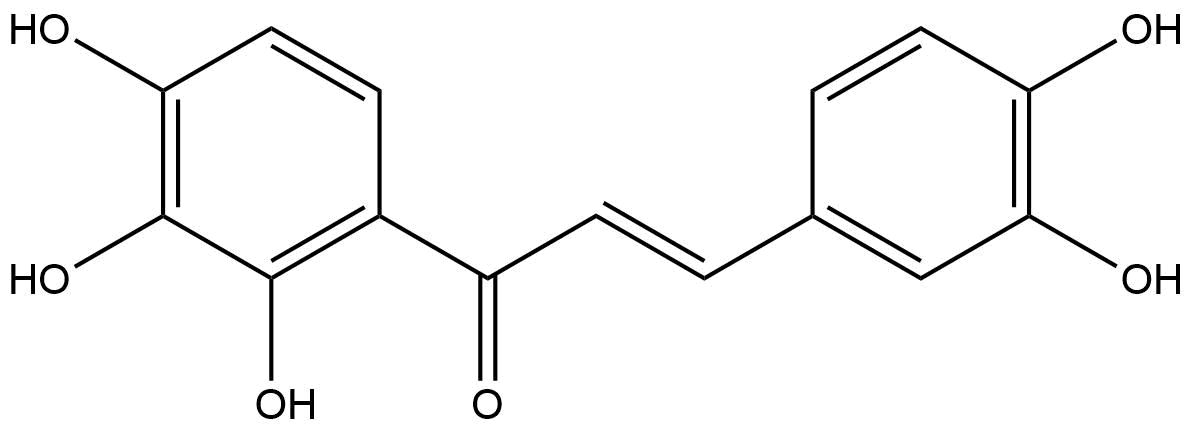


Product name: Okanin
Synonym name: 2',3,3',4,4'-Pentahydroxychalcone
Catalogue No.: BP2137
Cas No.: 484-76-4
Formula: C15H12O6
Mol Weight: 288.255
Botanical Source: Coreopsis tinctoria Nutt.
Type of Compound:
Purity: 95%~99%
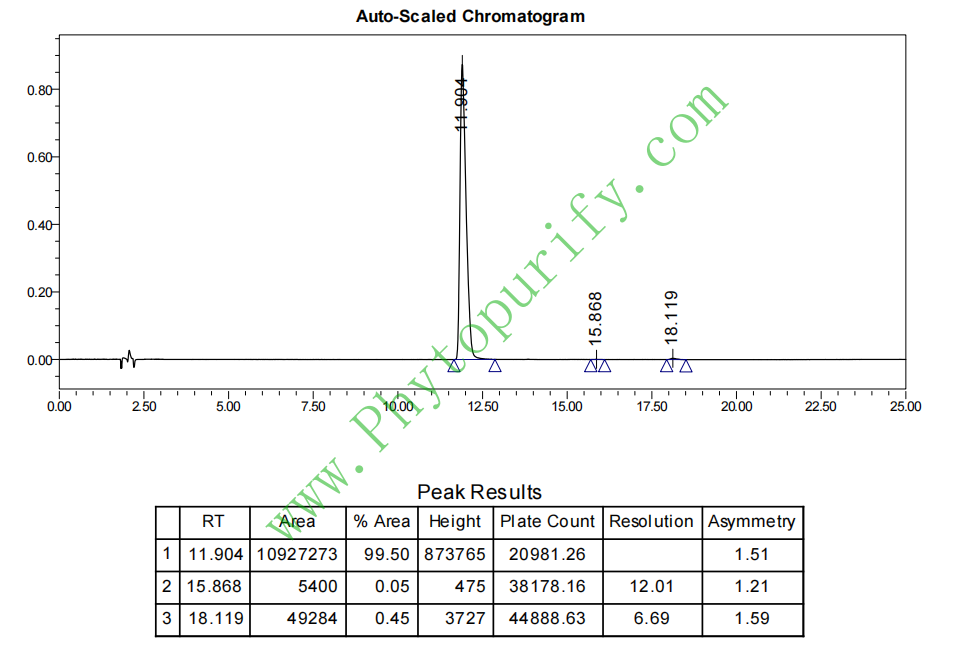
Analysis Method: HPLC-DAD or/and HPLC-ELSD
Identification Method: Mass, NMR
Packing: Brown vial or HDPE plastic bottle
Storage: Store in a well closed container, protected from air and light. Put into refrigerate or freeze for long term storage.
The product could be supplied from milligrams to grams
Inquire for bulk scale.
For Reference Standard and R&D, Not for Human Use Directly.
Description:
1. Okanin shows significant activities on both linoleic acid peroxidation inhibition and DPPH radical scavenging effect.
2. Okanin shows significant protective effects against tacrine-induced cytotoxicity in human liver-derived Hep G2 cells with the EC50 value of 29.8±1.1 uM.
3. Okanin can inhibit nitric oxide production and inducible nitric oxide synthase expression via nuclear factor-erythroid 2-related factor 2-dependent heme oxygenase-1 expression in lipopolysaccharide-activated macrophages.
4. Okanin attenuates LPS-induced microglial activation through inhibition of the TLR4/NF-κB signaling pathways, suggests that okanin may have potential as a nutritional preventive strategy for neurodegenerative disorders.
References:
Korean Journal of Pharmacognosy, 2009 , 40 (4) :345-50.
Antioxidative and hepatoprotective effect of compounds from the flowers of bidens Bipinnata L.
METHODS AND RESULTS:
Activity-guided fractionation of the EtOH extract of flowers of Bidens bipinnata L. have been furnished five flavonoids, sulfuretin(1), butein(2), 7,8,3′,4′-tetrahydroxyflavanone(3), maritimetin(4) and Okanin(5). All of the compounds showed significant activities on both linoleic acid peroxidation inhibition and DPPH radical scavenging effect. The evaluation for protective effect of isolated compounds against tacrine-induced cytotoxicity in human liver-derived Hep G2 cells was conducted. Compounds 1, 3, 4 and 5 showed significant protective effects with the EC50 values of 36.1±0.9, 23.3±0.7, 41.0±1.0 and 29.8±1.1 μM, respectively.
CONCLUSIONS:
Silybin, one of the well-known hepatoprotective agents, used as a positive control, and also showed protective effect with an EC50 value of 84.3±0.7 μM.
J Clin Biochem Nutr. 2012 Jan; 50(1): 53–58.
Okanin, a chalcone found in the genus Bidens, and 3-penten-2-one inhibit inducible nitric oxide synthase expression via heme oxygenase-1 induction in RAW264.7 macrophages activated with lipopolysaccharide
Okanin is one of the most abundant chalcones found in the genus Bidens (Asteraceae) that is used as various folk medications in Korea and China for treating inflammation.
METHODS AND RESULTS:
Here, we found that Okanin (possessing the α-β unsaturated carbonyl group) induced heme oxygenase-1 expression via nuclear factor-erythroid 2-related factor 2 activation in RAW264.7 macrophages. 3-Penten-2-one, of which structure, as in Okanin, possesses the α-β unsaturated carbonyl group, also induced nuclear factor-erythroid 2-related factor 2-dependent heme oxygenase-1 expression, while both 2-pentanone (lacking a double bond) and 2-pentene (lacking a carbonyl group) were virtually inactive. In lipopolysaccharide-activated RAW264.7 macrophages, both Okanin and 3-penten-2-one inhibited nitric oxide production and inducible nitric oxide synthase expression via heme oxygenase-1 expression.
CONCLUSIONS:
Collectively, our findings suggest that by virtue of its α-β unsaturated carbonyl functional group, Okanin can inhibit nitric oxide production and inducible nitric oxide synthase expression via nuclear factor-erythroid 2-related factor 2-dependent heme oxygenase-1 expression in lipopolysaccharide-activated macrophages.
HPLC of Okanin
Storage conditions:Short-term storage at 2~8℃, long-term storage at -20 ~ -80℃
118.2200
2.4941
1.5195
.0803
5.5265
4.8384
Low
88.3454
2.3925
Yes
Yes
No
No
Yes
No
0.6
Yes
No
Yes
Yes
Okanin (CAS number: 484-76-4) is a natural flavonoid compound mainly found in Coreopsis tinctoria. As one of the main active ingredients of this plant, Okanin has received widespread attention in recent years due to its diverse biological activities. Research has shown that Okanin has significant anti-inflammatory, antioxidant, and antimicrobial activities, particularly exhibiting unique advantages in regulating immune responses and inhibiting inflammatory signaling pathways. It effectively reduces lipopolysaccharide (LPS) - induced activation of microglia by inhibiting the Toll like receptor 4 (TLR4) - mediated nuclear factor kappa B (NF - κ B) signaling pathway, indicating its potential application value in neuroinflammation and related neurodegenerative diseases.
In addition, Okanin has shown certain activity in the field of antifungal infection, involving multiple key targets such as MAPK1, ERG11, CDR1, etc., all of which are important molecules in fungal growth and resistance mechanisms. The purpose of this article is to systematically review the chemical structure, physicochemical properties, plant sources, and extraction methods of Okanin, deeply explore its pharmacological activity and mechanism of action, evaluate its pharmacological properties and pharmacokinetic characteristics, and finally look forward to its clinical application prospects, providing theoretical basis and research direction for the field of natural product pharmacology and new drug development.
The molecular formula of Okanin is C15H12O6, with a molecular weight of 288.2550. Its chemical structure belongs to flavonoids, specifically dihydroxyflavonoid derivatives, which contain multiple hydroxyl and ketone groups, endowing it with strong polarity and antioxidant capacity. Its LogP value is 2.4941, indicating moderate lipid solubility that facilitates membrane penetration, but low water solubility (0.0803), suggesting limited solubility in aqueous phase. The polar surface area (TPSA) is 118.2200, indicating that the molecule has strong polarity characteristics, which have important implications for its binding with biomolecules and in vivo distribution.
The structural characteristics of Okanin enable it to exhibit excellent multi-target activity in terms of biological activity. It does not inhibit hERG channels, and the Ames test result is 0.6, indicating a low risk of genetic toxicity and good safety. The low permeability of the blood-brain barrier suggests that its direct role in the central nervous system may be limited, but it can still indirectly affect the neuroinflammatory process by regulating the activation of surrounding immune cells.
Okanin mainly comes from Coreopsis tinctoria, a herbaceous plant widely distributed in North America and some parts of China. As a traditional herb and natural dye plant, chrysanthemum contains abundant flavonoids and polyphenolic compounds. Okanin, as one of its main active ingredients, is usually obtained through plant extraction and purification.
Common extraction methods include solvent extraction, ultrasound assisted extraction, and liquid-liquid partitioning. Using ethanol or methanol as extraction solvents, combined with ultrasound assisted technology, can effectively improve the extraction rate of Okanin. After concentration, separation, and column chromatography purification, the extract was subjected to component identification and content determination using high-performance liquid chromatography (HPLC) and mass spectrometry (MS) techniques. In recent years, green extraction techniques such as supercritical CO2 extraction and microwave-assisted extraction have also been applied to the extraction of Okanin to improve extraction efficiency and reduce the use of organic solvents, in line with the environmental requirements of modern natural product development.
Okanin significantly reduces LPS induced activation of microglia and decreases the expression of pro-inflammatory factors such as TNF - α, IL-1 β, and IL-6 by inhibiting the TLR4/NF - κ B signaling pathway, thereby exerting anti-inflammatory effects. Multiple in vitro cell experiments and animal model studies have confirmed that Okanin can regulate the inflammatory response of immune cells, reduce neuroinflammatory damage, and suggest its potential therapeutic value in neurodegenerative diseases such as Alzheimer's disease and Parkinson's disease.
Okanin exhibits inhibitory activity against various fungal infection related targets, including mitogen activated protein kinase (MAPK1), fungal cell membrane synthase ERG11 (CYP51 homologous enzyme), efflux pump CDR1, β -1,3-glucan synthase FKS1, chitin synthase CHS3, cell attachment protein ALS3, and protease SAP2. Through multi-target synergistic effects, Okanin interferes with the synthesis and function of fungal cell walls and membranes, inhibits fungal growth and pathogenicity, and has good antifungal potential, especially showing certain inhibitory effects on drug-resistant strains.
In addition to anti-inflammatory and antifungal activities, Okanin also exhibits certain antioxidant, anti-tumor, and neuroprotective effects. Its antioxidant activity mainly comes from the phenolic hydroxyl structure in the molecule, which can clear free radicals and alleviate oxidative stress damage. Some studies have shown that Oka Ning induces tumor cell apoptosis and inhibits tumor cell proliferation, but the relevant mechanisms still need further exploration.
The main mechanism of action of Okanin focuses on its regulation of inflammatory signaling pathways and key fungal enzymes.
TLR4 is a key receptor for the immune system to recognize bacterial lipopolysaccharides (LPS), and upon activation, it initiates NF - κ B signaling through the MyD88 dependent pathway, inducing the expression of inflammatory factors. Okanin can block the activation of TLR4, inhibit downstream I κ B α phosphorylation and NF - κ B nuclear translocation, reduce the production of pro-inflammatory cytokines, alleviate inflammatory reactions, especially in microglia, and has neuroprotective effects.
Okanin exerts antifungal effects by interfering with the synthesis and function of fungal cell membranes and walls. Its targets include:
These multi-target mechanisms of action give Okanin potential advantages in antifungal therapy, especially in the treatment of drug-resistant strains, providing new ideas.
The pharmacological parameters of Okanin indicate its potential for development. The molecular weight of 288.2550 conforms to Lipinski's rule, and the LogP value of 2.4941 is moderate, indicating good membrane permeability. The TPSA is 118.2200, slightly higher than the ideal range, which may limit the oral absorption efficiency. Low water solubility (0.0803) suggests the need to consider solubility improvement strategies in formulation development, such as nanocarrier or solid dispersion technology.
The low permeability of the blood-brain barrier limits its ability to directly enter the central nervous system, but this is still beneficial for the regulation of peripheral inflammation. HERG channel inhibition is negative, reducing the risk of cardiac toxicity. The Ames test results showed low genetic toxicity and good safety.
At present, there is limited research on the pharmacokinetics of Okanin, and preliminary data indicates that its oral bioavailability is limited. In vivo metabolism is mainly carried out through the liver enzyme system, and the activity and toxicity of metabolites need further evaluation. In the future, systematic ADME (absorption, distribution, metabolism, excretion) research and pharmacokinetic analysis are needed to provide a basis for clinical translation.
Okanin, as a multifunctional natural product, has a wide range of pharmacological activities and good safety, demonstrating high clinical application potential. Its role in regulating neuroinflammation, especially in inhibiting the activation of microglia, provides new ideas for the adjuvant treatment of neurodegenerative diseases such as Alzheimer's disease and Parkinson's disease. Combining its multi-target antifungal mechanism, Okanin is expected to become a candidate molecule for novel antifungal drugs, especially in the treatment of drug-resistant fungal infections.
Future research should focus on the pharmacokinetic optimization, formulation development, and preclinical safety evaluation of Okanin. In addition, combining modern molecular biology and medicinal chemistry methods to deeply analyze its mechanism of action, screen structurally optimized derivatives, improve bioavailability and targeting, will promote its clinical translation process. The implementation of multicenter clinical trials will be a key step in verifying its efficacy and safety.
In summary, as an important active ingredient in Coreopsis tinctoria, Okanin has shown broad application prospects in anti-inflammatory, antifungal, and neuroprotective fields due to its unique chemical structure and multi-target mechanism of action. It effectively regulates immune inflammatory responses by inhibiting the TLR4/NF - κ B signaling pathway, while exerting synergistic inhibitory effects on key fungal enzymes and proteins, providing valuable natural molecular templates for new drug development. Although there are still challenges in pharmacokinetics and clinical applications, with the deepening of research and technological advancements, Okanin is expected to become a star molecule in the field of natural product pharmacology, driving innovative treatments for related diseases. Future research should focus on mechanism analysis, structural optimization, and clinical validation to achieve its translational application from laboratory to clinical practice.
