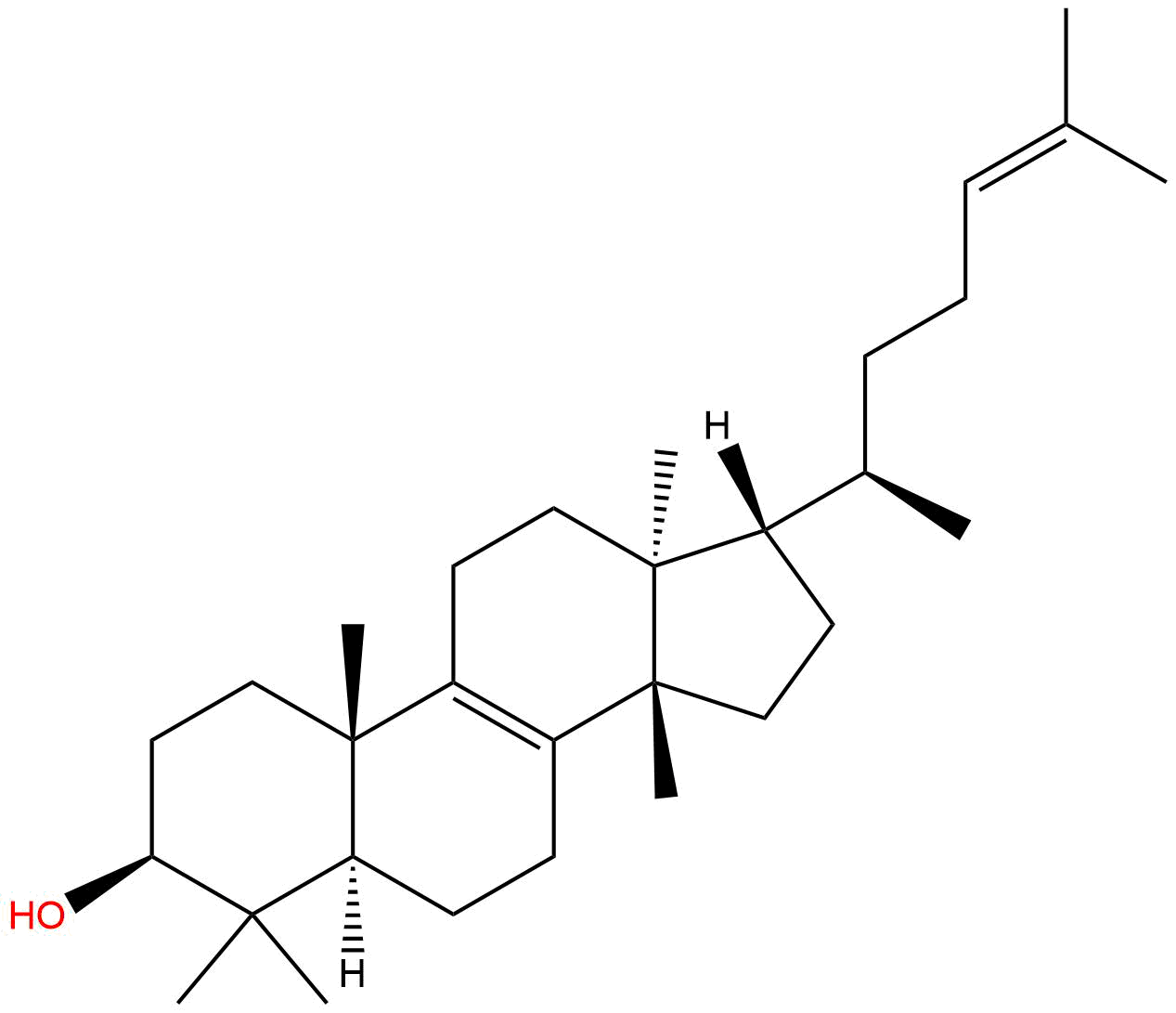


Synonym name:
Catalogue No.: BP0577
Cas No.: 514-47-6
Formula: C30H50O
Mol Weight: 426.729
Botanical Source: Euphorbia spp.
Purity: 95%~99%
Analysis Method: HPLC-DAD or/and HPLC-ELSD
Identification Method: Mass, NMR
Packing: Brown vial or HDPE plastic bottle
Can be supplied from milligrams to grams.
For Reference Standard and R&D, Not for Human Use Directly.
Inquire for bulk scale.
Storage conditions:Short-term storage at 2~8℃, long-term storage at -20 ~ -80℃
Euphor (CAS number: 514-47-6) is a natural tetracyclic triterpenoid alcohol derived from Euphorbia tirucalli, a plant in the Euphorbiaceae family. As one of the main active ingredients in the juice of this plant, Euphorbianolol has attracted much attention due to its significant anti-inflammatory, immunomodulatory, and anti-tumor activities. In recent years, with the in-depth study of the endocannabinoid system (ECS) and its role in inflammation and pain regulation, the potential of diterpenoid as a monoacylglycerol lipase (MGL) inhibitor has gradually been revealed. MGL, as a key enzyme in ECS, regulates the degradation of 2-arachidonoylglycerol (2-AG). Its inhibition can enhance endogenous cannabinoid signaling, thereby exerting anti-inflammatory and analgesic effects. In addition, the regulatory effects of diterpenoid on various tumor related targets demonstrate its broad prospects as a candidate anti-tumor drug. This article provides a systematic review of the chemical structure and physicochemical properties, plant sources and extraction methods, pharmacological activity and mechanism of action, pharmacological evaluation, and clinical application potential of Euphorbianolol. The aim is to provide a theoretical basis and reference for the in-depth research and drug development of this natural product.
Da Ji Di enol belongs to tetracyclic triterpenoid alcohol compounds, with a molecular formula of C30H50O and a molecular weight of 426.7290. Its structure is based on a four ring skeleton, containing a hydroxyl (- OH) functional group that gives it a certain polarity. The LogP value is as high as 8.7805, indicating strong lipid solubility, which is consistent with its hydrophobic skeleton structure. The extremely low topological polar surface area (TPSA) is 20.2300 Å ², indicating that it has fewer polar groups and is conducive to penetrating lipid membranes. Very low water solubility (0.0001 mg/mL) suggests poor solubility in aqueous phase, but high lipid solubility makes it easy to pass through cell membranes and the blood-brain barrier (BBB), which is particularly important in pharmacokinetics. The hERG channel inhibition experiment showed a negative result, indicating that Euphorbiamol is not prone to toxicity risks related to arrhythmia. The Ames test result is 0.0, indicating no mutagenicity and high safety. Overall, the physicochemical properties of Euphorbianolol conform to the typical characteristics of hydrophobic natural products, indicating its widespread distribution in the body, especially in the central nervous system.
Euphorbia tirucalli is mainly isolated from its milk. E. Tirucalli is a succulent shrub widely distributed in tropical and subtropical regions of the Euphorbiaceae family. It is commonly used in traditional medicine to treat diseases such as inflammation, infections, and tumors. Its milk contains abundant triterpenoids, among which the content of diterpenoid is relatively high.
The extraction process usually involves collecting milk and using organic solvents such as ethanol, methanol, or ethyl acetate for extraction. After rotary evaporation concentration, the extract was separated and purified using column chromatography (silica gel column, C18 reverse phase column, etc.). High performance liquid chromatography (HPLC) and mass spectrometry (MS) techniques are used for component identification and purity analysis. In recent years, green extraction techniques such as supercritical CO2 extraction and microwave-assisted extraction have also been attempted to improve the extraction efficiency and purity of diterpenoid.
Da Ji Di enol exhibits significant anti-inflammatory activity, mainly achieved by inhibiting the production of inflammatory mediators and regulating immune cell function. In vitro studies have shown that berberine can inhibit the expression of pro-inflammatory cytokines such as TNF - α, IL-1 β, and IL-6 in macrophages, and alleviate inflammatory responses. Its oral activity also demonstrates good anti-inflammatory effects in an in vivo model.
Importantly, Euphorbiamol can reversibly inhibit the activity of monoacylglycerol lipase (MGL) (IC50=315 nM), block the degradation of 2-AG, enhance endogenous cannabinoid signaling, and regulate immune responses and inflammatory processes. After MGL inhibition, the level of 2-AG increases, activating CB1 and CB2 receptors, exerting analgesic and anti-inflammatory effects, especially significantly relieving inflammatory pain in peripheral tissues.
Da Ji Di enol exhibits the ability to inhibit proliferation and induce apoptosis in various tumor cell lines. Its targets include various tumor related proteins, including anti apoptotic proteins MCL1 and BCL2, signal transduction factor STAT3, matrix metalloproteinase MMP2, DNA topoisomerases TOP1 and TOP2A, transcription factor HIF1A, mitogen activated protein kinase MAPK1, estrogen receptor ESR1, and aromatase CYP19A1.
Mechanistic studies have shown that diterpenoid inhibits the proliferation, migration, and invasion of tumor cells, promotes cell cycle arrest and apoptosis, and suppresses tumor related angiogenesis and metabolic adaptation by regulating the aforementioned targets. Especially in breast cancer, lung cancer and colorectal cancer models, Euphorbia officinalis Dielenol shows good anti-tumor potential.
Da Ji Di enol inhibits MGL activity through reversible binding, preventing the hydrolysis of 2-AG and leading to an increase in the levels of 2-AG both extracellular and intracellular. 2-AG, as an endogenous cannabinoid, activates CB1 and CB2 receptors, regulates neuroinflammation and immune response. CB2 receptors are mainly distributed in immune cells, and after activation, they inhibit the release of pro-inflammatory cytokines and alleviate inflammatory reactions. CB1 receptors are mainly distributed in the central nervous system and participate in pain regulation and neuroprotection. Da Ji Di enol exhibits potential dual analgesic and anti-inflammatory effects by regulating ECS and blocking the development of inflammatory pain.
The multiple regulation of these targets endows Da Ji Di enol with multi-target anti-tumor effects, making it suitable for therapeutic strategies in complex tumor microenvironments.
The molecular weight of Euphorbianolol, 426.7, is slightly higher than the Lipinski rule recommendation of 500 or less, but still within an acceptable range. Its extremely high LogP value (8.78) indicates strong lipid solubility, which may lead to widespread distribution in the body, especially easy to cross the blood-brain barrier, suggesting its potential application advantages in central nervous system diseases. However, high lipid solubility may also lead to reduced bioavailability and in vivo accumulation risks, which need to be addressed through formulation optimization.
A low TPSA value (20.23) is beneficial for membrane permeability and supports the feasibility of oral administration. The extremely low water solubility (0.0001 mg/mL) is a major challenge in its clinical development, which may limit absorption and in vivo distribution. Through pharmaceutical methods such as nanocarriers, liposomes, or solid dispersions, their solubility and bioavailability can be improved.
In terms of safety, Da Ji Di enol does not inhibit hERG channels and reduces the risk of cardiac toxicity; The Ames test is negative, indicating no significant mutagenicity and good safety. There is currently limited research on pharmacokinetics in vivo, and in the future, a systematic evaluation of its absorption, distribution, metabolism, and excretion (ADME) characteristics is needed to clarify in vivo exposure and half-life, providing a basis for clinical development.
Da Ji Di enol, as a natural product with a unique mechanism of action, has demonstrated broad clinical application potential. It inhibits and regulates the endogenous cannabinoid system through MGL, and has anti-inflammatory, analgesic, and immunomodulatory effects, making it suitable for the treatment of inflammatory diseases, chronic pain, and autoimmune diseases. In addition, its multi-target anti-tumor activity provides new ideas for cancer treatment, especially in the context of multidrug resistance and complex tumor microenvironment, with potential synergistic therapeutic value.
Future research should focus on:
In summary, as a natural product with multiple pharmacological activities, Euphorbianolol has the potential to become a new type of anti-inflammatory, immunomodulatory, and anti-tumor drug, and is worthy of further development.
As an important tetracyclic triterpenoid alcohol in Euphorbia tirucalli, Euphorbia tirucalli occupies an important position in the field of natural product pharmacology due to its unique chemical structure and significant biological activity. It exerts anti-inflammatory and immune regulatory effects by inhibiting MGL, regulating the endogenous cannabinoid system, and multi-target regulation of tumor related proteins, demonstrating broad anti-tumor potential. Despite the challenges posed by its high lipid solubility and low water solubility, its good safety and oral activity provide a solid foundation for its clinical development. In the future, through pharmacokinetic optimization, mechanism research, and clinical validation, Euphorbianolol is expected to become a new natural drug for the treatment of inflammatory diseases and tumors, promoting progress in natural product pharmacology and drug development.
