


Product name: Ginsenoside Ro
Synonym name: Chikusetsusaponin V; Polysciasaponin P3; Hericiumsaponin S3
Catalogue No.: BP0671
Cas No.: 34367-04-9
Formula: C48H76O19
Mol Weight: 957.117
Botanical Source: Panax japonicus C.A.Mey.
Physical Description:
Type of Compound: Triterpenoids
Purity: 95%~99%
Analysis Method: HPLC-DAD or/and HPLC-ELSD
Identification Method: Mass, NMR
Packing: Brown vial or HDPE plastic bottle
Storage: Store in a well closed container, protected from air and light. Put into refrigerate or freeze for long term storage.
Whenever possible, you should prepare and use solutions on the same day. However, if you need to make up stock solutions in advance, we recommend that you store the solution as aliquots in tightly sealed vials at -20℃. Generally, these will be useable for up to two weeks.
The product could be supplied from milligrams to grams
Inquire for bulk scale.
Chengdu Biopurify Phytochemicals Ltd. is a leading company in the research, development, manufacture and marketing of High Quality Phytochemicals and Extracts(especially Active Ingredients from Traditional Chinese Medicine,TCM), Natural Active Pharmaceutical Ingredients worldwide.
The main services:
A. Supply active ingredients and reference standards of TCM, from mgs to kgs scale
B. Custom extraction and purification, target Herb Active Ingredients
C. Custom synthesis and semi-synthesis for Natural Active Ingredients
D. CR(contract research), CM(contract manufacture) and PD(process development) services from lab scale, pilot scale to commercial scale(GMP is also available)
E. TCM compounds library for drug screen,more than 3000 compounds available, many of them are rare and unique.
HPLC of Ginsenoside Ro
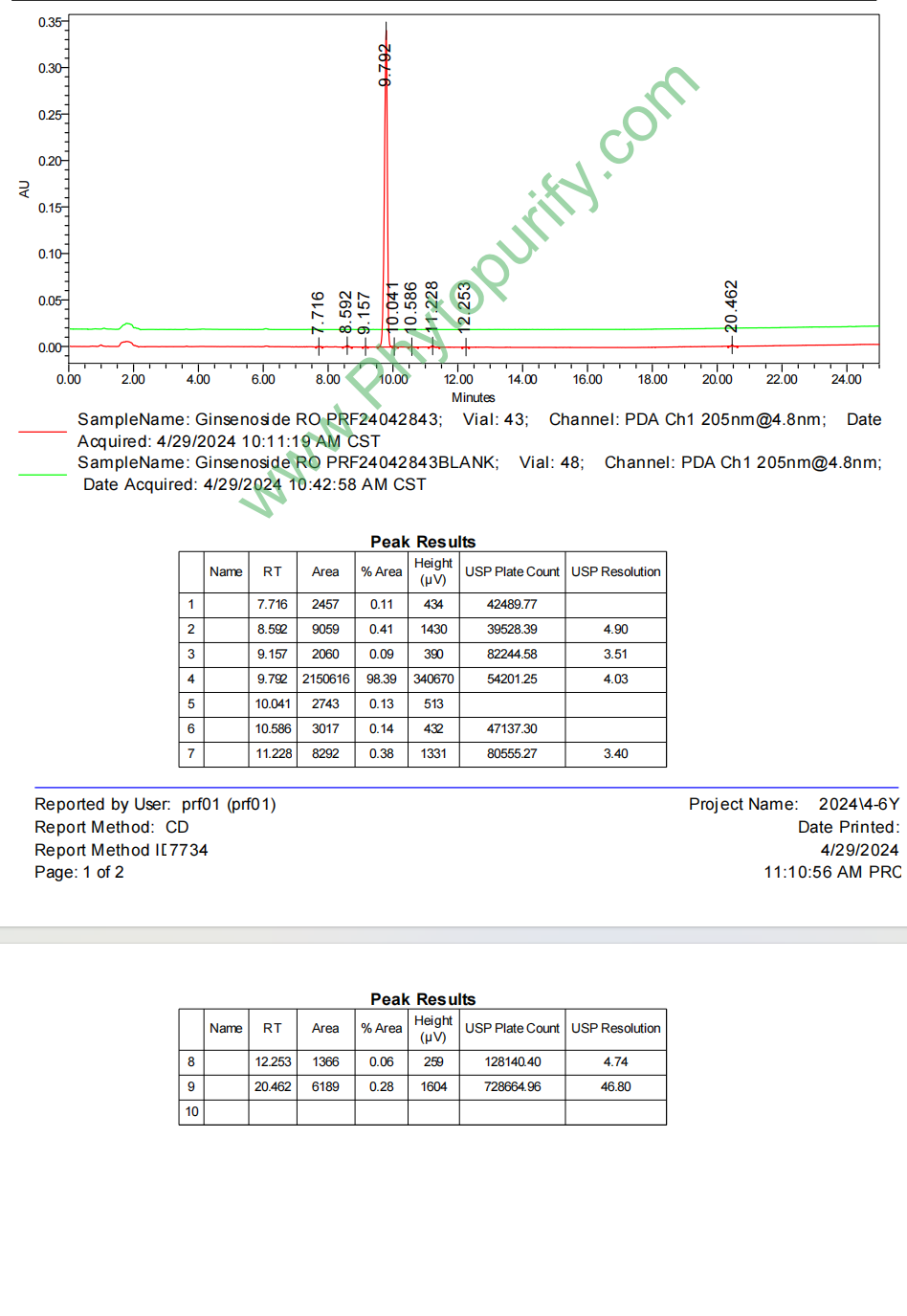
Storage conditions:Short-term storage at 2~8℃, long-term storage at -20 ~ -80℃
312.0500
2.0547
-.5771
.1942
.5349
.1139
Low
82.9272
6.2953
Yes
No
Yes
No
Yes
No
0.0
Yes
No
No
No
Ginsenoside Ro, chemical identifier CAS 34367-04-9, is a triterpenoid saponin of the oleanane type found in the traditional medicinal plant Panax ginseng C.A. Mey. and its related species. Unlike dammarane type saponins represented by ginsenediol type (such as Rb1, Rg1) and panaxatriol type saponins, ginsenoside Ro has attracted much attention due to its unique chemical skeleton and biological activity. Early studies have revealed that it has calcium ion (Ca ² ⁺) antagonist like activity, which can effectively inhibit platelet aggregation with an IC50 of 155 μ M. Its effect is related to reducing thromboxane A2 (TXA2) production and mildly inhibiting cyclooxygenase-1 (COX-1) and thromboxane synthase (TXAS) activity. In recent years, with the in-depth study of metabolic diseases, especially diabetes and its complications, the potential of ginsenoside Ro in regulating blood glucose homeostasis has gradually emerged, involving EHMT2, AMPK, SGLT2, BACE1 and other sub targets closely related to hyperglycemia and diabetes complications. This article aims to systematically review the chemical properties, plant sources, pharmacological activities, mechanisms of action, medicinal properties, and application prospects of ginsenoside Ro in the treatment of related diseases, in order to provide comprehensive scientific references for the in-depth research and development of this natural product.
Ginsenoside Ro, also known as Polysciasaponin P3, Chikusetsusaponin 5, or Chikusetsusaponin V, has a molecular formula of C ₄₈ H ₇₆ O ₁ and a molecular weight of 957.1170. From a chemical structure perspective, it belongs to the oleanolic acid type pentacyclic triterpenoid saponin. Its aglycone is oleanolic acid, and the sugar chain is complexly connected, usually with oligosaccharide chains connected at C-3 and C-28 positions, which is a significant feature that distinguishes it from damane type ginsenosides. This unique glycosylation pattern has a decisive impact on its water solubility and biological activity.
The theoretical calculation of the lipid water partition coefficient (LogP) is 2.0547, indicating that the compound has a certain lipophilicity, but not highly hydrophobic. Its topological polar surface area (TPSA) is as high as 312.0500 Å ², mainly attributed to the abundant hydroxyl and oxygen atoms on the sugar groups in the molecule, indicating its strong molecular polarity, which may affect its transmembrane transport ability. The water solubility value is 0.1942 (usually measured in mg/mL or log mol/L scale), indicating that its solubility in water is limited and it belongs to slightly soluble or poorly soluble compounds, which is a key factor to consider in its formulation development. Based on its molecular weight approaching 1000, high TPSA, and moderate LogP value, it is preliminarily judged that it meets multiple challenges in the Rule of Five for generic drugs (such as molecular weight>500, TPSA>140), indicating that its oral bioavailability may face challenges. In addition, predictions indicate low blood-brain barrier (BBB) permeability, which contradicts its potential to treat central nervous system related targets such as APP and BACE1, and may require structural modifications or special delivery systems. Preliminary safety predictions indicate that there is no risk of hERG potassium channel inhibition (low risk of QT interval prolongation), and the Ames test predicted a value of 0.0, suggesting a low potential risk of mutagenicity.
Ginsenoside Ro is mainly found in plants of the Panax genus in the Araliaceae family. Although Panax ginseng (Asian ginseng) and Panax quinquefolius (American ginseng), which are known for their dammarane type saponins, have relatively low levels, they are more abundant in Panax japonicus and its variants, Panax notoginseng, and some medicinal plants of the non-human ginseng genus such as Polyscias fruticosa (named Polysciasaponin P3). These plants are often used in traditional East Asian medicine for nourishing, anti-inflammatory, and improving blood circulation.
The extraction of ginsenosides Ro from plant materials usually follows the general extraction and purification process of triterpenoid saponins. Firstly, alcohol solvents (such as methanol, ethanol) or alcohol water mixed solutions are used for reflux extraction or ultrasound assisted extraction of dried rhizomes to effectively extract saponins with a wide range of polarities. Subsequently, preliminary enrichment and decolorization were carried out using macroporous adsorption resins (such as D101, AB-8), and gradient elution was performed using ethanol aqueous solutions of different concentrations. Ginsenoside Ro is usually collected in the medium to high concentration ethanol elution fractions (such as 50% -70% ethanol). Further purification relies on normal or reverse phase chromatography techniques. Silica gel column chromatography is commonly used for crude separation, followed by reversed-phase C18 medium pressure or high-pressure preparative liquid chromatography (MPLC/HPLC) for fine separation. High purity monomers are obtained by gradient elution with a mobile phase (such as acetonitrile water or methanol water system). Modern technologies such as high-speed countercurrent chromatography (HSCCC) have also been applied to the preparation of such saponins due to their efficient liquid-liquid partitioning and separation capabilities. The optimization of extraction process needs to take into account the yield and purity of the target compound, as well as the interference of other coexisting saponin components.
Ginsenoside Ro exhibits various pharmacological activities, and its research has expanded from cardiovascular protection to the fields of metabolism and nervous system.
Cardiovascular system activity (antiplatelet aggregation)This is the earliest clear function of ginsenoside Ro. It effectively inhibits platelet aggregation caused by various inducers such as collagen and ADP by antagonizing Ca ² ⁺ influx and suppressing key signaling pathways for platelet activation. Its IC50 is 155 μ M, indicating clear activity. Further research has shown that this effect is related to its ability to significantly reduce the generation of platelet aggregation promoting mediator TXA2, while also having a mild inhibitory effect on key enzymes COX-1 and TXAS in the TXA2 synthesis pathway. This suggests that ginsenoside Ro may have the potential to be developed as an antithrombotic drug by intervening in the process of thrombosis through multiple targets.
Anti hyperglycemia and improvement of insulin resistance activity This is a current research hotspot. In many animal models of diabetes, ginsenoside Ro showed good hypoglycemic effect. Its function is not limited to promoting glucose utilization, but also involves improving the insulin sensitivity of peripheral tissues. Research suggests that it can activate AMP activated protein kinase (AMPK), an energy receptor that plays a central role in promoting skeletal muscle glucose uptake and inhibiting liver gluconeogenesis. In addition, its potential inhibitory effect on sodium glucose cotransporter 2 (SGLT2) may reduce renal reabsorption of glucose and increase urinary glucose excretion, similar to the mechanism of action of clinical SGLT2 inhibitors.
Potential effect on complications of diabetes:
Other activities There are also studies reporting its anti-inflammatory and hepatoprotective activities, which are closely related to its basic oleanolic acid glycoside structure and glycosylation modification. However, there are relatively few studies on ginsenoside Ro, and the mechanism needs to be further explored.
The multiple pharmacological activities of ginsenoside Ro stem from its regulation of multiple molecular targets and signaling pathways, especially in the context of hyperglycemia and related complications, where its network of action is becoming increasingly clear.
AMPK, the core target of energy metabolism and insulin signaling pathway AMPK is the main switch for cellular energy metabolism. Ginsenoside Ro has been shown to activate AMPK, and its specific upstream mechanism may involve inducing an increase in intracellular AMP/ATP ratio or direct allosteric activation. After AMPK activation, on the one hand, it promotes the translocation of glucose transporter 4 (GLUT4) to the cell membrane, increasing glucose uptake in muscle and adipose tissue; On the other hand, inhibiting the expression of key enzymes involved in gluconeogenesis in the liver, such as phosphoenolpyruvate carboxykinase and glucose-6-phosphatase, reduces hepatic glucose output and achieves a decrease in systemic blood glucose levels.
Renal glucose reabsorption target - SGLT2 SGLT2 is a transporter protein mainly responsible for glucose reabsorption in the renal proximal tubules. Preliminary studies and molecular docking simulations suggest that ginsenoside Ro may competitively or conformationally inhibit the activity of SGLT2, reduce renal reabsorption of filtered glucose, increase urinary glucose excretion, and produce osmotic diuretic and hypoglycemic effects. This mechanism is independent of insulin and remains effective in insulin resistance.
Epigenetic regulatory target - EHMT2 Histone lysine methyltransferase 2 (EHMT2, also known as G9a) is an important epigenetic modifying enzyme. In the environment of diabetes, the abnormal high expression of EHMT2 is related to the suppression of insulin gene expression and the intensification of insulin resistance. Ginsenoside Ro may inhibit the activity of EHMT2, alter histone methylation modifications in specific gene promoter regions (such as H3K9me2), thereby relieving inhibition of genes beneficial for glucose metabolism (such as pancreatic duodenal homeobox factor-1), restoring pancreatic beta cell function, and improving peripheral insulin sensitivity.
Starch like pathology related targets - BACE1 and APP BACE1 is a key rate limiting enzyme for the generation of neurotoxic beta amyloid protein (A β). High blood sugar and insulin resistance can upregulate BACE1 expression and promote A β production. Ginsenoside Ro may reduce the production of A β by directly inhibiting BACE1 enzyme activity or regulating its expression. At the same time, its regulation of APP metabolism may tilt the processing pathway to the non amyloid generation pathway, thus exerting neuroprotective effects on diabetes related cognitive dysfunction and Alzheimer's disease like pathology.
Other related targets:
These targets do not exist in isolation, but form an interconnected network. For example, AMPK activation can inhibit EHMT2 activity, while the energy state changes caused by SGLT2 inhibition may also affect AMPK. The multi-target properties of ginsenoside Ro enable it to synergistically intervene in the complex pathological process of hyperglycemia and its complications from multiple levels.
Although ginsenoside Ro has significant pharmacological activity, its druggability faces a series of challenges, mainly due to its inherent physicochemical properties as a natural large polar triterpenoid saponin.
absorb The high molecular weight (957 Da) and high polarity surface area (TPSA>300 Å ²) severely limit its ability to cross the intestinal epithelial cell membrane through passive diffusion, and it is predicted that its oral absorption (F%) may be poor. Its slightly soluble nature may also lead to insufficient dissolution in the gastrointestinal tract, further affecting absorption. Formulation strategies such as using solubilizers (surfactants), forming cyclodextrin inclusion complexes, or developing nano delivery systems such as nanocrystals and liposomes are potential directions to improve their oral bioavailability.
distribution As mentioned earlier, its blood-brain barrier permeability is predicted to be "low", mainly due to its high TPSA and larger molecular size. This is a major obstacle for its action on central targets (such as BACE1 and APP) to treat diabetes encephalopathy or Alzheimer's disease. This obstacle may need to be overcome through structural modifications (such as preparing prodrugs to reduce polarity) or by utilizing brain targeted delivery systems (such as modifying nanoparticles). There is still a lack of systematic research on the distribution in other organizations.
Metabolism The typical metabolic pathways of triterpenoid saponins in the body include deglycosylation reactions that occur in the gastrointestinal tract and liver. The complex sugar chain of ginsenoside Ro is likely to be gradually hydrolyzed into secondary glycosides (such as oleanolic acid) or monosaccharide glycosides under the action of glycosidases secreted by gut microbiota. The activity of these metabolites may be different from that of the prototype drug, and even constitute the substance form that ultimately exerts its therapeutic effect. The binding reaction between phase I (such as CYP450 enzyme system) and phase II in the liver may also be involved in its metabolism. Clarifying its main metabolites, metabolic enzymes, and metabolic pathways is crucial for understanding its efficacy and toxicity.
excretion Prototype drugs and their metabolites may be mainly excreted through the kidneys (water-soluble metabolites) and bile (larger molecular weight prototypes or conjugates). Its molecular weight is close to the renal filtration threshold, and its excretion pathway needs to be experimentally verified.
Preliminary evaluation of safety The calculated toxicology prediction showed no risk of hERG inhibition, reducing concerns about cardiac toxicity; The negative prediction of Ames test also suggests a lower risk of genetic toxicity. However, this cannot completely replace comprehensive preclinical toxicology evaluation. Saponin compounds may cause hemolysis due to their surface activity and require in vitro hemolysis testing. The safety of long-term administration, potential toxicity to major organs (liver, kidney), and interactions with other drugs all need to be evaluated through systematic preclinical studies.
At present, there is still a lack of publicly available data on the pharmacokinetics of ginsenoside Ro system, which is a key gap that must be filled in order to move towards drug development.
Ginsenoside Ro, as a natural product with multi-target effects, has broad development prospects in the following fields, but also faces many challenges.
Potential clinical application directions:
challenges faced:
Future research prospects:
Ginsenoside Ro, as a kind of oleanane type triterpenoid saponins with unique structure and diverse activities in Panax plants, has expanded from the initial research on cardiovascular protective agents to a natural candidate molecule with great potential in the prevention and treatment of metabolic diseases, especially diabetes and its multi system complications. It demonstrates the advantages of multi pathway and multi link intervention in complex diseases by regulating multiple key targets such as AMPK, SGLT2, EHMT2, BACE1, etc. However, its inherent pharmaceutical challenges, such as poor solubility, permeability, and potential low bioavailability, are the main bottlenecks restricting its translation into clinical applications. Future research should aim to comprehensively utilize medicinal chemistry, pharmacy, and modern biotechnology to optimize its physicochemical properties and pharmacokinetic behavior based on a deep understanding of its molecular mechanism, and verify its effectiveness and safety through systematic preclinical evaluation. Ginsenoside Ro and its derivatives or preparations are expected to provide important scientific basis and candidate entities for the development of new, multi target natural drugs for the management of diabetes and its complications.
