


Product name: Chikusetsusaponin IVa
Synonym name: Calenduloside F; Glucopyranosiduronic acid; Momordin IIb; Silphioside G; Hericiumsaponin S1
Catalogue No.: BP0675
Cas No.: 51415-02-2
Formula: C42H66O14
Mol Weight: 794.976
Botanical Source: Panax japonicus C.A.Mey.
Physical Description:
Type of Compound: Triterpenoids
Purity: 95%~99%
Analysis Method: HPLC-DAD or/and HPLC-ELSD
Identification Method: Mass, NMR
Packing: Brown vial or HDPE plastic bottle
Storage: Store in a well closed container, protected from air and light. Put into refrigerate or freeze for long term storage.
The product could be supplied from milligrams to grams
Inquire for bulk scale.
Description:
Chikusetsusaponin IVa is a novel AMPK activator, can induce insulin secretion from βTC3 cells via GPR40 mediated calcium and PKC pathways, may be developed into a new potential for therapeutic agent used in T2DM patients.Chikusetsusaponin IVa exerts antithrombotic effects, including minor hemorrhagic events.
References:
Biochem Biophys Res Commun. 2015 Apr 17;459(4):591-6.
Chikusetsusaponin IVa methyl ester induces cell cycle arrest by the inhibition of nuclear translocation of β-catenin in HCT116 cells.
We demonstrate that Chikusetsusaponin IVa methyl ester (CME), a triterpenoid saponin from the root of Achyranthes japonica, has an anticancer activity.
METHODS AND RESULTS:
We investigate its molecular mechanism in depth in HCT116 cells. CME reduces the amount of β-catenin in nucleus and inhibits the binding of β-catenin to specific DNA sequences (TCF binding elements, TBE) in target gene promoters. Thus, CME appears to decrease the expression of cell cycle regulatory proteins such as Cyclin D1, as a representative target for β-catenin, as well as CDK2 and CDK4. As a result of the decrease of the cell cycle regulatory proteins, CME inhibits cell proliferation by arresting the cell cycle at the G0/G1 phase.
CONCLUSIONS:
Therefore, we suggest that CME as a novel Wnt/β-catenin inhibitor can be a putative agent for the treatment of colorectal cancers.
J Med Food. 2012 Dec;15(12):1073-80.
Antithrombotic effect of chikusetsusaponin IVa isolated from Ilex paraguariensis (Maté).
The triterpene Chikusetsusaponin IVa was isolated from the fruit of Ilex paraguariensis.
METHODS AND RESULTS:
Using biochemical and pharmacological methods, we demonstrated that Chikusetsusaponin IVa (1) prolongs the recalcification time, prothrombin time, activated partial thromboplastin time, and thrombin time of normal human plasma in a dose-dependent manner, (2) inhibits the amidolytic activity of thrombin and factor Xa upon synthetic substrates S2238 and S2222, (3) inhibits thrombin-induced fibrinogen clotting (50% inhibition concentration, 199.4 ± 9.1 μM), and (4) inhibits thrombin- and collagen-induced platelet aggregation. The results also indicate that Chikusetsusaponin IVa preferentially inhibits thrombin in a competitive manner (K(i)=219.6 μM). Furthermore, when administered intravenously to rats, Chikusetsusaponin IVa inhibited thrombus formation in a stasis model of venous thrombosis, although it did not induce a significant bleeding effect. Chikusetsusaponin IVa also prolonged the ex vivo activated partial thromboplastin time.
CONCLUSIONS:
Altogether, these data suggest that Chikusetsusaponin IVa exerts antithrombotic effects, including minor hemorrhagic events. This appears to be important for the development of new therapeutic agents.
HPLC of Chikusetsusaponin IVa
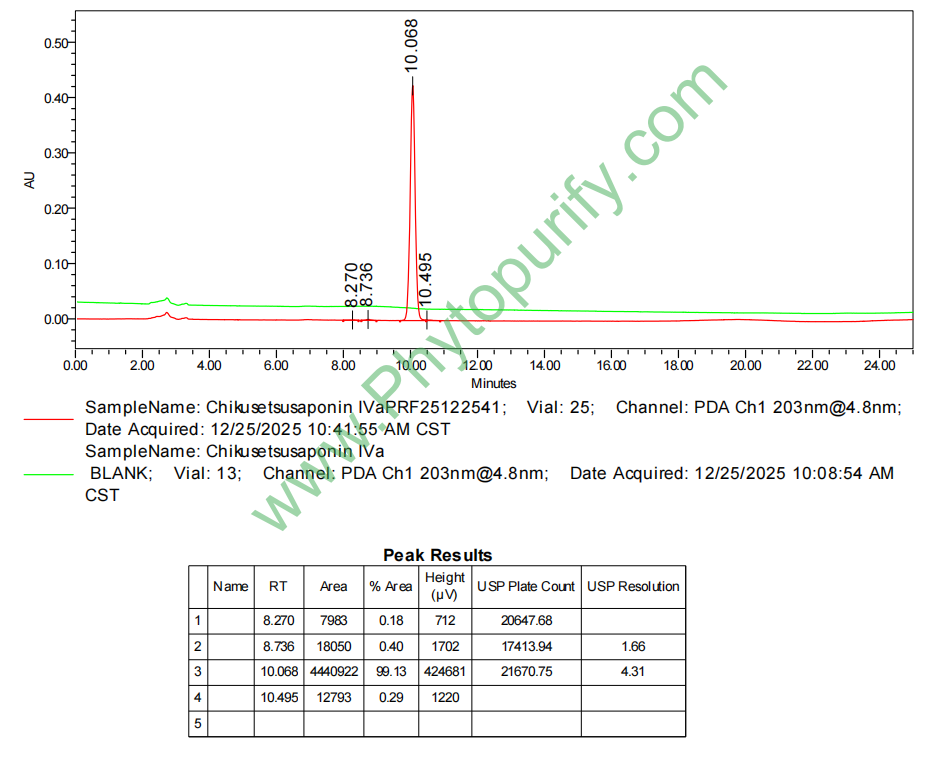
Storage conditions:Short-term storage at 2~8℃, long-term storage at -20 ~ -80℃
232.9000
2.9232
.2011
.0699
.6100
.1880
Low
86.5593
5.7742
No
No
Yes
No
No
No
0.0
Yes
No
No
No
Natural products, as an important source of drug discovery, play an irreplaceable role in the history of human disease prevention and treatment. Among them, saponin compounds have always been a hot topic in medicinal chemistry and pharmacology research due to their structural diversity and wide range of biological activities. Chikusetsu saponin IVa (Cs IVa), CAS number 51415-02-2, is a triterpenoid saponin of oleanane type isolated from the traditional medicinal plant Chikusetsu. In recent years, with the deepening of research technology, the pharmacological activity spectrum of Cs IVa has been continuously expanded, and its mechanism of action has extended from traditional anti-inflammatory and hepatoprotective effects to cutting-edge fields such as regulating cell fate, metabolic balance, and tumor microenvironment. Research has shown that Cs IVa is not only an orally active protein kinase activator, but also binds to the key effector molecule YAP in the Hippo pathway, and exerts multiple biological effects such as anti-inflammatory, antiviral, anti-tumor, blood glucose regulation, and bone and liver protection through multi-target and multi pathway synergy. This article aims to systematically review the chemical properties, plant sources, pharmacological activities, molecular mechanisms of action, pharmacological evaluation, and clinical application potential of Cs IVa, in order to provide comprehensive scientific references for the deep development and transformation research of this natural product.
The chemical name of Zhujie ginseng saponin IVa is 3-O - [β - D-glucopyranosyl (1 → 2) - β - D-glucopyranosyl] - oleanolic acid-28-O - β - D-glucopyranosyl ester. Its molecular formula is C42H66O14The molecular weight is 794.9760. Structurally, it takes oleanolic acid as the aglycone and connects a disaccharide chain consisting of a glucose group (1 → 2) glucuronic acid at the C-3 position, while esterifying a glucose unit at the C-28 position. This unique glycosylation pattern has a decisive impact on its biological activity and solubility.
The physicochemical properties parameters show that the calculated lipid water partition coefficient LogP is 2.9232, indicating that the compound has a certain lipophilicity, but not highly hydrophobic. The topologically polar surface area (TPSA) is as high as 232.9000 Å ², mainly attributed to the abundant hydroxyl groups in the molecule and multiple oxygen atoms on the sugar chain, indicating its strong ability to form hydrogen bonds. The water solubility value is 0.0699 (usually measured in mg/mL or mol/L, relative here), indicating that it belongs to the category of slightly soluble to poorly soluble compounds, which is related to its larger molecular weight and more polar groups, and is also a common challenge faced by most saponin compounds. These basic physicochemical parameters provide important basis for subsequent formulation research and pharmacokinetic behavior.
Zhujie Ginseng Saponin IVa is mainly derived from Zhujie Ginseng, a plant of the Panax genus in the Araliaceae family(Panax japonicus C. Dry rhizomes of A. Mey. Zhujie ginseng, as a traditional Chinese medicine, is commonly used in Asia to treat cough, hemoptysis, traumatic injuries, and rheumatism. Except for bamboo ginseng, in the same genus of plants such as pearl ginseng(Panax japonicus var. major)There is also a high content in it.
Its extraction and separation usually follow the conventional process of natural product chemistry. Firstly, the dried roots and stems of bamboo ginseng are crushed and subjected to heating reflux or ultrasound assisted extraction using methanol, ethanol, or ethanol water mixed solvents to obtain the crude extract of total saponins. Subsequently, macroporous adsorption resins (such as D101, AB-8) were used for preliminary enrichment and decolorization, followed by gradient elution with water and different concentrations of ethanol to collect saponin rich fractions. Further purification relies on techniques such as normal or reverse phase silica gel column chromatography and preparative high-performance liquid chromatography (HPLC). The combination of a reverse phase C18 chromatographic column with acetonitrile water or methanol water system is a key step in separating and obtaining high-purity Cs IVa. Modern technologies such as high-speed countercurrent chromatography (HSCCC) have also been applied to the efficient preparation and separation of such saponins due to their advantages of not requiring solid carriers and high recovery rates. The optimization of extraction process is usually based on the yield and purity of Cs IVa, involving multiple factors such as solvent type, concentration, temperature, time, and solid-liquid ratio.
A large number of pharmacological studies both in vitro and in vivo have revealed the extensive and significant biological activities of saponins IVa from Panax ginseng.
The multiple pharmacological activities of bamboo ginseng saponin IVa stem from its precise regulation of complex cellular signaling networks, and its mechanism of action has been studied at the molecular target level.
Based on the provided pharmacological parameters and existing research, the preliminary evaluation of the pharmacological properties of Cs IVa is as follows:
At present, there is still a lack of publicly available data on the pharmacokinetics of the Cs IVa system, such as absolute bioavailability, half-life, tissue distribution, plasma protein binding rate, etc. This is a key information gap that must be filled as it moves towards drug development.
The multi-target and multi pathway pharmacological properties exhibited by bamboo ginseng saponin IVa provide broad prospects for its application in multiple disease fields.
However, its clinical translation still faces challenges:First Poor water solubility and potential low bioavailability are the primary pharmaceutical challenges that require improvement through strategies such as nano formulations (such as liposomes, polymer micelles), prodrug modification, and eutectic technology.secondly Systematic preclinical pharmacokinetic and toxicological studies need to be conducted to clarify its in vivo fate and safety window.Again Its multi-target nature is a double-edged sword. While it brings comprehensive therapeutic effects, it may also increase the complexity of the mechanism of action and the risk of unpredictable side effects, requiring more precise mechanism research and disease model validation.finally It is necessary to ensure stable and sufficient drug sources are obtained from natural sources, or to develop feasible chemical synthesis or synthetic biology preparation routes.
Zhujie ginseng saponin IVa, as a natural triterpenoid saponin derived from traditional Chinese medicine, has become a star molecule in modern natural product pharmacology research due to its unique chemical structure and multidimensional pharmacological activity. From directly combining YAP to regulate cell growth and apoptosis, to synergistically exerting anti-inflammatory and antioxidant effects through multiple pathways such as MAPK, Nrf2, JAK/STAT, the mechanism network of action is becoming increasingly clear. The potential demonstrated in antiviral, anti-tumor, metabolic regulation, and organ protection has laid a solid foundation for its application in new drug development, especially in the development of drugs for complex multifactorial diseases such as cancer, chronic inflammation, and metabolic syndrome. Although there are still key scientific issues that need to be addressed in terms of drug formulation, systemic pharmacokinetics, and clinical translation, with the advancement of formulation technology and the continuous deepening of molecular mechanism research, Zhujie Ginsenoside IVa is expected to gradually move from an excellent pharmacological tool molecule to a candidate drug with clear clinical application value, demonstrating the enduring vitality of natural products in innovative drug discovery. Future research should focus on optimizing its structure, precise target validation, and comprehensive efficacy evaluation based on modern disease models to accelerate its transition from laboratory to clinical use.
