


Product name: Oroxin A
Synonym name: Baicalein-7-O-glucoside
Catalogue No.: BP1043
Cas No.: 57396-78-8
Formula: C21H20O10
Mol Weight: 432.381
Botanical Source: Oroxylum indicum(L.)Vent.
Physical Description:
Type of Compound: Flavonoids
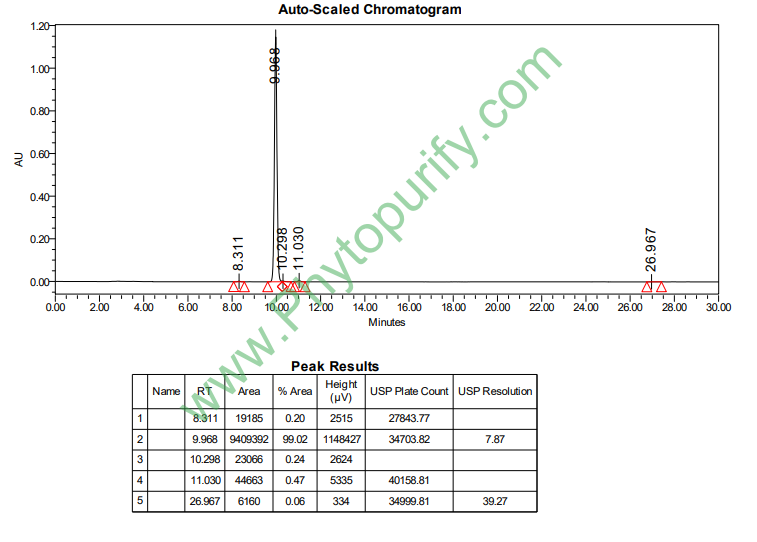
Purity: 95%~99%
Analysis Method: HPLC-DAD or/and HPLC-ELSD
Identification Method: Mass, NMR
Packing: Brown vial or HDPE plastic bottle
Storage: Store in a well closed container, protected from air and light. Put into refrigerate or freeze for long term storage.
Whenever possible, you should prepare and use solutions on the same day. However, if you need to make up stock solutions in advance, we recommend that you store the solution as aliquots in tightly sealed vials at -20℃. Generally, these will be useable for up to two weeks.
The product could be supplied from milligrams to grams
Inquire for bulk scale.
Description:
Oroxin A is a xanthine oxidase (XO) inhibitor, it exerts its antibreast cancer effects by inducing ER stress-mediated senescence, activating the key stress signaling pathway, and increasing key ER stress genes and expression levels.
References:
Anticancer Drugs. 2016 Mar;27(3):204-15.
Oroxin A inhibits breast cancer cell growth by inducing robust endoplasmic reticulum stress and senescence.
Breast cancer is a major cause of cancer death among women. Although various anticancer drugs have been used in clinics, drugs that are effective against advanced and metastatic breast cancer are still lacking and in great demand.
METHODS AND RESULTS:
In this study, we found that Oroxin A, an active component isolated from the herb Oroxylum indicum (L.) Kurz, effectively inhibited the growth of human breast cancer cells MDA-MB-231 and MCF7 by inducing endoplasmic reticulum (ER) stress-mediated senescence. Oroxin A caused breast cancer cell cycle arrest at the G2/M stage, and reorganization of microtubules and actin cytoskeleton accompanied by a decrease in cellular mitosis. ER-specific probe ER-Tracker Red and confocal microscope imaging showed that ER-Tracker Red-positive cells increased in an Oroxin A dosage-dependent manner. In addition, Oroxin A increased cell population with high β-Gal activity and SAHF-positive staining; these data suggest that Oroxin A induces breast cancer cell ER stress and senescence. Mechanistic studies showed that Oroxin A led to a significant increase in intracellular reactive oxygen species levels, promoted expression of ER stress markers ATF4 and GRP78, and increased the phosphorylation of a key stress-response signaling protein p38, resulting in an ER stress-mediated senescence.
CONCLUSIONS:
Taken together, our data indicate that Oroxin A exerts its antibreast cancer effects by inducing ER stress-mediated senescence, activating the key stress p38 signaling pathway, and increasing key ER stress genes ATF4 and GRP78 expression levels.
HPLC of Oroxin A
Storage conditions:Short-term storage at 2~8℃, long-term storage at -20 ~ -80℃
170.0500
.3873
.3254
.4780
.5930
.0981
Low
83.5403
3.8233
Yes
No
No
No
Yes
No
0.6
Yes
No
Yes
No
Natural products, as an important treasure trove for drug discovery and development, play an irreplaceable role in the history of human disease prevention and treatment. Among them, flavonoids have attracted much attention due to their wide range of biological activities and low toxicity. Oroxin A, as a traditional medicinal plant derived from the wood butterfly(Oroxylum indicum The main flavonoid carbon glycosides isolated from (L.) Kurz seeds have become a hot topic in natural product pharmacology research in recent years due to their multi-target and multi pathway pharmacological activities. Its CAS number is 57396-78-8, and it is one of the key components that exert pharmacological effects in the extract of wood butterfly seeds (OISE).
Modern pharmacological research has revealed that arbutin A exhibits a diverse spectrum of biological activities. It is not only a partial agonist of peroxisome proliferator activated receptor gamma (PPAR gamma), but also exhibits significant alpha glucosidase inhibitory activity and antioxidant capacity. What is particularly noteworthy is its potential in the field of cancer research and its clear hepatoprotective effect. Especially in terms of liver protection, research has preliminarily outlined the outline of its liver protective effect through multiple mechanisms such as activating the nuclear factor E2 related factor 2 (NRF2) antioxidant pathway, regulating drug metabolizing enzymes (such as CYP450 family), and affecting bile acid receptors (FXR). This article aims to systematically review the chemical properties, plant sources, pharmacological activities, molecular mechanisms of action, medicinal properties, and clinical application prospects of arbutin A, in order to provide comprehensive scientific references for the in-depth research and development of this natural product.
The chemical name of arbutin A is baicalin-7-O - β - D-glucoside, which is a flavonoid carbon glycoside compound. Its molecular formula is C21H20O10 and its molecular weight is 432.3810. Its basic structural skeleton is composed of a flavonoid nucleus (Huangqinsu) and a D-glucose unit connected by a C-O glycosidic bond at position 7. This glycosidic structure significantly affects its physicochemical properties and biological activity.
From the analysis of the parameters related to drug properties, arbutin A exhibits good drug like characteristics. Its lipophilic water partition coefficient (LogP) is 0.3873, indicating that the compound has moderate lipophilicity and leans towards hydrophilicity, which is beneficial for its dissolution in aqueous media. Its topological polar surface area (TPSA) is 170.0500 Å ², which is a relatively high value, reflecting the presence of multiple hydrogen bond acceptors and donors (mainly from hydroxyl and sugar groups) in the molecule, which usually affects its membrane permeability. The water solubility data is 0.4780 mg/mL, which belongs to the category of slight solubility. However, compared to many pure flavonoid glycosides, its water solubility is improved due to the presence of sugar groups. The blood-brain barrier (BBB) permeability is predicted to be "low", indicating that it is not easily able to enter the central nervous system. This may help reduce central side effects for drugs that mainly act on the peripheral system. In terms of preliminary safety prediction, it has no inhibitory activity on hERG potassium channels (hERG inhibition: No), suggesting a lower risk of causing QT interval prolongation in the heart. The Ames test result is 0.6 (usually judged by whether it is mutagenic, and this value needs to be interpreted in conjunction with specific models, but generally values close to or lower than 1 are considered to have a high possibility of negative), indicating a low risk of genetic toxicity. These physicochemical and preliminary toxicological parameters have laid a favorable foundation for the further development of arbutin A.
Wood butterfly glycoside A is mainly derived from the plant wood butterfly in the family Verbenaceae(Oroxylum indicum The seeds of (L.) Kurz have a long history of application in traditional medical systems in many regions of Asia, especially in China, India, Thailand, and other countries. Its seeds are named after their flat, transparent wing membranes that resemble butterflies. In traditional Chinese medicine, they are often referred to as "thousand sheets of paper" or "torn cloth seeds" and are commonly used to treat symptoms such as lung heat cough, sore throat, and liver and stomach qi pain.
The extraction of arbutin A from butterfly seeds is usually carried out using organic solvent extraction method. The classic process involves crushing dried wood butterfly seeds and first degreasing them with petroleum ether or n-hexane to remove oil and wax. Subsequently, medium polarity solvents such as methanol, ethanol, or aqueous ethanol (such as 70% -80% ethanol) are used for reflux extraction or ultrasound assisted extraction. Ethanol has become a commonly used solvent due to its high safety, low cost, and good extraction efficiency. The crude extract (OISE) is obtained by filtering and concentrating the extract.
To further purify the monomers of arbutin A, it is necessary to combine multiple chromatographic separation techniques. The crude extract is usually first subjected to macroporous adsorption resin (such as D101, AB-8) column chromatography, followed by gradient elution with water and different concentrations of ethanol to enrich flavonoid glycosides. Subsequently, further separation was performed using silica gel column chromatography, polyamide column chromatography, or reverse phase silica gel column chromatography (such as ODS-C18). High performance liquid chromatography (HPLC), especially preparative HPLC, is the key technology for obtaining high-purity monomers of arbutin A. Modern extraction techniques such as microwave-assisted extraction and supercritical fluid extraction have also been applied in research aimed at improving extraction efficiency and the yield of target components.
A large number of in vitro and in vivo studies have shown that arbutin A has a wide range of pharmacological activities, mainly including the following aspects:
Hepatoprotective effect This is one of the most prominent pharmacological activities of arbutin A. In various experimental liver injury models, such as acetaminophen, carbon tetrachloride, D-galactosamine, and alcohol induced liver injury, arbutin A has shown significant protective effects. It can effectively reduce the levels of transaminase (ALT, AST) and alkaline phosphatase (ALP) in serum, alleviate pathological damage to liver tissue, such as hepatocyte necrosis, steatosis, and inflammatory infiltration. Its hepatoprotective effect is closely related to enhancing the liver's antioxidant defense system, inhibiting lipid peroxidation, regulating inflammatory response, and resisting liver cell apoptosis.
Anti diabetes and hypolipidemic activity Wood butterfly glycoside A, as a partial agonist of PPAR γ, can regulate glucose and lipid metabolism. PPAR γ is a key target for insulin sensitization, and partial activation may result in fewer side effects (such as edema and weight gain) than full agonists (such as thiazolidinedione drugs). In addition, its alpha glucosidase inhibitory activity can delay the digestion and absorption of intestinal carbohydrates and reduce postprandial blood glucose. Animal experiments have shown that lupuloside A can improve the abnormal glucose tolerance of diabetes model animals, reduce fasting blood glucose, and regulate the levels of serum total cholesterol, triglycerides and low-density lipoprotein.
Antioxidant and anti-inflammatory activities Wood butterfly glycoside A has strong free radical scavenging ability, which can effectively scavenge DPPH, ABTS ⁺ and other free radicals, and inhibit iron ion induced lipid peroxidation. In cell models, it can enhance antioxidant enzyme activity and reduce the accumulation of reactive oxygen species (ROS). Its anti-inflammatory effect is manifested by inhibiting the production of nitric oxide (NO), prostaglandin E2 (PGE2), and pro-inflammatory factors such as tumor necrosis factor - α (TNF - α) and interleukin-6 (IL-6) in macrophages stimulated by lipopolysaccharides (LPS). The mechanism is related to the inhibition of nuclear factor kappa B (NF - κ B) and mitogen activated protein kinase (MAPK) signaling pathways.
Antitumor activity Studies have shown that luteolin A can inhibit the proliferation and promote apoptosis of many cancer cell lines (such as liver cancer, breast cancer, colon cancer, lung cancer, etc.). Its anti-tumor mechanism involves inducing cell cycle arrest (such as G2/M phase arrest), activating the mitochondrial apoptosis pathway, regulating the Bcl-2/Bax protein ratio, and increasing the expression of pro apoptotic proteins. In addition, it can also inhibit the migration and invasion of tumor cells, demonstrating potential anti metastatic ability.
Other activities The study also reported that arbutin A has potential activities such as neuroprotection, anti fibrosis, and antiviral effects, but its research depth and breadth are not as extensive as the above aspects.
The multiple pharmacological activities of arbutin A stem from its interactions with multiple key biomolecule targets, forming a multi-target action network.
PPAR γ partial excitement Wood butterfly glycoside A can directly bind to the ligand binding domain (LBD) of PPAR γ, induce conformational changes, promote heterodimer formation with retinol X receptor (RXR), and then bind to the peroxisome proliferator response element (PPRE) in specific gene promoter regions to regulate downstream gene transcription. As a partial agonist, it may not only enhance insulin sensitivity and regulate lipid metabolism gene expression, but also avoid the overactivation side effects caused by complete agonists.
Activate NRF2/ARE antioxidant pathway (core mechanism of liver protection)One of the core mechanisms of arbutin A in liver protection is the activation of the NRF2 signaling pathway. It may dissociate NRF2 from Keap1 and translocate it to the nucleus by modifying cysteine residues on Keap1 protein. In the nucleus, NRF2 binds to antioxidant response elements (ARE), initiating the transcription of a series of phase II detoxifying enzymes and antioxidant proteins, including:
Regulating drug metabolizing enzymes Wood butterfly glycoside A has a regulatory effect on cytochrome P450 enzyme systems (CYPs). Research has shown that it can inhibit the activity of CYP2E1 (which is involved in the activation of various prodrugs, such as the generation of N-acetyl benzoquinone imine NAPQI, a toxic metabolite of acetaminophen), thereby reducing liver toxicity mediated by CYP2E1. Meanwhile, it may induce or regulate the expression of CYP3A4 (the most important drug metabolizing enzyme in the human body), affecting the metabolism of endogenous substances and exogenous drugs. This suggests that potential drug drug interactions should be taken into account when using combination therapy.
Affects the FXR signaling pathway The farnesol X receptor (FXR) is a key regulatory factor in bile acid homeostasis, lipid and glucose metabolism. Arbutin A may act as a regulator of FXR, affecting the expression of downstream target genes and exerting a protective effect in cholestatic liver injury and non-alcoholic fatty liver disease (NAFLD).
Directly inhibit alpha glucosidase Wood butterfly glycoside A can bind to the active pocket of alpha glucosidase through hydrogen bonding, hydrophobic interactions, etc., competitively inhibiting the activity of the enzyme, delaying the hydrolysis of disaccharides and polysaccharides into monosaccharides, and directly reducing postprandial blood glucose peak.
Intervention in inflammation and apoptosis pathways By inhibiting the activation of NF - κ B (preventing I κ B degradation and p65 nuclear translocation) and phosphorylation of the MAPK family (such as p38, JNK, ERK), arbutin A downregulates the expression of inflammatory mediators. In terms of promoting apoptosis, it regulates the balance of Bcl-2 family proteins, induces a decrease in mitochondrial membrane potential, releases cytochrome c, and activates the caspase cascade reaction, leading to cell apoptosis.
Based on the physical and chemical parameters mentioned earlier, arbutin A has certain potential as a drug. Its moderate LogP and certain water solubility provide the possibility for oral absorption, but its high TPSA and glycosidic structure may limit its passive transmembrane diffusion, and its absorption may depend on transport proteins in the intestine (such as sodium dependent glucose transporter SGLT1). The low permeability of the blood-brain barrier limits its scope of action mainly to the periphery.
At present, research on the pharmacokinetics of arbutin A is relatively limited, but there are some animal experimental data available. After oral administration, arbutin A may be partially hydrolyzed by gut microbiota into aglycones (baicalein) and glucose in the gastrointestinal tract. The aglycones have higher lipid solubility and may be absorbed. The prototype drug and its metabolites undergo extensive II binding reactions in vivo, such as glucuronidation and sulfation. Pharmacokinetic studies in rats have shown that the peak time (Tmax) of arbutin A after oral administration is relatively short, but its absolute bioavailability may not be high, which is consistent with its characteristics as a highly polar glycoside compound. Its distribution in the body is mainly in organs such as the liver and kidneys, which is consistent with the prediction of less central distribution. The main routes of excretion may be through urine and bile.
It should be noted that arbutin A, as a potential regulator of CYP3A4, may interact with other drugs metabolized by this enzyme. In addition, its glycoside baicalein is known to be a substrate and inhibitor of CYP1A2 and UGT enzymes, which further increases the complexity of its pharmacokinetic interactions. In depth ADME (absorption, distribution, metabolism, excretion) research, especially the pharmacokinetic characteristics in the human body, is the necessary path for its clinical application.
The multi-target properties of arbutin A have demonstrated broad application prospects in the prevention and treatment of various diseases.
liver disease This is the most promising direction. Arbutin A can be used as an adjuvant therapy or prevention for chemical liver injury, such as drug-induced liver injury and alcoholic liver disease. It is also highly valuable in the treatment of NAFLD/non-alcoholic fatty liver disease (NASH), as it simultaneously regulates lipid metabolism (via PPAR γ, FXR), antioxidant (via NRF2), and anti-inflammatory (inhibiting NF - κ B) effects, precisely targeting the "multiple strikes" pathological process of NASH. In the future, it can be explored for development as a hepatoprotective drug or functional food additive.
Type 2 diabetes and its complications As a partial agonist of PPAR γ and an inhibitor of α - glucosidase, arbutin A has a dual hypoglycemic mechanism and may be developed as a novel oral hypoglycemic drug or a supplement to existing drugs. Its improvement effect on diabetes complications (such as diabetes nephropathy and liver disease) is also worth further study.
neoadjuvant therapy Given its anti-tumor activity and relative low toxicity to normal cells, arbutin A may be used as a sensitizer and adjuvant for chemotherapy or radiotherapy, to alleviate the side effects of radiotherapy, inhibit tumor metastasis, or reverse multidrug resistance. Its antioxidant and anti-inflammatory properties also help improve the overall condition of cancer patients.
Other It also has exploratory value in fields such as metabolic syndrome, chronic inflammatory diseases, and neurodegenerative diseases.
However, pushing it from the laboratory to clinical practice still faces challenges: firstly, it is necessary to systematically complete preclinical pharmacological and toxicological evaluations, and clarify its safe dosage range. Secondly, it is necessary to conduct in-depth pharmacokinetic studies on the human body, clarify its absorption, metabolic patterns, and potential interactions. Thirdly, it is necessary to optimize the drug delivery system, such as utilizing nanotechnology, phospholipid complexes, etc., to improve its oral bioavailability. Finally, explore its more precise mechanism of action, particularly its network pharmacology effects as a partial agonist or modulator under different pathological conditions.
As a natural flavonoid glycoside derived from traditional medicinal plants, arbutin A has become a star molecule in natural product pharmacology research due to its unique chemical structure and multi-target pharmacological activity. Its significant effects in liver protection, blood sugar reduction, antioxidant, anti-inflammatory, and anti-tumor have been increasingly supported by scientific evidence. Its core mechanism of action, particularly by activating the NRF2 pathway to enhance endogenous antioxidant defense, regulating metabolism as a partial agonist of PPAR γ, and directly inhibiting α - glucosidase, constitutes the molecular basis of its pleiotropy. Although it has shown certain advantages in drug development, its comprehensive pharmacokinetic characteristics, long-term safety, and efficient delivery strategy remain key issues that need to be addressed in future translational research. With the deepening application of systems biology, network pharmacology, and modern pharmaceutical technology, arbutin A is expected to gradually develop from a promising lead compound into an innovative drug or functional ingredient for the treatment of liver diseases, metabolic diseases, and even tumor adjuvant therapy, fully reflecting the value of natural products in modern medicine.
