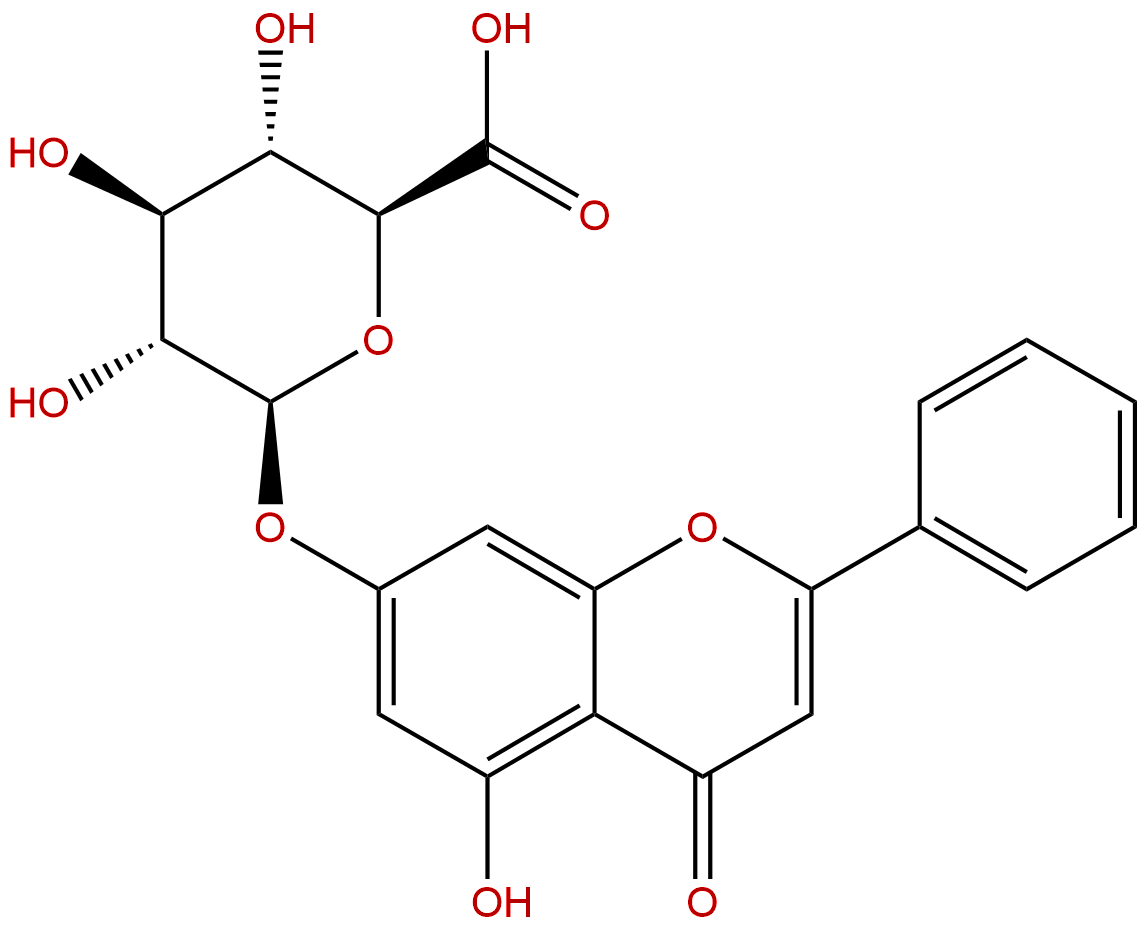


Product name: Chrysin 7-glucuronide
Synonym name:
Catalogue No.: BP3423
Cas No.: 35775-49-6
Formula: C21H18O10
Mol Weight: 430.365
Botanical Source:
Physical Description: Yellow powder
Type of Compound: Flavonoids
Purity: 95%~99%
Analysis Method: HPLC-DAD or/and HPLC-ELSD
Identification Method: Mass, NMR
Packing: Brown vial or HDPE plastic bottle
The product could be supplied from milligrams to grams. Inquire for bulk scale.
We provide solution to improve the water-solubility of compounds, thereby facilitating the variety of activity tests and clinic uses.
For Reference Standard and R&D, Not for Human Use Directly.
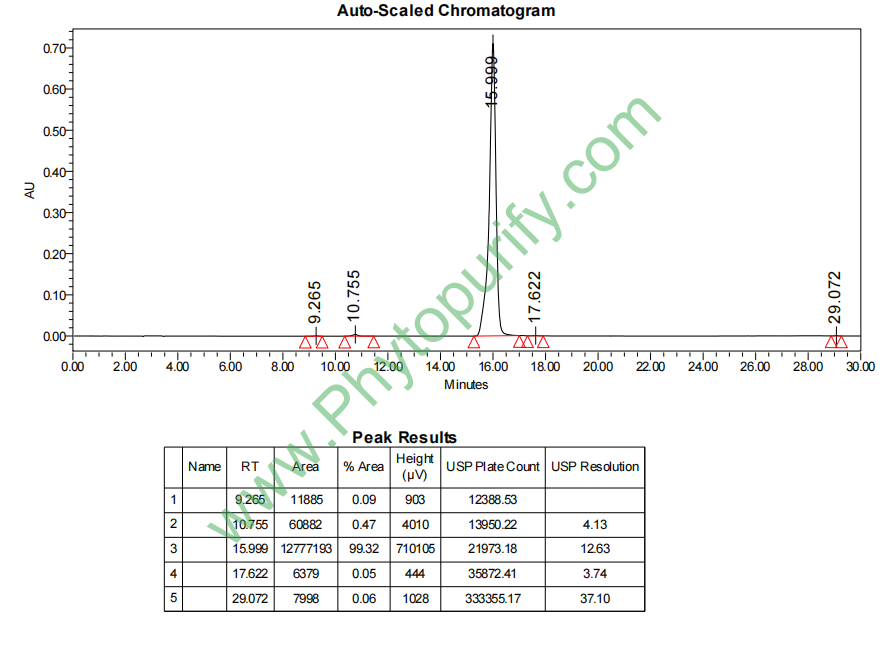
HPLC of Chrysin 7-glucuronide
Storage conditions:Short-term storage at 2~8℃, long-term storage at -20 ~ -80℃
166.8900
.8838
-1.3348
.8875
.5591
.1025
Low
87.8522
3.7667
Yes
No
No
No
Yes
No
0.6
Yes
No
Yes
No
Flavonoids, as one of the most widely distributed plant secondary metabolites in nature, have long been an important source of drug research and functional food development due to their diverse chemical structures and extensive biological activities. Chrysin, also known as 5,7-dihydroxyflavone, is one of the many flavonoids found in various plants such as propolis and passion fruit. It has attracted much attention due to its potential anti-inflammatory, antioxidant, and anti-tumor activities. However, the limitations of poor water solubility and low oral bioavailability of Baiyangsu severely restrict its potential for drug development. In living organisms, paeoniflorin undergoes metabolism in organs such as the liver, often leading to glucuronidation reactions and the production of corresponding glucuronide metabolites. among which,Baiyangsu 7-O-glucuronide Chrysin 7-glucuronide (C7G; CAS number: 35775-49-6) is one of the most important phase I metabolites of paeoniflorin. In the past, such metabolites were often considered as inactive or easily excreted end products. However, recent studies have shown that C7G not only exists as a metabolite, but it may also have unique biological activities, even surpassing its aglycone quercetin in some aspects. Especially as a potential Estrogen blocker And also in antioxidant The regulatory role in the network transforms it from a simple metabolic "waste" to an active molecule with significant research value. This article aims to systematically review the chemical properties, sources, pharmacological activities, mechanisms of action, pharmacological properties, and application prospects of C7G, in order to provide comprehensive scientific references for the in-depth research and development of this natural metabolite.
The molecular formula of Baiyangsu-7-O-glucuronic acid glycoside is C21H18O11, with a molecular weight of 430.3650. Its chemical structure is based on the mother nucleus of poplar extract (5,7-dihydroxyflavone), which is connected to a glucuronic acid group through a glycosidic bond on the 7th hydroxyl group of the A ring. This structural modification fundamentally changes its physicochemical properties.
Compared with the lipophilic glycoside poplar extract (with a higher logP value), the introduction of glucuronic acid groups significantly enhances the polarity of the molecule. Calculated results The LogP value is approximately 0.8838 This indicates a significant decrease in lipophilicity and a significant increase in hydrophilicity. its Topological Polarity Surface Area (TPSA) up to 166.89 Å ²This is mainly attributed to the dense polar oxygen atoms on the glucuronic acid group. The change in physical and chemical properties directly affects its solubility, which is predicted Water solubility is approximately 0.8875 mg/mL It is much better than the almost insoluble poplar extract. This increase in water solubility means that C7G has better dispersibility and transport ability in biological fluids such as blood and tissue fluids.
However, the increase in polarity also brings new challenges. The prediction model shows that C7G passes through The ability of the blood-brain barrier (BBB) is relatively low This limits its potential application in central nervous system diseases. In the early screening of drug safety, C7G exhibits good cardiac safety potential, and data shows that it Not inhibiting hERG potassium channels It suggests that the risk of causing QT interval prolongation in the heart is relatively low. In addition, it The Ames test value is 0.6 Preliminary evidence suggests that there is no significant mutagenicity under testing conditions, providing preliminary support for its safety. These basic pharmacological parameters outline C7G as a molecular profile with improved water solubility, limited central permeability, and preliminary promising safety.
Strictly speaking, the direct content of abscisin-7-O-glucuronide in plants is usually extremely low, as it is mainly a product of metabolic conversion of ingested abscisin-7-O-glucuronide in mammals (including humans). Therefore, its main 'source' is Endogenous biotransformation When humans or animals consume foods rich in paeoniflorin (such as propolis, passion fruit extract) or paeoniflorin monomers, paeoniflorin rapidly undergoes glucuronidation in the intestine and liver, catalyzed by the uridine diphosphate glucuronosyltransferase (UGT) family, especially subtypes UGT1A1, UGT1A9, and UGT2B7, producing C7G and other positional isomers. C7G subsequently enters the bloodstream or is excreted through bile and urine.
However, trace amounts of flavonoid glucuronides have also been reported in a few plants. To obtain sufficient C7G for in vitro and in vivo studies, it mainly relies on the following two strategies:
1. Chemical/enzymatic synthesis This is currently the main way to obtain standard samples and a large number of research samples. Chemical synthesis usually starts with poplar extract, selectively protecting the 5-hydroxy group, and then undergoing glycosylation reaction with activated glucuronic acid derivatives (such as bromoglucuronic acid methyl ester), and finally deprotection to obtain the target product. The enzymatic method utilizes UGT enzymes from microorganisms or plants, or enzyme systems with glycosylation ability, to catalyze the reaction of lignin with UDP glucuronic acid under mild conditions. It has the advantages of strong regional selectivity and environmental friendliness.
2. Biotransformation and Separation Using liver microsomes, recombinant UGT enzymes, or certain cell systems with similar metabolic functions, poplar extract is converted into C7G in vitro, and then separated and purified by high performance liquid chromatography (HPLC) or preparative liquid chromatography. Isolating C7G from the blood or urine of herbal extracts containing poplar extract after animal administration is also a feasible but complex approach.
The pharmacological activity research of C7G has gradually received attention in recent years, and its activity spectrum overlaps with its aglycone poplar extract, while exhibiting unique features.
antioxidant activity This is one of the most core and extensively studied activities of C7G. Unlike many flavonoids that directly scavenge free radicals, the antioxidant effect of C7G is more reflected in Regulating the cell's own antioxidant defense system Up there. Research has shown that C7G can effectively alleviate cell damage caused by oxidative stress inducers such as hydrogen peroxide (H ₂ O ₂) and tert butyl hydroperoxide (t-BHP). Its function is not simply to directly quench reactive oxygen species (ROS), but to achieve systemic antioxidant activity by upregulating the expression and activity of endogenous antioxidant enzymes in cells.
Estrogen regulating/blocking activity C7G is defined as a type of Estrogen blocker Research has shown that C7G can competitively bind to estrogen receptors (ER), especially ER α, but it does not trigger typical estrogen like gene transcriptional activation effects. Instead, it may antagonize the effects of endogenous estrogens such as 17 β - estradiol. This selective estrogen receptor modulator (SERM) like characteristic makes it have potential value in the prevention and treatment of hormone dependent breast cancer. It may play a role by blocking the estrogen driven tumor cell proliferation signal.
anti-inflammatory activity Inflammation is closely related to oxidative stress. C7G has been proven to have anti-inflammatory effects in various cellular inflammation models. It can inhibit the excessive production of nitric oxide (NO), prostaglandin E2 (PGE2), as well as pro-inflammatory mediators such as tumor necrosis factor - α (TNF - α) and interleukin-6 (IL-6) in macrophages stimulated by lipopolysaccharides (LPS). Its anti-inflammatory mechanism is related to the inhibition of the activation of key pro-inflammatory transcription factors such as nuclear factor kappa B (NF - κ B) and activator protein-1 (AP-1).
Other potential activities The preliminary study also suggests that C7G may inhibit the proliferation of some tumor cell lines (such as breast cancer and liver cancer cells) and induce cell cycle arrest. In addition, it has shown certain potential in protecting endothelial cell function and anti fibrosis, but these studies are still in their infancy and require more evidence to support them.
C7G exerts pharmacological effects, particularly through its core molecular mechanisms of antioxidant and estrogen blocking activity, involving precise regulation of multiple key targets and pathways.
1. Core mechanism of antioxidant effect: activation of Nrf2/ARE pathway
The core of C7G antioxidant system lies in activation Nuclear factor E2 related factor 2 (Nrf2, encoded by NFE2L2 gene)In the resting state, Nrf2 binds to its inhibitory protein Keap1 in the cytoplasm and is degraded by ubiquitination. After C7G intervention, it may disrupt the Keap1-Nrf2 complex by modifying cysteine residues on Keap1, promoting Nrf2 stability and translocation to the nucleus. In the nucleus, Nrf2 binds to antioxidant response elements (ARE), initiating the transcription of a series of phase II detoxifying enzymes and antioxidant proteins. The key targets upregulated by C7G through this pathway include:
* antioxidant enzyme Superoxide Dismutase(SOD1, SOD2)Catalase(CAT)Glutathione peroxidase(GPX1)They work together to eliminate ROS such as superoxide anions and hydrogen peroxide.
* Heme oxygenase-1 (HMOX1)Catalyze the degradation of hemoglobin to produce biliverdin and carbon monoxide, which have antioxidant and anti-inflammatory effects.
* Quinone oxidoreductase 1 (NQO1)Promote detoxification of quinone substances.
In addition, C7G can directly or indirectly inhibit enzymes related to oxidative damage, such as Tyrosinase (TYR), as well as matrix metalloproteinases induced by oxidative stress(MMP1, MMP3)Thus, it plays a protective role in diseases related to oxidation and degradation, such as skin photoaging and arthritis.
2. Mechanism of estrogen blockade: ER receptor antagonism
As an estrogen blocker, C7G's direct molecular target is Estrogen receptor (ER)It can enter the nucleus and bind to the ligand binding domain of ER α. However, unlike estradiol, the receptor conformational changes induced by C7G-ER complex may hinder the recruitment of co activators (such as SRC family) or make it easier to recruit co repressors, leading to inhibition of gene transcription driven by classical estrogen response elements (ERE) (such as cell cycle proteins D1 and c-Myc). This competitive antagonistic effect blocks the key signal of estrogen promoting cell proliferation, which is the molecular basis of its anti breast cancer potential.
3. The role of networking
It is worth noting that the mechanism of action of C7G is not isolated. The activation of the Nrf2 pathway can alleviate inflammation (as oxidative stress is an important trigger for inflammation), and its anti-inflammatory effects (such as inhibiting NF - κ B) can also reduce the production of ROS. There is also a cross-talk between estrogen receptor signaling and cell growth and metabolic pathways. Therefore, C7G is likely to act on Nrf2 and ER are the two core nodes Furthermore, it affects a complex cellular signaling network, ultimately achieving a comprehensive effect of antioxidant, anti-inflammatory, and anti proliferative.
Although C7G is an in vivo metabolite of paeoniflorin, its drug like and pharmacokinetic (PK) characteristics still need to be independently evaluated.
The cognitive transformation of Baiyangsu 7-O-glucuronide from "metabolic endpoint" to "active endpoint" has opened up unique application prospects for it.
Disease prevention and control field:
Research and Development Strategies and Challenges:
As a key metabolite of the natural flavonoid compound poplar glycoside, 7-O-glucuronide has gradually shed its traditional label as an "inert metabolite" and demonstrated its ability to Systemic antioxidant (via Nrf2 pathway) and Estrogen receptor antagonist The core of diverse biological activities. Its good water solubility and preliminary safety characteristics provide favorable conditions for its drug development, although the challenges it faces include poor blood-brain barrier penetration and potential enzymatic stability issues. With the continuous deepening of understanding of the mechanism of action of C7G and the advancement of medicinal chemistry and drug delivery technology, structural optimization and formulation innovation targeting it are expected to overcome existing limitations. In the future, C7G can not only serve as a key intermediate for studying the in vivo effects of paeoniflorin, but it is also more likely to develop into a potential candidate drug or functional ingredient for the prevention and treatment of oxidative stress-related diseases, chronic inflammation, and hormone dependent tumors, reflecting the unique value and broad prospects of exploring new drug sources from natural metabolites.
