


Product name: Chrysin
Synonym name: Chrysinic acid
Catalogue No.: BP0346
Cas No.: 480-40-0
Formula: C15H10O4
Mol Weight: 254.241
Botanical Source: Oroxylum indicum(L.)Vent.
Physical Description:
Type of Compound: Flavonoids
Purity: 95%~99%
Analysis Method: HPLC-DAD or/and HPLC-ELSD
Identification Method: Mass, NMR
Packing: Brown vial or HDPE plastic bottle
Storage: Store in a well closed container, protected from air and light. Put into refrigerate or freeze for long term storage.
Whenever possible, you should prepare and use solutions on the same day. However, if you need to make up stock solutions in advance, we recommend that you store the solution as aliquots in tightly sealed vials at -20℃. Generally, these will be useable for up to two weeks.
The product could be supplied from milligrams to grams
Inquire for bulk scale.
Chengdu Biopurify Phytochemicals Ltd. is a leading company in the research, development, manufacture and marketing of High Quality Phytochemicals and Extracts(especially Active Ingredients from Traditional Chinese Medicine,TCM), Natural Active Pharmaceutical Ingredients worldwide.
The main services:
A. Supply active ingredients and reference standards of TCM, from mgs to kgs scale
B. Custom extraction and purification, target Herb Active Ingredients
C. Custom synthesis and semi-synthesis for Natural Active Ingredients
D. CR(contract research), CM(contract manufacture) and PD(process development) services from lab scale, pilot scale to commercial scale(GMP is also available)
E. TCM compounds library for drug screen,more than 3000 compounds available, many of them are rare and unique.
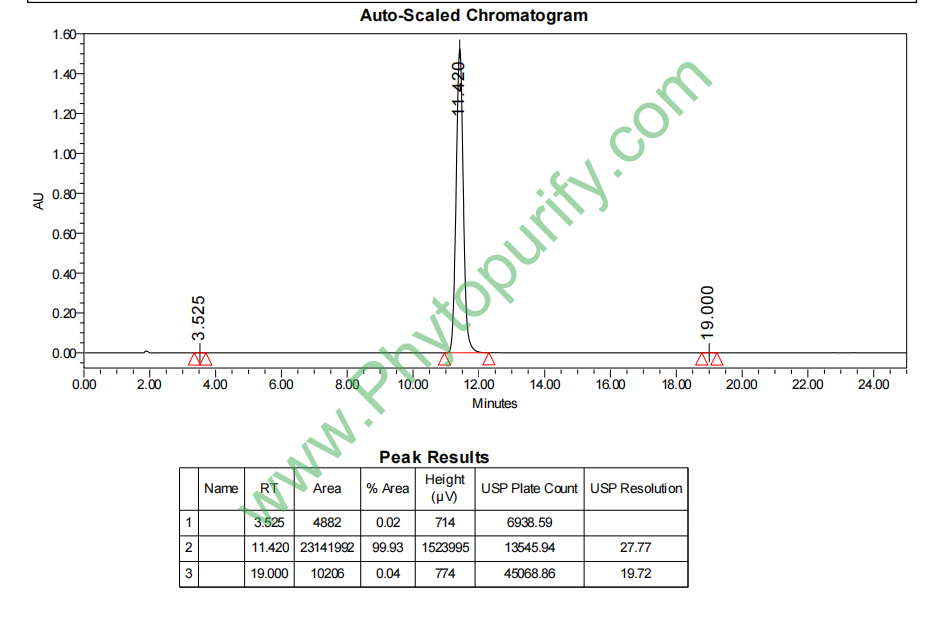
HPLC of Chrysin
Storage conditions:Short-term storage at 2~8℃, long-term storage at -20 ~ -80℃
70.6700
2.7293
2.5135
.0377
3.4898
12.6340
Low
92.7039
2.0960
Yes
No
No
No
Yes
No
0.6
Yes
No
Yes
No
Natural products have long been an important source of innovative drug discovery, among which flavonoids have attracted much attention due to their broad biological activity and low toxicity. Chrysin, also known as 5,7-dihydroxyflavone, is a typical dihydroxyflavone compound with a CAS number of 480-40-0. It was initially recognized for its presence in natural products such as propolis and exhibited various pharmacological activities including antioxidant, anti-inflammatory, and anti-tumor effects. In recent years, with the in-depth understanding of the mechanism of complex diseases such as tumors and neurodegenerative diseases, the potential of chrysin as a multi-target regulator has become increasingly prominent. Especially in the research of hormone related tumors such as breast cancer, its characteristics as an estrogen blocker have aroused widespread interest in the pharmacological community. This article aims to systematically review the chemical properties, plant sources, pharmacological activities, molecular mechanisms of action, pharmacological evaluation, and clinical application prospects of poplar extract, in order to provide comprehensive scientific references for the in-depth development and transformation research of this natural product.
The molecular formula of poplar extract is C ₁₅ H ₁₀ O ₄, with a molecular weight of 254.2410 g/mol. Its basic skeleton is flavonoids (2-phenylchromenone), with one phenolic hydroxyl group at each of the 5th and 7th positions of the A ring, which is the key pharmacophore for its antioxidant activity. This structure makes it a representative member of dihydroxyflavones and 7-hydroxyflavonols.
In terms of physical and chemical properties, Baiyangsu exhibits typical flavonoid compound characteristics. Its lipid water partition coefficient (LogP) is 2.7293, indicating that it has moderate lipophilicity, which is beneficial for transmembrane transport, but may also affect its dispersion in the aqueous phase. The theoretical polar surface area (TPSA) is 70.6700 Å ², reflecting the area occupied by polar groups (mainly two hydroxyl groups) in the molecule. The water solubility is poor, about 0.0377 mg/mL, which to some extent limits its bioavailability. In addition, the predictive model shows that its blood-brain barrier permeability is low, suggesting that it may not easily enter the central nervous system. In the early safety screening, the Ames test result of Baiyangsu was 0.6 (usually considered negative if less than 2), indicating a low risk of mutagenicity and no significant inhibitory effect on hERG potassium channels, suggesting a low potential risk of arrhythmia.
Poplar extract is widely distributed in nature and mainly exists in various plants and bee products. Its classic plant sources include plants of the Wisteria genus, such as the wood butterfly Oroxylum indicum Bark and seeds of poplar trees, bark of poplar trees, and passion fruit(Passiflora Spp.) and some mushrooms. In addition, propolis, especially poplar type propolis, is one of the most abundant and well-known natural sources of poplar extract, which is also the origin of its name "poplar extract".
Organic solvent extraction is commonly used to extract lignin from raw materials. Common solvents include methanol, ethanol, ethyl acetate, etc. The typical extraction process is to heat and reflux the dried and crushed plant materials or propolis with an appropriate solvent or ultrasound assisted extraction, followed by filtration and concentration to obtain crude extract. Further purification relies on chromatographic techniques such as silica gel column chromatography, high-performance liquid chromatography (HPLC), etc. to obtain high-purity poplar extract monomers. With the development of green chemistry, modern technologies such as supercritical fluid extraction (such as CO ₂ extraction) have also been explored to improve extraction efficiency and selectivity. Research on biosynthetic pathways has shown that paeoniflorin is catalyzed by a series of enzymes such as chalcone synthase from phenylalanine in plants, laying the foundation for future large-scale production through synthetic biology strategies.
Numerous in vitro and in vivo studies have confirmed that paeoniflorin has diverse pharmacological activities, providing support for its multifaceted therapeutic potential.
The pharmacological action of chrysin, especially its anti breast cancer activity, is achieved by regulating multiple key signal pathways and molecular targets, which reflects the characteristics of multi target action. The mechanism of action of the mentioned targets can be summarized as follows:
Although poplar extract exhibits excellent biological activity in vitro, its pharmacological properties, especially oral bioavailability, are the main bottleneck restricting its clinical translation.
Pharmacokinetic studies have shown that the oral absorption of Baiyangsu is rapid but limited. The main reason is that the first pass effect is significant, and it is easily bound by metabolic enzymes such as UDP glucuronosyltransferase (UGT) in the intestine and liver, generating glucuronide or sulfate conjugates, resulting in a low proportion of prototype drugs entering the systemic circulation. This is also one of the reasons why it predicts low blood-brain barrier permeability. Its poor water solubility also affects its dissolution and absorption in the gastrointestinal tract.
In order to improve its bioavailability, researchers have explored various strategies:
1. Structural modification Synthesize its prodrugs or derivatives, such as preparing phospholipid complexes, amino acid ester derivatives, etc., to improve solubility and metabolic stability.
2. Formulation technology Utilizing nanotechnology, such as the preparation of poplar extract nanocrystals, liposomes, solid lipid nanoparticles, polymer micelles, etc., to enhance their solubility, stability, and targeting by increasing specific surface area, promoting lymphatic absorption, or providing protective carriers.
3. Combined administration Combined with metabolic enzyme inhibitors (such as piperine), it can significantly inhibit the glucuronidation of paeoniflorin, thereby increasing its blood drug concentration.
In terms of toxicology research, existing animal experiments have shown that salicylic acid has good safety at appropriate doses, but the potential toxicity of long-term use at high doses still needs to be systematically evaluated. The negative Ames test and lack of hERG inhibitory properties provide preliminary support for its safety.
The multi-target pharmacological properties of Baiyangsu provide possibilities for its application in various disease fields, but its development is still in the preclinical or early clinical exploration stage.
Future research directions should focus on: ① Deeply elucidating its complex network of interactions, especially the interactions between different targets; ② Conduct Good Laboratory Practice (GLP) toxicology studies in compliance with regulations to clarify the safe dosage range; ③ Vigorously promote the development of formulations based on new delivery systems to fundamentally solve the problem of low bioavailability; ④ Design and carry out rigorous clinical trials to verify its effectiveness and safety in specific diseases (such as drug-resistant breast cancer).
Poplar extract, as a widely sourced natural dihydroxyflavonoid, has demonstrated significant drug development value due to its multiple pharmacological activities such as antioxidant, anti-inflammatory, and anti-tumor effects, as well as its unique mechanism of acting on key targets such as AMPK, STAT3, BCL2, estrogen receptor, and multidrug resistance protein. Although its poor solubility and oral bioavailability are currently the main obstacles to clinical translation, this challenge is gradually being overcome through the continuous innovation of modern medicinal chemistry and pharmacy methods. With the deepening understanding of its molecular mechanism and breakthroughs in delivery technology, Populus euphratica is expected to develop from a promising lead compound into an innovative drug or highly effective adjuvant therapy for the prevention and treatment of diseases such as cancer and inflammation, providing a model for the modernization and precision application of natural products.
