


Synonym name: Bergaptol geranyl ether; 5-Geranyloxypsoralen; Bergaptin
Catalogue No.: BP0255
Cas No.: 7380-40-7
Formula: C21H22O4
Mol Weight: 338.403
Botanical Source: bergamot oil. Also from lemon oil and oils of other Citrus spp. and Daucus carota and the fruit of Tetradium danielli
Purity: 95%~99%
Analysis Method: HPLC-DAD or/and HPLC-ELSD
Identification Method: Mass, NMR
Packing: Brown vial or HDPE plastic bottle
Can be supplied from milligrams to grams.
For Reference Standard and R&D, Not for Human Use Directly.
Inquire for bulk scale.
HPLC of Bergamottin
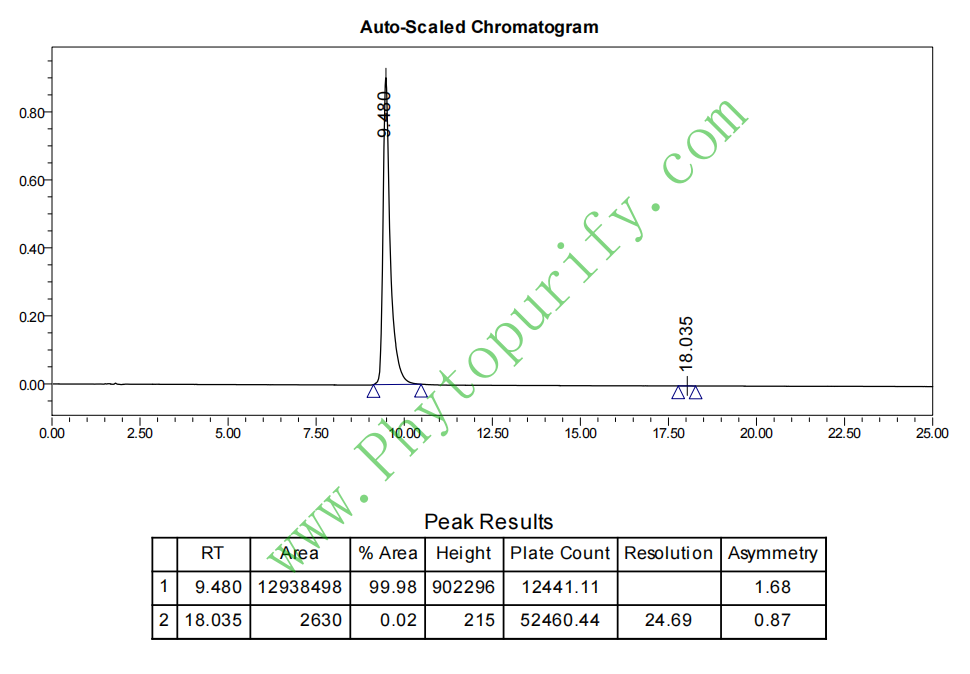
Storage conditions:Short-term storage at 2~8℃, long-term storage at -20 ~ -80℃
Bergamottin (CAS number: 7380-40-7) is a naturally occurring furan coumarin compound found in bergamot and other citrus fruits. As an important natural product, bergamot extract has received widespread attention due to its unique biological activity and potential pharmacological applications. In recent years, with the deepening of pharmacological research on natural products, bergamot extract has shown significant competitive inhibition in regulating the activity of cytochrome P450 enzymes, especially CYP1A1, with a Ki value as low as 10.703 nM, indicating its high enzyme inhibition efficacy. In addition, bergamot has shown potential application value in the treatment of complex diseases such as obstructive sleep apnea (OSA) by interacting with various disease-related targets.
This article aims to systematically review the chemical structure and physicochemical properties, plant sources and extraction methods, pharmacological activity and mechanism of action, pharmacological evaluation and pharmacokinetic characteristics of bergamot extract, and explore its prospects and challenges in clinical applications. By integrating existing literature, it is expected to provide scientific basis and theoretical support for the further drug development and clinical translation of bergamot extract.
Bergamot extract is a furan coumarin compound with a molecular formula of C21H22O4 and a molecular weight of 326.40. Its structural features include the fusion of a coumarin skeleton and a furan ring, exhibiting typical aromatic and conjugated systems of furan coumarin compounds. The LogP value of bergamot extract is 4.20, indicating its strong hydrophobicity, which facilitates its penetration into cell membranes but may affect its water solubility and bioavailability. Its topological polar surface area (TPSA) is 55.76 Å ², indicating that the molecule has a certain polarity, which facilitates the binding of the molecule to biological targets.
In the molecular structure, bergamot contains four hydrogen bond receptor sites, which may participate in the formation of hydrogen bonds with protein targets, enhancing binding affinity. Its blood-brain barrier permeability is low, indicating limited distribution in the central nervous system, which has a certain impact on its application in neurological related diseases. The existing data has not yet clarified the hepatotoxicity and cardiotoxicity of bergamot extract. The hERG channel inhibition experiment results were negative, indicating its good cardiac safety, but further systematic toxicological evaluation is still needed.
Bergamot is mainly found in the peel and essential oil of Citrus bergamia, and is also present in other citrus plants such as Citrus paradisi and Citrus limon. The natural accumulation of bergamot extract is influenced by factors such as plant variety, growth environment, harvesting period, and processing method, resulting in significant differences in its content.
The extraction of bergamot extract is often carried out by solvent extraction combined with chromatographic separation. Traditional extraction often uses organic solvents such as ethanol, methanol, or ethyl acetate to improve extraction efficiency through leaching, ultrasound assisted extraction, or microwave-assisted extraction. After rotary evaporation and concentration, the extract was purified using silica gel column chromatography, high-performance liquid chromatography (HPLC), or preparative liquid chromatography to obtain high-purity bergamot extract. In recent years, green extraction technologies such as supercritical CO2 extraction and deep eutectic solvent assisted extraction have gradually been applied to the extraction of bergamot extract, which has the advantages of environmental friendliness and high efficiency and energy saving.
The pharmacological activity research of bergamot extract covers multiple aspects such as enzyme inhibition, anti-inflammatory, anti-tumor, neuroprotection, and metabolic regulation. Its most significant biological function is the competitive inhibition of CYP1A1 in the cytochrome P450 enzyme system, with a Ki value of 10.703 nM, demonstrating extremely strong enzyme inhibitory efficacy. This mechanism of action makes bergamot extract of great significance in drug metabolism regulation and drug interaction research.
In addition, bergamot has the potential to regulate multiple targets related to obstructive sleep apnea (OSA), including APP (amyloid precursor protein), MAOA (monoamine oxidase A), ESR1/ESR2 (estrogen receptor alpha/beta), ABCG2 (ATP binding cassette transporter G2), PTGS1 (cyclooxygenase 1), members of the carbonic anhydrase family CA4, CA9, CA12, and HMGCR (3-hydroxy-3-methylglutaryl-CoA reductase). These targets involve multiple pathophysiological pathways such as neuroprotection, inflammatory response, lipid metabolism, and respiratory regulation, suggesting that bergamot may alleviate OSA and its related complications through multi-target synergistic effects.
In terms of anti-inflammatory effects, bergamot extract can inhibit PTGS1 activity, reduce prostaglandin synthesis, and exert anti-inflammatory and analgesic effects. Its regulatory effect on MAOA may affect neurotransmitter metabolism, thereby improving sleep quality and cognitive function. Partial in vitro and animal experiments have also shown that bergamot extract has antioxidant and anti-tumor potential, but the relevant mechanisms still need to be further elucidated.
The main mechanism of action of bergamot extract is based on its competitive inhibition of CYP1A1. CYP1A1 is a member of the cytochrome P450 family, involved in the metabolism of various exogenous and endogenous substances, including the activation of carcinogens. By inhibiting CYP1A1, bergamot extract can reduce the production of harmful metabolites, lower the risk of cell toxicity and gene damage.
In the pathological mechanism of obstructive sleep apnea, bergamot exerts its effects by regulating multiple targets:
By comprehensively regulating the above multiple targets, bergamot extract exhibits multidimensional therapeutic potential, especially in the multifactorial pathological mechanisms of complex diseases such as OSA, where it has unique advantages.
The pharmacological parameters of bergamot extract show that its molecular weight is moderate (326.40 Da), which meets the basic requirements of Lipinski's rule. The LogP is 4.20, indicating that it has good lipid solubility, which is beneficial for membrane penetration, but may limit its water solubility and oral bioavailability. The TPSA is 55.76 Å ², indicating that its polarity is moderate and conducive to binding with target proteins.
The low blood-brain barrier permeability of bergamot indicates its limited distribution in the central nervous system, which may affect its therapeutic efficacy in neurological diseases, but also reduces the risk of central nervous system toxicity. The information regarding hepatotoxicity and cardiotoxicity is not yet clear, and the hERG channel inhibition experiment results were negative, indicating good cardiac safety. The Ames test data is lacking and further evaluation of its genetic toxicity is needed.
Pharmacokinetic studies have shown that bergamot has certain metabolic stability in vivo, but as a CYP1A1 inhibitor, it may affect the metabolism of other drugs and pose potential drug interaction risks. The oral absorption, distribution, metabolism, and excretion (ADME) characteristics still require systematic research, especially in-depth analysis of its bioavailability, half-life, and metabolic pathways, which will help optimize the dosing regimen and formulation design.
As a natural product, bergamot has shown broad application prospects in the treatment of obstructive sleep apnea and related metabolic and neurological diseases due to its significant CYP1A1 inhibitory activity and multi-target regulatory ability. It may improve the sleep quality of OSA patients and reduce related complications by regulating multiple pathological pathways such as inflammatory response, oxidative stress, neurotransmitter metabolism, and lipid metabolism.
In addition, bergamot extract also has potential value in the fields of anti-tumor, anti-inflammatory, and cardiovascular disease. Future research should focus on the molecular details of its mechanism of action, pharmacokinetic optimization, and safety evaluation, promoting its transition from laboratory research to clinical application.
However, the pharmacological limitations of bergamot extract, such as poor water solubility, low oral bioavailability, and potential drug interaction risks, need to be overcome through strategies such as structural modification, nanocarrier delivery, and dosage form innovation. Meanwhile, toxicology and preclinical research of the system are key steps in its clinical development.
As a natural furan coumarin compound with significant CYP1A1 competitive inhibitory activity, bergamot has shown important value in the treatment of obstructive sleep apnea and related diseases due to its multi-target regulatory ability and good pharmacological activity. Its unique chemical structure and physicochemical properties provide a solid foundation for drug design, but further exploration is still needed in terms of drug properties and safety.
In the future, through interdisciplinary collaboration, combined with modern medicinal chemistry, molecular biology, and pharmacokinetic techniques, bergamot extract is expected to become an important candidate molecule for the development of new natural medicines, providing new ideas and strategies for the treatment of complex diseases.
