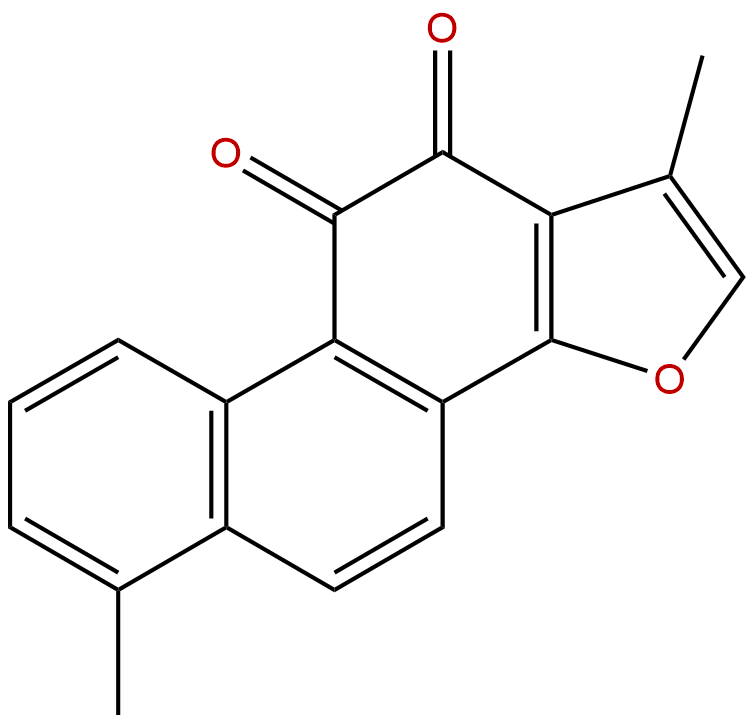


Product name: Tanshinone I
Synonym name: Tanshinquinone I
Catalogue No.: BP1361
Cas No.: 568-73-0
Formula: C18H12O3
Mol Weight: 276.291
Botanical Source: Pigment from Root of several Salvia spp.
Physical Description: Red powder
Type of Compound: Diterpenoids
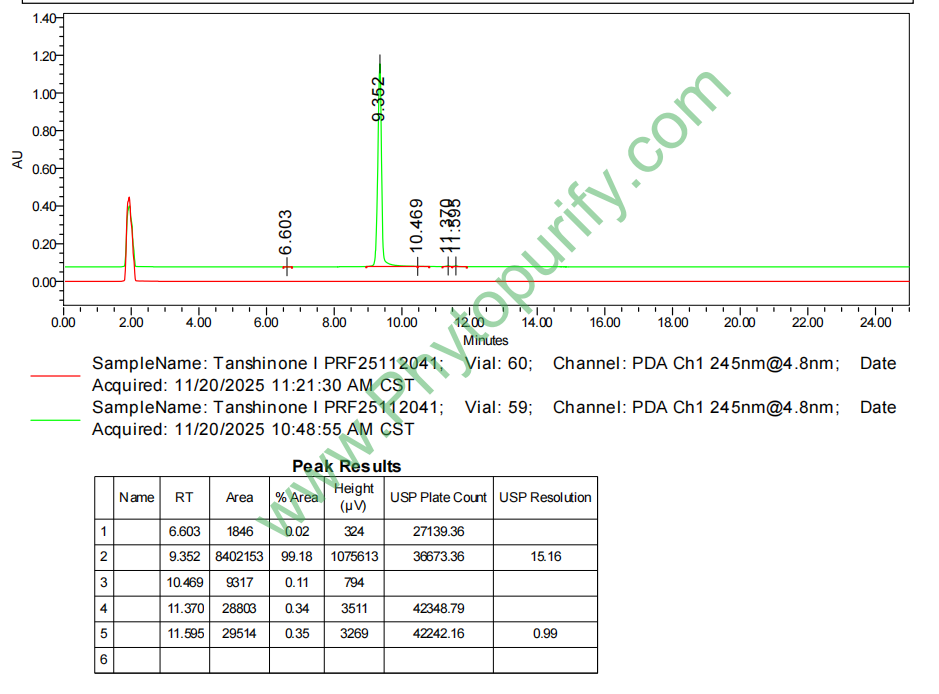
Purity: 95%~99%
Analysis Method: HPLC-DAD or/and HPLC-ELSD
Identification Method: Mass, NMR
Packing: Brown vial or HDPE plastic bottle
Storage: Store in a well closed container, protected from air and light. Put into refrigerate or freeze for long term storage.
Whenever possible, you should prepare and use solutions on the same day. However, if you need to make up stock solutions in advance, we recommend that you store the solution as aliquots in tightly sealed vials at -20℃. Generally, these will be useable for up to two weeks.
The product could be supplied from milligrams to grams, up to kilograms
Inquire for bulk scale.
Descriptions:
Tanshinone I, a major active principle of Salvia miltiorrhiza (Danshen), has been shown to overcome tumor drug resistance and metastasis, it inhibits angiogenesis, inhibits proliferation, migration and tube formation of vascular endothelial cells, rat aortic ring sprouting and the neovascularization of the chick chorioallantoic membrane in a concentration-dependent manner; it as promising angiogenesis inhibitors.[1]
Tanshinone I can suppress growth and invasion of human breast cancer cells, MDA-MB-231, through regulation of adhesion molecules.[2]
Tanshinone I, tanshinone IIA and cryptotanshinone, can protect against liver toxicity in vivo and in vitro due to its antioxidant effects.[3]
Tanshinone I exerts neuroprotection in cerebrovascular diseases including transient ischemic attack, it can promote neurogenesis in the mouse DG and that the neurogenesis is related with increases of Wnt-3, p-GSK-3β and β-catenin immunoreactivities.[4]
Tanshinone I can effectively induce apoptosis in estrogen receptor-positive (MCF-7) and estrogen receptor-negative (MDA-MB-231) breast cancer cells; it has growth inhibition and apoptosis induction in human colon cancer Colo 205 cells.[5]
Tanshinone I enhances learning and memory, and ameliorates memory impairment in mice via the extracellular signal-regulated kinase signalling pathway.[6,7]
References:
[1] Wang Y, Li J X, Wang Y Q, et al. Oncotarget, 2015, 6(18):16031-42.
[2] Nizamutdinova I T, Lee G W, Lee J S, et al. Carcinogenesis, 2008, 29(10):1885-92.
[3] Park E J, Zhao Y Z, Kim Y C, et al. Food Chem Toxicol , 2009, 47(11):2742-8.
[4] Bai H C, Park J H, Cho J H, et al. Neurochem Res, 2016,41(8):1958-68.
[5] Nizamutdinova IT, Lee GW, Son KH, et al. Int J Oncol, 2008, 33(3):485-91.
[5] Su C C, Chen G W, Lin J G. Int J Mol Med, 2008, 22(5):613-8.
[6] Dong H K, Kim S, Su J J, et al. Brit J Pharmacol, 2009, 158(4):1131-42.
[7] Shi Z, He J, Yao T, et al. J Pharm Biomed Anal, 2005, 37(3):481-6.
HPLC of Tanshinone I
Storage conditions:Short-term storage at 2~8℃, long-term storage at -20 ~ -80℃
Tanshinone I (CAS number: 568-73-0) is a major active ingredient isolated from the traditional Chinese medicine Salvia miltiorrhiza Bunge, and is an important member of the tanshinone compounds. Tanshinone I has attracted widespread attention in the field of natural product pharmacology due to its unique chemical structure and diverse biological activities. In recent years, with the in-depth study of the pathogenesis of cardiovascular diseases, especially atherosclerosis, tanshinone I has shown significant therapeutic potential because of its regulatory effect on related molecular targets. This article aims to systematically review the chemical properties, plant sources, pharmacological activities, mechanisms of action, pharmacological evaluation, and clinical application prospects of tanshinone I, in order to provide theoretical basis and research direction for the drug development of this natural product.
Tanshinone I is a typical dihydronaphthoquinone compound with a molecular formula of C18H12O3 and a molecular weight of 276.2910. Its chemical structure contains a naphthoquinone skeleton, which has a strong conjugated system and hydrophobicity. In terms of physical and chemical properties, the LogP value of Tanshinone I is 3.7405, indicating that it has good lipid solubility and is beneficial for cell membrane penetration ability. The polar surface area (TPSA) is 47.2800, indicating that its molecular polarity is moderate and may affect its in vivo distribution and targeting. The extremely low water solubility (0.0002 mg/mL) limits its oral bioavailability and formulation development. Tanshinone I has a high blood-brain barrier penetration ability, indicating its potential application value in central nervous system diseases. The negative result of hERG channel inhibition experiment indicates a low risk of cardiac toxicity. The Ames test result is 1.8, indicating a low risk of genotoxicity and meeting drug safety requirements.
Tanshinone I mainly exists in the lipid soluble extract of Danshen roots. Danshen is the dried root and rhizome of Salvia miltiorrhizia Bunge, a plant in the family Lamiaceae. It is a classic medicinal herb used in traditional Chinese medicine to promote blood circulation, remove blood stasis, and improve blood circulation. Danshen roots contain various tanshinone compounds, among which tanshinone I is relatively abundant.
The extraction methods usually use techniques such as organic solvent reflux extraction, ultrasound assisted extraction, or microwave-assisted extraction. Common solvents include ethanol, methanol, and ethyl acetate. After extraction, high-purity tanshinone I was obtained through separation and purification techniques such as silica gel column chromatography and high-performance liquid chromatography (HPLC). In recent years, supercritical CO2 extraction technology has also been applied to the extraction of tanshinone I due to its green environmental protection and high efficiency, significantly improving the extraction efficiency and purity.
Tanshinone I has shown a variety of pharmacological activities, including anti-inflammatory, antioxidant, anti-tumor, cardiovascular protection and other aspects, especially in the prevention and treatment of atherosclerosis shows a unique advantage.
Anti atherosclerotic effect
Tanshinone I can significantly slow down the formation of atherosclerotic plaque by regulating lipid metabolism, inhibiting inflammatory reaction and improving vascular endothelial function. In vitro studies have shown that tanshinone I can inhibit human IIA recombinant phospholipase A2 (sPLA2) and rabbit recombinant cytoplasmic phospholipase A2 (cPLA2), with IC50 values of 11 μ M and 82 μ M, respectively, reducing the release of inflammatory mediators and alleviating vascular wall inflammation.
anti-inflammatory activity
Tanshinone I can inhibit the expression of various pro-inflammatory factors, such as tumor necrosis factor - α (TNF - α), interleukin-6 (IL-6), and inducible nitric oxide synthase (iNOS), reducing inflammation and protecting tissues from damage.
Antioxidant effect
By clearing reactive oxygen species (ROS) and enhancing endogenous antioxidant enzyme activity, tanshinone I reduces oxidative stress, prevents lipid peroxidation, and protects endothelial cell function.
Antitumor activity
Tanshinone I exhibits inhibitory effects on cell proliferation, induces apoptosis, and blocks the cell cycle in various tumor cell lines, involving multiple signaling pathways, and has potential anti-cancer value.
Cardiovascular protection
Tanshinone I exerts a cardioprotective effect and reduces myocardial injury by regulating myocardial cell apoptosis and improving myocardial ischemia-reperfusion injury.
The mechanism of tanshinone I involves many molecular targets, especially in the prevention and treatment of atherosclerosis. Its main targets include:
AMPK(PRKAA1)
As a key regulatory factor of cellular energy metabolism, the activation of AMPK helps to regulate lipid metabolism and inflammatory response. Tanshinone I can promote the balance of lipid metabolism and inhibit the progress of atherosclerosis by activating AMPK pathway.
EHMT2(EHMT2)
EHMT2 is a histone methyltransferase involved in epigenetic regulation. Tanshinone I may regulate the activity of EHMT2, affect the expression of related genes, and regulate inflammation and cell apoptosis.
MCL1 and BCL2
Both of these proteins are anti apoptotic proteins, and tanshinone I promotes apoptosis of diseased cells and inhibits pathological cell proliferation by regulating their expression.
RECQ1
RECQ1 is a DNA helicase involved in maintaining genomic stability. Tanshinone I may regulate cell repair and apoptosis mechanisms by affecting RECQ1 function.
LOX-1
LOX-1 is a receptor for oxidized low density lipoprotein (oxLDL), which is involved in the occurrence and development of atherosclerosis. Tanshinone I inhibits LOX-1 expression, reduces oxLDL mediated inflammatory response and vascular damage.
ABCA1
ABCA1 is a key cholesterol transporter protein that promotes reverse cholesterol transport. Tanshinone I promotes cholesterol efflux and reduces lipid deposition by upregulating ABCA1.
IDO1
IDO1 is involved in tryptophan metabolism and immune regulation, and its regulation by tanshinone I helps to regulate the immune microenvironment and alleviate inflammation.
In addition, tanshinone I, as an inhibitor of IIA type human recombinant sPLA2 and rabbit recombinant cPLA2, significantly reduces the release of inflammatory mediators, alleviates vascular wall inflammation, and exerts multi-target synergistic effects.
Tanshinone I has shown certain advantages and challenges in the evaluation of drug properties:
Molecular properties
The molecular weight of 276.2910 conforms to Lipinski's rule and is beneficial for oral absorption. A LogP value of 3.74 indicates moderate lipid solubility, which facilitates cell membrane penetration, but extremely low water solubility (0.0002 mg/mL) limits oral bioavailability and formulation development.
Blood-brain barrier penetration
Tanshinone I has a high blood-brain barrier penetration ability, indicating its potential application value in the treatment of central nervous system diseases.
safety
HERG channel inhibition is negative, reducing the risk of cardiac toxicity. The Ames test result is 1.8, indicating a low risk of genotoxicity.
Pharmacokinetic characteristics
At present, there is limited research on the in vivo pharmacokinetics of tanshinone I. Previous studies have shown that its oral absorption is poor, the half-life in the body is moderate, and it is mainly metabolized through the liver. Further clarification is needed on the metabolites and their activities. The development of new drug delivery systems such as nanocarriers, liposomes, and solid dispersions has become a research hotspot to improve bioavailability.
Tanshinone I, as an important active ingredient in Salvia miltiorrhiza, has attracted extensive attention due to its multi target and multi mechanism pharmacological activities, especially its potential therapeutic value in atherosclerosis and related cardiovascular diseases. Its regulation of key targets, such as AMPK, LOX-1 and ABCA1, is expected to improve dyslipidemia, inhibit inflammatory reaction, promote vascular repair, and delay the process of atherosclerosis.
The key to future clinical applications lies in solving the problems of poor water solubility and low oral bioavailability, optimizing the route of administration and dosage form design. Meanwhile, the pharmacokinetics, safety evaluation, and preclinical animal model validation of the system are the foundation for promoting its clinical translation. Combining modern molecular pharmacology and medicinal chemistry techniques, tanshinone I is expected to develop into a new type of cardiovascular disease treatment drug.
In addition, the potential of tanshinone I in anti-tumor, neuroprotective and other fields is also worth further exploration. By modifying its structure and developing derivatives, enhancing its activity and drug properties will broaden its clinical application scope.
Tanshinone I, as a natural product with significant pharmacological activity, shows the therapeutic potential of multiple targets and mechanisms, especially in atherosclerosis and related cardiovascular diseases. Its unique chemical structure and physicochemical properties provide a good foundation for drug development, but poor water solubility and low bioavailability are still urgent problems to be solved. In the future, through in-depth mechanism research, drug design, and dosage form optimization, tanshinone I is expected to become an important breakthrough in the field of natural product pharmacology, bringing new treatment options for cardiovascular disease patients. Continuous basic and clinical research will drive it from the laboratory to clinical applications, maximizing its medicinal value.
