


Product name: Kaempferol-3-Rutinoside
Synonym name: Nicotiflorin; Nicotifloroside
Catalogue No.: BP0823
Cas No.: 17650-84-9
Formula: C27H30O15
Mol Weight: 594.522
Botanical Source: numerous plant spp. for example Sophora japonica, Chromolaena moritziana , Mitracarpus scaber
Physical Description: Yellow powder
Type of Compound: Flavonoids
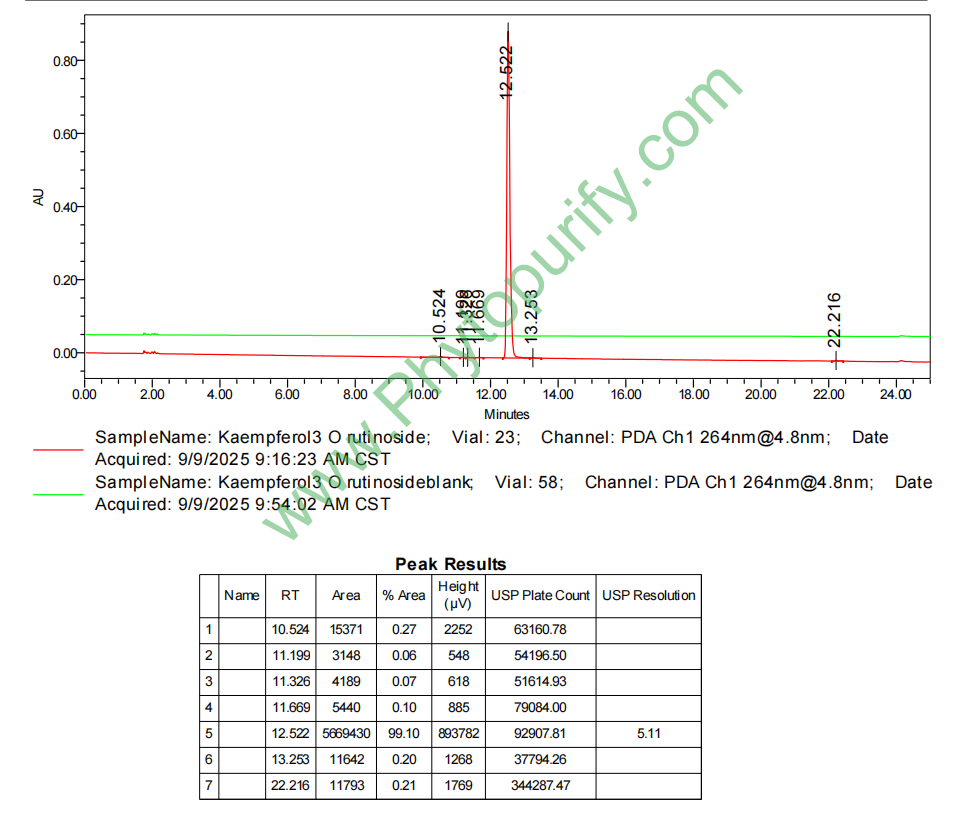
Purity: 95%~99%
Analysis Method: HPLC-DAD or/and HPLC-ELSD
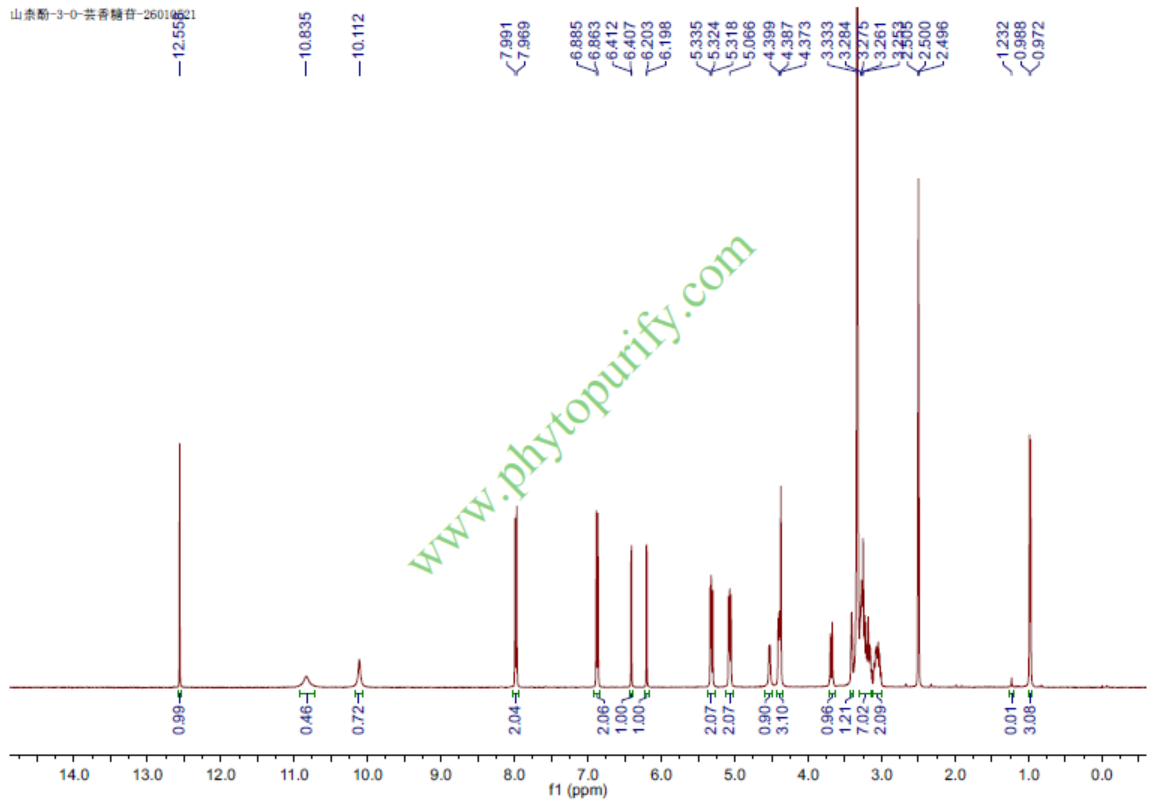
Identification Method: Mass, NMR
Packing: Brown vial or HDPE plastic bottle
Storage: Store in a well closed container, protected from air and light. Put into refrigerate or freeze for long term storage.
Whenever possible, you should prepare and use solutions on the same day. However, if you need to make up stock solutions in advance, we recommend that you store the solution as aliquots in tightly sealed vials at -20℃. Generally, these will be useable for up to two weeks.
The product could be supplied from milligrams to grams, up to kilograms
Inquire for bulk scale.
Descriptions:
Nicotiflorin is a flavonoid glycoside extracted from a traditional Chinese medicine Flos Carthami, it has a protective effect against cerebral ischemic damage.[1]
Nicotiflorin has protective effects on reducing memory dysfunction, energy metabolism failure and oxidative stress in multi-infarct dementia model rats.[2]
Nicotiflorin has neuro-protection in permanent focal cerebral ischemia and in neuronal cultures. [3]
References:
[1] Li R, Guo M, Zhang G, et al. J Ethnopharmacol, 2006, 107(1):143-50.
[2] Huang J, Fu S Y, Cao Y, et al. Pharmacol Biochem Behavior, 2007, 86(4):741-8.
[3] Li R, Guo M, Zhang G, et al. Biol Pharm Bull, 2006, 29(9):1868-72.
[4] Sun J, Xiao-Juan H E, Liu J Q. China Pharmacy, 2015, 9.
HPLC of Kaempferol-3-Rutinoside
HNMR of Kaempferol-3-Rutinoside
Storage conditions:Short-term storage at 2~8℃, long-term storage at -20 ~ -80℃
Kaempferol-3-O-rutinoside (CAS number 17650-84-9), as a natural flavonoid compound, has received widespread attention in the field of natural product pharmacology in recent years due to its unique structural characteristics and diverse biological activities. This compound belongs to the Kaempferol O-glucoside class, which is a disaccharide derivative formed by connecting Kaempferol to the rutin glycosyl group at position 3 ([6-deoxy - α - L-mannosyl - (1 → 6) - β - D-glucosyl]) through a glycosidic bond. Kaempferol-3-O-rutinoside was first isolated and identified from the leaves of Solanum campaniforme in the Solanaceae family, and has since been reported in various plants. As a natural flavonoid glycoside, it exhibits significant pharmacological activities such as antioxidant, anti-inflammatory, and anti-tumor, especially in regulating oxidative stress-related diseases, demonstrating potential therapeutic value.
This article aims to systematically review the chemical structure and physicochemical properties, plant sources and extraction methods, pharmacological activity and mechanism of action, pharmacological evaluation and pharmacokinetic characteristics of kaempferol-3-O-rutinoside, and explore its clinical application prospects and future development directions in combination with current research progress, providing theoretical basis and research reference for the drug development of this natural product.
The molecular formula of kaempferol-3-O-rutinoside is C27H30O15, with a molecular weight of 594.5220. Its core structure is the kaempferol flavonoid skeleton, with the 3-hydroxyl group connected to the rutin glycosyl group through a glycosidic bond. Rutin glycosyl group is composed of a 6-deoxy - α - L-mannose and a β - D-glucose linked by a 1 → 6 glycosidic bond, endowing the molecule with high polarity and water solubility.
In terms of physical and chemical properties, the LogP value of kaempferol-3-O-rutinoside is about -0.2757, indicating its strong hydrophilicity. The measured water solubility value is 2.4253, supporting its good water solubility. The topological polar surface area (TPSA) is as high as 249.2 Å ², reflecting the presence of a large number of polar groups on the molecular surface, which is conducive to the formation of hydrogen bonds and electrostatic interactions with biomolecules. The compound has low blood-brain barrier permeability, indicating limited penetration ability in the central nervous system. The negative result of hERG channel inhibition experiment indicates a low risk of cardiac toxicity. The Ames test result is 0.6, indicating a low risk of genotoxicity and meeting safety requirements.
Structurally, kaempferol-3-O-rutinoside belongs to the rutin class and possesses typical structural characteristics of trihydroxyflavones. The diglycoside not only enhances its water solubility, but may also affect its bioavailability and metabolic stability.
Kaempferol-3-O-rutinoside was initially isolated from Solanum campaniforme leaves. In addition, this compound has been reported in various plants, especially in vegetables, fruits, and medicinal plants rich in flavonoid glycosides. Common plant sources include Solanaceae, Brassicaceae, and leguminous plants, and the content of kaempferol-3-O-rutinoside in these plants varies depending on the species, ecological environment, and growth stage.
The extraction method mainly uses polar solvents such as ethanol, water, or their mixed solvent systems, and improves the extraction efficiency through modern technologies such as reflux extraction, ultrasound assisted extraction, or microwave-assisted extraction. The extraction solution was concentrated, liquid-liquid partitioned, and purified by multi-stage column chromatography. Finally, the components were identified and the purity was confirmed by means of high-performance liquid chromatography (HPLC), mass spectrometry (MS), and nuclear magnetic resonance (NMR).
In recent years, green and efficient extraction techniques such as supercritical fluid extraction and membrane separation have gradually been applied to the extraction of flavonoid glycosides, significantly improving extraction purity and yield, reducing solvent consumption and environmental pollution.
As a typical trihydroxyflavonoid glycoside, kaempferol-3-O-rutinoside exhibits strong antioxidant capacity. In vitro studies have shown that the compound can effectively scavenge various free radicals, including hydroxyl radicals (· OH), superoxide anions (O2 · -), and hydrogen peroxide (H2O2), significantly inhibiting lipid peroxidation and DNA oxidative damage. Its antioxidant mechanism is mainly achieved through direct electron donor action and metal ion chelation.
Multiple cell model studies have confirmed that kaempferol-3-O-rutinoside can significantly alleviate cell damage caused by oxidative stress. In human liver cell, nerve cell, and myocardial cell models, this compound enhances cell tolerance to oxidative damage and promotes cell survival by activating the intracellular antioxidant enzyme system.
Flavonoids generally have anti-inflammatory activity, and kaempferol-3-O-rutinoside is no exception. It can inhibit the expression of inflammatory mediators such as TNF - α, IL-6, IL-1 β, and alleviate the inflammatory response. Related studies have shown that this compound exerts immunomodulatory effects by regulating the NF - κ B signaling pathway, reducing the activity of pro-inflammatory enzymes.
Preliminary in vitro experiments have revealed that kaempferol-3-O-rutinoside has inhibitory effects on proliferation and induces apoptosis in various tumor cells. Its mechanism involves cell cycle arrest, mitochondrial mediated apoptosis, and oxidative stress regulation, suggesting its potential value as a natural anti-tumor drug.
In addition, kaempferol-3-O-rutinoside has shown certain activities in antibacterial, antiviral, neuroprotective, and cardiovascular protection, and related research is still ongoing.
The pharmacological core of kaempferol-3-O-rutinoside lies in its regulation of oxidative stress-related signaling pathways, particularly through the activation of nuclear factor erythroid 2-related factor 2 (NFE2L2/NRF2) pathway to achieve cell protective function. NRF2, as a key intracellular antioxidant transcription factor, regulates the expression of various antioxidant enzyme genes, including superoxide dismutase (SOD1, SOD2), catalase (CAT), glutathione peroxidase (GPX1), and heme oxygenase-1 (HMOX1).
Kaempferol-3-O-rutinoside promotes the nuclear translocation of NRF2, enhances its binding to antioxidant response elements (ARE), induces the expression of downstream antioxidant enzyme genes, enhances cellular antioxidant defense capabilities, reduces ROS accumulation, and alleviates oxidative damage. In addition, the compound can also inhibit pro-inflammatory signaling pathways such as NF - κ B, reduce the release of inflammatory mediators, and alleviate inflammatory responses.
In terms of regulating cell apoptosis, kaempferol-3-O-rutinoside promotes the activation of apoptosis related enzymes and induces programmed cell death in tumor cells by regulating Bcl-2 family proteins and mitochondrial membrane potential. Its impact on the cell cycle is manifested as G1/S phase arrest, inhibiting cell proliferation.
In summary, the multi-target mechanism of action of kaempferol-3-O-rutinoside provides a molecular basis for its broad pharmacological activity, especially in the treatment of antioxidant damage related diseases.
The pharmacological evaluation of kaempferol-3-O-rutinoside shows that it has good safety and suitable pharmacokinetic characteristics. Its molecular weight is 594.5, slightly higher than the ideal range of traditional small molecule drugs, but its high polarity and water solubility help improve in vivo distribution. A negative LogP value indicates strong hydrophilicity, which may limit its passive diffusion through lipid membranes but facilitate dissolution and transport in plasma.
The low permeability of the blood-brain barrier suggests that its application in central nervous system diseases may be limited, but this also reduces the potential risk of central neurotoxicity. The hERG channel inhibition experiment was negative, indicating good cardiac safety. The Ames test results showed no significant genotoxicity, supporting the safety of its long-term use.
In terms of pharmacokinetics, existing research is relatively limited. Preliminary in vivo experiments have shown that the absorption of kaempferol-3-O-rutinoside is slow after oral administration, and its bioavailability is limited, which may be related to its high molecular weight and glycoside structure. It is mainly hydrolyzed into kaempferol in the body by gut microbiota, which is an active metabolite and exerts pharmacological effects. The metabolic pathways include phase I and phase II metabolic reactions in the liver, mainly excreted through glucuronidation and sulfation.
In the future, further systematic pharmacokinetic and pharmacodynamic studies are needed to optimize the administration route and dosage form design, improve its bioavailability and clinical application potential.
Based on the significant antioxidant and cell protective activities of kaempferol-3-O-rutinoside, its clinical application prospects are broad in various oxidative stress-related diseases. Oxidative stress is an important pathogenesis of cardiovascular disease, neurodegenerative disease, diabetes, tumor and other chronic diseases. Kaempferol-3-O-rutoside enhances endogenous antioxidant defense by activating the NRF2 signal pathway, which has potential preventive and therapeutic value.
In cardiovascular disease, the compound can alleviate ischemia reperfusion injury, inhibit the progression of atherosclerosis, and protect the function of myocardial cells; In neurological diseases, although the permeability of the blood-brain barrier is low, its metabolite kaempferol may play a neuroprotective role and has potential adjuvant therapeutic value for Alzheimer's disease, Parkinson's disease, and other conditions.
In addition, the anti-inflammatory and anti-tumor activities of kaempferol-3-O-rutinoside provide new ideas for its use in the treatment of inflammatory diseases and tumors. By combining modern drug delivery systems such as nanocarriers and targeted drug delivery technology, it is expected to overcome the shortcomings of their low bioavailability and improve clinical efficacy.
Future research should focus on:
As an important natural flavonoid glycoside, kaempferol-3-O-rutinoside exhibits a wide range of pharmacological effects and good safety due to its unique chemical structure and significant antioxidant, anti-inflammatory, and anti-tumor activities. It exerts cell protection and disease intervention effects by regulating NRF2 and related antioxidant enzyme targets, providing new natural drug candidate molecules for the treatment of oxidative stress-related diseases.
Although the research on its pharmacokinetics and clinical applications is still in its infancy, with the advancement of extraction and purification technologies and drug delivery systems, kaempferol-3-O-rutinoside is expected to become an important direction for the development of natural product drugs. In the future, it is necessary to strengthen interdisciplinary research, promote its transition from laboratory to clinical practice, and ultimately achieve its widespread application in disease prevention and treatment.
