| Catalog No | Package | Original Price | Price | Inventory | Quantity | Operating |
|---|---|---|---|---|---|---|
| BPF2371-5mg | 5mg | $350.00 | Sign in |
|


Storage conditions:Short-term storage at 2~8℃, long-term storage at -20 ~ -80℃
289.6600
-1.1954
-1.3170
2.7141
.4653
.1462
Low
72.5582
4.7849
Yes
No
No
No
Yes
No
0.6
Yes
No
Yes
Yes
Natural products, as an important source of drug discovery, play an irreplaceable role in the long history of human fight against diseases. Flavonoids, as the most widely distributed class of secondary metabolites in nature, have attracted much attention due to their structural diversity and extensive biological activity. Among them, Kaempferol and its derivatives are extensively studied flavonols, exhibiting various pharmacological effects such as antioxidant, anti-inflammatory, anti-tumor, and cardiovascular protection. However, structural modifications of flavonoids in nature, especially hydroxylation and glycosylation, can significantly alter their physicochemical properties, bioavailability, and targeting specificity, resulting in unique biological effects.
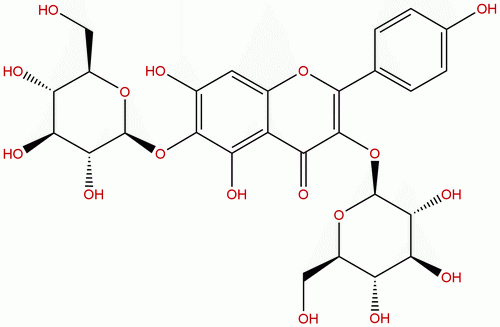
6-Hydroxykaempferol 3,6-di-O-glucoside (6HKDG) is a structurally unique flavonol glycoside. Unlike common kaempferol glycosides, 6HKDG introduces an additional hydroxyl group at the C-6 position of the A ring and is linked to a glucose group at the C-3 and C-6 positions, respectively. The structural characteristics of "dihydroxylation" and "disaccharideization" make it unique in the flavonoid compound family. Although its research history is relatively short, in recent years, with the advancement of separation and identification techniques and the deepening of biological activity screening, 6HKDG has gradually stood out from many natural products, especially in the field of antioxidant stress, showing remarkable potential.
Modern medical research shows that oxidative stress is the common pathophysiological basis of a variety of chronic diseases, including cardiovascular diseases, neurodegenerative diseases, diabetes complications and aging process. The excessive production of reactive oxygen species (ROS) and reactive nitrogen species (RNS) can attack biomolecules (lipids, proteins, DNA), leading to cell damage and functional impairment. Therefore, the search for efficient and low toxicity natural antioxidants has become a hot topic in drug development. 6HKDG is considered a highly promising natural antioxidant lead compound due to its powerful free radical scavenging ability endowed by its polyphenolic hydroxyl structure and its regulatory effect on the endogenous antioxidant defense system of cells. This article aims to systematically review the chemical structure, plant origin, pharmacological activity, mechanism of action, and pharmacological characteristics of 6HKDG, in order to provide comprehensive academic references for the in-depth research and development of this compound.
The chemical structure of 6-hydroxykaempferol-3,6-di-O-glucoside is based on the flavonol core (2-phenylchromenone). Its core structural features are: the B ring is a 4 '- hydroxyphenyl group, the C-3 hydroxyl group of the C ring is replaced by a β - D-glucosyl group, the C-5 and C-7 positions of the A ring are hydroxyl groups, and the C-6 position is simultaneously connected to a β - D-glucosyl group and a hydroxyl group. This structure significantly distinguishes it from common kaempferol-3-O-glucoside or kaempferol-3,7-di-O-glucoside. The precise chemical name is: 3,5,7,4 '- tetrahydroxy-6- (β - D-glucopyranosyl) flavone-3-yl - β - D-glucopyranoside. Its molecular formula is C ₂₇ H ∝₀ O ₁₇, and its molecular weight is 626.5200 g/mol.
From the perspective of physical and chemical properties, 6HKDG exhibits typical characteristics of polyhydroxyflavonoid glycosides. Its lipophilic water partition coefficient (LogP) is -1.1954, indicating that the compound has strong hydrophilicity and high solubility in water (water solubility parameter is 2.7141). This characteristic stems from its molecular structure containing up to 10 hydroxyl groups and two sugar units, making it highly susceptible to forming hydrogen bonds with water molecules. The polar surface area (TPSA) is as high as 289.6600 Å ², far exceeding the recommended upper limit of 140 Å ² for oral drugs, indicating poor transmembrane permeability and potential challenges in oral bioavailability. In addition, high TPSA also explains the reason for its low blood-brain barrier (BBB) penetration ability, which limits its direct application in the treatment of central nervous system diseases, but may also reduce potential toxicity to the central nervous system. In terms of chemical stability, 6HKDG is relatively stable in acidic environments, but under alkaline conditions or exposure to strong light and high temperature, its glycosidic bonds may undergo hydrolysis and phenolic hydroxyl groups may also be oxidized. Therefore, in the process of extraction, separation, storage, and formulation development, attention should be paid to avoiding light, low temperature, and controlling the pH environment.
6-Hydroxykaempferol-3,6-di-O-glucoside is not widely present in all plants, and its distribution has relative specificity. At present, the main sources of literature reports are concentrated in certain specific medicinal and edible plants. Among them, the most famous source is the Asteraceae plant safflower(Carthamus tinctorius L. The petals of. As a traditional Chinese medicine for promoting blood circulation and removing blood stasis, safflower has a complex chemical composition and is rich in flavonoids, quinone chalcones (such as crocin), and other compounds. 6HKDG is one of the flavonoid glycosides with high content in safflower, and is considered as an important substance basis for its antioxidant and cardiovascular protective activities. In addition, in the ginger family plant turmeric(Curcuma longa L. The presence of this compound has also been detected in the rhizomes of certain leguminous plants, seeds or leaves of certain species, as well as in some edible flowers such as marigolds. It is worth noting that the content of 6HKDG in plants is influenced by various factors, including variety, origin, harvest season, growth stage, and processing method. For example, during the peak flowering period of safflower, the accumulation of 6HKDG in the petals usually reaches its peak.
For the extraction of 6HKDG, solvent extraction method is currently mainly used, supplemented by modern separation and purification technology. Due to its high polarity and good water solubility, polar solvent systems are often used. The classic extraction process is as follows: after crushing dried plant materials (such as safflower petals), ethanol water mixed solvents (such as 50% -80% ethanol) are used for heating reflux extraction or ultrasound assisted extraction. Ultrasound assisted extraction is more conducive to protecting thermosensitive components due to its high efficiency, short time, and controllable temperature. After the extraction solution is concentrated under reduced pressure, crude extract is obtained. Subsequently, using liquid-liquid extraction method, solvents such as petroleum ether, ethyl acetate, and n-butanol were sequentially used for fractional extraction to remove lipophilic impurities and moderately polar components. 6HKDG is mainly enriched in the n-butanol extraction layer or water layer. Further purification usually relies on column chromatography techniques, such as macroporous adsorption resin (such as D101, AB-8 type) column chromatography, which uses different concentrations of ethanol water gradient elution to preliminarily enrich the target components. Subsequently, high-purity 6HKDG monomer can be obtained by combining polyamide column chromatography, silica gel column chromatography, or preparative high-performance liquid chromatography (Prep HPLC). In recent years, high-speed countercurrent chromatography (HSCCC) has been successfully applied as an efficient liquid-liquid distribution chromatography technique for the rapid separation of various polar flavonoid glycosides, including 6HKDG, in safflower. It has the advantages of high sample recovery rate and less irreversible adsorption.
The pharmacological activity research of 6-hydroxykaempferol-3,6-di-O-glucoside mainly focuses on its antioxidant, anti-inflammatory, skin protection, and cardiovascular protection aspects, among which antioxidant activity is its most core and fundamental role.
antioxidant activity The antioxidant capacity of 6HKDG is its most prominent characteristic. In vitro chemical experiments have shown that the compound can efficiently scavenge various free radicals, including 1,1-diphenyl-2-trinitrophenylhydrazine (DPPH) free radical, 2,2 '- diazo-bis-3-ethylbenzothiazoline-6-sulfonic acid (ABTS) cationic free radical, superoxide anion free radical, and hydroxyl free radical. Its activity is significantly superior to many common monosaccharide flavonoid glycosides, and even close to or equivalent to positive controls such as vitamin C or quercetin. This powerful direct radical scavenging ability is mainly attributed to the phenolic hydroxyl groups at C-3 ', C-4', C-5, and C-7 positions in its molecule, which can act as hydrogen atom donors and effectively neutralize the chain reaction of free radicals. In addition, 6HKDG exhibits significant metal ion chelating ability, especially for Fe ² ⁺ and Cu ² ⁺, which helps to inhibit the Fenton reaction and reduce the generation of highly active hydroxyl radicals. In cell models, 6HKDG pretreatment can significantly alleviate oxidative damage induced by hydrogen peroxide (H ₂ O ₂), tert butyl hydroperoxide (t-BHP), or ultraviolet (UV) to various cells such as keratinocytes, fibroblasts, and endothelial cells. This is manifested by reducing intracellular ROS levels, decreasing the content of lipid peroxidation product malondialdehyde (MDA), increasing cell viability, and inhibiting cell apoptosis.
anti-inflammatory activity Oxidative stress is closely related to inflammatory response. The anti-inflammatory effect of 6HKDG has been confirmed in some preliminary studies. In a macrophage model stimulated by lipopolysaccharide (LPS), 6HKDG can inhibit the production of inflammatory mediators such as nitric oxide (NO) and prostaglandin E ₂ (PGE ₂), and downregulate the mRNA and protein expression levels of pro-inflammatory cytokines such as tumor necrosis factor - α (TNF - α), interleukin-6 (IL-6), and interleukin-1 β (IL-1 β). The mechanism may be related to the inhibition of the activation of the nuclear factor kappa B (NF - κ B) signaling pathway.
Skin protective activity Given its strong antioxidant and anti-inflammatory abilities, 6HKDG has demonstrated potential applications in the field of skin protection. Research has shown that 6HKDG can inhibit oxidative damage and apoptosis of human keratinocytes (HaCaT cells) induced by ultraviolet B (UVB). More importantly, it can inhibit the expression and activity of UVB induced matrix metalloproteinase-1 (MMP-1) and matrix metalloproteinase-3 (MMP-3). MMP-1 and MMP-3 are key enzymes that degrade collagen and elastin in the dermis of the skin, and their overexpression is the main molecular mechanism of skin photoaging (wrinkle formation, relaxation). Therefore, 6HKDG is expected to become an effective ingredient for preventing and treating skin photoaging by inhibiting MMPs. In addition, it can also inhibit the activity of tyrosinase (TYR). Tyrosinase is a key rate limiting enzyme in melanin synthesis, and its activity inhibition suggests that 6HKDG may have whitening effects and can be used to improve pigmentation disorders.
Cardiovascular protective activity Based on its antioxidant and anti-inflammatory properties, 6HKDG also exhibits protective effects on the cardiovascular system. In the endothelial cell injury model induced by oxidized low density lipoprotein (ox LDL), 6HKDG can reduce the apoptosis and dysfunction of endothelial cells, and inhibit the adhesion of monocytes to endothelial cells, which is the early key event of atherosclerosis. In addition, in the myocardial ischemia-reperfusion injury model, 6HKDG pretreatment can reduce the myocardial infarction area and improve cardiac function, and its mechanism is related to reducing oxidative stress and inhibiting myocardial cell apoptosis.
The pharmacological activity of 6-hydroxykaempferol-3,6-di-O-glucoside is not solely dependent on its direct chemical antioxidant activity, but rather on its regulation of multiple signaling pathways and key molecular targets within cells. Based on existing research, its mechanism of action mainly involves the following aspects:
1. Activate the nuclear factor E2 related factor 2 (Nrf2)/antioxidant response element (ARE) signaling pathway This is the core mechanism by which 6HKDG exerts cell protective effects. Nrf2 is the "main switch" that regulates the endogenous antioxidant defense system in cells. Under normal physiological conditions, Nrf2 binds to Kelch like ECH associated protein 1 (Keap1) and is in an inhibited state. When cells are stimulated by oxidative stress or electrophilic agents, Nrf2 dissociates from Keap1, translocates into the nucleus, binds to ARE, and initiates the transcription of downstream antioxidant and detoxifying enzyme genes. Research has shown that 6HKDG can effectively promote nuclear translocation of Nrf2, thereby upregulating the expression of its target genes, including:Heme oxygenase-1 (HMOX1/HO-1)、Superoxide dismutase 1 (SOD1/CuZn SOD)、Superoxide dismutase 2 (SOD2/Mn-SOD)、Catalase (CAT)、Glutathione peroxidase 1 (GPX1) and Quinone oxidoreductase 1 (NQO1) Wait. By enhancing the activity of these endogenous antioxidant enzymes, 6HKDG can construct a powerful cellular defense system that continuously removes ROS, thereby protecting cells from more severe oxidative damage in the future. NFE2L2 (NRF2) is the core transcription factor of this pathway, while HMOX1, SOD1, CAT, GPX1, and SOD2 are its key effector molecules.
2. Inhibit the expression and activity of matrix metalloproteinases (MMPs)As mentioned earlier, 6HKDG can significantly inhibit the expression of MMP-1 and MMP-3. The mechanism may involve multiple levels. Firstly, by clearing ROS, the activation of ROS mediated mitogen activated protein kinase (MAPK) signaling pathways (such as p38, JNK, ERK), which are upstream signals that induce MMP expression, is reduced. Secondly, 6HKDG may directly or indirectly inhibit the activity of transcription factors such as activator protein-1 (AP-1) and NF - κ B, which have binding sites on the promoter of MMP genes. By inhibiting these pro-inflammatory and pro degradation signaling pathways, 6HKDG effectively reduces the transcription and synthesis of MMPs. MMP1 and MMP3 are key targets in skin photoaging and tissue remodeling.
3. Inhibit tyrosinase (TYR) activity The inhibitory effect of 6HKDG on TYR is the molecular basis of its whitening activity. TYR is a copper containing oxidase that is the rate limiting enzyme in melanin synthesis. 6HKDG may chelate with copper ions in the TYR active center through its phenolic hydroxyl group, forming competitive inhibition and blocking the step of tyrosine conversion to dopaquinone, ultimately reducing melanin production. This inhibitory effect may be dose-dependent.
4. Regulating cell apoptosis and autophagy Under oxidative stress conditions, 6HKDG can inhibit mitochondrial pathway apoptosis by regulating Bcl-2 family proteins (such as upregulating anti apoptotic protein Bcl-2 and downregulating pro apoptotic protein Bax) and inhibiting Caspase-3 activation. In addition, preliminary evidence suggests that 6HKDG may also help cells clear damaged proteins and organelles by inducing moderate autophagy, thereby maintaining a stable intracellular environment and resisting stress damage.
In summary, the mechanism of action of 6HKDG is a multi-target, multi pathway synergistic network. Its core lies in enhancing endogenous antioxidant defense by activating the Nrf2 ARE pathway, while directly clearing free radicals, chelating metal ions, and inhibiting the activity of key effector enzymes such as MMPs and TYR, ultimately achieving a comprehensive effect of antioxidant, anti-inflammatory, anti-aging, and cell protection.
To advance 6-hydroxykaempferol-3,6-di-O-glucoside from a natural product lead compound to a clinical candidate drug, a systematic evaluation of its drug like and pharmacokinetic (ADME) properties is necessary.
Drugability assessment Based on the Lipinski Five Rules and other relevant parameters, the pharmacological properties of 6HKDG face significant challenges. Its molecular weight (626.52 Da) far exceeds the threshold of 500 Da; A low LogP value (-1.1954) indicates strong hydrophilicity, which is not conducive to transmembrane passive diffusion; The number of hydrogen bond donors (10) and hydrogen bond acceptors (17) far exceeds the upper limit of the rule. These characteristics result in extremely low oral bioavailability, making it a typical "non class drug" molecule. However, the evaluation of drug properties is not absolute. For natural products, especially polar glycosides, poor oral absorption does not mean that they have no development value at all. They can improve their membrane permeability and bioavailability through novel drug delivery systems such as prodrug design, nano formulations (such as liposomes, polymer nanoparticles), phospholipid complexes, etc. In addition, for local topical applications (such as skin, mucous membranes) or injection routes of administration, these restrictions may be relatively small. For example, the application of 6HKDG in skin whitening and anti-aging can be effectively delivered through transdermal delivery systems such as microemulsions and liposomes. In terms of safety, preliminary toxicity predictions indicate that 6HKDG has a low risk of inhibiting hERG potassium ion channels (hERG inhibition: no), and Ames test results (0.6) suggest a low risk of genetic toxicity, providing some positive support for its safety.
Pharmacokinetic characteristics At present, there is insufficient direct research data on the pharmacokinetics of 6HKDG in vivo, but based on its structural characteristics and known metabolic patterns of related flavonoid glycosides, reasonable inferences can be made.absorb After oral administration, the absorption of 6HKDG in the small intestine is extremely limited. Its high polarity and high molecular weight make it difficult to passively diffuse through intestinal epithelial cells. Some molecules may be absorbed through paracellular pathways or active transport mediated by intestinal transporters such as glucose transporter SGLT1, but the efficiency is low.distribution After absorption into the bloodstream, due to its hydrophilicity, 6HKDG is mainly distributed in plasma and extracellular fluid, and its binding rate with plasma proteins may be low. Its high TPSA and low LogP determine that it cannot penetrate the blood-brain barrier, limiting its application in the central nervous system.Metabolism The metabolism of 6HKDG in the body mainly occurs in the intestine and liver. Firstly, the β - glucosidase produced by the gut microbiota hydrolyzes its glycosidic bonds, gradually producing 6-hydroxykaempferol-3-O-glucoside, 6-hydroxykaempferol-6-O-glucoside, and ultimately producing the aglycone -6-hydroxykaempferol. Glycosides subsequently undergo phase II metabolism in the liver, such as glucuronidation, sulfation, or methylation, producing metabolites that are more easily excreted. It is worth noting that these metabolites (especially aglycones) may have different biological activities from the parent compound.excretion Metabolites are mainly excreted through bile and urine. Due to its large molecular weight and high polarity, bile excretion may be its main clearance pathway.
In summary, the main challenge for the pharmacological properties of 6HKDG lies in poor oral absorption. The future research focus should be on developing efficient delivery systems to overcome this bottleneck, while delving into whether their metabolites in vivo are active and how to utilize their potential for local applications.
Although 6-hydroxykaempferol-3,6-di-O-glucoside faces challenges in drug development, its unique pharmacological activity spectrum, especially its strong antioxidant, anti-aging, and whitening effects, opens up broad prospects for its application in specific fields.
1. Skin care and cosmetics field This is the most promising application direction for 6HKDG with practical conversion potential. It inhibits the dual activity of MMP-1/3 and TYR, making it an ideal anti-aging and whitening active ingredient. It can be predicted that 6HKDG will be developed into a new type of skin care essence, facial mask, sunscreen or freckle cream. Through transdermal technologies such as liposomes and nanoemulsions, the skin permeability and stability can be effectively improved. Compared with traditional ingredients such as vitamin C and arbutin, 6HKDG may have better comprehensive effects and lower irritability.
2. Adjuvant therapy for cardiovascular diseases Given its antioxidant and vascular protective effects, 6HKDG has the potential to serve as an adjuvant therapy or preventive dietary supplement for cardiovascular diseases. Although oral bioavailability is low, designing it into oral nano formulations or enteric coated formulations may increase its systemic exposure. In addition, intravenous injection of formulations may be a more direct and effective way of administration for acute myocardial ischemia-reperfusion injury.
3. Anti inflammation and tissue protection In local inflammatory diseases such as inflammatory bowel disease and arthritis, local administration of 6HKDG (such as enema, intra-articular injection) may exert anti-inflammatory and antioxidant effects while avoiding systemic side effects.
Future research directions:
1. In depth mechanism research Using gene knockout or RNA interference techniques, clarify the exact contributions of key targets such as Nrf2 and MMPs in the pharmacological effects of 6HKDG in in in vitro and in vivo models. Explore whether it affects other important pathways such as Sirtuins, FOXO, etc.
2. Metabolomics and pharmacokinetics Systematically study the metabolic fate of 6HKDG in vivo, identify its main metabolites, and evaluate the biological activity of these metabolites. Develop sensitive and reliable biological sample analysis methods to support preclinical and clinical pharmacokinetic studies.
3. Drug delivery system development Key research and development of new delivery systems that can significantly improve the oral bioavailability or skin permeability of 6HKDG, such as phospholipid complexes, self microemulsifying drug delivery systems, soluble microneedles, etc.
4. Structural modification and structure-activity relationship Using 6HKDG as the lead, systematic structural modifications are carried out, such as replacing the glucose group with other sugar groups, introducing methyl or acetyl groups, etc., in order to obtain derivatives with stronger activity, better stability, and higher bioavailability.
5. toxicological evaluation Conduct systematic acute toxicity, long-term toxicity, and reproductive toxicity studies to provide complete data for their safety evaluation.
6-Hydroxykaempferol-3,6-di-O-glucoside, as a structurally unique natural flavonol diglycoside, exhibits excellent antioxidant activity beyond ordinary flavonol glycosides due to its special structure of C-6 hydroxylation and disaccharideization. Its mechanism of action is not singular, but rather enhances the endogenous antioxidant defense system by directly clearing free radicals, chelating metal ions, and activating the Nrf2 ARE signaling pathway at its core, while inhibiting key effector enzymes such as MMP-1, MMP-3, and TYR, thus demonstrating significant potential in anti photoaging, whitening, cardiovascular protection, and other fields.
Although its high polarity and high molecular weight pose challenges for its low oral bioavailability, this does not negate its development value. Through innovative formulation techniques, local administration strategies, or structural modifications, these obstacles are expected to be overcome. At present, research on 6HKDG is still in its early stages, and there is still a long way to go from basic pharmacology to clinical translation. In the future, with the in-depth analysis of its mechanism of action, comprehensive elucidation of pharmacokinetic characteristics, and successful development of efficient delivery systems, 6-hydroxykaempferol-3,6-di-O-glucoside is expected to gradually develop from a promising natural lead compound into a drug or functional cosmetic raw material that plays an important role in skin health, cardiovascular protection, and other fields. In depth research on it not only helps to reveal the complex relationship between the structure and activity of flavonoids in nature, but also provides valuable examples for discovering innovative drugs from traditional medicinal plants.
Batch can search by a CAS number,one per line
