| Catalog No | Package | Original Price | Price | Inventory | Quantity | Operating |
|---|---|---|---|---|---|---|
| BPF2521-5mg | 5mg | $420.00 | Sign in |
|


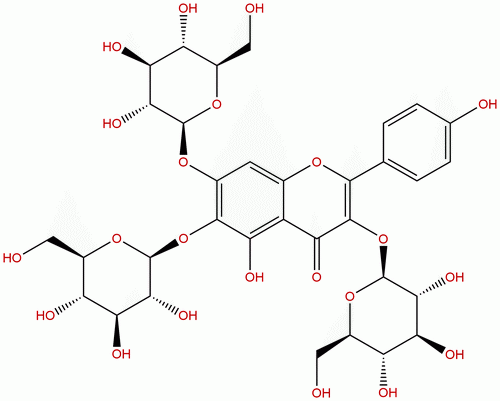
Product name: 6-Hydroxykaempferol-3,6,7-triglucoside
Synonym name:
Catalogue No.: BPF2521
Cas No.: 145134-62-9
Formula: C33H40O22
Mol Weight: 788.661
Botanical Source:
Physical Description:
Type of Compound: Flavonoids
Purity: 95%~99%
Analysis Method: HPLC-DAD or/and HPLC-ELSD
Identification Method: Mass, NMR
Packing: Brown vial or HDPE plastic bottle
The product could be supplied from milligrams to grams
Inquire for bulk scale.
For Reference Standard and R&D, Not for Human Use Directly.
Storage conditions:Short-term storage at 2~8℃, long-term storage at -20 ~ -80℃
368.8100
-1.8760
-1.8971
4.9928
.4201
.1524
Low
65.0732
5.3822
Yes
No
No
No
Yes
No
0.0
Yes
Yes
Yes
Yes
Natural products, as an important source of drug discovery, have long played an irreplaceable role in human health maintenance and disease treatment. Flavonoids, as the largest class of secondary metabolites in plants, have attracted much attention due to their extensive and significant biological activities, especially their antioxidant, anti-inflammatory, anti-tumor, and cardiovascular protective effects. Among numerous flavonoids, Kaempferol and its derivatives exhibit unique chemical and biological properties due to their multi hydroxyl substitution pattern in the core structure. 6-Hydroxykaempferol-3,6,7-tri-O-glucoside (6HK-3,6,7-Glc) is a highly glycosylated flavonol glycoside characterized by a glucose group attached to the C-3, C-6, and C-7 sites of the kaempferol nucleus, and an additional hydroxyl group at the C-6 site. This unique "polyhydroxy, polysaccharide based" structure endows the compound with excellent hydrophilicity and potential biological activity.
Although the distribution of 6HK-3,6,7-Glc in nature is relatively limited, mainly found in certain medicinal plants and vegetables, its potential in antioxidant stress-related diseases is gradually being revealed. Oxidative stress is the common pathophysiological basis of many chronic diseases, including cardiovascular diseases, neurodegenerative diseases, diabetes and its complications, skin aging and cancer. Therefore, the search for efficient and low toxicity natural antioxidants has always been a hot topic in pharmacological research. 6HK-3,6,7-Glc has shown great potential as a lead compound or dietary supplement due to its strong free radical scavenging ability and regulatory effects on multiple antioxidant signaling pathways. This article aims to systematically review the chemical structure, plant origin, extraction process, pharmacological activity, mechanism of action, pharmacological characteristics, and clinical application prospects of 6-hydroxykaempferol-3,6,7-tri-O-glucoside, in order to provide comprehensive academic references for the in-depth research and development of this natural product.
The chemical structure of 6-hydroxykaempferol-3,6,7-tri-O-glucoside is based on the flavonol core - kaempferol. Kaempferol (3,5,7,4 '- tetrahydroxyflavone) itself has a classic C6-C3-C6 skeleton, consisting of two benzene rings (A and B) connected by an oxygen-containing heterocyclic ring (C ring). The structural specificity of 6HK-3,6,7-Glc is reflected in the following three aspects: firstly, an additional hydroxyl group (- OH) is introduced at the C-6 position of the A ring, making it a hexahydroxy substituted flavonol (6-hydroxykaempferol); Secondly, the hydroxyl groups at positions C-3, C-6, and C-7 are all replaced by β - D-glucose groups, forming a tri glycoside. This structure results in a molecular weight of 788.66 Da, far exceeding most small molecule flavonoid glycosides.
From the perspective of physical and chemical properties, this compound has extremely strong hydrophilicity. The calculated lipid water partition coefficient (LogP) is -1.8760, indicating that its solubility in the aqueous phase is much higher than that in the lipid phase. This characteristic is closely related to its topologically polar surface area (TPSA) of up to 368.81 Å ². TPSA reflects the total surface area of polar atoms (such as oxygen and nitrogen) and their connected hydrogen atoms in a molecule, and is commonly used to predict the transmembrane absorption capacity of molecules. A molecule with a TPSA greater than 140 Å ² is generally considered difficult to passively diffuse across the cell membrane. The TPSA value of 6HK-3,6,7-Glc far exceeds this threshold, indicating extremely low cell membrane permeability and potential challenges in oral bioavailability. However, its water solubility (4.9928) is good, which provides the possibility for its distribution in plasma and active transport through specific transporters such as glucose transporters GLUTs or sodium glucose cotransporters SGLTs. In addition, the compound's ability to penetrate the blood-brain barrier is predicted to be low, which limits its direct application in central nervous system diseases, but also reduces the potential risk of neurotoxicity. In terms of safety, preliminary predictions indicate a low risk of inhibition of hERG potassium channels (No), and the Ames test result is 0.0, suggesting no significant mutagenicity. This provides a favorable starting point for the safety evaluation of it as a candidate drug.
6-Hydroxykaempferol-3,6,7-tri-O-glucoside is not widely present in nature, and its sources are mainly concentrated in a few specific plant families and genera. The main sources of current literature reports include:
The choice of extraction method directly affects the yield and purity of 6HK-3,6,7-Glc. Given its high water solubility and thermal stability, traditional solvent extraction methods are still effective, but conditions need to be optimized to maximize extraction efficiency.
The pharmacological activity research of 6-hydroxykaempferol-3,6,7-tri-O-glucoside mainly focuses on its strong antioxidant capacity, which has led to potential intervention effects on various oxidative stress-related diseases.
This is the most core and extensively studied pharmacological activity of 6HK-3,6,7-Glc. Its antioxidant mechanism is multifaceted:
The skin is one of the main target organs of oxidative stress, and ultraviolet (UV) radiation is the main exogenous factor leading to skin photoaging and skin cancer. 6HK-3,6,7-Glc shows great potential in skin protection:
Oxidative stress and inflammatory response are closely related and mutually causal. The antioxidant activity of 6HK-3,6,7-Glc also lays the foundation for its anti-inflammatory effect. Research has shown that this compound can inhibit the production of pro-inflammatory cytokines (such as TNF - α, IL-6, IL-1 β) and nitric oxide (NO) in macrophages stimulated by lipopolysaccharide (LPS). The mechanism may be related to the inhibition of the activation of the NF - κ B signaling pathway.
Oxidized low density lipoprotein (ox LDL) is a key factor in the occurrence and development of atherosclerosis. 6HK-3,6,7-Glc can inhibit the oxidative modification of LDL through its antioxidant activity. In addition, it can protect endothelial cells from oxidative stress damage, maintain normal vasodilation function of blood vessels, and may exert antithrombotic effects by inhibiting platelet aggregation.
The pharmacological effects of 6-hydroxykaempferol-3,6,7-tri-O-glucoside are not solely dependent on direct chemical reactions, but are achieved through precise regulation of multiple signaling pathways within cells. Its core mechanism mainly revolves around Nuclear factor E2 related factor 2 (NRF2) The signal pathway unfolds.
NRF2 is a core transcription factor that cells use to respond to oxidative stress and electrophilic substances. Under physiological conditions, NRF2 binds to the inhibitory protein KEAP1 in the cytoplasm and is in an inactive state degraded by ubiquitination. When cells are exposed to oxidative stress or electrophilic compounds, the conformation of KEAP1 changes, releasing NRF2. Activated NRF2 translocates into the nucleus and binds to antioxidant response elements (ARE), initiating the transcription of a series of downstream protective genes.
6HK-3,6,7-Glc has been confirmed to be an effective activator of NRF2. Its mechanism of action may include:
- Directly modify KEAP1 The phenolic hydroxyl groups in the compound may be oxidized into quinone structures, which then covalently bind to cysteine residues (such as Cys151, Cys273, Cys288) on the KEAP1 protein, causing conformational changes in KEAP1 and releasing NRF2.
- Activate upstream kinase By activating upstream signaling pathways such as PI3K/Akt and MAPK (such as ERK, JNK, p38), phosphorylating NRF2 or KEAP1 promotes nuclear translocation of NRF2.
By activating NRF2, 6HK-3,6,7-Glc, a series of antioxidant and detoxifying enzymes can be upregulated, which is the key to its long-lasting and broad-spectrum protective effects. These target genes include:
- antioxidant enzyme:SOD1(Copper zinc superoxide dismutase)SOD2(Manganese Superoxide Dismutase)CAT(Catalase)GPX1(Glutathione peroxidase 1)HMOX1(Heme oxygenase 1). The products of HMOX1, biliverdin/bilirubin and carbon monoxide, have antioxidant and anti-inflammatory activities.
- Detoxifying enzyme Glutathione S-transferases (GSTs), quinone oxidoreductase 1 (NQO1), etc.
In summary, the main molecular targets of 6HK-3,6,7-Glc can be summarized as follows:
- Upstream signaling molecules:KEAP1、PI3K、Akt、MAPKs(ERK, JNK, p38)。
- Core transcription factors:NRF2(NFE2L2)。
- effector protein:SOD1、SOD2、CAT、GPX1、HMOX1、MMP1、MMP3、TYR。
This multi-target and multi pathway regulatory mode enables 6HK-3,6,7-Glc to synergistically resist oxidative stress from multiple levels and exert comprehensive protective effects.
To push 6-hydroxykaempferol-3,6,7-tri-O-glucoside from the laboratory to clinical application, strict evaluation of its pharmacological properties is necessary. Based on its physicochemical properties and preliminary pharmacokinetic predictions, this compound faces significant challenges but also unique opportunities.
Given the bottleneck of low oral bioavailability, future drug development strategies should focus on:
- Prodrug design Esterification or etherification modification of hydroxyl groups in molecules to enhance their lipophilicity, allowing them to be passively diffused and absorbed into the body before being converted into active forms by esterases or enzymatic hydrolysis.
- nano-formulation Using nanocarrier technologies such as liposomes, polymer nanoparticles, and solid lipid nanoparticles, the compound is encapsulated to enhance its oral absorption and targeted delivery capabilities.
- Non oral administration route: Develop transdermal drug delivery preparations (such as cream and gel) for skin care and anti light aging; Or develop injections (such as intravenous injection) for the treatment of acute oxidative stress injury.
- Simplified structure Retain the core active groups (such as 6-hydroxykaempferol), reduce the number of sugar groups, and design analogs with simpler structures and better membrane permeability.
Although 6-hydroxykaempferol-3,6,7-tri-O-glucoside faces challenges in oral drug development, its unique pharmacological activity and good safety make its application prospects in specific fields still broad.
This is the closest application direction of 6HK-3,6,7-Glc to industrialization. Its powerful antioxidant, tyrosinase inhibiting, and MMPs inhibiting activities make it an ideal choice Anti aging, whitening, sun protection Active ingredients. By means of transdermal administration (such as adding to face cream, essence liquid and facial mask), the problem of oral absorption can be bypassed and the target cells of skin can be directly acted on. Its high water solubility also makes it easy to formulate in water-based cosmetics. In the future, developing nano lipid carriers or microemulsion formulations containing 6HK-3,6,7-Glc to improve their skin permeability and stability will be a research hotspot.
As a natural ingredient in cruciferous vegetables such as broccoli, 6HK-3,6,7-Glc can be considered as a type of Dietary antioxidants Although its individual oral bioavailability is low, its metabolites (such as 6-hydroxykaempferol) may accumulate in the body and exert systemic antioxidant effects through long-term dietary intake. It has a certain market potential to develop it into functional food raw materials or dietary supplements to help prevent chronic diseases related to oxidative stress (such as cardiovascular diseases, diabetes complications). It should be emphasized that its efficacy needs to be validated through rigorous clinical research.
For diseases that require systematic administration, such as Acute lung injury, ischemia-reperfusion injury, non-alcoholic fatty liver disease The bioavailability of 6HK-3,6,7-Glc needs to be addressed through pharmaceutical methods. Once efficient oral or injectable formulations are successfully developed, their potential as NRF2 agonists will be fully unleashed. Especially, compared with NRF2 agonists currently under clinical research (such as dimethyl fumarate and otipram), 6HK-3,6,7-Glc, as a natural product, may have better safety.
6-Hydroxykaempferol-3,6,7-tri-O-glucoside, as a structurally unique natural flavonol glycoside, has shown great potential in skin protection, anti-aging, and prevention and treatment of oxidative stress-related diseases due to its excellent antioxidant activity, clear NRF2 signaling pathway regulation mechanism, and effective inhibition of tyrosinase and matrix metalloproteinases. Its high water solubility and low toxicity provide a good safety foundation for drug development. However, its extremely low membrane permeability and oral bioavailability are the core challenges facing its drug development. Future research should focus on overcoming this bottleneck through pharmaceutical methods such as nanodelivery systems or prodrug design strategies, while delving deeper into their in vivo metabolic processes and metabolite activity. It can be foreseen that with the deepening of research and technological progress, 6-hydroxykaempferol-3,6,7-tri-O-glucoside is expected to gradually transform from a laboratory research tool into a cosmetic active ingredient, functional food raw material, and even a candidate drug for treating oxidative stress-related diseases with practical application value, contributing to the human health cause.
Batch can search by a CAS number,one per line
