


Product name: Hericenone C
Synonym name:
Catalogue No.: BP2347
Cas No.: 137592-03-1
Formula: C35H54O6
Mol Weight: 570.811
Botanical Source: Hericium erinaceus
Type of Compound:
Purity: 95%~99%
Analysis Method: HPLC-DAD or/and HPLC-ELSD
Identification Method: Mass, NMR
Packing: Brown vial or HDPE plastic bottle
Storage: Store in a well closed container, protected from air and light. Put into refrigerate or freeze for long term storage.
Whenever possible, you should prepare and use solutions on the same day. However, if you need to make up stock solutions in advance, we recommend that you store the solution as aliquots in tightly sealed vials at -20℃. Generally, these will be useable for up to two weeks.
The product could be supplied from milligrams to grams
Inquire for bulk scale.
For Reference Standard and R&D, Not for Human Use Directly.
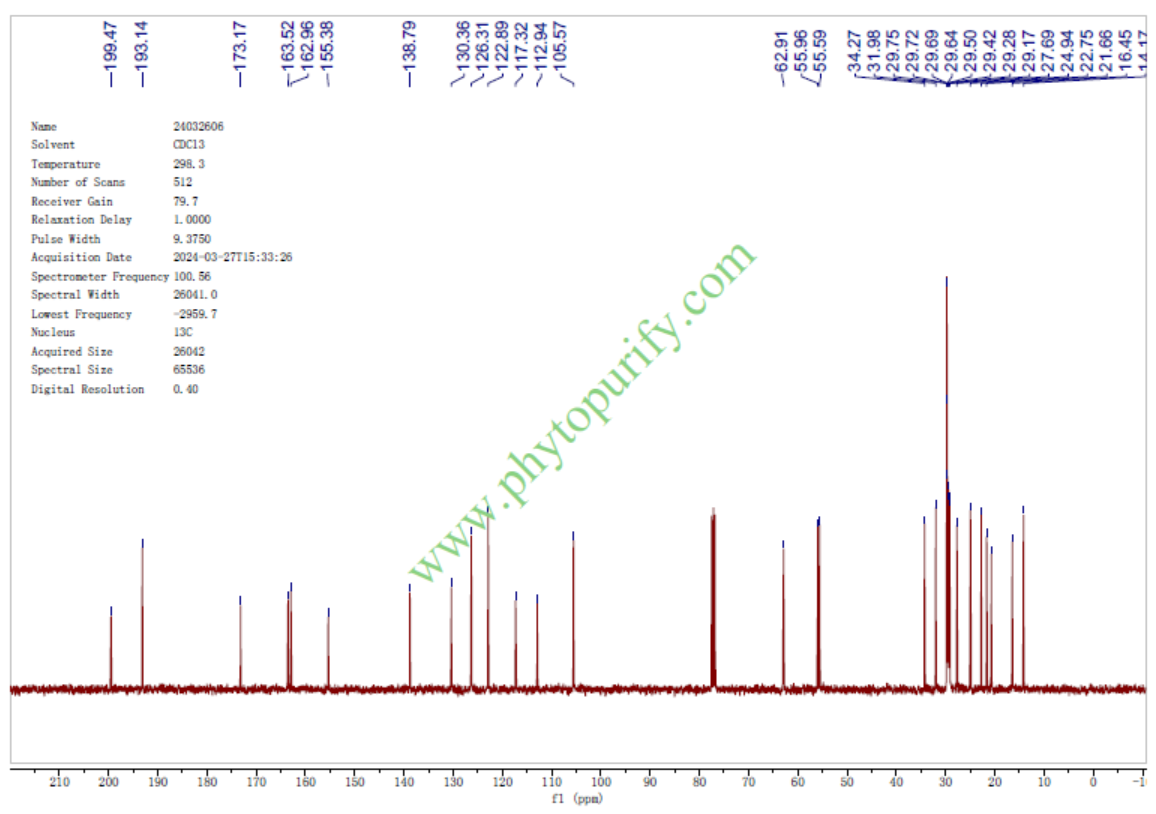
NMR of Hericenone C
HPLC of Hericenone C

Storage conditions:Short-term storage at 2~8℃, long-term storage at -20 ~ -80℃
89.9000
8.8452
8.8011
.0093
2.7664
2.2822
High
92.8905
3.1443
No
No
Yes
No
No
No
0.0
No
No
No
No
Natural products, as an important source of drug discovery, play an irreplaceable role in human health. Among the many fungi with medicinal value, Hericium erinaceus(Hericium erinaceus)It has attracted much attention due to its unique neuroprotective activity. Hericium erinaceus, also known as Hericium erinaceus or Hedgehog fungus, is a precious fungus that can be used for both medicine and food. It has a long history of consumption and medicinal use in East Asian countries such as China and Japan. Traditional Chinese medicine believes that Hericium erinaceus has the effects of invigorating the spleen, nourishing the stomach, calming the mind, and improving intelligence. Modern research has confirmed that it contains various bioactive secondary metabolites, including compounds such as hericenones and erinacines.
Hericenone C (CAS number: 137592-03-1) is a representative phenolic compound isolated from Hericium erinaceus, belonging to the isopentenyl phenolic derivatives. Since the first isolation and identification of Hericium erinaceus mycelium culture in the 1990s, Hericium erinaceus ketone C has attracted widespread attention due to its unique chemical structure and significant biological activity. Research has shown that Hericium erinaceus C has the ability to inhibit the activation of the NF - κ B signaling pathway induced by lipopolysaccharide (LPS), reduce the phosphorylation level of p65 subunit, and thus exert anti-inflammatory and neuroprotective effects. This discovery provides a molecular level explanation for the traditional medicinal value of Hericium erinaceus and also provides lead compounds for the development of new neuroprotective drugs.
In recent years, with the aging of the population, the incidence rate of neurodegenerative diseases, such as Alzheimer's disease and Parkinson's disease, has continued to rise. However, the existing therapeutic drugs have limited effects and obvious side effects. Neuroprotective agents derived from natural products have become a research hotspot due to their multi-target and low toxicity characteristics. Monkey head mushroom ketone C, as a natural compound with clear neuroprotective activity, has increasingly highlighted its research value and application prospects. This article will provide a systematic review of the research progress of Hericione C from the aspects of chemical structure, source extraction, pharmacological activity, mechanism of action, and pharmacological evaluation, in order to provide reference for the in-depth research and development of this compound.
The chemical structure of Hericium erinaceus C belongs to the isopentenyl phenolic compound, with a molecular formula of C ∝₅ H ₄₆ O ₇ and a molecular weight of 570.8110 Da. From the structural characteristics, Hericium erinaceus C molecule contains a phenolic acid core skeleton, which is connected to multiple isopentenyl side chains and methoxy substituents. Specifically, the compound contains a benzene ring structure, with functional groups such as carboxyl, hydroxyl, and methoxy attached to the benzene ring, and multiple isopentenyl units connected through ether bonds or carbon carbon bonds. This unique structure endows Hericione C with rich chemical properties and biological activity.
In terms of physical and chemical properties, Hericium erinaceus C exhibits typical lipid soluble compound characteristics. Its lipophilic water partition coefficient (LogP) is 8.8452, indicating that the compound has extremely high lipophilicity, which is closely related to the presence of multiple hydrophobic isopentenyl side chains in its molecule. High lipid solubility means that Hericin erinaceus C can easily penetrate biological membranes, including the blood-brain barrier, which is of great significance for its central nervous system activity. The topological polar surface area (TPSA) is 89.9000 Å ², which is at a moderate level, indicating that the compound may have some oral absorption potential, but may also be affected by efflux transporters.
The water solubility of Hericium erinaceus C is extremely low, only 0.0093 mg/mL, which is consistent with its high lipid solubility characteristics. Low water solubility is a common challenge in the development of natural product drugs, which may affect their formulation development and bioavailability. In terms of drug safety, computer simulation prediction results show that Hericione erinaceus C does not have hERG potassium channel inhibitory activity (hERG inhibition: no), which reduces its risk of causing cardiac toxicity (such as QT interval prolongation). In addition, the Ames test result was 0.0, indicating that the compound did not exhibit mutagenicity in the bacterial recovery mutation test, suggesting a low risk of genetic toxicity.
It is worth noting that the blood-brain barrier penetration ability of monkey head mushroom ketone C is predicted to be "high", which is crucial for the development of neuroprotective drugs. Many natural compounds with neuroprotective activity are limited in their clinical applications due to their inability to effectively penetrate the blood-brain barrier. The advantage of Hericium erinaceus C makes it a highly promising candidate molecule for development. However, high lipid solubility also brings some challenges, such as increasing the risk of accumulation in adipose tissue and potentially affecting the metabolic clearance rate of drugs.
Hericione C is mainly derived from Hericium erinaceus(Hericium erinaceus)This is a fungus belonging to the Basidiomycota phylum and the Hericidae family. Monkey head mushrooms usually grow on dead or standing broad-leaved trees in nature, mainly distributed in northern temperate regions including China, Japan, South Korea, Europe, and North America. In China, Hericium erinaceus is mainly produced in the northeast, north, and southwest regions, with abundant wild resources in provinces such as Heilongjiang, Jilin, and Hebei. Due to limited wild resources and difficult collection, the artificial cultivation technology of Hericium erinaceus has become quite mature. A large amount of mycelium and fruiting bodies can be obtained through solid culture or liquid fermentation, providing raw material guarantee for the large-scale extraction of Hericium erinaceus ketone C.
The content of Hericione C in Hericium erinaceus varies significantly depending on the strain, culture conditions, growth stage, and harvesting time. Generally speaking, the content of ketone compounds in Hericium erinaceus mycelium is higher than that in fruiting bodies, and the content is relatively higher in mycelium cultured by liquid fermentation. Research has shown that optimizing the composition of the culture medium (such as carbon sources, nitrogen sources, trace elements) and culture conditions (temperature, pH, light, ventilation, etc.) can significantly increase the yield of Hericione C. For example, adding an appropriate amount of plant hormones or precursor substances (such as phenylalanine, isopentenyl pyrophosphate, etc.) to the culture medium can promote the activation of related secondary metabolic pathways, thereby increasing the accumulation of target compounds.
The conventional methods for extracting monkey head mushroom ketone C include solvent extraction, ultrasound assisted extraction, microwave-assisted extraction, etc. Due to the high lipid solubility of Hericium erinaceus C, organic solvents such as methanol, ethanol, ethyl acetate, chloroform, etc. are usually used for extraction. Among them, ethanol has become the most commonly used extraction solvent due to its high safety, good extraction efficiency, and ease of industrial application. The typical extraction process is to crush the dried mycelium or fruiting body of Hericium erinaceus, soak it in 70% -95% ethanol at room temperature or heating conditions for extraction, and concentrate the extract under reduced pressure to obtain the crude extract. Ultrasonic assisted extraction can significantly shorten extraction time and improve extraction efficiency, while microwave-assisted extraction is suitable for large-scale and rapid extraction.
The separation and purification of Hericione C in crude extract is usually achieved by combining various chromatographic techniques. Common separation methods include silica gel column chromatography, ODS reverse phase column chromatography, Sephadex LH-20 gel column chromatography and preparative high-performance liquid chromatography (HPLC). Due to the similarity in structure between Hericinone C and other Hericinone compounds (such as Hericinone A, B, D, etc.), separation is difficult and usually requires multi-step chromatographic separation to obtain high-purity target compounds. In recent years, new separation methods such as high-speed countercurrent chromatography (HSCCC) and molecular imprinting technology have also been attempted for the separation and purification of Hericium erinaceus C, achieving good results.
It is worth noting that Hericione C is sensitive to light, heat, and oxygen during the extraction and separation process, and is prone to oxidative degradation. Therefore, during the operation, it is advisable to avoid light and operate at low temperatures as much as possible, and an appropriate amount of antioxidants (such as vitamin C, BHT, etc.) can be added to the solvent to protect the target compound. In addition, establishing efficient and environmentally friendly extraction processes, improving the recovery rate and purity of target compounds, and reducing production costs are the key technical bottlenecks for the industrial application of Hericium erinaceus C.
The pharmacological activity research of Hericium erinaceus C mainly focuses on neuroprotection, anti-inflammatory and antioxidant aspects, among which the neuroprotective effect is the most in-depth and extensive. In recent years, multiple studies have revealed the protective effects of monkey head mushroom ketone C in various neural injury models, providing scientific basis for its application in the treatment of neurodegenerative diseases.
In terms of neuroprotective activity, Hericium erinaceus C exhibits significant protective effects against neuronal damage. Research has shown that in the glutamate induced neurotoxicity model, Hericione C can significantly increase the survival rate of nerve cells and reduce cell apoptosis. The excitotoxicity caused by excessive release of glutamate is a common pathological feature of various neurodegenerative diseases, and the intervention of Hericium erinaceus C in this process suggests that it may have broad neuroprotective application value. In addition, in the oxidative stress-induced neuronal damage model, Hericium erinaceus C can reduce intracellular reactive oxygen species (ROS) levels and enhance antioxidant enzyme activity, thereby reducing oxidative damage to neuronal cells.
Of particular note is the protective effect of Hericium erinaceus C in Alzheimer's disease (AD) related models. Research has shown that Hericium erinaceus C can inhibit the aggregation and fiber formation of β - amyloid protein (A β), reducing A β - induced neurotoxicity. The abnormal aggregation and deposition of A β is one of the core pathological features of Alzheimer's disease, and the intervention of Hericium erinaceus C in this process provides new ideas for the treatment of AD. Meanwhile, Hericium erinaceus C can also promote the synthesis and release of nerve growth factor (NGF), which is an important neurotrophic factor for maintaining neuronal survival and function. The decrease in its expression level is closely related to the onset of neurodegenerative diseases such as AD.
In the Parkinson's disease (PD) model, monkey head mushroom ketone C also exhibits a protective effect. Research has shown that in a PD mouse model induced by 1-methyl-4-phenyl-1,2,3,6-tetrahydropyridine (MPTP), monkey head mushroom ketone C can alleviate damage to dopaminergic neurons and improve motor dysfunction. This discovery suggests that Hericium erinaceus C may exert neuroprotective effects through multiple mechanisms, including anti-inflammatory, antioxidant, and neurotrophic effects.
The anti-inflammatory activity of Hericium erinaceus C is an important basis for its neuroprotective effect. Research has confirmed that Hericium erinaceus C can significantly inhibit the inflammatory response induced by lipopolysaccharide (LPS). In LPS stimulated microglia, monkey head mushroom ketone C can reduce the expression levels of pro-inflammatory factors such as tumor necrosis factor - α (TNF - α), interleukin-1 β (IL-1 β), and interleukin-6 (IL-6). Microglia are innate immune cells in the central nervous system, and chronic neuroinflammation caused by their overactivation is a common feature of various neurodegenerative diseases. Monkey head mushroom ketone C exerts neuroprotective effects by inhibiting excessive activation of microglia and reducing neuroinflammatory responses.
In addition, Hericione C also exhibits certain antioxidant activity. Research has shown that Hericium erinaceus C can directly scavenge free radicals such as DPPH free radicals and ABTS cationic free radicals, and enhance the activity of intracellular antioxidant enzymes such as superoxide dismutase (SOD) and glutathione peroxidase (GSH Px). Oxidative stress is closely related to the onset of neurodegenerative diseases, and the antioxidant activity of Hericium erinaceus C may be closely related to its neuroprotective effects.
It is worth noting that the inhibitory effect of Hericium erinaceus C on the NF - κ B signaling pathway is one of the key mechanisms underlying its anti-inflammatory and neuroprotective activities. Research has found that Hericium erinaceus C can inhibit LPS induced NF - κ B luciferase reporter gene activity, reduce the phosphorylation level of p65 subunit, and thus block the activation of the NF - κ B signaling pathway. NF - κ B is a key transcription factor that regulates inflammatory response and cell survival, and its overactivation is closely related to the pathological processes of various neurodegenerative diseases. Monkey head mushroom ketone C exerts anti-inflammatory and neuroprotective effects by inhibiting the NF - κ B signaling pathway and reducing the expression of downstream inflammatory factors.
The pharmacological effects of Hericium erinaceus C involve multiple molecular targets and signaling pathways, among which the regulation of the NF - κ B signaling pathway is one of its core mechanisms of action. NF - κ B is an important transcription factor that plays a crucial role in inflammatory response, immune response, and cell survival. In the resting state, NF - κ B binds to the inhibitory protein I κ B and exists in an inactive form in the cytoplasm. When cells are stimulated by LPS, TNF - α, etc., I κ B kinase (IKK) is activated, leading to phosphorylation and degradation of I κ B, releasing NF - κ B dimers (mainly p50/p65 heterodimers). The released NF - κ B enters the nucleus and binds to the κ B site in the promoter region of the target gene, initiating the transcription of downstream inflammatory factors, chemokines, and adhesion molecules.
Research has shown that Hericium erinaceus C can inhibit LPS induced NF - κ B luciferase reporter gene activity, indicating that it can block the transcriptional activation function of NF - κ B. Further research has found that Hericium erinaceus C can reduce the phosphorylation level of p65 subunit, which is a key step in NF - κ B transcriptional activation. The phosphorylation sites of p65 mainly include Ser276, Ser529, and Ser536, and the phosphorylation of these sites can enhance the transcriptional activity, nuclear localization, and interaction with co activators of p65. Monkey head mushroom ketone C may reduce p65 phosphorylation by inhibiting the activity of upstream kinases such as IKK or protein kinase A (PKA).
In addition to the NF - κ B signaling pathway, monkey head mushroom ketone C may also exert neuroprotective effects by regulating other signaling pathways. Research has shown that Hericium erinaceus C can activate the PI3K/Akt signaling pathway, which is an important pro survival kinase that can promote cell survival and inhibit apoptosis. Activation of the PI3K/Akt pathway in nerve cells can protect cells from oxidative stress and excitotoxic damage. Monkey head mushroom ketone C may enhance cell anti apoptotic ability and exert neuroprotective effects by activating the PI3K/Akt pathway.
In addition, monkey head mushroom ketone C may also exert anti-inflammatory effects by regulating the mitogen activated protein kinase (MAPK) signaling pathway. The MAPK family includes members such as ERK, JNK, and p38 MAPK, which play important roles in inflammatory responses. Research has shown that Hericium erinaceus C can inhibit LPS induced phosphorylation of p38 MAPK and JNK, thereby reducing the expression of downstream inflammatory factors. The activation of p38 MAPK and JNK can promote the transcription and synthesis of pro-inflammatory cytokines, and the inhibition of these kinases by Hericium erinaceus C may be closely related to its anti-inflammatory activity.
In terms of molecular targets, Hericione C may directly interact with certain proteins, thereby affecting their function. For example, Hericione C may directly bind to and inhibit the activity of IKK, thereby blocking the activation of the NF - κ B signaling pathway. In addition, Hericione C may also exert its biological activity by affecting receptors or channel proteins on the cell membrane. Due to its high lipid solubility, Hericione C may indirectly regulate cell signal transduction by inserting into the lipid bilayer of the cell membrane, affecting membrane fluidity and membrane protein function.
It is worth noting that the promoting effect of Hericium erinaceus C on NGF synthesis and release may involve the synergistic regulation of multiple signaling pathways. Research has shown that Hericium erinaceus C can activate the phosphorylation of cAMP response element binding protein (CREB), which is a key transcription factor regulating NGF gene transcription. Monkey head mushroom ketone C may promote the expression and release of NGF by activating the PKA/CREB signaling pathway. NGF can bind to TrkA receptors, activate downstream PI3K/Akt and MAPK/ERK signaling pathways, thereby promoting neuronal survival and differentiation.
The multi-target action characteristics of Hericium erinaceus C give it unique advantages in neuroprotection. Compared with synthetic drugs targeting a single target, Hericione C can simultaneously regulate multiple signaling pathways related to neurodegenerative diseases, which may have better efficacy and lower side effects. However, the specific molecular targets of Hericium erinaceus C still need further research and confirmation, especially its direct interaction mechanism with proteins is not fully understood. Future research can identify the direct target of Hericione C through techniques such as chemical proteomics, surface plasmon resonance (SPR), and molecular docking, providing a basis for a deeper understanding of its mechanism of action and optimization of its pharmacological activity.
As a natural product candidate drug, the evaluation of the pharmacological properties of Hericium erinaceus C is a key step in determining whether it can enter the clinical development stage. Based on existing physicochemical properties and pharmacokinetic prediction data, Hericione C exhibits some favorable drug properties, but also faces some challenges.
From the perspective of medicinal chemistry, the molecular weight of Hericione erinaceus C is 570.8110 Da, slightly higher than the "five rules" (molecular weight<500 Da) standard of traditional small molecule drugs. A higher molecular weight may affect its oral absorption and membrane permeability, but considering its high lipid solubility (LogP=8.8452) and good blood-brain barrier penetration ability, this molecular weight may not be the main obstacle to its central nervous system activity. It is worth noting that the LogP value of Hericione C is much higher than the ideal range for traditional oral medications (LogP 1-3), and its extremely high lipid solubility may limit its solubility and absorption rate in vivo, while increasing its risk of accumulation in adipose tissue.
Water solubility is one of the main challenges in evaluating the pharmacological properties of Hericium erinaceus C. Its water solubility is only 0.0093 mg/mL, making it an extremely insoluble compound in water. Low water solubility not only affects the bioavailability of oral formulations, but also limits the development of injectable formulations. To improve the water solubility of Hericium erinaceus C, various formulation strategies can be employed, such as preparing liposomes, nanoemulsions, solid dispersions, or cyclodextrin inclusion complexes. In addition, prodrug design is also an effective strategy by introducing hydrophilic groups (such as phosphate esters, amino acid esters, etc.) into the molecule to improve its water solubility and release the active parent drug after enzymatic hydrolysis in vivo.
In terms of pharmacokinetics, the blood-brain barrier penetration ability of monkey head mushroom ketone C is predicted to be "high", which is its significant advantage as a neuroprotective drug. The blood-brain barrier is the main barrier that restricts drugs from entering the central nervous system, and many compounds with neuroprotective activity are limited in their clinical application due to their inability to effectively penetrate the blood-brain barrier. The high lipid solubility of Hericium erinaceus C enables it to pass through the blood-brain barrier through passive diffusion, thereby achieving effective concentrations in the central nervous system. However, high lipid solubility also means that Hericilone C may be recognized and transported by efflux transporters such as P-glycoprotein (P-gp), thereby reducing its effective concentration in brain tissue. Therefore, studying the interaction between Hericium erinaceus C and efflux transporters is crucial for accurately assessing its brain targeting.
The metabolic stability of Hericium erinaceus C is another issue that needs attention. Phenolic compounds are often prone to phase II metabolic reactions such as glucuronidation and sulfation, leading to rapid clearance and low bioavailability. In addition, the isopentenyl side chains in the molecule may be oxidized and metabolized by cytochrome P450 enzymes, producing various metabolites. Further research is needed on the metabolic pathways and pharmacological activities of the metabolites of Hericium erinaceus C to evaluate its in vivo efficacy and safety.
In terms of safety, computer simulation prediction results show that Hericione erinaceus C does not have hERG inhibitory activity (hERG inhibition: No), reducing its risk of causing cardiac toxicity. The Ames test result is 0.0, indicating no mutagenicity. These preliminary safety data provide favorable conditions for the further development of Hericione C. However, the predicted results of computer simulations still need to be validated through in vitro and in vivo experiments, especially safety evaluation data such as long-term toxicity, reproductive toxicity, and carcinogenicity, which are crucial for evaluating their clinical application potential.
The pharmacokinetic characteristics of Hericium erinaceus C still need to be systematically studied through animal experiments, including key parameters such as oral bioavailability, tissue distribution, metabolic pathways, excretion pathways, and half-life. These data will provide important basis for the formulation design and administration scheme optimization of Hericium erinaceus C. Considering its low water solubility and high lipid solubility, Hericium erinaceus C may be more suitable for development as a lipid or nano formulation to enhance its oral bioavailability. In addition, non oral routes of administration such as transdermal and nasal administration may also become potential ways of administering Hericium erinaceus C, especially for neuroprotective drugs that require targeting the central nervous system.
Monkey head mushroom ketone C, as a natural product with clear neuroprotective activity, has shown broad application prospects in the treatment and prevention of neurodegenerative diseases. With the acceleration of the aging process of the global population, the incidence rate of neurodegenerative diseases such as Alzheimer's disease and Parkinson's disease continues to rise, bringing heavy burdens to society and families. At present, the drugs used in clinical practice to treat neurodegenerative diseases mainly focus on symptomatic treatment, lacking disease modifying therapies that can effectively delay disease progression. The multi-target effects of Hericium erinaceus C, including anti-inflammatory, antioxidant, neurotrophic, and anti apoptotic activities, make it a promising candidate for multifunctional treatment of neurodegenerative diseases.
In the treatment of Alzheimer's disease, monkey head mushroom ketone C may have a comprehensive intervention effect on the pathological process of AD by inhibiting A β aggregation, reducing neuroinflammation, and promoting NGF synthesis through multiple mechanisms. Especially its ability to inhibit the NF - κ B signaling pathway can alleviate chronic neuroinflammation in the brains of AD patients, which is considered one of the key driving factors for the onset and progression of AD. In addition, the promotion of NGF synthesis by monkey head mushroom ketone C may help maintain the survival and function of cholinergic neurons and improve cognitive function in AD patients.
In the treatment of Parkinson's disease, monkey head mushroom ketone C protects dopaminergic neurons through antioxidant and anti-inflammatory effects, which may delay the disease progression of PD. The main pathological feature of PD is the progressive loss of dopaminergic neurons in the substantia nigra of the midbrain, in which oxidative stress and neuroinflammation play important roles. Monkey head mushroom ketone C can simultaneously alleviate oxidative damage and inflammatory response, providing a new strategy for the treatment of PD.
In addition to neurodegenerative diseases, Hericione C may also play a role in other neurological disorders. For example, in cerebral ischemia-reperfusion injury, the anti-inflammatory and antioxidant activities of Hericium erinaceus C may help alleviate brain damage and improve prognosis. In spinal cord injury and peripheral nerve injury, the neurotrophic and neuroprotective effects of Hericium erinaceus C may promote nerve regeneration and functional recovery. In addition, monkey head mushroom ketone C may also be used to treat mental illnesses such as depression and anxiety, as neuroinflammation and decreased levels of neurotrophic factors are closely related to the onset of these diseases.
However, the clinical application of Hericium erinaceus C still faces some challenges and issues that need to be addressed. Firstly, the issue of bioavailability caused by its low water solubility and high lipid solubility needs to be addressed through formulation technology. Secondly, the pharmacokinetic characteristics and long-term safety of Hericium erinaceus C in vivo need to be systematically evaluated. Thirdly, the structure-activity relationship of Hericione erinaceus C is not yet fully studied, and optimizing its pharmacological activity and medicinal properties through structural modification is of great value. Fourthly, the interaction between Hericium erinaceus C and other drugs needs to be studied, especially the possibility and potential risks of combination therapy with commonly used clinical neuropharmaceuticals.
Future research should focus on the following aspects: firstly, modifying the structure of Hericione erinaceus C through medicinal chemical methods to improve its water solubility and metabolic stability, while maintaining or enhancing its neuroprotective activity; The second is to develop a drug delivery system suitable for Hericium erinaceus C, such as nanoliposomes, polymer nanoparticles, phospholipid complexes, etc., to improve its oral bioavailability and brain targeting; The third is to use modern molecular biology techniques to further elucidate the molecular targets and signaling pathway regulatory mechanisms of Hericium erinaceus C; The fourth is to systematically evaluate the efficacy and safety of Hericium erinaceus C through in vitro and in vivo models, laying the foundation for its entry into clinical trials.
In addition, as an active ingredient in Hericium erinaceus, the synergistic effect of Hericium erinaceus ketone C with other active ingredients such as Hericium erinaceus glycosides and Hericium erinaceus polysaccharides is also worth paying attention to. The traditional medicinal value of Hericium erinaceus may stem from the comprehensive action of multiple active ingredients. Studying the synergistic effect of Hericium erinaceus ketone C with other ingredients may provide scientific basis for the development of compound preparations based on Hericium erinaceus.
Monkey head mushroom ketone C, as a representative active compound isolated from Monkey head mushroom, has attracted widespread attention for its unique chemical structure and significant neuroprotective activity. This article provides a systematic review of the research progress of Hericium erinaceus C from the aspects of chemical structure, source extraction, pharmacological activity, mechanism of action, pharmacological evaluation, and clinical application prospects. Research has shown that Hericium erinaceus C exerts neuroprotective effects by inhibiting the NF - κ B signaling pathway, reducing p65 phosphorylation, alleviating neuroinflammatory responses, and promoting NGF synthesis through multiple mechanisms. Its high lipid solubility and excellent blood-brain barrier penetration ability give it a unique advantage in the development of neuroprotective drugs.
However, the clinical application of Hericium erinaceus C still faces challenges such as poor water solubility and low bioavailability, which need to be addressed through formulation technology and structural modification. Future research should further elucidate its molecular mechanism, optimize its pharmacokinetic properties, and systematically evaluate its safety and efficacy. With the increasingly urgent demand for the treatment of neurodegenerative diseases, Hericium erinaceus C and its derivatives are expected to become candidate molecules for the new generation of neuroprotective drugs, bringing new hope for the treatment of neurodegenerative diseases.
The journey from natural products to clinical drugs is a long and challenging one, and research on Hericione C is still in its early stages. However, based on its clear pharmacological activity and unique chemical structure, we have reason to believe that through continuous in-depth research and development, Hericione C and its analogues will play an important role in the field of neuroprotection and contribute to human health.
