


Synonym name: Fucosterin
Catalogue No.: BP0602
Cas No.: 17605-67-3
Formula: C29H48O
Mol Weight: 412.702
Botanical Source: Characteristic sterol of brown algae; bladderwrack Fucus vesiculosus. Also present in Sargassum tortile, Cystoseira sp., Bifurcaria sp., Turbinaria conoides, scallop Patinopecten yessoensis and a marine unicellular alga. Also in sponges St
Purity: 95%~99%
Analysis Method: HPLC-DAD or/and HPLC-ELSD
Identification Method: Mass, NMR
Packing: Brown vial or HDPE plastic bottle
Can be supplied from milligrams to grams.
For Reference Standard and R&D, Not for Human Use Directly.
Inquire for bulk scale.
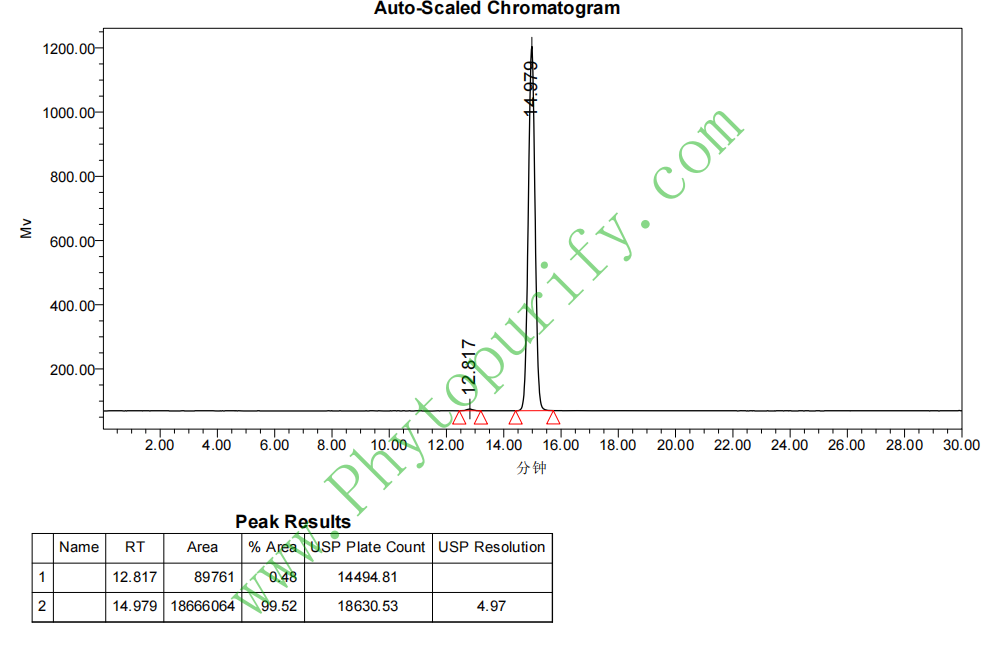
HPLC of Fucosterol
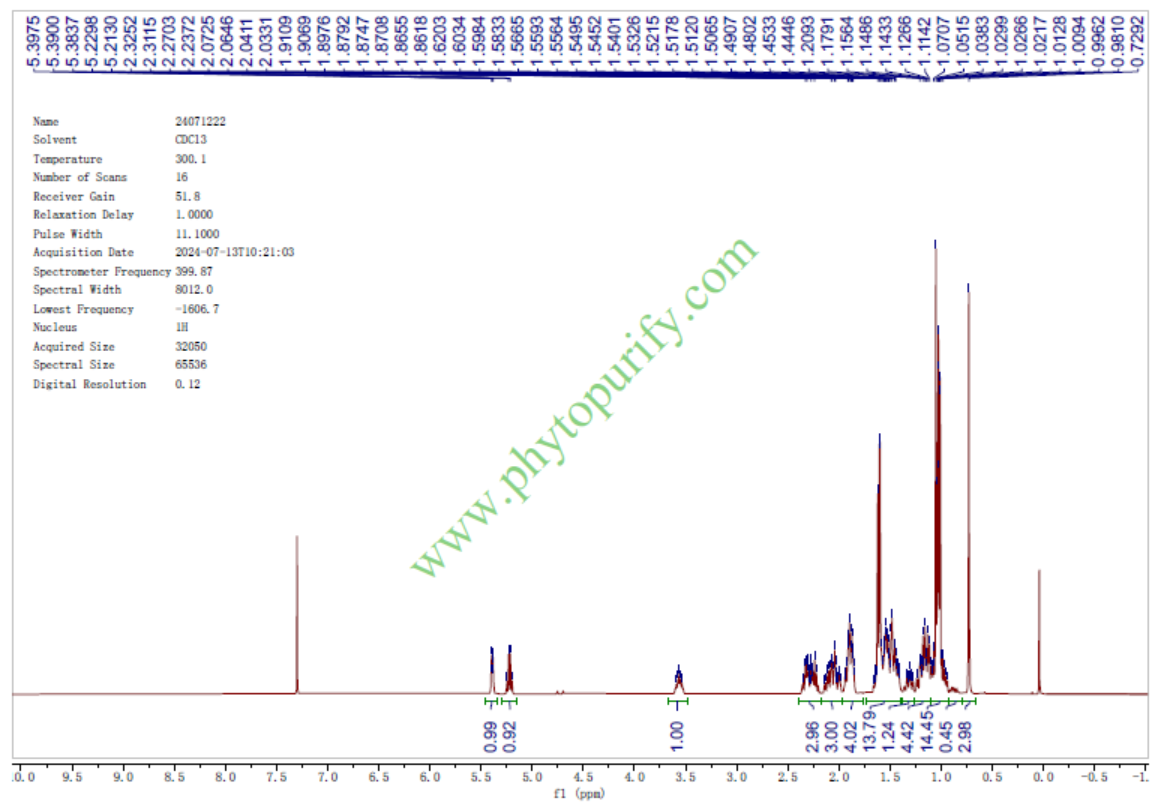
HNMR of Fucosterol
Storage conditions:Short-term storage at 2~8℃, long-term storage at -20 ~ -80℃
20.2300
8.2776
8.2753
.0001
8.3974
4.9106
High
93.2104
4.4944
No
No
No
No
No
No
0.0
No
No
No
No
Fucosterol (CAS number 17605-67-3) is a natural sterol compound widely found in seaweed, especially in brown algae and diatoms. As an important member of marine natural products, fucoidans have received widespread attention in the field of natural medicine research and development in recent years due to their unique chemical structure and diverse biological activities. A large number of studies have shown that fucosterol has multiple pharmacological activities, such as significant antioxidant, anti adipogenesis, hypolipidemic, anti diabetes and anti-cancer, which shows its potential application value in the treatment of metabolic diseases and tumors.
With the global prevalence of metabolic syndrome and related diseases, finding safe and effective natural active ingredients has become an important direction for drug development. Fucosterol regulates lipid metabolism and cell signal transduction through multiple targets and pathways, especially in regulating the expression of PPAR α and C/EBP α, and activating AMPK signaling pathway, which provides a new idea for the intervention of obesity, nonalcoholic fatty liver disease (NAFLD), type 2 diabetes and other diseases. In addition, its mechanism of action in regulating cancer cell apoptosis and inhibiting tumor growth has gradually been revealed, demonstrating its potential as a candidate anti-tumor drug.
This article will provide a systematic review of the chemical structure and physicochemical properties, plant sources, and extraction methods of fucoidan, with a focus on its pharmacological activity and mechanism of action. Combining the evaluation of drug properties and pharmacokinetic characteristics, it will explore its prospects and challenges in clinical applications, aiming to provide theoretical basis and reference for related scientific research and drug development.
Fucosol is a typical sterol compound with a molecular formula of C29H48O and a molecular weight of 412.7020. Its structural characteristic is the presence of a hydroxyl group on the steroid skeleton, which has strong hydrophobicity. The LogP value of fucoidan is as high as 8.2776, indicating its strong lipid solubility and extremely low water solubility (0.0001), which has a significant impact on its absorption and distribution in vivo. Its topological polar surface area (TPSA) is 20.23 Å ², and a lower TPSA is advantageous for membrane penetration.
The chemical structure of fucoidan is relatively stable and does not exhibit hERG channel inhibition. The Ames gene mutation test result is negative, indicating a low risk of genetic toxicity. It is worth noting that fucoidan has a high blood-brain barrier penetration ability, which provides the possibility for its potential application in central nervous system diseases.
Structurally, fucoidan is similar to cholesterol, but has specific unsaturated bonds and methyl substitutions on the side chains of the steroid skeleton, endowing it with unique biological activity. Its molecular structure is as follows:
These structural features determine its affinity and regulatory ability towards multiple biological targets.
Fucosteroids are mainly found in brown algae (such as kelp, kelp, and diatoms) and some diatoms, and are the main representatives of sterol components in these seaweed. Its content is greatly affected by the type, growth environment, harvesting season, and extraction process. Brown algae, due to their abundant content of fucoxasterol, have become the main industrial extraction source of this compound.
The extraction of fucoidan often uses organic solvent extraction combined with chromatographic separation technology, and the main steps include:
In recent years, supercritical CO2 extraction technology has gradually been applied to the extraction of fucoidans due to its green and efficient nature, significantly improving the purity and yield of extraction.
The pharmacological activities of fucosterol cover many fields such as metabolic diseases, tumors and nervous system diseases, which are mainly manifested in antioxidant, anti adipogenesis, hypolipidemic, anti diabetes and anti-cancer effects.
Fucosteroids can effectively eliminate free radicals and alleviate oxidative stress damage. In vitro experiments have shown that it can significantly inhibit lipid peroxidation and protect the stability of cell membrane structure. By activating the NFE2L2 (NRF2) signaling pathway, it promotes the expression of antioxidant enzymes and enhances cellular antioxidant defense capabilities.
Fucosteroids inhibit adipocyte differentiation and lipid accumulation by regulating the expression of key transcription factors PPAR α and C/EBP α involved in adipogenesis. It activates the AMPK signaling pathway, promotes fatty acid oxidation, inhibits the activity of fat synthesis related enzymes, and exhibits good anti obesity effects. Animal model studies have confirmed that fucoidan can significantly reduce body fat content and improve lipid metabolism abnormalities.
Fucosteroids can lower blood cholesterol levels through a multi-target mechanism. Its targets include HMGCR (3-hydroxy-3-methylglutaryl-CoA reductase), LDLR (low-density lipoprotein receptor), PCSK9 (proprotein convertase subtilisin 9), and CETP (cholesterol ester transfer protein), which regulate cholesterol synthesis, uptake, and transport processes. Research has shown that fucoidan can effectively reduce serum total cholesterol and low-density lipoprotein cholesterol (LDL-C), and increase high-density lipoprotein cholesterol (HDL-C) levels.
Fucosteroids improve insulin resistance and promote glucose uptake and utilization by activating AMPK (PRKAA1) and regulating the expression of glucose metabolism key enzyme GCK (glucokinase). In addition, it has an inhibitory effect on PTPN1 (protein tyrosine phosphatase 1B), enhances insulin signaling, and lowers blood glucose levels. Both animal models and cell experiments have confirmed its significant hypoglycemic and protective effects on pancreatic beta cell function.
Fucosteroids exhibit inhibitory activity on proliferation and induction of apoptosis in various tumor cell lines. Its mechanism involves regulating multiple signaling pathways, including inhibiting STAT3, PRKCA (protein kinase C alpha), MAPK1 (mitogen activated protein kinase 1), and regulating BCL2 family protein expression to promote cell apoptosis. Fucosteroids can also affect NOTCH1 signaling, inhibit tumor stem cell characteristics, and reduce tumor invasiveness. In addition, its regulation of TOP1 and TOP2A (topoisomerase) activity suggests that it may intervene in DNA replication and repair processes.
Fucosteroids also exhibit anti-inflammatory, neuroprotective, and immunomodulatory effects. It reduces inflammation and protects nerve cells from damage by regulating the expression of TLR2 (Toll like receptor 2) and NOS2 (nitric oxide synthase 2).
The multi-target mechanism of action of fucoidan is the basis of its multiple pharmacological activities. Its main molecular targets cover multiple levels such as metabolic regulation, signal transduction, and gene expression regulation.
In summary, fucoidan exerts a synergistic effect through multiple targets and pathways, regulating metabolism, cell proliferation, and immune inflammatory responses, demonstrating its broad pharmacological potential.
The pharmacological evaluation of fucoidan shows that it has certain advantages in safety and pharmacokinetics, but there are also challenges.
The development of novel drug delivery systems such as nanocarriers, liposomes, and solid dispersions has become a research hotspot to overcome the low water solubility and bioavailability of fucoidans. These technologies are expected to improve their in vivo stability and targeting, enhancing drug efficacy.
Fucosteroids, with their ability to regulate metabolism and tumor related signaling pathways through multiple targets, have shown broad application prospects in the fields of metabolic diseases and tumor therapy.
Fucosteroids have shown the potential to inhibit tumor growth and promote apoptosis in various cancer models. In the future, they can be used as candidate molecules for anti-tumor drugs or in combination with existing chemotherapy drugs to enhance efficacy and reduce side effects.
The high blood-brain barrier penetration, antioxidant and anti-inflammatory effects of fucoidan provide possibilities for the treatment of neurodegenerative diseases. In addition, its immune regulatory function also provides insights for the study of autoimmune diseases.
Fucosterol, as a natural sterol with extensive sources and abundant biological activities, shows good development potential by virtue of its multiple pharmacological effects such as multi target regulation of lipid metabolism, antioxidant, anti diabetes and anti-tumor. Despite the challenges posed by its high lipid solubility and low water solubility, modern pharmaceutical formulation technology and systematic pharmacological research have the potential to overcome these obstacles and promote its clinical application. In the future, fucoidan is expected to become an important natural drug resource in the fields of metabolic diseases and tumor treatment, contributing new strength to human health.
