Introduction/Overview
In the field of natural product chemistry and pharmacology research, ginseng, as a traditional precious Chinese medicinal herb, has always been a focus of scientific attention for the exploration and mechanism elucidation of its active ingredients. In addition to the well-known ginsenosides, another important bioactive component in ginseng, polyacetylene compounds, is gradually showing its unique medicinal value. Panaxydiol (CAS: 63910-76-9) is one of the representative members. Early studies have found that panaxadiol has the activity of inhibiting histamine release from mast cells, indicating its potential in anti allergic and anti-inflammatory effects. In recent years, with the deepening of research on aging biology, anti-aging has become a cutting-edge hotspot in modern pharmacy. Research has shown that the pharmacological activity of panaxadiol may involve multiple key targets and pathways closely related to the aging process, such as AMPK, SIRT1, NRF2, TP53, etc. This provides a solid scientific basis for its transition from traditional "tonifying" effects to modern "anti-aging" drug development. This article aims to provide a systematic review of the chemical properties, plant sources, pharmacological activities of panaxadiol, with a particular focus on the molecular mechanisms, pharmacological evaluation, and future application prospects of its anti-aging potential. The aim is to provide comprehensive academic references for further research and development of this compound.
Chemical structure and physicochemical properties
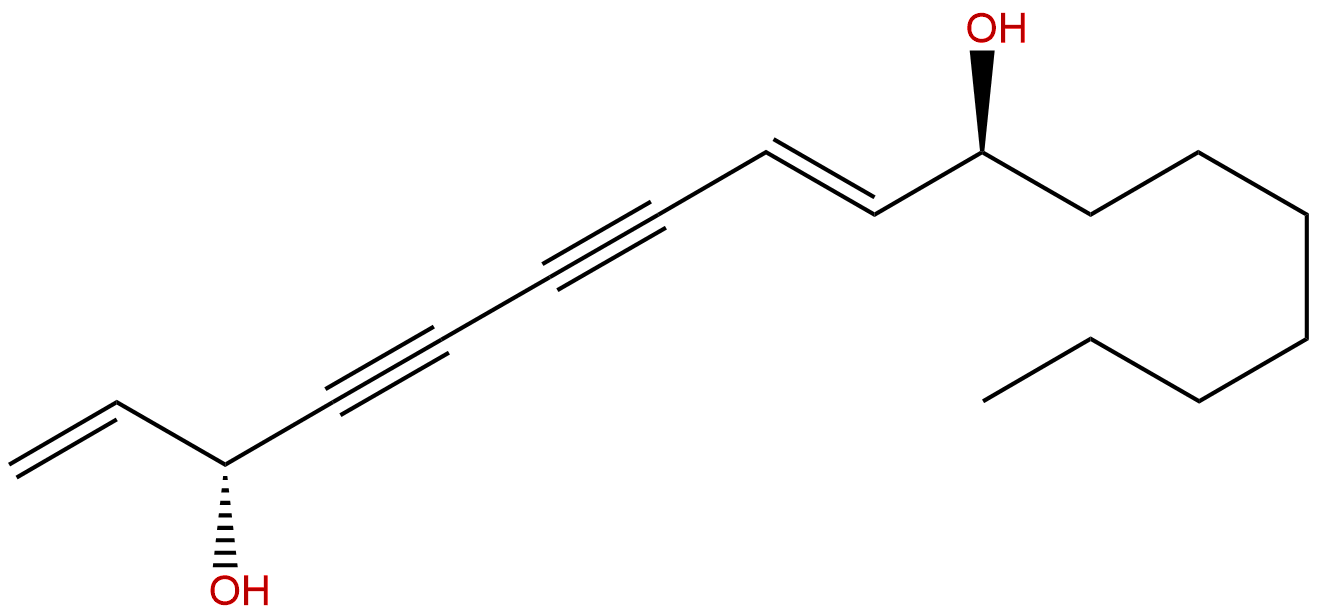
Ginsenoside diol is an aliphatic polyacetylene alcohol compound. Its molecular formula is C17H24O2 and its molecular weight is 260.3770. Its core structural feature is a long-chain conjugated ene alkyne system, with a diol group attached at the end. This unique conjugated structure is not only its chemical characteristic, but also closely related to its biological activity, allowing it to interact with various enzymes and receptors in the organism.
According to the provided pharmacological parameters, the lipid water partition coefficient (LogP) of panaxadiol is 3.4704, indicating that the compound has moderate lipophilicity and tends to be distributed in a lipid environment, which facilitates its penetration into cell membranes. Its topological polar surface area (TPSA) is 40.4600 Å ², which is relatively small and further supports its good membrane permeability. However, its water solubility is relatively low, only 0.0215 mg/mL, which may pose challenges in formulation development and in vivo absorption. In terms of pharmacokinetic property prediction, the ability of panaxadiol to cross the blood-brain barrier (BBB) is relatively low, indicating that its direct effect on the central nervous system may be limited, but it may also reduce the risk of related central side effects. Importantly, preliminary toxicity predictions showed no inhibitory activity on hERG potassium channels (hERG inhibition: No), and the Ames test result was 0.0, indicating that it may not have mutagenicity and potential cardiac toxicity risks, providing positive preliminary clues for its safety evaluation.
Plant sources and extraction methods
Ginsenoside diol mainly comes from plants of the Panax genus in the Araliaceae family, especially the roots, rhizomes, and fibrous roots of Panax ginseng C.A. Mey. In addition, it has also been detected in the same genus of plants, Panax quinquefolius L. and Panax notoginseng. Polyacetylene compounds are relatively abundant in fresh ginseng, but they may degrade or transform during processing (such as steaming and drying) due to thermal instability. Therefore, the extraction process is crucial for their yield and stability.
The traditional extraction method mainly uses organic solvent extraction. Common solvents include methanol, ethanol, ethyl acetate, chloroform, etc. The typical extraction process is as follows: dry and crushed ginseng raw materials are extracted by cold soaking or heating reflux with an appropriate organic solvent (such as methanol), and the extracted liquids are combined and concentrated under reduced pressure to obtain the crude extract. Subsequently, various chromatographic techniques such as silica gel column chromatography, reverse phase column chromatography, and high-performance liquid chromatography (HPLC) were used for separation and purification. Due to the sensitivity of polyacetylene compounds to light, heat, and oxygen, attention should be paid to avoiding light, operating at low temperatures, and under inert gas protection throughout the extraction and separation process to prevent oxidation or polymerization. In recent years, modern technologies such as supercritical fluid extraction (SFE), ultrasound assisted extraction, and microwave-assisted extraction have also been applied to the extraction of panaxadiol. These methods have the advantages of high efficiency, low solvent consumption, and good protection of thermally unstable components.
Pharmacological activity research
Early research confirmed the activity of panaxadiol in inhibiting histamine release, laying the foundation for its anti allergic and anti-inflammatory effects. Histamine is a key mediator in allergic reactions and inflammatory processes, and inhibition of its release helps alleviate related symptoms. However, what is even more remarkable is its extensive pharmacological activity demonstrated in anti-aging and related fields.
- Cell proliferation inhibition and anticancer activity Multiple studies have shown that panaxadiol has significant inhibitory effects on proliferation and induces apoptosis in various cancer cell lines, such as colon cancer, gastric cancer, lung cancer, neuroblastoma, etc. Its strength of action is even better than some traditional chemotherapy drugs, and its toxicity to certain normal cells is relatively low, showing a certain degree of selectivity.
- Neuroprotective activity In cell models of neurodegenerative diseases such as Alzheimer's disease and Parkinson's disease, panaxadiol exhibits the potential to protect neurons, reduce oxidative damage, and inhibit cell apoptosis. Although its blood-brain barrier permeability is low, it may still have practical value by indirectly affecting the central nervous system through dosage form modification or action on peripheral inflammation.
- Anti inflammatory and immune regulation In addition to inhibiting histamine release, panaxadiol can also downregulate the expression of pro-inflammatory cytokines such as tumor necrosis factor - α (TNF - α) and interleukin-6 (IL-6), regulate the function of immune cells such as macrophages, and thus play a role in chronic inflammation related diseases.
- Anti-aging potential This is the forefront direction of current research. The essence of aging is the process of cumulative decline in cellular function over time, involving multiple levels such as oxidative stress, telomere shortening, genomic instability, epigenetic changes, mitochondrial dysfunction, etc. Preliminary research suggests that panaxadiol may delay the emergence of various aging phenotypes by activating cellular self-protection pathways, clearing free radicals, maintaining mitochondrial homeostasis, and promoting autophagy.
Mechanism of action and molecular targets
The anti-aging and other pharmacological activities of panaxadiol are closely related to its regulation of multiple key signaling pathways and molecular targets. Based on the provided target information, the mechanism of action network can be summarized as follows:
- Energy metabolism and longevity pathway: AMPK and SIRT1 AMPK (AMP dependent protein kinase) is an energy receptor in cells, while SIRT1 (silencing information regulator 1) is a NAD+- dependent deacetylase. Both are core factors that regulate metabolism, stress resistance, and lifespan. Research has shown that panaxadiol may activate AMPK, thereby upregulating SIRT1 activity. The activation of AMPK/SIRT1 pathway can promote mitochondrial biosynthesis, enhance autophagy, inhibit mTOR signaling, thereby improving cellular metabolism, clearing damaged components, and delaying aging.
- Oxidative stress defense system: NRF2, SOD1, CAT, HMOX1 NRF2 (nuclear factor E2 related factor 2) is the overall switch for antioxidant reactions. Ginsenoside diol may promote gene expression of a series of downstream antioxidant enzymes and phase II detoxifying enzymes, including superoxide dismutase (SOD1), catalase (CAT), and heme oxygenase-1 (HMOX1), by activating NRF2. This network works synergistically to effectively eliminate excess reactive oxygen species (ROS) and alleviate oxidative damage, which is one of the core mechanisms of anti-aging.
- Cell cycle and aging related signals: TP53, CDKN1A, FOXO1 TP53 (p53 protein) is a well-known tumor suppressor and also participates in the regulation of cellular aging. It can upregulate the cyclin dependent kinase inhibitor p21 (encoded by the CDKN1A gene), leading to cell cycle arrest in the G1 phase and inducing cell aging or apoptosis. Ginsenoside diol may achieve a balance between clearing cells with severe gene damage (anti-cancer) and avoiding premature aging of normal tissues by moderately regulating the TP53-p21 axis. Meanwhile, it may activate FOXO1 (forkhead box protein O1), a longevity related transcription factor that upregulates antioxidant and DNA repair related genes, promoting stress resistance.
- Telomere maintenance: TERT Telomerase reverse transcriptase (TERT) is the core catalytic subunit of telomerase, responsible for maintaining telomere length. Telomere shortening is an important marker of cellular replicative aging. There are studies suggesting that certain natural products may indirectly affect TERT activity or telomere stability. It is worth further exploring whether panaxadiol can indirectly affect telomere function through the aforementioned pathways, such as activating SIRT1.
- Mitochondrial function and apoptosis In addition to improving mitochondrial quality through AMPK/SIRT1, panaxadiol may also directly act on mitochondria, inducing a decrease in mitochondrial membrane potential and releasing cytochrome C, thereby activating the Caspase cascade reaction and inducing cancer cell apoptosis. This pro apoptotic effect is directly related to its anticancer activity.
In summary, panaxadiol may exert its effects through a synergistic network of multiple targets and pathways, intervening in aging and related pathological processes from multiple levels such as energy metabolism, oxidative stress defense, cell cycle regulation, and genome stability.
Evaluation of drug properties and pharmacokinetics
Although panaxadiol has shown good biological activity in vitro and some animal models, its drug affinity still needs to be comprehensively evaluated.
-
Absorption, distribution, metabolism, excretion (ADME):
- absorb Among them, an equal LogP value and a smaller TPSA are beneficial for its passive diffusion and intestinal absorption. However, low water solubility may limit its dissolution rate in gastrointestinal fluids, becoming the limiting step for oral absorption. The future research direction is to improve the solubility and bioavailability of nano formulations, solid dispersions, liposomes and other dosage form technologies.
- distribution Its lipophilicity may lead to its accumulation in adipose tissue. The low permeability of the blood-brain barrier limits its direct central function, but as mentioned earlier, this may not necessarily be a disadvantage.
- Metabolism and excretion Polyacetylene compounds are potential substrates or regulators of cytochrome P450 enzymes (CYP). The specific metabolic pathways, main metabolites, and whether there are metabolic interactions with other drugs still need to be systematically studied through in vitro models such as liver microsomes and primary liver cells, as well as in vivo experiments. The main pathways of excretion may be through bile and feces.
-
safety The preliminary predictive data provided (no hERG inhibition, Ames negative) is a positive starting point. However, a comprehensive preclinical safety evaluation is still required, including acute toxicity, subchronic/chronic toxicity, reproductive toxicity, genetic toxicity (supplemented with other trials), etc. The pro apoptotic mechanism on which its anticancer activity depends also requires an evaluation of its potential toxicity to rapidly proliferating normal tissues such as bone marrow and gastrointestinal mucosa.
-
Formulation Challenge Due to its instability to light, heat, and oxygen, special protective measures need to be taken during the production and storage of pharmaceutical formulations, such as using dark packaging, nitrogen filling, adding antioxidants, and making solid dosage forms.
At present, there are still few reports on the pharmacokinetic studies of the panaxadiol system, which is a key gap that must be filled for its clinical application.
Clinical application prospects and prospects
The clinical application prospects of panaxadiol are broad, but the road is long and needs to be promoted in stages and with focus.
-
Potential indications:
- Anti aging and age-related diseases: As a dietary supplement or prescription drug, it is used to delay aging, improve aging related symptoms (such as muscle loss and cognitive decline), or prevent and treat age-related diseases, such as Alzheimer's disease, atherosclerosis, type 2 diabetes, etc.
- Cancer adjuvant therapy Based on its selective inhibition of cancer cell growth, it can be explored as an adjuvant drug for chemotherapy or targeted therapy, enhancing efficacy, reducing side effects, or reversing drug resistance.
- Allergic and inflammatory diseases Develop local or systemic medications for the treatment of allergic rhinitis, asthma, atopic dermatitis, and other diseases.
-
Future research directions:
- In depth mechanism research Using techniques such as gene knockout/knockdown, chromatin immunoprecipitation (ChIP), proteomics, etc., accurately verify the direct interaction between panaxadiol and the aforementioned targets (AMPK, SIRT1, NRF2, etc.), and elucidate the complete map of its upstream sensor and downstream effector network.
- Structural optimization and derivative development In response to its poor water solubility and stability, a series of derivatives or prodrugs are synthesized through chemical modification to improve its pharmaceutical properties while retaining or enhancing its activity.
- Advanced Delivery System Develop delivery systems based on nanotechnology (such as polymer nanoparticles, lipid nanoparticles), exosomes, or actively targeted ligand modifications to improve their stability, bioavailability, and targeting (such as targeting tumor tissue or senescent cells).
- System preclinical and clinical research Complete Good Laboratory Practice (GLP) toxicology studies that comply with regulations and validate their efficacy and safety in appropriate animal disease models, particularly aging animal models. Eventually advancing to the clinical trial stage.
-
Challenges and Opportunities The main challenges lie in its low natural content, high extraction and separation costs, physical and chemical property defects, and the balance between effectiveness and safety under complex mechanisms of action. The opportunity lies in the urgent global demand for safe and effective anti-aging interventions, as well as the application of new tools such as multi omics technology and artificial intelligence drug design, which will accelerate their translation from laboratory to clinical.
Conclusion
Ginsenoside diol, as an important polyacetylene active ingredient in ginseng, has expanded its research from early antihistamine activity to the promising field of anti-aging. It demonstrates the potential for multidimensional intervention in the biological basis of aging by acting on multiple core targets closely related to the aging process, such as AMPK/SIRT1, NRF2 antioxidant pathway, and TP53/p21 cell cycle regulation. Despite facing challenges such as low water solubility, poor stability, and lack of systematic pharmacokinetic data in drug development, its unique chemical structure and preliminary good safety predictions have laid the foundation for its further development. In the future, through in-depth molecular mechanism analysis, rational structural modification, innovative drug delivery strategies, and systematic preclinical evaluation, panaxadiol is expected to develop from a potential natural product lead compound into an innovative drug for anti-aging and related disease prevention and treatment, providing new solutions for human healthy aging. The research process also fully reflects the enormous potential of exploring the value of modern drugs from the treasure trove of traditional Chinese medicine.