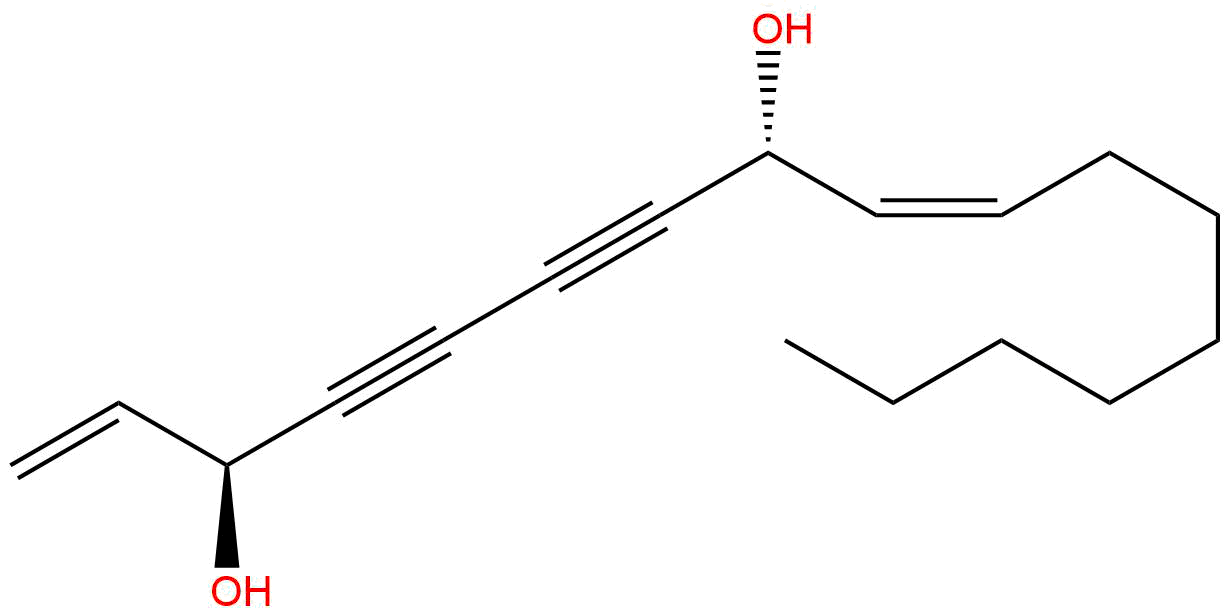


Name: Falcarindiol
Synonym name: (+)-(3R,8S)-Falcarindiol; 3(R),8(S),9(Z)-Falcarindiol; (3R),(8S)-Falcarindiol; 55297-87-5
Catalogue No.: BP0581
Cas No.: 225110-25-8
Formula: C17H24O2
Mol Weight: 260.377
Botanical Source: roots of Aegopodium podagraria, Angelica acutiloba (Dong Dang Gui), Angelica japonica, Anthriscus sylvestris, Apium sp., Aralia cordata (udo), Crithmum maritimum (rock samphire), Daucus carota (carrot), Dendropanax arboreus, Falcaria vulgaris
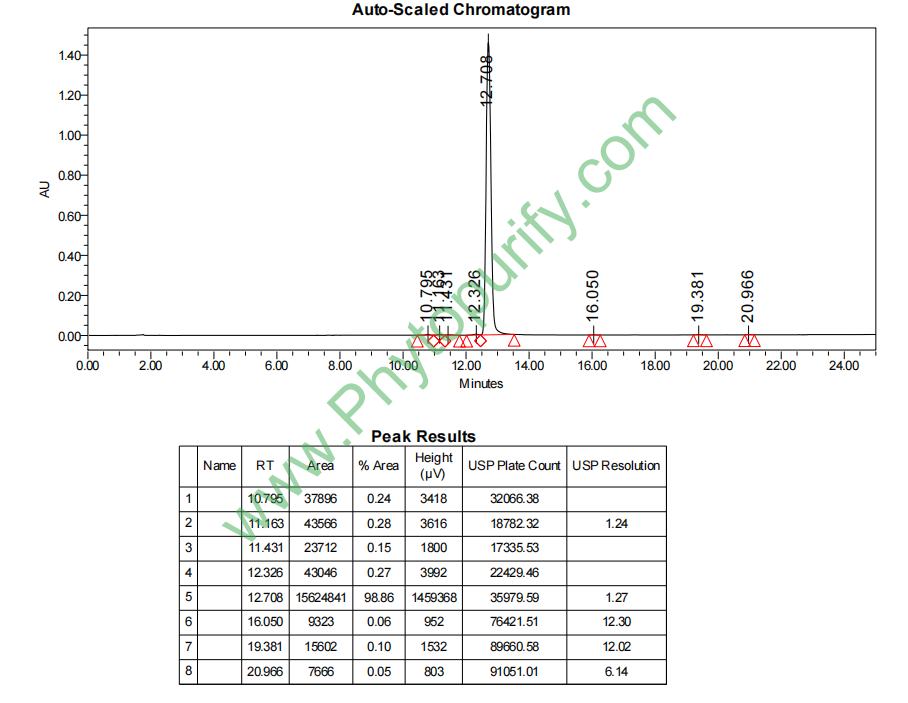
Purity: 95%~99%
Analysis Method: HPLC-DAD or/and HPLC-ELSD
Identification Method: Mass, NMR
Packing: Brown vial or HDPE plastic bottle
Can be supplied from milligrams to grams.
For Reference Standard and R&D, Not for Human Use Directly.
Inquire for bulk scale.
HPLC of Falcarindiol
Storage conditions:Short-term storage at 2~8℃, long-term storage at -20 ~ -80℃
40.4600
3.6837
3.6845
.0216
3.6619
7.1158
High
90.8645
4.1177
No
Yes
Yes
No
No
No
0.6
No
No
Yes
Yes
Falcarindiol (CAS number: 225110-25-8) is an important natural polyacetylene based lipid widely found in plants of the Umbelliferae family, such as carrots (Daucus carota), celery (Apium graveolens), and Heraclium sphondylium. In recent years, fakalin diol has received widespread attention in the fields of pharmacology and natural product chemistry due to its multi-target and multi pathway biological activities. Its unique structure endows it with significant oral biological activity, which can activate peroxisome proliferator activated receptor gamma (PPAR gamma) and regulate the expression of cholesterol transporter ABCA1 in cells. In addition, farcalin diol has shown good potential in inducing apoptosis, autophagy and multiple pharmacological effects such as anti-inflammatory, antibacterial, anti-cancer and anti diabetes. This article provides a systematic review of the chemical structure and physicochemical properties, plant sources and extraction methods, pharmacological activity and mechanism of action, pharmacological evaluation, pharmacokinetic characteristics, and clinical application prospects of farnesol, aiming to provide theoretical basis and reference for the drug development and mechanism research of this natural product.
Fakalin diol belongs to the natural product category of polyacetylene, with a chemical formula of C17H24O2 and a molecular weight of 260.3770. Its structural feature is a polyacetylene skeleton containing two hydroxyl groups and multiple conjugated triple bonds, specifically a 1,9-dihydroxy-3,5,7-triacetylene structure. This structure endows fakalin diol with high chemical reactivity and biological activity.
In terms of physical and chemical properties, the LogP value of falacalin diol is 3.6837, indicating its moderate lipid solubility, which is conducive to cell membrane penetration and oral absorption. The polar surface area (TPSA) is 40.46 Å ², indicating moderate polarity and favorable binding to the target protein. The low water solubility (0.0216 mg/mL) to some extent limits its solubility and bioavailability in the aqueous phase. The blood-brain barrier has high permeability, indicating its potential for central nervous system action. The hERG channel inhibition test result was negative, indicating a low risk of cardiac toxicity associated with famotidine diol. The Ames mutagenicity test score is 0.6, indicating a low risk of genetic toxicity and a good safety basis.
Fakalin diol is mainly found in the fat soluble parts of plants in the Umbelliferae family, especially in carrot roots, celery leaves, and European windbreak. Its content is greatly affected by plant species, growth environment, and harvesting time. Traditional extraction methods often use solvent extraction techniques, and commonly used solvents include organic solvents such as ethanol, methanol, and ethyl acetate.
The specific extraction process generally includes the following steps:
In recent years, green and efficient extraction techniques such as supercritical fluid extraction (SFE) and microwave-assisted extraction (MAE) have also been gradually applied to the extraction of farcalin diol, significantly improving extraction efficiency and purity, reducing solvent usage, and in line with the sustainable development trend of modern natural product extraction.
Fakalin diol shows a variety of significant pharmacological activities, covering anti-inflammatory, antibacterial, anti-cancer, anti diabetes and other fields.
Farcalin diol can significantly inhibit the production of inflammatory mediators and reduce the expression of pro-inflammatory cytokines such as tumor necrosis factor alpha (TNF - α), interleukin-6 (IL-6), and prostaglandin E2 (PGE2). Its anti-inflammatory mechanism is partially attributed to the inhibition of the nuclear factor kappa B (NF - κ B) signaling pathway, which blocks the transmission of inflammatory signals and reduces tissue inflammatory responses. In addition, faracalin diol can activate PPAR γ, regulate the inflammatory state of immune cells, and further exert anti-inflammatory effects.
Farcalin diol exhibits inhibitory effects on various Gram positive and Gram negative bacteria, particularly exhibiting strong antibacterial activity against Staphylococcus aureus, Escherichia coli, and Pseudomonas aeruginosa. Its antibacterial mechanism may involve disrupting bacterial cell membrane structure, interfering with cellular metabolism and energy synthesis processes.
Farcalin diol has shown anti-tumor activity in various cancer models, especially in the field of liver cancer where research is more in-depth. Its anti-cancer mechanism includes inducing tumor cell apoptosis, autophagy, and cell cycle arrest. By regulating multiple signaling pathways, such as inhibiting the anti apoptotic protein BCL2, blocking the STAT3 and PI3K/Akt pathways, the proliferation and migration ability of tumor cells can be reduced. In addition, fakalin diol can downregulate the expression of matrix metalloproteinase 9 (MMP9), inhibit tumor invasion and metastasis. Its potential for multi-target comprehensive regulation of liver cancer related targets includes BCL2, STAT3, TOP1, MAPK1, TERT, PIK3CA, MMP9, EGFR, PTGS2, and TP53.
Facalinediol shows good anti diabetes activity by activating PPAR γ, enhancing insulin sensitivity, promoting glucose metabolism and lipid regulation. It can also up regulate the expression of intracellular cholesterol transporter ABCA1, improve lipid metabolism abnormalities, and alleviate diabetes related metabolic disorders. In addition, the autophagy induced by farcalin diol is helpful to protect the function of pancreatic islet β cells and delay the process of diabetes.
The biological activity of faracalin diol is based on its regulation of multiple signaling pathways and molecular targets, reflecting the pharmacological characteristics of multi-target and multi mechanism.
As an agonist of PPAR γ, farcalin diol regulates lipid metabolism, inflammatory response, and cell differentiation by binding to and activating the nuclear receptor. PPAR γ activation promotes the expression of ABCA1, enhances cholesterol efflux, reduces lipid accumulation, and has anti atherosclerosis and anti diabetes effects.
Farcalin diol can induce apoptosis in cancer cells, involving activation of the mitochondrial pathway, regulation of BCL2 family protein expression, release of cytochrome C, and activation of the caspase cascade reaction. At the same time, fakalin diol induces autophagy, promotes the degradation of damaged proteins and organelles within cells, maintains cellular homeostasis, and enhances its anti-cancer and anti metabolic disease effects.
Farcalin diol inhibits the NF - κ B signaling pathway and reduces the expression of pro-inflammatory cytokines; Simultaneously, by activating PPAR γ to negatively regulate inflammatory response, tissue damage can be alleviated. Its inhibitory effect on PTGS2 (COX-2) reduces prostaglandin synthesis and further exerts anti-inflammatory effects.
Farcalin diol inhibits the growth and metastasis of liver cancer cells through multi-target synergistic effects. Its targeted regulation includes:
The pharmacological evaluation of famotidine diol shows that it has good potential for drug development. The molecular weight of 260.38 conforms to Lipinski's rule, and the LogP is moderate, indicating good oral absorption. Low water solubility is a major challenge in its drug development, and its bioavailability needs to be improved through formulation technology. High blood-brain barrier permeability provides potential indications for its central nervous system.
In terms of safety, the non inhibition of hERG channels reduces the risk of cardiac toxicity, and Ames test results show low genetic toxicity, supporting the safety of long-term medication. Pharmacokinetic studies have shown that after oral administration, famotidine diol is rapidly absorbed and widely distributed. Its metabolism is mainly through the liver enzyme system, and its excretion pathways are mainly through bile and urine. Moderate half-life, supporting the design of daily dosing regimens.
To overcome the limitations of poor water solubility and bioavailability, the development of novel drug delivery systems such as nanocarriers, liposomes, and solid dispersions has become a current research hotspot, significantly improving the in vivo stability and targeting of farcalin diol.
Farcalin diol, with its multi-target and multi mechanism pharmacological properties, has shown broad clinical application prospects in the fields of anti-tumor, anti-inflammatory, and metabolic disease treatment. Especially in the treatment of liver cancer, farcalin diol has the potential to become an adjuvant or alternative therapy by regulating multiple key oncogenic signaling pathways, inhibiting tumor growth and metastasis.
In addition, its anti-inflammatory and anti diabetes effects provide new ideas for the treatment of chronic inflammatory diseases and metabolic syndrome. Future research needs to focus on the preclinical safety evaluation, pharmacokinetic optimization, and clinical trial design of famotidine diol, in order to further clarify its therapeutic window and indications.
At the same time, the structural modification and derivative development of fakalin diol are also effective strategies to enhance its efficacy and drug properties. Combining modern drug design technologies, such as computer-aided drug design (CADD), high-throughput screening, and targeted delivery systems, will help accelerate the clinical translation of drugs related to farcalin diol.
As a kind of natural polyacetylene oxide with rich biological activity, farcalin diol has shown significant anti-inflammatory, antibacterial, anti-cancer and anti diabetes effects. Its unique chemical structure and multi-target mechanism of action provide valuable examples for the development of natural product drugs. Despite challenges such as water solubility and bioavailability, faracalin diol is expected to become an important candidate drug for the treatment of various diseases in the future through modern drug formulations and structural optimization techniques. Future research should further deepen its mechanism of action, improve pharmacokinetic and toxicological evaluations, promote its clinical application, and contribute to the development of natural product pharmacology.
