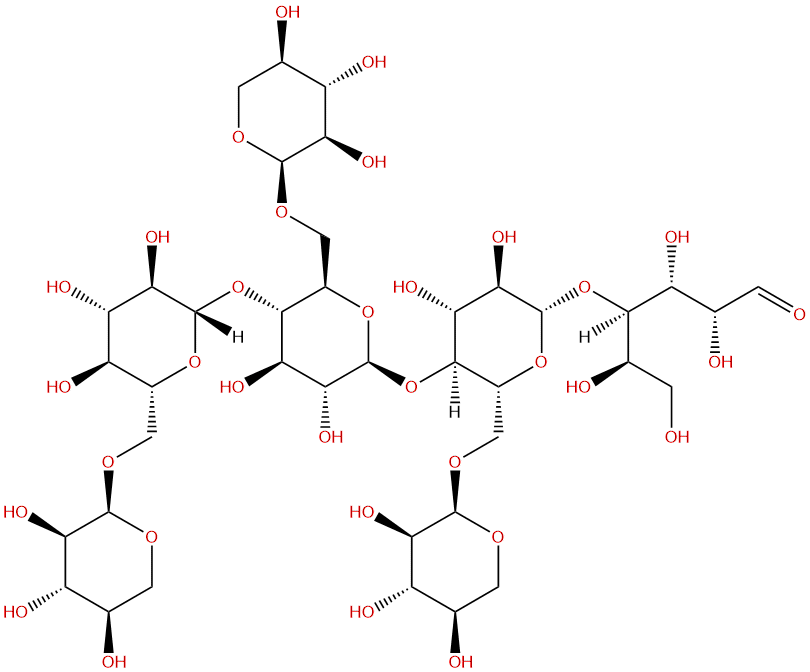


Product name: Xyloglucan heptasaccharide
Synonym name: Heptasaccharide Glc4Xyl3
Catalogue No.: BP4074
Cas No.: 121591-98-8
Formula: C39H66O33
Mol Weight: 1062.92
Botanical Source:
Physical Description:
Type of Compound: Oligoses
Purity: 95%~99%
Analysis Method: HPLC-DAD or/and HPLC-ELSD
Identification Method: Mass, NMR
Packing: Brown vial or HDPE plastic bottle
Storage: Store in a well closed container, protected from air and light. Put into refrigerate or freeze for long term storage.
Whenever possible, you should prepare and use solutions on the same day. However, if you need to make up stock solutions in advance, we recommend that you store the solution as aliquots in tightly sealed vials at -20℃. Generally, these will be useable for up to two weeks.
The product could be supplied from milligrams to grams
Inquire for bulk scale.
For Reference Standard and R&D, Not for Human Use Directly.
Storage conditions:Short-term storage at 2~8℃, long-term storage at -20 ~ -80℃
Xyloglucan heptasacharide, as a natural polysaccharide derived oligosaccharide, has attracted widespread attention in the field of natural product pharmacology in recent years. Its unique structural features and diverse biological activities make it show great potential in prebiotic research, intestinal health regulation, and immune regulation. Wood seven sugar mainly regulates the intestinal microbiota environment, promotes the growth of beneficial bacteria, and thereby affects host immune response and intestinal barrier function, becoming one of the important candidate molecules for the prevention and treatment of intestinal diseases and the development of functional foods.
This article reviews the chemical structure and physicochemical properties, plant sources, and extraction methods of wood seven sugar, systematically summarizes its pharmacological activity and mechanism of action, focuses on exploring its interactions with key molecular targets, evaluates its pharmacological parameters and pharmacokinetic characteristics, and finally looks forward to its potential and future development direction in clinical applications, aiming to provide theoretical basis and practical guidance for related research.
Xyloglucan is an oligosaccharide composed of seven sugar units, which is a typical representative of xyloglucan structure. Its molecular formula is C42H70O35, with a molecular weight of 1062.9240 Da, and it has high polarity and water solubility. The core structure of wood seven sugar is a β -1,4-glucose skeleton, with xylose residues attached to the side chains to form a branched structure. This branching structure endows it with strong hydration ability and the potential to bind with biomolecules.
In terms of physicochemical properties, the LogP value of wood seven sugar is -4.2866, indicating its strong hydrophilicity and difficulty in passing through lipid soluble membranes, which is consistent with its characteristics as a local acting molecule in the intestine. Its topological polar surface area (TPSA) is as high as 532.43 Å ², further indicating its high polarity and difficulty in penetrating the blood-brain barrier (BBB), which is consistent with its low brain permeability. The water solubility is as high as 93.79%, which is beneficial for its dissolution and biological function in the intestinal environment. The hERG channel inhibition test result was negative, and the Ames mutagenicity test result was 0.0, indicating its high safety and low risk of toxic side effects.
Xylose is mainly present in the cell walls of various plants, especially in plants rich in xyloglucan such as leguminous plants, woody plants, and certain grasses. As one of the main polysaccharide components of plant cell walls, it participates in the structural stability of cell walls and intercellular interactions.
The extraction of wood seven sugar is usually carried out by water extraction combined with enzymatic hydrolysis. Firstly, plant cell wall polysaccharides are extracted using hot water or buffer solution, followed by enzymatic hydrolysis using specific xyloglucanase to obtain oligosaccharides containing specific structures. Temperature, pH, and enzymatic hydrolysis time need to be controlled in the extraction process to ensure the structural integrity and purity of the product. The purification steps often use membrane filtration, ion exchange chromatography, and high-performance liquid chromatography (HPLC) techniques to ensure the acquisition of high-purity xylose.
In recent years, emerging technologies such as ultrasound assisted extraction and microwave-assisted extraction have also been applied to the extraction of xylose, improving extraction efficiency and yield while reducing energy consumption and time costs. In addition, the biological fermentation method provides a feasible path for the industrial production of xylose by degrading plant polysaccharides through microbial fermentation.
The pharmacological activity of wood seven sugar mainly focuses on its prebiotic function and regulation of intestinal health. Numerous in vitro and animal experiments have shown that xylose can selectively promote the growth of beneficial bacteria such as Bifidobacterium, regulate gut microbiota structure, and improve gut microbiota imbalance. This prebiotic effect has shown significant effects in preventing and alleviating diseases such as intestinal inflammation, diarrhea, and irritable bowel syndrome (IBS).
In addition, wood seven sugar has a protective effect on the intestinal mucosa by enhancing intestinal barrier function, reducing intestinal permeability, and lowering the risk of endotoxins entering the bloodstream. It can also regulate the immune system, promote the expression of anti-inflammatory cytokines such as IL-22, inhibit inflammatory responses, and alleviate intestinal mucosal damage.
In the aspect of metabolic diseases, Xheptacosan affects energy metabolism and lipid metabolism by regulating the activities of short chain fatty acid (SCFAs) receptors GPR41 and GPR43, showing potential anti obesity and anti diabetes effects. It has good safety and no obvious toxic side effects, providing a basis for its use as a functional food and pharmaceutical excipient.
The biological mechanism of action of wood seven sugar involves multiple molecular targets, mainly achieved by regulating intestinal immunity and barrier function.
TLR4 and TLR2 (Toll like receptors 4 and 2)
Xylose can regulate the TLR4 and TLR2 signaling pathways and modulate innate immune responses. By moderately activating these receptors, it promotes immune tolerance and anti-inflammatory response, preventing intestinal damage caused by excessive inflammation.
MUC2 (Mucin 2)
MUC2 is the main component of the intestinal mucus layer. Xylose promotes the expression and secretion of MUC2, enhances the mucus barrier, and prevents pathogenic microorganisms from invading.
IL-22 (interleukin 22)
IL-22 plays a crucial role in maintaining the integrity and repair of intestinal epithelial cells. Wood seven sugar promotes intestinal mucosal repair and antibacterial defense by regulating the expression of IL-22.
OCLN (tight junction protein Occludin), ZO1 (tight junction protein Zonula Occludens-1), CLDN1 (tight junction protein Claudin-1)
These proteins are important components of tight junctions in intestinal epithelial cells. Xylose upregulates their expression, enhances the integrity of the intestinal barrier, reduces intestinal permeability, and prevents the infiltration of harmful substances.
GPR41 and GPR43 (short chain fatty acid receptors)
Wood seven sugar promotes the production of short chain fatty acids by intestinal probiotics, activates GPR41 and GPR43 receptors, regulates energy metabolism and inflammatory response, and exerts metabolic regulatory effects.
BIFIDO (Bifidobacterium)
As a prebiotic, xylose selectively promotes the growth of bifidobacteria, improves the balance of gut microbiota, and enhances host immune function.
In summary, wood seven sugar regulates intestinal microbiota, immune response, and barrier function through multi-target and multi-path synergistic effects, demonstrating its complex and effective biological activity mechanism.
The pharmacological evaluation of wood seven sugar shows that it has good safety and suitable physical and chemical characteristics for local intestinal effects. Its molecular weight is large, polarity is strong, and LogP value is low, indicating that it is difficult to be absorbed into the systemic circulation by the intestine and mainly functions in the intestinal lumen. This characteristic enables it to precisely regulate the intestinal environment while reducing systemic side effects.
The low permeability of the blood-brain barrier reduces the risk of central nervous system toxicity. The negative inhibition of hERG channel indicates a lower risk of cardiac toxicity. The Ames test result is 0.0, indicating no mutagenic risk and high safety.
In terms of pharmacokinetics, xylose is mainly fermented and degraded by microorganisms in the intestine, producing metabolites such as short chain fatty acids, and exerting downstream physiological functions. Its self absorption rate is extremely low, the system exposure is limited, and the metabolic pathway mainly relies on the intestinal microbial enzyme system. Excretion is mainly through feces, with a small burden on the liver and kidneys.
Therefore, wood seven sugar is suitable for development as a prebiotic formulation for the intestine, such as oral solid preparations, liquid drinks, or enteric coated capsules, to exert local regulatory effects.
Wood seven sugar, as a natural prebiotic, has broad clinical application prospects. Its potential in the prevention and treatment of intestinal diseases is particularly prominent, including:
In the future, by combining modern biotechnology and nano delivery systems, the targeted delivery and bioavailability of xylose are expected to be further improved. In addition, in-depth analysis of its molecular mechanisms and interactions with the gut microbiome will promote its application in precision medicine.
The conduct of clinical trials is a crucial step in verifying their safety and effectiveness. At present, there is a lack of relevant clinical research, and there is an urgent need for systematic design of randomized controlled trials to clarify the dosage, administration route, and indication range.
In summary, as a natural oligosaccharide with unique structure and diverse functions, wood seven sugar exhibits significant prebiotic activity and intestinal protection. It exerts a multi-target synergistic regulatory effect by regulating gut microbiota, immune factors, and barrier proteins, and has good safety and potential as a drug. In the future, with the advancement of extraction and purification technology and the deepening of mechanism research, xylose is expected to become an important molecule in the field of intestinal disease prevention and functional food development, providing new natural drug resources and treatment strategies for human health.
