

Product name: Brassinolide
Synonym name:
Catalogue No.: BP3087
Cas No.: 72962-43-7
Formula: C28H48O6
Mol Weight: 480.686
Botanical Source:
Physical Description:
Type of Compound:
Purity: 95%~99%
Analysis Method: HPLC-DAD or/and HPLC-ELSD
Identification Method: Mass, NMR
Packing: Brown vial or HDPE plastic bottle
The product could be supplied from milligrams to grams. Inquire for bulk scale.
We provide solution to improve the water-solubility of compounds, thereby facilitating the variety of activity tests and clinic uses.
For Reference Standard and R&D, Not for Human Use Directly.
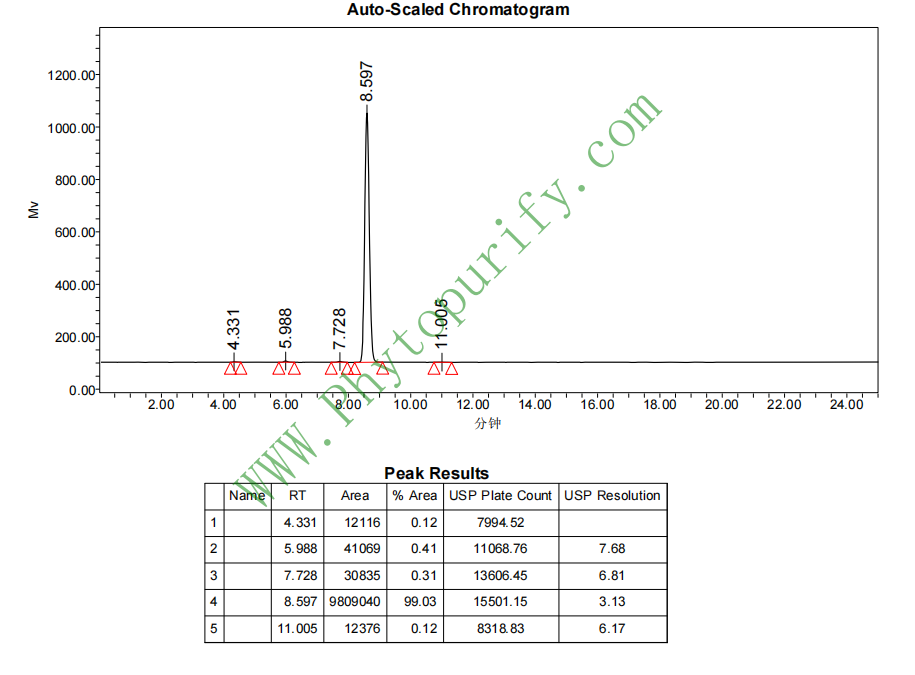
HPLC of Brassinolide
Storage conditions:Short-term storage at 2~8℃, long-term storage at -20 ~ -80℃
107.2200
3.3407
3.3410
.0293
1.3673
11.4482
Low
81.5543
5.0403
No
No
No
No
No
No
0.0
Yes
No
No
No
Brassinolide, also known as brassinolide, is a steroid plant hormone widely present in the plant kingdom with extremely high physiological activity. Since its first isolation and identification from rapeseed pollen by American scientists Grove et al. in 1979, it has revolutionized our understanding of the regulatory mechanisms of plant growth and development as the sixth largest class of plant hormones after auxin, gibberellin, cytokinin, abscisic acid, and ethylene. Its CAS number is 72962-43-7, which is the prototype and most biologically active member of brassinosteroids. Brassinolide can exert powerful physiological effects at extremely low concentrations (usually in the nanomolar range), including promoting cell elongation and division, enhancing photosynthesis, improving stress resistance (such as cold, drought, salt, and disease resistance), and regulating the entire life cycle of plants from seed germination to aging. With the rapid development of molecular biology and structural biology techniques, the signal perception, transduction, and cross dialogue network of brassinolide with other hormone signaling pathways have been gradually elucidated. The discovery of its core receptor BRI1 and a series of downstream signaling components (such as BAK1, BSK1, BSU1, BZR1/BES1, etc.) has laid a solid foundation for a deeper understanding of its mechanism of action. This review aims to systematically elucidate the chemical properties, sources, pharmacological activities, molecular mechanisms of action, pharmacological characteristics, and potential applications of brassinolide in agriculture and medicine, in order to provide comprehensive references for related research and development.
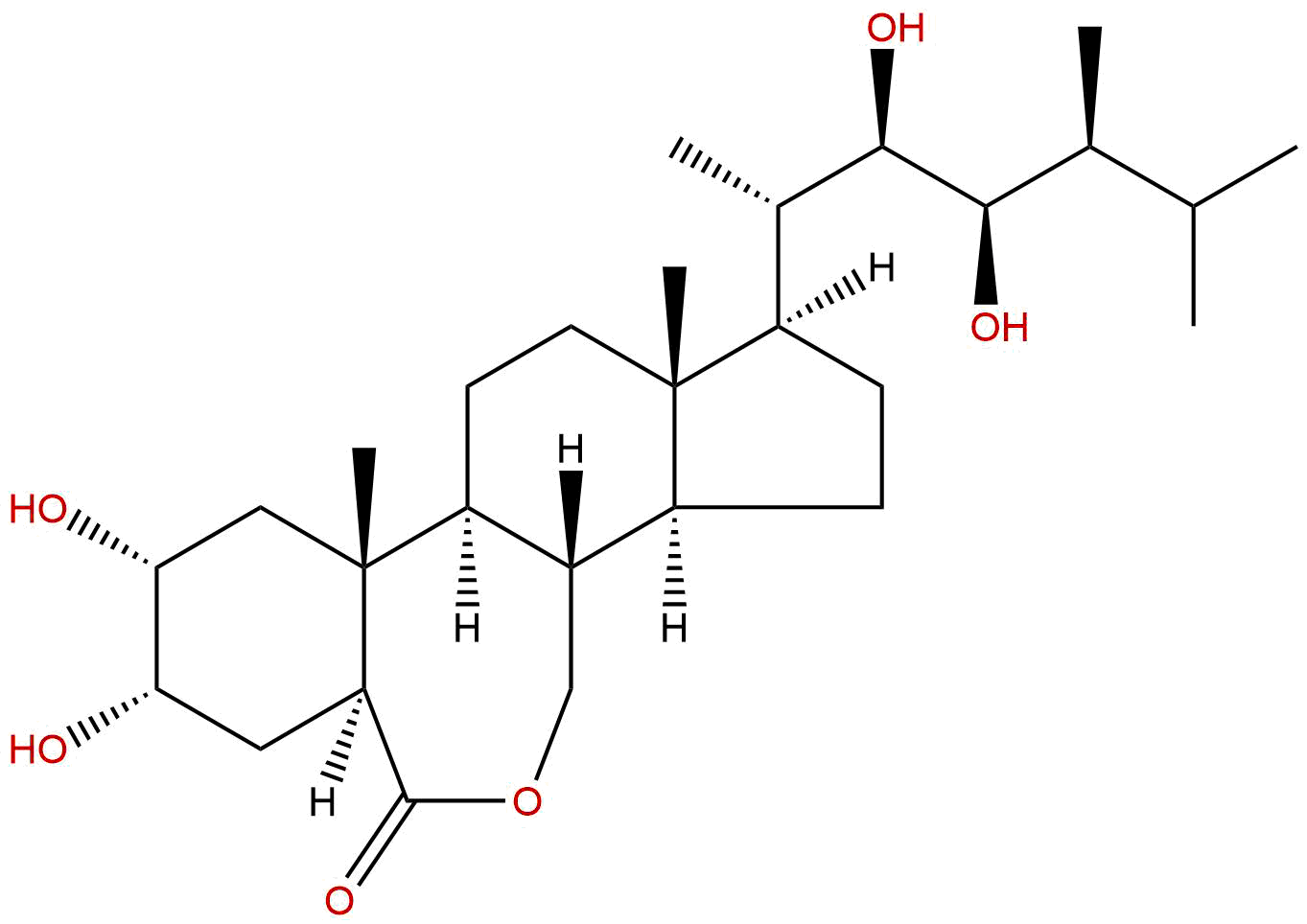
The molecular formula of brassinolide is C28H48O6, with a molecular weight of 480.6860. Its core structure is a steroid skeleton, which shares structural similarities with animal sterols such as estrogen and ecdysteroids, reflecting a certain degree of conservation in the evolution of bioactive steroid molecules. Its structural features mainly include: A/B rings are cis fused (5 α - cholestane skeleton), and B ring contains a key 7-oxa-6-one (lactone) structure, which is the key to its high biological activity; In addition, there is an alpha oriented hydroxyl group (2 α, 3 α - dihydroxy) at positions C-2 and C-3, and a cis adjacent dihydroxy group (22R, 23R dihydroxy) at positions C-22 and C-23, with a methyl group at position C-24 at the end of the side chain. These multiple hydroxyl structures determine their certain hydrophilicity.
From the analysis of physical and chemical properties, the calculated lipid water partition coefficient (LogP) is 3.34, indicating that the molecule has moderate lipophilicity and can cross the cell membrane. The topological polar surface area (TPSA) is 107.22 Å ², reflecting the polarity brought by multiple hydroxyl groups. Its water solubility is relatively low, about 0.0293 mg/mL, which is often improved in practical applications by preparing soluble salts or emulsions. These properties collectively affect its absorption, distribution, and metabolic behavior within living organisms. Despite its complex structure, large-scale production has been achieved through chemical synthesis (such as asymmetric synthesis) and biological fermentation technology, providing material support for research and application.
Brassinolide was originally derived from rapeseed(Brassica napus L. It was separated from the pollen of (), hence the name. Subsequent research has found that it is not unique to rapeseed, but is widely present in various organs of higher plants, such as pollen, seeds, tender leaves, stem tips, and fruits. However, its content is extremely low (usually at the level of ng/g fresh weight), and it is unevenly distributed in different species and tissues. In addition to rapeseed, its presence has also been detected in various economic crops such as tea, beans, corn, and rice. There are also a series of brassinosteroid analogues in nature that have similar structures to brassinosteroids but different activities, such as 24 epigbrassinosteroids and 28 high brassinosteroids.
Due to its extremely low natural content, extracting and preparing it directly from plants is costly and difficult to meet the needs of large-scale applications. The traditional extraction methods involve multi-step separation and purification processes such as organic solvent extraction (such as methanol, ethyl acetate), silica gel column chromatography, and high-performance liquid chromatography (HPLC), which are complex and have low yields. Therefore, currently commercialized brassinolide and its highly active analogues mainly rely on chemical total synthesis or semi synthesis. In addition, utilizing microorganisms (such as certain fungi) for fermentation to produce brassinosteroids is also a promising research direction aimed at developing more economical and environmentally friendly production processes.
The pharmacological activity of brassinolide is mainly reflected in its comprehensive regulation of plant growth, development, and stress resistance, and its action has high efficiency and multiple effects.
The mechanism of action of brassinolide has been studied at the molecular level, forming a relatively clear signal transduction pathway. Its core lies in binding to receptor complexes on the cell membrane, initiating a series of phosphorylation/dephosphorylation cascade reactions, and ultimately regulating the activity of transcription factors in the nucleus, thereby altering gene expression profiles.
Although brassinolide is mainly used as a plant growth regulator, analyzing its pharmacological parameters from a medicinal chemistry perspective can help to comprehensively understand its biological characteristics and provide reference for its potential cross-border applications, such as developing new drugs as lead compounds.
According to the provided parameters, the molecular weight is 480.69, which falls within the general range of drug like molecules (<500). The LogP value of 3.34 indicates that it has good membrane permeability. The TPSA value of 107.22 Å ² is slightly higher than the threshold commonly believed to be easy to penetrate the blood-brain barrier (about 60-70 Å ²), combined with its prediction of "low blood-brain barrier penetration", which is related to its larger polarity and molecular size. The extremely low water solubility (0.0293 mg/mL) is the main formulation challenge, which requires improving bioavailability through appropriate dosage forms such as nano formulations, cyclodextrin inclusion complexes, and emulsions.
In terms of preliminary safety evaluation, key parameters showed no significant hERG potassium channel inhibitory activity (hERG inhibition: No), indicating a low risk of causing QT interval prolongation in the heart. The Ames test result is 0.0 (usually indicating no mutagenicity), indicating that there is no genotoxic signal in this testing system. These are important safety indicators in early drug development.
Regarding pharmacokinetics, studies in plants have shown that exogenous brassinolide can be rapidly absorbed and transported, and undergo various modifications such as hydroxylation, glycosylation, acylation, etc. in the body, leading to metabolic inactivation or storage. Its half-life is relatively short. Pharmacokinetic data in animals or humans are extremely limited due to their primary use in the agricultural sector. If considering its potential new application directions, systematic ADME (absorption, distribution, metabolism, excretion) research will be necessary.
At present, the "clinical application" of brassinolide is mainly concentrated in the agricultural field. As an efficient, low toxicity, and environmentally friendly plant growth regulator and stress inducer, it has been widely used in various crops such as rice, wheat, corn, vegetables, fruits, etc., for increasing yield and quality, resisting disasters and reducing disasters, and alleviating drug damage, achieving significant economic and social benefits.
Looking ahead, its potential application prospects may expand in the following directions:
As an important class of plant sterol hormones, the discovery and research of brassinolide have greatly enriched the content of plant hormone biology. From the identification of chemical structures, to the elucidation of physiological functions, and to the precise analysis of signal transduction pathways, the scientific exploration of brassinolide is a model of plant science research. It not only plays an increasingly important role as an efficient agricultural chemical in ensuring global food security, but its unique chemical structure and mode of action also provide valuable models for basic research in life sciences. In the future, with the integration of interdisciplinary fields such as multi omics technology, synthetic biology, nanotechnology, and computational simulation, research on brassinolide will shift from describing phenomena to emphasizing mechanism analysis and artificial design. It is expected to generate more breakthrough achievements in green agriculture, plant biotechnology, and even innovative drug research and development, demonstrating broader application prospects.
